

Cartagena
Colonial jewel of the Caribbean
Colonial jewel of the Caribbean
Cartagena vacation — UNESCO old town, Rosario Islands, boutique hotels & insider tips for your Cartagena vacation

Best time to travel
December to April
Why Cartagena will enchant you
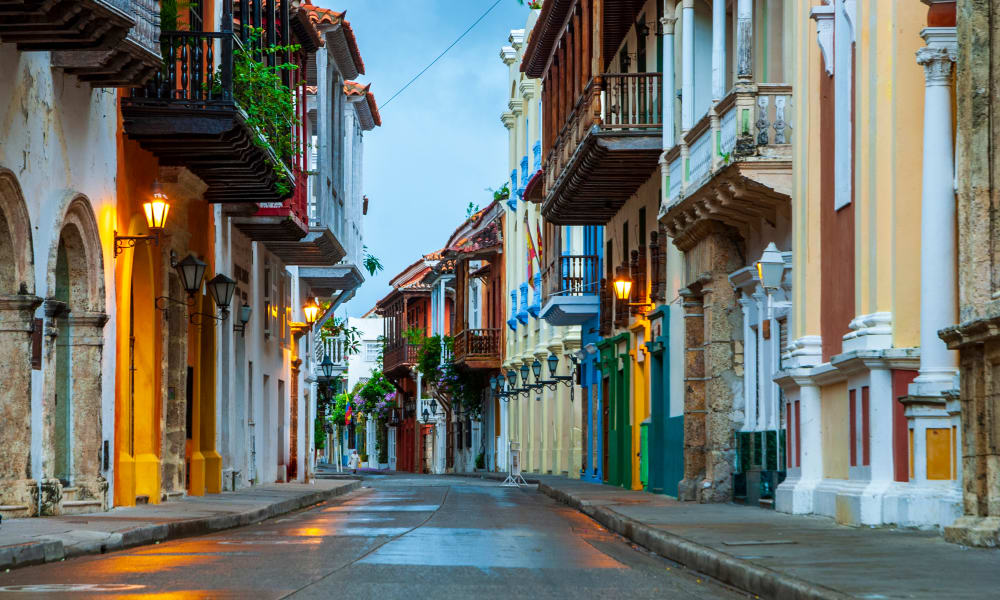
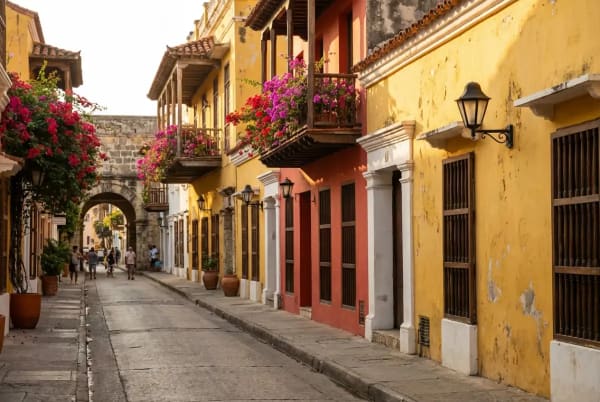
Through the Torre del Reloj, you step into another world. Behind the clock tower from the 17th century lies a labyrinth of alleys lined with colonial facades in canary yellow, coral red, and lavender blue. Bougainvillea cascades from wrought-iron balconies, and the intricately crafted door knockers on the heavy wooden doors reveal the stories of their former residents: lizards for aristocrats, lions for military officers, fish for sailors and merchants. The air is filled with the scent of fried Arepa de Huevo, mixed with jasmine and the salty breeze of the Caribbean.
Cartagena de Indias — not to be confused with Cartagena in Spain — is much more than a colonial backdrop. Founded in 1533, the city on Colombia's Caribbean coast has been a UNESCO World Heritage Site since 1984 and boasts the most extensive and best-preserved system of military fortifications in South America. In 2024, over 855,000 international visitors arrived — and yet the city has retained its unpretentious Caribbean charm. Away from the photographed plazas, Getsemaní pulses with a neighborhood full of street art and champeta rhythms. On the Rosario Islands, a Caribbean experience awaits away from mass tourism.
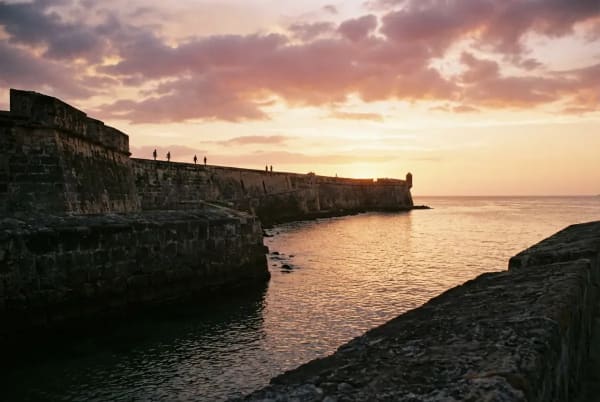
Anyone planning a vacation in Cartagena enters a city where history, culture, and Caribbean lifestyle converge in a way that cannot be understood from guidebooks — but only on location, in the warm evening light on the 11-kilometer long city walls, with a cocktail in hand and looking out over a Caribbean sea that slowly turns golden. Whether you are still wondering, where to travel in Latin America — Cartagena provides a compelling answer.
Cartagena de Indias attractions — the most beautiful places in the city
Ciudad Amurallada — The walled old town (UNESCO)
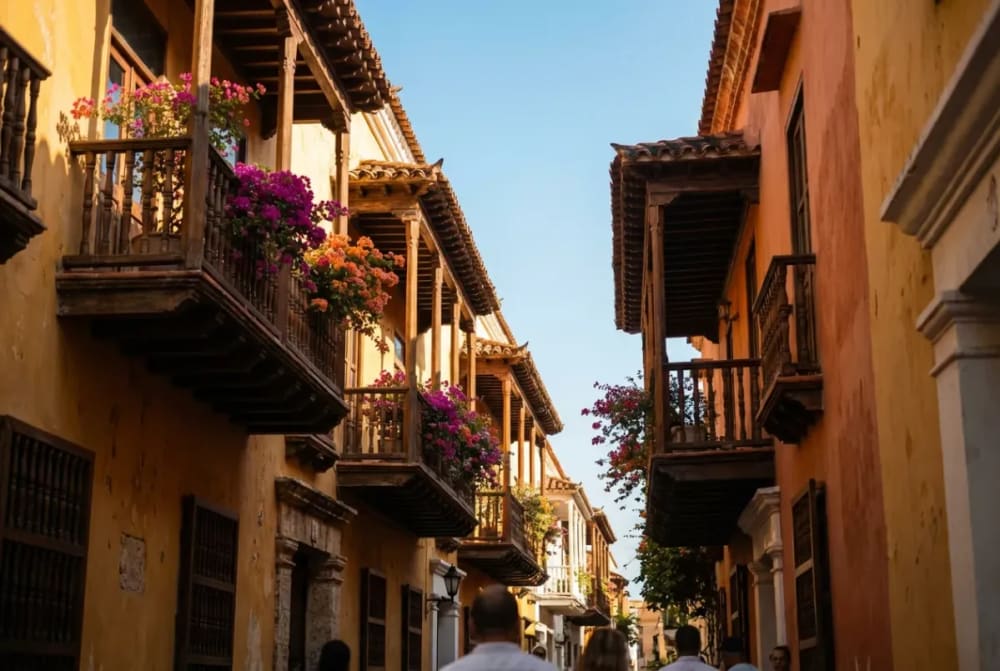
The city walls were built starting in 1586 — in response to the devastating attack by Sir Francis Drake — and were completed only in 1796. Nearly 200 years of construction for 11 kilometers of walls, some over 20 meters thick, enclosing the entire historic core with bastions, watchtowers, and gates. In 1741, Cartagena resisted a powerful British Armada under Admiral Vernon — one of the decisive battles of the colonial era that shaped the course of history in the Caribbean.
Behind the walls lies a vibrant open-air museum: The architecture combines Spanish, Caribbean, and Moorish influences in a density rarely found in Latin America. On Plaza Santo Domingo stands Fernando Botero's bronze sculpture "La Gorda Gertrudis". In the Iglesia San Pedro Claver, the remains of the saint who fought for the rights of enslaved Africans in the 17th century are preserved. At the Palacio de la Inquisición, a museum recalls the dark chapters of colonial rule. And on Plaza Bolívar — the more authentic alternative to the touristier Plaza Santo Domingo — you will encounter the Museo del Oro Zenú with its collection of pre-Columbian goldsmithing.
Insider tip
A walk on the city walls at sunset is one of those moments in a Cartagena vacation that is unforgettable. Come early — the walls get very crowded in the evening. The section between the old town and Getsemaní offers the best view of the open sea, while the sun bathes the colonial facades in warm gold.
Ciudad Amurallada
- City walls — Free — publicly accessible
- Palacio de la Inquisición — 20,000–24,000 COP (approx. 5 EUR)
- Museo del Oro Zenú — Tue–Sat 10:00–17:00, Sun 10:00–15:00 (free)
- Tip — Early morning or late afternoon for cooler temperatures
Castillo San Felipe de Barajas — Latin America's largest fortress
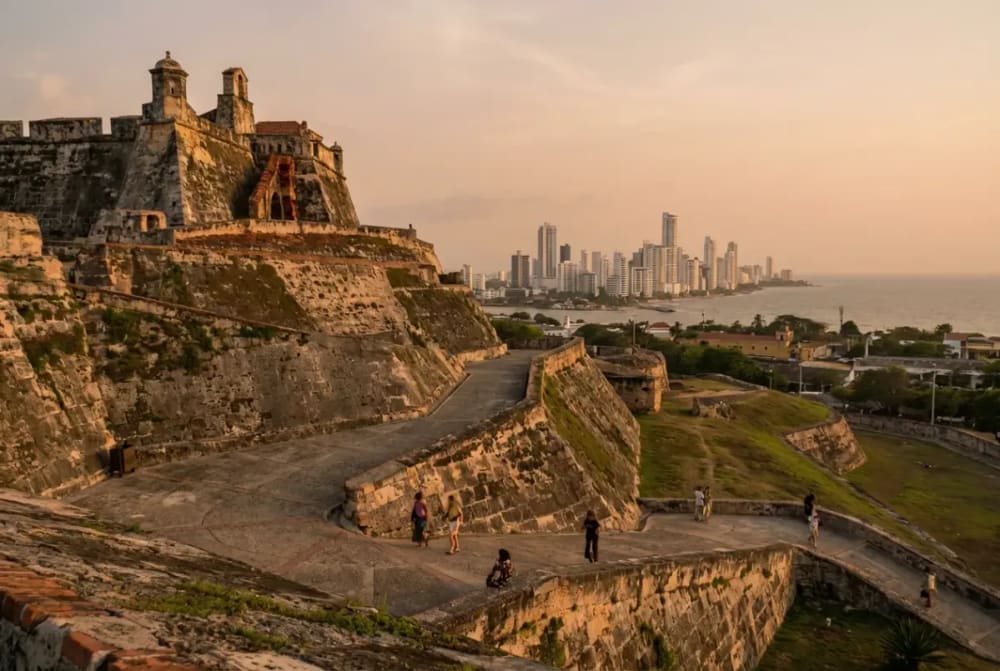
The largest Spanish fortress in the Americas crowns the hill of San Lázaro and is one of the most impressive sights of a Cartagena vacation. Built in 1657, it served as a bulwark against pirates and enemy armadas. Particularly fascinating: The complex underground tunnel system that served for communication, escape, and supply during sieges. Visitors can walk parts of it — the cool silence in the corridors, interrupted only by one's own breath, is an experience that is hard to find elsewhere in the Caribbean.
Plan two to three hours for exploration, including tunnel system, ramparts, and viewpoints. From the upper bastions, you'll overlook the entire old town, the skyscrapers of Bocagrande, and the endless blue of the Caribbean. All ticket sales revenue goes directly into the maintenance of the fortress.
Castillo San Felipe de Barajas
- Admission — 25,000 COP (approx. 6 EUR), children/students 10,500 COP
- Opening hours — Daily 8:00–18:00
- Free tip — Last Sunday of the month free (except January + December)
- Duration — 2–3 hours including a tunnel system
Getsemaní — Street Art and Caribbean lifestyle
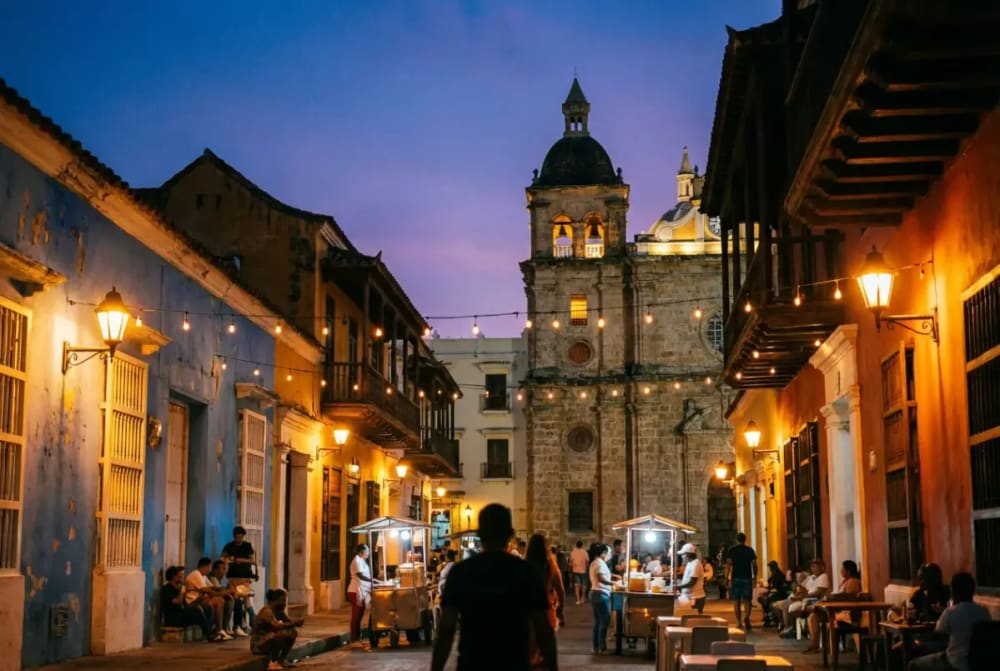
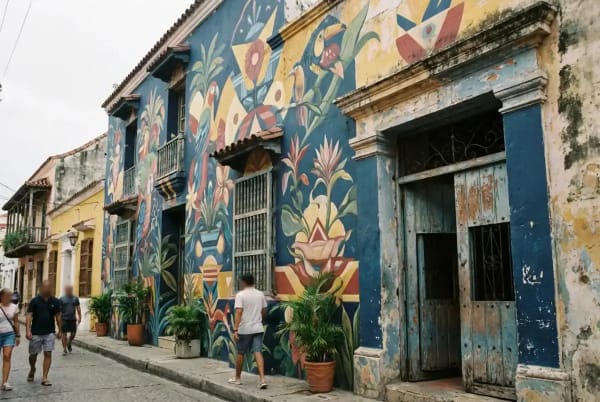
What Comuna 13 is for Medellín, Getsemaní is for Cartagena: a neighborhood that has reinvented itself. A few years ago, it was avoided; today, the barrio right in front of the city walls is the city's most creative hotspot. The annual Aerosol Street Art Festival in February brings international artists here to paint new murals on the house walls. Calle de la Sombrilla — "Umbrella Street" — is the most photographed motif of the neighborhood.
On Plaza de la Trinidad, the heart of Getsemaní, Colombian hosts and travelers blend in the evenings over street food,Champeta-rhythms — a music genre with African roots that carries the musical heritage of San Basilio de Palenque — and the energy of a neighborhood that celebrates its identity rather than relinquishing it. Getsemaní offers everything the old town has — only at lower prices and with its own, rougher atmosphere.
Getsemaní
- Best time — In the evenings after 18:00 for the liveliest atmosphere
- Accessibility — 5–10 minutes on foot from the old town
- Nightlife — Café Havana (Salsa), Bazurto Social Club (Champeta)
Let us help you plan your Cartagena vacation together — we know every one of these places from personal experience and will create your customized program. Schedule a consultation now .
Excursions from Cartagena — Islands, Beaches, and Culture
Rosario Islands — Snorkeling in the Caribbean
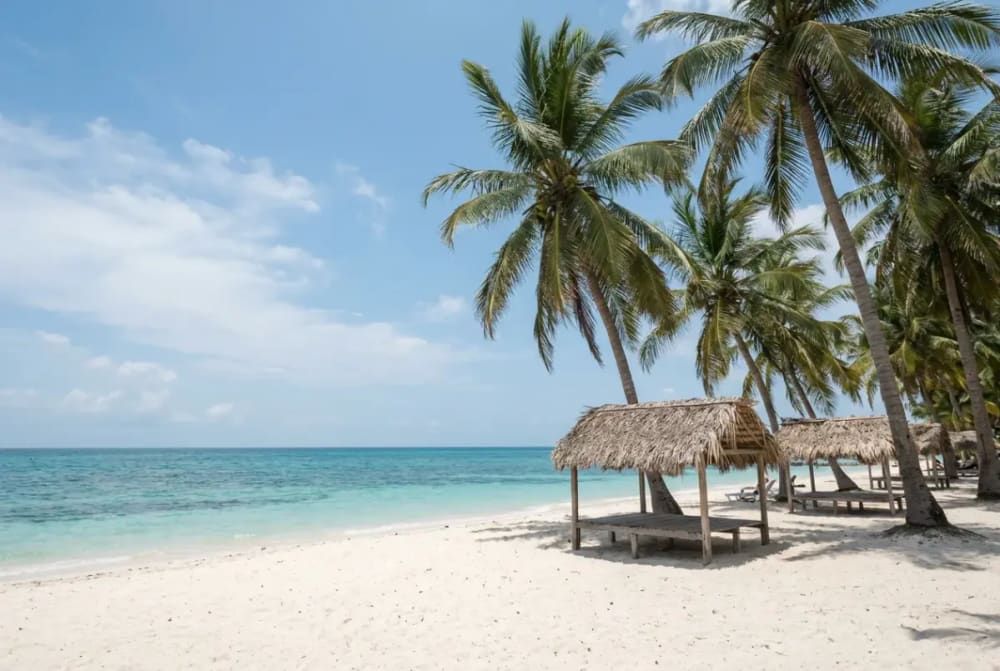
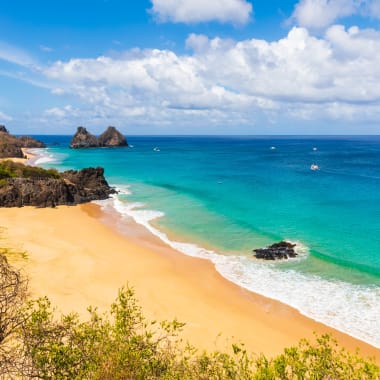
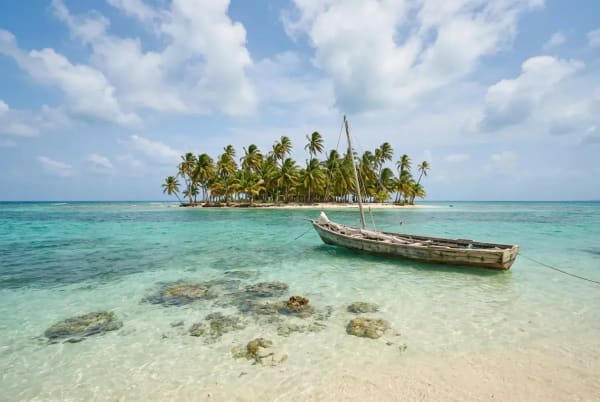
The Islas del Rosario are an archipelago of about 27 islands, approximately 45 minutes by boat from Cartagena. They are part of a National Park with coral reefs, turquoise water, and mangrove landscapes — here you will find the Caribbean that one imagines during a vacation in Cartagena, Colombia. The water shimmers in shades from turquoise to deep blue as colorful schools of fish glide between the corals. Cartagena's city beaches are honestly less impressive — for a true Caribbean feel, the island trip is a must. If you want to explore the underwater world in more depth, our guide to Diving and Snorkeling in Colombia has more information.
For a relaxing beach day, we recommend Playa Blanca on the Barú Peninsula: bright turquoise water, golden sand, and — if you arrive early or stay after 3 PM — pleasant tranquility. If you prefer something unusual: The Totumo mud volcano, an hour north, promises a unique experience — in the warm mineral mud, the body floats effortlessly.
Insider tip
Playa Blanca via shuttle bus instead of boat tour: from 80,000 COP per person — significantly cheaper than the boat option (from 159,000 COP). The journey by bus takes about an hour over the bridge to Barú.
Rosario Islands & Playa Blanca
- Rosario day tour — from 120,000 COP (approx. 27 EUR) + 20,000 COP dock tax
- Playa Blanca boat — from 159,000 COP (approx. 36 EUR)
- Boat ride — approx. 45 min to the Rosario Islands
- Best time — Dec–Apr (calm sea), less crowding during the week
Mud volcano Totumo — Colombia's quirkiest experience
The Totumo mud volcano stands 20 meters high and extends over 2,000 meters deep. Thanks to the mineral-rich composition of the mud, it is impossible to sink — the body floats naturally while the warm, soft mud envelops the skin. After the bath, you will be washed off in a nearby lagoon by local helpers. Bring small bills: photos cost 4,000 COP, a massage in the volcano also costs 4,000 COP.
Volcán del Totumo
- Group tour — from 95,000 COP (approx. 22 EUR) including transport
- Total duration — approx. 4–5 hours including travel time
- Distance — approx. 1 hour northeast of Cartagena
- Tip — Book in the morning — less waiting time at the volcano
San Basilio de Palenque — Cradle of Freedom
San Basilio de Palenque, located about 55 kilometers south of Cartagena, is also worth a visit. The first free town of formerly enslaved Africans in the Americas — officially recognized in 1713 — is a UNESCO masterpiece of intangible cultural heritage. Here lives thePalenquero-language, the only Spanish-based creole language in Latin America, a mix of Spanish, Portuguese, and Bantu languages. This is also where the Palenqueras come from, who sell fruit in the colorful dresses in Cartagena's old town — ambassadors of a vibrant history of resistance and cultural resilience. Please always ask for permission before photographing the Palenqueras, and give an appropriate tip (5,000–10,000 COP).
San Basilio de Palenque
- Group tour — from 290,000 COP (approx. 65 EUR)
- Total duration — 5–6 hours including round trip
- Distance — 55 km, approx. 1.5 hours drive
- Tip — Bring a hat, sunscreen, and extra water
La Boquilla — Mangroves and Fishing Tradition
Off the beaten path lies La Boquilla, a traditional fishing village with Afro-Colombian heritage, 20 minutes north of the old town. By canoe, you glide through natural tunnels of mangroves, learn traditional net fishing, and enjoy a lunch of fresh catch at the home of a fishing family: fish, coconut rice, and fried plantains. An alternative to the island tours — more authentic, quieter, and a window into life off the tourist trails.
La Boquilla
- Mangrove Tour — from 80,000 COP (approx. 18 EUR)
- Duration — 3–4 hours
- Getting there — Taxi approx. 20 min., 27,000 COP
- Tip — In the morning for the best bird watching
Cartagena Hotel — which neighborhood suits you?
The choice of neighborhood determines your entire Cartagena experience. Three options, three completely different atmospheres:
Ciudad Amurallada is the first choice for travelers who want to wake up in the historical heart. Here are the most elegant boutique hotels in restored colonial houses — with courtyards where tropical plants climb centuries-old stone walls, rooftop pools with views over the roofs, and breakfast under bougainvillea. The prices are the highest in the city (from about 250 USD/night), but everything is within walking distance.
Getsemaní offers bohemian flair at significantly lower prices (from about 80 USD/night). If you are looking for street art, nightlife, and a vibrant neighborhood, this is the right place. The old town can be reached in five minutes on foot. In high season (December to March), book early — the best boutique hotels fill up quickly.
Bocagrande is the modern neighborhood with international hotel chains (Hilton, Hyatt Regency), close to the beach and with a skyline view. Safe and comfortable, but without the colonial charm of the old town. For families and travelers who prefer modern infrastructure.
Insider Tip
Our recommendation: For an authentic Cartagena experience, choose the Ciudad Amurallada — here you will feel the history with every step. If you want to save on budget and go out in the evening, Getsemaní is the perfect choice. Bocagrande only if you prefer proximity to the beach and modern hotel infrastructure.
Your perfect Cartagena vacation — three-day itinerary suggestion
Day 1 — Colonial splendor and vibrant history
Day 2 — Getsemaní, street art, and cuisine
Day 3 — Caribbean day — islands or beach
Note: For culture enthusiasts: Instead of a day on the island, take a trip to San Basilio de Palenque — the cradle of the Palenqueras and a UNESCO World Heritage site. Or a morning at the Totumo mud volcano combined with an afternoon on the beach at La Boquilla.
Boutique hotels in Cartagena — handpicked recommendations
We recommend two houses that we know personally and that make the difference between a good and a special Cartagena vacation:
Casa San Agustín
Colonial luxury in the old town
From 350 USD / night
- 3 connected colonial houses
- Pool in the courtyard
- Restaurant Alma
- Ciudad Amurallada
Hotel Capellán de Getsemaní
Bohemian charm with pool
From 120 USD / night
- Rooftop pool & jacuzzi
- Getsemaní location
- Value for money
- 5 min. to the old town
Let us help you find the Cartagena hotel that best fits your expectations — we know these houses and their special features from personal experience. Make a request .
Restaurants and cuisine in Cartagena
Cartagena's cuisine is Caribbean, African, and Colombian at the same time — and it starts on the street. At every second stand, there is the scent of freshly fried Arepa de Huevo (corncake with egg) and Carimañola (yuca croquettes), starting at 3,000 COP each. At Coctelería Erika, an institution for over 50 years, you can try Colombian ceviche — unlike the Peruvian version, prepared here with ketchup, mayo, and lime juice. The taste surprises — and convinces.
For lunch, we recommend La Cocina de Pepina: authentic home cooking like Mote de Queso, popular among Colombian regulars, no reservations possible — first come, first served. At the other end of the spectrum is Celele in Getsemaní — run by the Caribe Lab project, formerly among the 50 best restaurants in the world, with an anthropological-gastronomic concept that celebrates indigenous ingredients and Caribbean biodiversity.
Insider Tip
Definitely visit the Bazurto Market with a local guide — the large, lively market where the locals shop. It doesn’t get more authentic: steaming pots, fresh fish, tropical fruits in all colors. In the evening, eat at Plaza de la Trinidad in Getsemaní — significantly cheaper than in the old town's restaurants and with more Caribbean atmosphere.
Nightlife and culture in Cartagena
Cartagena's nightlife is as diverse as the city itself. In Café Havana in Getsemaní, live salsa bands play until the early morning hours — the dance floor is tiny, the energy immense. In Bazurto Social Club, Champeta pulsates, the Afro-Colombian music genre with roots in San Basilio de Palenque. And in Alquímico, one of the World's 50 Best Bars, the bar team mixes cocktails with Colombian ingredients like Lulo, Corozo, and Colombian rum over three floors.
For culture enthusiasts, a visit to the Museo de Arte Moderno in the old town or a detour to the annual Hay Festival (January) — one of the most important literature festivals in Latin America, is worthwhile. The FICCI (Festival Internacional de Cine de Cartagena) in March is the oldest film festival in Latin America.
Insider Tip
Shopping Tip: Las Bóvedas, 23 vaults in the city wall, offer handcrafted goods and souvenirs. For Colombian emeralds at fair prices: visit jewelers in the Ciudad Amurallada and pay attention to certificates. A traditional Sombrero Vueltiao — Colombia's national symbol — is the most stylish souvenir.
Best time to travel to Cartagena — when should you travel?
The dry season from December to April is the best time to travel to Cartagena — clear skies, plenty of sunshine, minimal rain. January is the driest month with an average of only 5 mm of rainfall. Temperatures remain consistently warm throughout the year at 28–32 °C, and humidity is high — light, breathable clothing is essential.
The rainy season from May to November brings short but intense showers — typically in the afternoon or evening. October is the rainiest month with around 231 mm of rainfall. However, the low season (August to November) offers significantly cheaper flights and hotels, often at half the price of high season. The showers rarely last longer than an hour, and afterwards the old town smells fresh and blooming. Those who travel at the best travel time for Colombia are also doing right for Cartagena.
Note
Budget Tip: Travel in the low season (Aug–Nov) — the short rain showers hardly disturb and hotels often cost less than half. The shoulder season of April/May offers the best compromise of weather and prices.
Getting there: Flights to Cartagena Colombia
Rafael Núñez Airport (CTG) is only about 5 kilometers from the historic center — one of the closest airports to the city in Colombia. The transfer time to your Cartagena hotel is only 15 to 20 minutes. More information on flights to Colombia .
Transfer Airport CTG → Old Town / Getsemaní Airport Rafael Núñez → Ciudad Amurallada / Getsemaní
By domestic flight, you can reach Cartagena in one hour from Bogotá or Medellín .
Safety in Cartagena
Cartagena is generally safe for travelers — this is confirmed by our own experiences on site. In the main tourist areas — Old Town, Getsemaní, Bocagrande — there is a strong police presence. Violent crime against tourists is practically unknown. The most common problems are pickpocketing, high prices from taxi drivers, and aggressive beach vendors. Also, read our blog article Traveling safely in Colombia — the truth for a personal experience report.
Basic caution
Do not wear flashy jewelry or expensive smartphones openly. Keep wallets in the front pocket or in theft-proof crossbody bags. Use official taxis or ride-share apps (Uber, InDrive) — agree on the fare BEFORE getting in. Avoid Matuna (between Getsemaní and Old Town) at night.
Detailed and up-to-date information on safety in Colombia . Also, inform yourself about entry and visa as well as vaccinations and health .
Getting around locally
The Old Town and Getsemaní are completely walkable — comfortable shoes are sufficient for a whole day. For trips to Bocagrande, La Boquilla, or Castillo San Felipe, it is best to use a taxi. Taxis in Cartagena do not have taximeters — a fixed price system applies (minimum fare: 10,800 COP, approx. 2.40 EUR). At the airport, yellow automatic kiosks provide the correct price.
Insider tip
InDrive instead of Uber or taxi: With the app, you suggest your own price — often significantly cheaper. Minimum taxi fare: 10,800 COP (approx. 2.40 EUR).
What does a vacation in Cartagena cost? Entrance fees and expenses
Prices as of March 2026. 1 EUR ≈ 4,400 COP. Detailed information on travel costs and budget.
Further exploring Colombia
A vacation in Cartagena, Colombia can be excellently combined with other stops on a Colombia round trip . You can reach Medellín or Bogotá within an hour by domestic flight. The Caribbean coast around Santa Marta and the Tayrona National Park is accessible by bus or short flight. And those who want to see the natural wonder Caño Cristales can ideally combine it with an extended round trip.
Santa Marta — Gateway to Sierra Nevada
Tayrona National Park — Jungle meets Caribbean beach
Medellín — The City of Eternal Spring
Caño Cristales — The River of Five Colors
Our round trip Colombia Coffee & Caribbean connects Cartagena with the coffee region and Medellín. For a comprehensive overview, we recommend our City Round Trip Bogotá, Medellín & Cartagena or the 3-week intensive round trip for those who want to take more time.
Further information on entry and visa , vaccinations and health and on the packing list can be found in our Colombia travel guides.
To book a trip or for more information, contact us. We'll help you plan and guide you through your upcoming adventure!
Frequently Asked Questions
We recommend three to four days: one day for the Old Town and Castillo San Felipe, one day for Getsemaní, street art, and culinary experiences, and one day for a trip to the Rosario Islands or Playa Blanca. A fourth day is worthwhile for San Basilio de Palenque or the Totumo mud volcano.
The best time to visit Cartagena is the dry season from December to April — clear skies, lots of sun, and little rain. Temperatures are consistently between 28–32 °C year-round. If you want to save money: the off-season from August to November often offers hotel prices at half price with short, manageable rain showers. The shoulder season of April/May is the best compromise between weather and prices.
The Ciudad Amurallada for colonial luxury in boutique hotels, Getsemaní for bohemian flair and better prices, Bocagrande for modern hotels close to the beach. Our recommendation: Ciudad Amurallada or Getsemaní — here you will experience the authentic Cartagena on foot.
Yes, Cartagena is generally safe. In the Old Town, Getsemaní, and Bocagrande, there is a strong police presence. As in any major city, do not wear valuables openly, use official taxis or apps, and agree on prices beforehand. Detailed information in our Colombia safety guide.
By domestic flight in about an hour — several connections daily. Rafael Núñez International Airport (CTG) is only 5 km from the center, and the transfer takes 15–20 minutes by taxi (approximately 5 EUR) or ride-share app.
Yes — the Rosario Islands offer turquoise Caribbean waters and good snorkeling opportunities, just 45 boat minutes from Cartagena. A cheaper alternative is Playa Blanca on Barú, accessible by shuttle bus from 80,000 COP.
A vacation in Cartagena offers a wide price range: street food starting at 1 EUR, local lunches from 3 EUR, upscale restaurants from 18 EUR per person. Boutique hotels in the Old Town range from 250–500+ USD per night, in Getsemaní from 80 USD. Day trips cost between 22–65 EUR. Detailed budget information can be found in our Colombia cost overview.
The Ciudad Amurallada (Old Town) offers colonial elegance, museum-like architecture, and the highest quality hotels. Getsemaní, right outside the city walls, is livelier, more creative, and cheaper — with street art, nightlife, and a bohemian atmosphere. Both are connected within 5 minutes on foot.
Light, breathable clothing (it is 28–32 °C year-round), high-SPF sunscreen, comfortable shoes for cobblestones, a light rain jacket (especially May–November), and a theft-proof bag. For upscale restaurants: smart casual. Our complete Colombia packing list helps with preparations.