


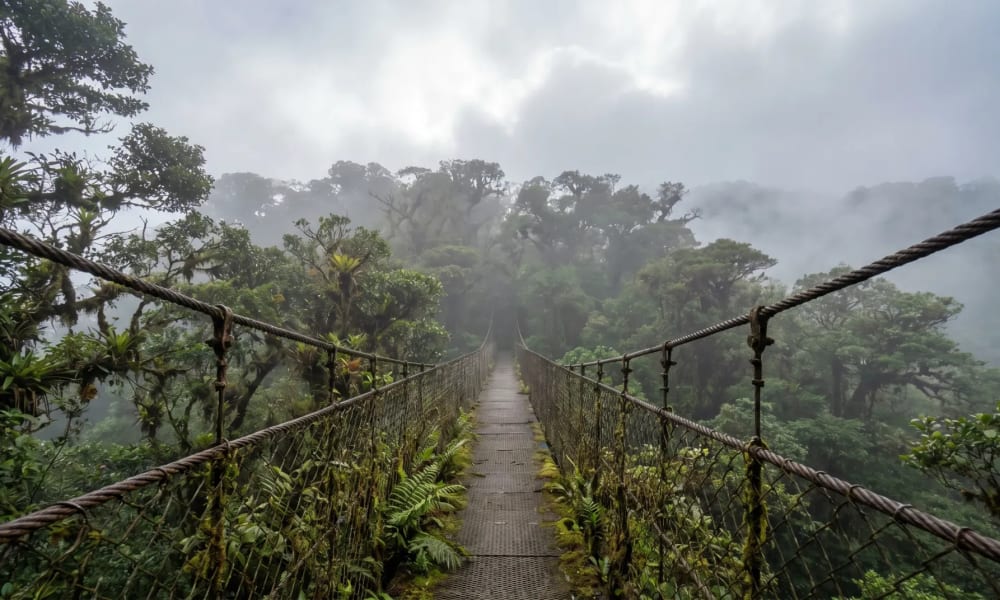
This image was generated with AI.
Monteverde Cloud Forest
Costa Rica's most mystical cloud forest — founded by pacifist Quakers, home to the Resplendent Quetzal
Costa Rica's most mystical cloud forest — founded by pacifist Quakers, home to the Resplendent Quetzal
National Geographic calls it "the jewel in the crown of all cloud forest reserves." At 1,440 meters, clouds drift between moss-covered giants, 2.5 percent of the world's biodiversity crammed into about 100 square kilometers — and it all started with 44 Quakers who fled the war and chose to preserve the forest instead.

Best time to visit
December to April
Why Monteverde?
National Geographic calls it "the jewel in the crown of all cloud forest reserves." It sounds like marketing — but is a remarkably precise description. Of the roughly 0.26 percent of the Earth's surface covered by tropical cloud forests, Monteverde is among the most studied, best protected, and biologically richest. The cloud forest region around Monteverde alone is estimated to host 2.5 percent of the Earth's total biodiversity — on an area smaller than Lake Constance.
The difference from the rainforest is not a label, but an ecological boundary. Cloud forest forms where altitude, humid air, and condensation converge: Monteverde sits at 1,440 meters, the reserves reach up to 1,800 meters. Clouds do not drift over the forest — they drift through it. Humidity fluctuates between 74 and 97 percent, and the average annual temperature is a cool 18 degrees Celsius. On every branch, every trunk, mosses, lichens, ferns, and orchids grow. 29 percent of the documented flora are epiphytes — plants that live on other plants without parasitizing.
For travelers to Costa Rica, Monteverde provides the perfect contrast. After the volcanic landscapes of Arenal and La Fortuna and before the Pacific beach of Manuel Antonio, a place emerges that offers nothing else in Costa Rica: mystical silence, the constant dance of clouds, and a founding story that one usually only knows from novels.
Four men in prison, a dream of peace
In November 1950, 44 Quakers from eleven families left their home in Fairhope, Alabama. Four young friends from the community were recently imprisoned for refusing to serve in the Korean War. The community decided to leave the country. Their choice fell on Costa Rica — for one remarkable reason: In 1948, President José Figueres abolished the army. A country without military, a country that matched pacifist values.
The group purchased about 1,400 acres of land from the Guacimal Land Company and local Ticos, divided it into family farms — and immediately protected about a third of it, approximately 554 acres, as a water catchment area. It was one of the very first private nature reserves in Costa Rica, years before the country established its national parks. One of the original settlers was named Wolf Guindon. He came to Monteverde at the age of 20, initially the first chainsaw dealer in Costa Rica — and later became one of the region's most determined forest protectors. His arc from sawyer to guardian is one of the most beautiful biographies Monteverde has to offer.
In 1972, the Quakers teamed up with biologist George Powell and the Tropical Science Center, purchasing an additional 328 acres and officially founding the Reserva Biológica Bosque Nuboso Monteverde. Today, the reserve covers 10,500 acres. The Monteverde Friends School established in 1951 still exists today — a brief visit is worthwhile to understand the community behind the forest.
The three reserves — Monteverde, Santa Elena, Curi-Cancha
The name "Monteverde" commonly refers to three different protected areas that lie close together yet offer very different experiences. Anyone visiting the region for the first time should be aware of the differences — otherwise, they may choose the wrong reserve for their interests.
Reserva Biológica Bosque Nuboso Monteverde — the main reserve
10,500 acres, managed by the Tropical Science Center, 11 trails over 13 kilometers. The densest primary forest, the purest cloud forest atmosphere — and the highest visitor pressure. Since December 8, 2025, a completely new ticket system has been in effect, fundamentally changing the way the park is visited. There are now three fixed routes: the Essence Trail (1.4 km), the Heart of Forest Trail (2.7 km), and the Continental Divide Trail (4 km). Each route costs 29 US dollars for adults, 16 US dollars for children aged 5 to 11, free for children under 5. A maximum of 26 people are allowed per time slot, and booking is solely available online in advance through cloudforestmonteverde.com — walk-ins are no longer accepted. Anyone arriving late loses their ticket without a refund.
Open daily from 7:30 AM to 4:00 PM. The adjustment might sound bureaucratic but benefits the forest: fewer people on the trails, quieter wildlife observations, less soil erosion. For a visit, this means: plan ahead. Spontaneous visits to Monteverde will not work in 2026.
Reserva Bosque Nuboso Santa Elena — the quieter neighbor
310 acres at an elevation of 1,600 meters, just above the continental water divide. Santa Elena is situated higher than the main reserve and is often even cloudier — the atmosphere travelers expect from Monteverde is found here in its purest form. Five routes spread over 12 kilometers of trails. Entrance: 16 US dollars for adults, 7 US dollars for children. Open from 7:00 AM to 3:00 PM.
The key point: Santa Elena receives 60 to 70 percent fewer visitors than the main reserve. For hikers who want to avoid the hustle, this is the smarter choice — especially since the tightened access rules in the main reserve. A local bus departs from downtown Santa Elena for about 3 US dollars at 6:30 AM, 8:30 AM, 10:30 AM, and 12:30 PM to the reserve.
Curi-Cancha Reserve — the Quetzal insider tip
83 acres, private wildlife reserve, maximum 50 visitors per day. 5.2 kilometers of paths across 9 trails, open from 7:00 AM to 3:00 PM, entrance 25 US dollars for adults. Curi-Cancha is not an alternative to the cloud forest experience — it is something different. Parts of the area were formerly pasture, the vegetation is more open, and exactly this makes wildlife observations easier than in dense primary forest.
Here live 250 documented bird species. Above all: Curi-Cancha is considered the most reliable place in all of Monteverde to see the Resplendent Quetzal. The key spot is an Aguacatillo tree — a wild avocado — near the Alondra Trail, about five minutes from the entrance. During the breeding season from February to June, it is the main food source for the Quetzal. Guided birdwatching starts at 7:30 AM, group tour 40 US dollars per person, private tour 62 US dollars, plus 13 percent VAT.
Insider tip: Mention at check-in in Curi-Cancha that you want to see a Quetzal. The staff know the current nesting trees and mark them on the map. Early morning between 7 and 9 AM is the most productive time in all three reserves.
Hanging bridges & canopy — seeing the cloud forest from above
Understanding the cloud forest means seeing it from two sides: from the ground, where moss dampens the roots — and from above, where the light hits the canopy. Monteverde is one of the few places in the world where both perspectives are accessible through infrastructure.
Selvatura Park — hanging bridges and Superman zipline
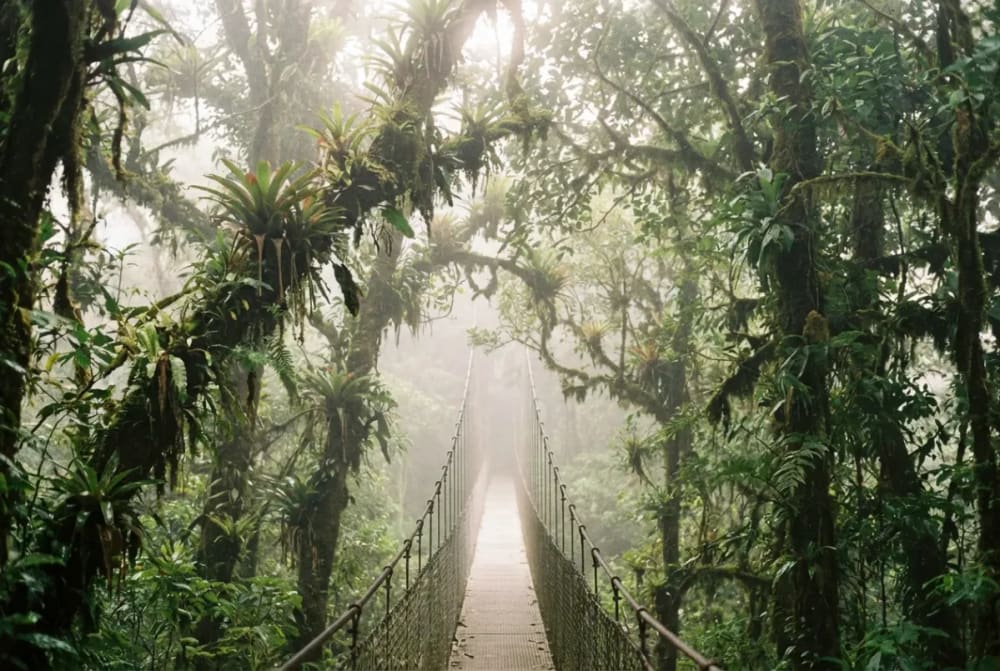
The Selvatura Park is the most famous of the canopy offerings. Eight hanging bridges spread over a 3-kilometer loop through the treetops, the longest bridge measures 157 meters, and the highest hangs 60 meters above the forest floor. The bridges are 1.22 meters wide and CFIA-certified. Self-guided tour lasts about 1 to 1.5 hours, price: 49 US dollars for adults, 44 US dollars for students aged 12 to 18, 34 US dollars for children aged 4 to 11, plus 13 percent VAT. Open daily from 7:00 AM to 4:00 PM, 365 days a year.
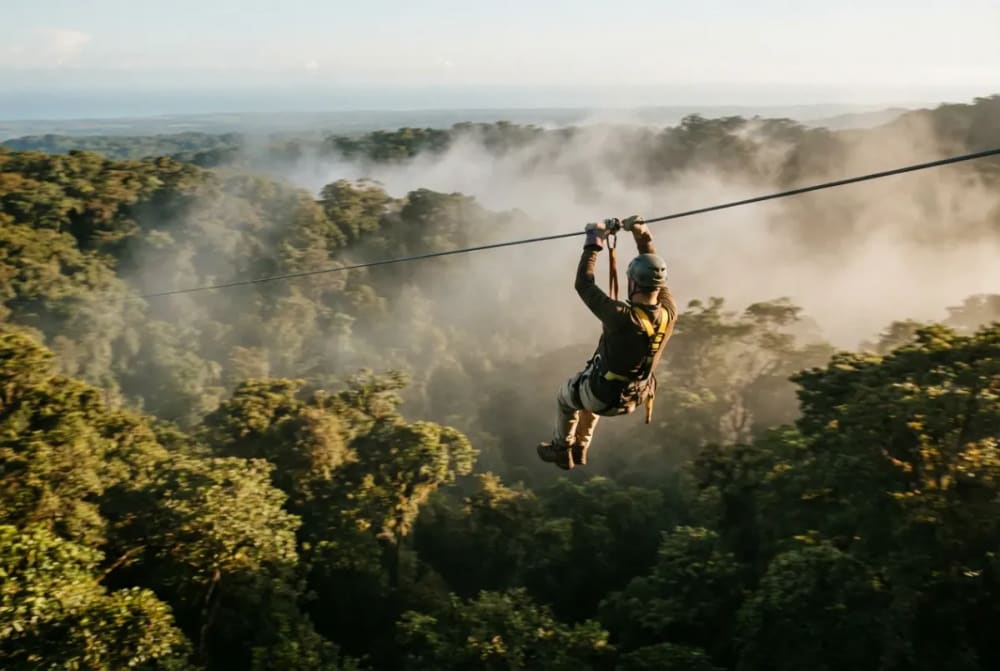
The second side of Selvatura is the canopy tour: 13 ziplines on 15 platforms, the longest line measures one kilometer. For those wanting to take it up a notch, the Superman upgrade for an additional 13.50 US dollars lets you glide in a lying position with outstretched arms, in what feels like free flight over the canopy. Tourist sources state that the Superman zipline reaches up to 100 km/h; the official Selvatura site does not quote an exact speed, but that it is fast enough to feel the wind in your eyes is undisputed. Minimum weight 55 kilograms, minimum height 150 centimeters.
Treetopia Park — zipline, gondola, and the longest bridge
Treetopia (formerly Sky Adventures Monteverde) is the all-rounder of the region. The offering divides into three areas: zipline (7 cables, longest line 750 meters, highest platform 100 meters), six hanging bridges with the longest bridge in the region at 237 meters, and the Aerial Tram — a gondola that rises to 1,740 meters. The gondola is wheelchair accessible, making it a rare option for families with seniors or guests with limited mobility to experience the canopy without hiking. Prices in 2025: zipline 99 US dollars, hanging bridges 49 US dollars, tram 59 US dollars, combo packages 99 to 149 US dollars.
Insider tip: If you want to combine hanging bridges and zipline, book the combo package at special prices at Selvatura. For those traveling with children or seniors, Treetopia is the better option with the gondola. During peak season, both parks are often fully booked — advance reservations recommended.
Wildlife — Quetzal, hummingbirds, sloths
The numbers are breathtaking: 425 bird species, 3,200 plant species (including 700 tree species and 500 orchid species), 658 butterfly species, 120 mammal species, and around 120 reptile and amphibian species live in the Monteverde cloud forest region. Jaguar, ocelot, howler monkeys, white-headed capuchins, both sloth species — they all share this small section of the continental divide.
The Resplendent Quetzal
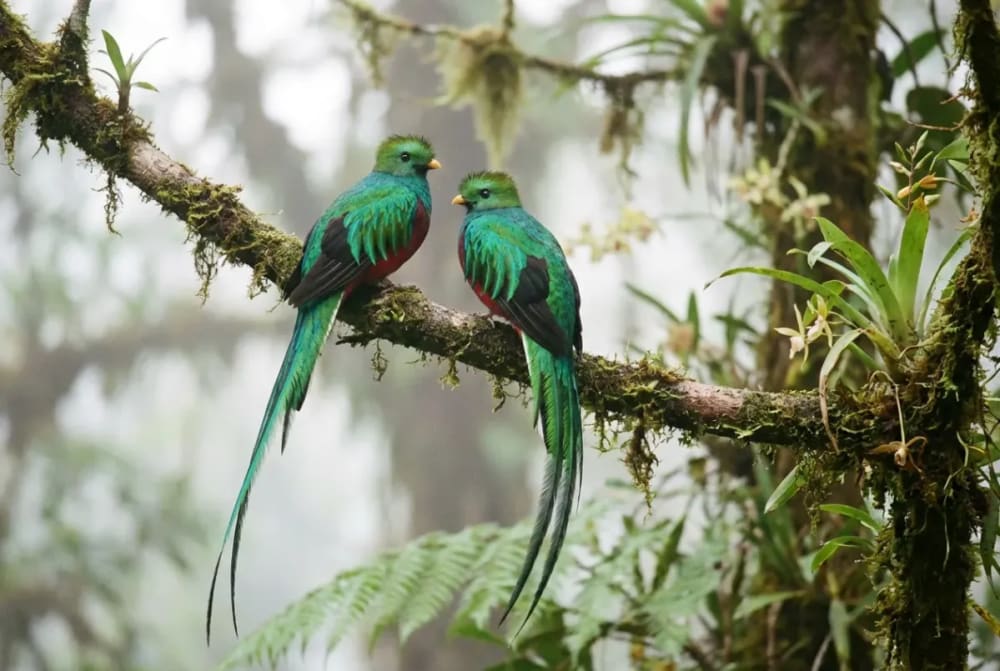
No other bird in Central America is as closely associated with a place. The male Resplendent Quetzal (Pharomachrus mocinno) has brilliant green tail feathers up to one meter long — longer than its own body. The Aztecs and Maya saw it as a sacred bird; today it is the symbol of Costa Rican conservation.
The best time for sightings is mid-February to May, the breeding season. Main activity occurs between 6 and 9 AM. Curi-Cancha is the most reliable address, the main reserve the classic option, Santa Elena the quieter choice. Booking a local nature guide dramatically increases the likelihood of sightings — the guides know the current nesting trees and respond to courtship calls that an untrained ear cannot hear.
The Golden Toad — a silent witness of climate change
Not every wildlife story in Monteverde is cheerful. The Golden Toad (Bufo periglenes), endemic to a tiny area of only 4 square kilometers north of Monteverde, was last sighted on May 15, 1989. It is now considered extinct. In 1999, the IPCC confirmed what local biologists had long suspected: the El Niño event of 1986/87 had dried up the habitat, and the chytrid fungus took care of the rest. The Golden Toad is probably the most famous case of climate change-induced extinction of a vertebrate worldwide — and it died in a forest that the Quakers were trying to save. Monteverde is thus not only a treasure trove of biodiversity but also a memorial.
Night in the forest
About 75 percent of wildlife in the cloud forest are only active at night. A guided night walk opens up a forest that one does not get to know during the day: kinkajous in the treetops, tarantulas on moss, red-eyed tree frogs on leaves, snakes, owls, sleeping sloths. Kinkajou Night Walk is family-run, active for over 15 years, and limits groups to a maximum of 10 people — one of the most authentic tour options in the region. The Curi-Cancha night tour runs from 5:30 PM to 7:30 PM. The Ranario (frog pond) is also worth a visit in the evening: a day ticket is valid for a second visit after 6 PM, and only then do the frogs become really loud.
Activities & tours
Beyond the three reserves and the two canopy parks, Monteverde has a density of small, specialized offerings that are among the best in Costa Rica. The Butterfly Garden showcases 50 butterfly species in one of the largest facilities in the world (a 90 x 27 meter dome). The Ranario presents more than 25 native frog and toad species with a ticket valid for day and evening. The Café Colibrí right at the entrance of the main reserve is known for its hummingbird feeders — up to ten species in a small space, plus good coffee as a jumpstart before visiting the reserve.
And then there's the Monteverde Cheese Factory. Founded in 1953 by the Quakers, it was the first pasteurized cheese company in Costa Rica. The settlers had a problem: their mountain farms produced more milk than they could sell fresh — the transport routes were too poor. The solution came from a government flyer about cheese production. From 10 kilograms of daily production, 3,300 kilograms were made; today the factory processes 33,000 liters of milk daily from 160 farms. In 2013 it was sold to the Mexican Sigma Group. There are no official tours anymore, but through a glass wall, one can observe the production; in the shop, there’s Queso Monteverde, milkshakes, and ice cream — a welcome stop on the way between Santa Elena and the reserve.
Suggested itinerary: 7:00 AM breakfast at Café Colibrí, 7:30 AM reserve visit with a guide, 1:00 PM lunch in Santa Elena, afternoons at Selvatura hanging bridges, 5:30 PM night walk. In the evening, Taco Taco Taqueria or Stella's Bakery for a local recommendation without tourist prices.
Best time to travel & climate
Dry season from December to April: sunny days, cool-fresh climate with daytime highs around 22 degrees Celsius and nights around 18 degrees. March is the driest month with only 15 millimeters of rainfall over 7 rainy days. This is the classic high season — with higher prices and full reserves. February to May is also the Quetzal breeding season, those wanting to see this bird should travel within this window.
Rainy season from May to November: October is the wettest month with 368 millimeters over 23 rainy days. September and October are the least recommended months. However, the rest of the rainy season is by no means unattractive: the vegetation is lush green, the cloud atmosphere is more intense, tourists significantly fewer, prices around 20 percent lower. Rain usually falls in the afternoons; mornings are often clear. Those visiting the reserves between 7 and 11 AM miss out on little compared to the dry season.
May and November are the most underrated months — transition months with first or last rain, plenty of sunshine, and empty trails. For travelers with a flexible schedule, the smartest choice.
For packing list and clothing, regardless of the season: rain poncho, hiking shoes with good grip, a warm layer for cool evenings. The average annual temperature is 18 degrees Celsius — even in March, one can be chilly in a t-shirt and shorts.
Getting there & logistics
From San José to Monteverde
The distance is about 165 to 180 road kilometers, the travel time 3 to 3.5 hours — longer than the kilometers suggest. The last 38 kilometers on Route 606 are winding, narrow, and lead over single-lane bridges. The good news: Route 606 was completely paved in 2019; a 4x4 is not necessary outside of the rainy season.
- Shared Shuttle: about 40 to 60 US dollars per person, door-to-door, 4 hours travel time. Departures from San José around 7:00 AM, return at 8:00 AM and 1:00 PM. The most comfortable option for first-time visitors.
- Public Bus (Transmonteverde S.A.): about 8 US dollars, departures at 6:30 AM and 2:30 PM from Terminal Atlántico Norte (Terminal 7-10 was closed in April 2025). Travel time is 3 hours direct — the cheapest option, but rarely the best choice for premium travelers.
- Rental Car: Route 1 north to Sardinal, then Route 606. For travelers connecting multiple regions in Costa Rica, the most flexible option.
Jeep-Boat-Jeep from and to Arenal
The most beautiful connecting route in Costa Rica connects Arenal and La Fortuna with Monteverde — not via mountain roads but by Jeep-Boat-Jeep transfer. An initial jeep takes you to the dam of Lake Arenal, a boat crosses the lake in 30 to 40 minutes (with the Arenal Volcano as a backdrop), and a second jeep brings you up to Monteverde in about 90 minutes. Total time is 3.5 to 4 hours instead of 5 hours around the mountains. Departures daily at 8:00 AM and 2:00 PM. Prices: 33 to 40 US dollars shared, 245 US dollars private for up to 5 people.
Insider tip: The morning trip at 8 AM is cheaper and offers clearer volcano views during the crossing. Book early during peak season.
Within the region, all reserves, Selvatura, Treetopia, and the Cheese Factory are reachable within 5 to 15 minutes by car from downtown Santa Elena — by taxi, hotel shuttle, or rental car. Parking at the reserves is scarce during peak season.
Staying in Monteverde
Almost all accommodations are in rustic lodge style — including the luxury houses. Air conditioning is unnecessary with average temperatures around 19 degrees; those expecting it should reconsider their choice. Orientation: Most hotels are located in or around Santa Elena, not in the actual district of Monteverde. In everyday language, the entire region is usually simply called "Monteverde".
- Hotel Belmar — luxurious eco-boutique hotel in wooden architecture, mountain view, dedicated focus on sustainability. Rooms start at 270 US dollars, suites up to 1,200 US dollars per night.
- Monteverde Lodge & Gardens — nature immersion lodge with its own forest area, private hiking trails, and award-winning fusion restaurant.
- Fondavela Mountain Hotel — our midrange recommendation: 9 acres of its own cloud forest area, heated pool, own nature trails.
Two to three nights are the right duration for most travelers, four to five for a relaxed experience with spontaneous days. Many accommodations accept cash payments upon arrival for platform bookings — bring enough cash.
For the perfect choice of your accommodation — including small boutique lodges that do not list on booking platforms — speak directly with us .
Customized Monteverde trip
Monteverde is one of those places where planning makes a difference — not because it is difficult, but because the fine differences between the three reserves, the canopy parks, and the seasons define the experience. We know the region from our own advisor trips, have tested the new ticket systems of the main reserve ourselves, and work with local guides who know the current quetzal nesting trees.
For a personalized Costa Rica route that connects Monteverde with Arenal, Manuel Antonio, or the Osa Peninsula, speak with our Costa Rica team — we typically respond within 24 hours.
To book a trip or for more information, contact us. We'll help you plan and guide you through your upcoming adventure!
Frequently asked questions
**Two to three nights** are the right size for most travelers. With two nights, one can visit one reserve and the hanging bridges in one day, a night walk, and a second reserve visit the next. Three nights allow time for a focused Quetzal tour in Curi-Cancha, the Cheese Factory, the Butterfly Garden, and a rest day. Four nights are luxurious — then one can combine Monteverde and Santa Elena at leisure and walk individual trails twice.
Since the new ticket system in the main reserve (December 2025), the answer has shifted. Those wanting to see Monteverde as a first visit, with a guide, and to experience the classic biologist founding story should book the **main reserve** online in advance (29 US dollars per trip). Those seeking tranquility, denser cloud atmosphere, and fewer people should choose **Santa Elena** (16 US dollars) — the higher situated, often cloudier reserve with 60 to 70 percent fewer visitors. Those wanting to see Quetzals should choose Curi-Cancha. The three are not mutually exclusive: two reserves can be easily combined in two days.
Three ingredients significantly increase the likelihood: **right season** (mid-February to May, breeding season), **right time of day** (6 to 9 AM), and **right place**. Curi-Cancha is the most reliable address — especially the Aguacatillo tree near the Alondra Trail, five minutes from the entrance. Book a local nature guide: The guides respond to courtship calls that an untrained ear cannot hear and know the current nesting trees. Mention at check-in in Curi-Cancha that you want to see a Quetzal.
Both, if the calendar allows. If one has to choose: **hanging bridges** at Selvatura or Treetopia offer a meditative, nature-oriented canopy experience — ideal for families, photographers, bird watchers. **Zipline** (especially the Superman variant at Selvatura) is pure adrenaline, lying above the cloud forest. For travelers with limited mobility, the gondola at **Treetopia** is the compromise — height and panorama without effort. Selvatura offers combo packages of hanging bridges and canopy at special prices.
**Shuttle** is the more relaxing choice for first-time visitors and travelers without a rental car request: door-to-door, no navigation on the winding Route 606, luggage included, about 40 to 60 US dollars per person. **Rental car** is worthwhile if you want to connect several regions in Costa Rica flexibly — Arenal, Manuel Antonio, Osa Peninsula. For the Arenal-Monteverde transfer, the **Jeep-Boat-Jeep** is the most beautiful solution regardless of transport mode: spectacular lake crossing instead of mountain detour.
Yes — with restrictions. The months **September and October** are genuinely strenuous due to heavy rainfall; it is worth skipping Monteverde during this time. **May, June, July, November**, on the other hand, are fantastic: lush green vegetation, dense cloud atmosphere, significantly fewer tourists, prices around 20 percent lower. Rain usually falls in the afternoons; mornings are often clear — those visiting the reserves between 7 and 11 AM get almost the same experience as in the dry season. A rain poncho is essential.
You might also like this
This image was generated with AI.
This image was generated with AI.