



This photo was animated with AI.
Galápagos Islands
Where evolution becomes visible
WHY YOU SHOULD TRAVEL TO THE GALÁPAGOS ISLANDS
The Galápagos Islands is one of the few destinations in the world where you truly do not know what to expect next — and that is exactly what makes it so special. The animals here simply have no fear of humans. Giant tortoises, sea lions, iguanas, and flamingos often encounter you just a few steps away. They just stay. That does not happen anywhere else in the world.
The Galápagos Islands are clearly a destination for anyone who wants to actively shape their vacation. Relaxation is rather out of the question here. You hike on lava trails through one of the most original landscapes on Earth, snorkel with penguins and sea lions, or dive into an underwater world filled with hammerhead sharks, mantas, and colorful schools of fish.
What makes the Galápagos Islands special for us
The word 'unique' takes on a whole new meaning in the Galápagos Islands. In the Duden dictionary, the Galápagos Islands should appear as part of the definition. What you experience there is truly unique; wildlife like I have never encountered before, whether on land or in water. A nature that could not be more original, where everything develops just as evolution intends.
A moment I will never forget:
Snorkel on and off into the water — out of the corner of my eye, what is that? A penguin. We swim together quite a distance, perhaps half a meter between us. Where does one experience something like this?
— Nils
What fascinates us about the Galápagos Islands is exactly this combination: a destination that challenges you physically while also allowing you to pause time and again. A travel experience you will cherish for a lifetime.
Details
Best travel time
Year-round
Flight time
approx. 16–18h
Duration of travel
7–14 days
Price
from €6,900


Hotels & Lodges on the Galápagos Islands
Exclusive camps embedded in the midst of nature - we take you to unparalleled places


No problem! Just get in touch with us, we can definitely make your dream trip a reality.
Regions in Galápagos Islands
Santa Cruz
Discover Santa Cruz Galapagos: Charles Darwin Research Station, free-roaming giant tortoises in the highlands, Tortuga Bay, and Puerto Ayora. Diving at Gordon Rocks and day trips from the hub island.

San Cristobal
San Cristobal Galapagos — Darwin's first island, Kicker Rock as the best dive and snorkel spot, sea lions right on the beach, and the second Galapagos airport. Discover the underestimated island.


5 reasons for a Galápagos trip
1. Animals without flight distance — a behavior that exists only here.Over millennia, Galápagos animals evolved in complete isolation and without natural land enemies. The result: Sea lions sleep on park benches, marine iguanas lie right in the middle of the path, blue-footed boobies let you get as close as two meters. No zoo in the world can replicate this — and no other destination on Earth offers comparable wildlife proximity.
2. Evolution documented over 45,000 km² of ocean.Charles Darwin went ashore on the islands from September 15 to October 20, 1835, aboard the HMS Beagle — his first island was San Cristóbal. The 18 species of Darwin's finches (current taxonomy), the giant tortoises, and the marine iguanas provided the building blocks for his theory of evolution. 97% of reptiles and 80% of land birds are endemic — values that no other archipelago can reach.
3. UNESCO World Heritage from day one.On September 8, 1978, the Galápagos Islands were the first natural heritage site to be added to the UNESCO list worldwide. 97% of the land area is under national park protection, and the marine reserve covers 133,000 km². Those who travel here enter a place defined by the world as indispensable — and which, thanks to strict visitor rules, will remain as it is in the future.
4. World-class diving — Wolf and Darwin Island.The waters in the northern part of the archipelago are among the top five diving destinations in the world. Schools of hundreds of hammerhead sharks in a single dive, whale sharks from June to November, manta rays, Galápagos sharks. Liveaboard spots must be booked 12 to 18 months in advance — for good reason.
5. Premium travel with purpose.The national park fee of 200 USD, the mandatory naturalist guide (max. 16 guests), and fixed daily quotas per visitor zone ensure that Galápagos will never become mass tourism. Every trip directly finances species protection, research, and biosecurity. No greenwashing, but lived consequences.
Our Galápagos trips
We organize your Galápagos Islands trip individually — as an expedition cruise on selected yachts, as land-based island hopping with boutique hotels, or as a combination of both. Three programs have proven especially good as an introduction: the 8-day Galápagos yacht expedition for travelers with limited time and a maximum wildlife focus, an individual island hopping for active nature lovers with a need for flexibility, and a diving cruise to Wolf and Darwin Island for certified divers wanting to experience hammerhead schools. Every trip can be combined with mainland Ecuador, Peru, or Costa Rica.
The Galápagos Islands at a glance
The archipelago consists of 13 main islands and over 100 smaller islands and rocks, spread over 45,000 km² of Pacific. Each island has its own character, geology, and wildlife. Five islands are particularly relevant for your travel planning.
Santa Cruz is the tourism center of the archipelago. Puerto Ayora (about 12,000 inhabitants) is home to the Charles Darwin Research Station, the heart of species protection since 1964. In the highlands, wild giant tortoises live in finca reserves, at Tortuga Bay beach, sea turtles nest, and the main airport Baltra is just 45 minutes away. The perfect starting point for any Galápagos Islands trip. More about Santa Cruz
Isabela is the largest island at 4,586 km² and has more wild giant tortoises than all other islands combined. Six merged shield volcanoes dominate the landscape, including Sierra Negra with the second largest active volcanic crater in the world (10 km diameter, last eruption 2018). Off the west coast, cold Cromwell current water meets the largest marine iguana colonies — here live Galápagos penguins and flightless cormorants. More about Isabela
Española is the oldest main island, around 4 million years old, and one of the most species-rich stops on any cruise. 25,000 to 35,000 wave albatrosses — nearly the entire world population — breed on the cliffs of Punta Suárez between April and December. The marine iguanas are brightly colored red and green during the mating season. Only accessible by cruise. More about Española
San Cristóbal is the easternmost island and the official capital of the archipelago. This is where Darwin first landed in 1835. The island has its own airport (SCY), a lively harbor with sea lion colonies on the promenade, and Kicker Rock (León Dormido) — a 153-meter-high volcanic tuff formation considered one of the best snorkeling and diving spots in the archipelago. Hammerhead sharks and Galápagos sharks just below the water surface. More about San Cristóbal
Floreana is the island with the most dramatic history and one of the most ambitious rewilding projects in the world. The historical post barrel has been functioning since the 18th century, and flamingo lagoons are just minutes from the harbor. In spring 2024, 158 giant tortoises were rewilded after more than 150 years of absence — by 2025, over 600 young had already been born. More about Floreana
This image was generated with AI.
Insider tip — Fernandina and Española only accessible by cruise.The two most ecologically spectacular islands of the archipelago are closed to land-based travel. Those who want to see flightless cormorants, the largest marine iguana colony (Fernandina) or wave albatrosses (Española) strictly need an expedition cruise. Land-based island hopping is restricted to Santa Cruz, Isabela, and San Cristóbal — there you will experience giant tortoises, sea lions, marine iguanas, and blue-footed boobies in great density, but not the western wildlife highlights.
Staying in Galápagos — Yachts and Hotels
The accommodation landscape in Galápagos is divided into two worlds. Cruise yachts with 16 to a maximum of 100 guests sail at night, arrive as the first at visitor points in the morning, and offer all-inclusive services — from economy class (350–500 USD per person per day) to luxury expedition yacht (1,500+ USD). Land-based hotels focus on Santa Cruz (Puerto Ayora), Isabela (Puerto Villamil), and San Cristóbal (Puerto Baquerizo Moreno), ranging from family guesthouses to eco-boutique hotels with beach access. A summary of our handpicked yachts and lodges is available upon request — the best docks during peak season should be reserved 9 to 12 months in advance.

This image was generated with AI.
Discover Galápagos
Where evolution becomes visible — the unique ecosystem
Three ocean currents meet at the Galápagos archipelago: the cold Humboldt current from the south, the warm Panama current from the north, and the cold, nutrient-rich Cromwell undercurrent from the west. This oceanographic uniqueness explains why penguins live on an equatorial archipelago, how flightless cormorants came to exist, and why whales, sharks, and sea lions occur in such high density. The islands themselves are geologically young — the oldest around 4 million years, the youngest like Fernandina less than 700,000 years. In this isolation, species evolved that do not exist anywhere else on Earth.
Charles Darwin spent five weeks on the islands from September 15 to October 20, 1835, aboard the HMS Beagle, led by Captain Robert FitzRoy. What he documented — the different beak shapes of the now 18 known species of Darwin's finches, the variation of giant tortoise shells between the islands, the behavior of marine iguanas — provided the empirical basis for ‘On the Origin of Species’ (1859) 24 years later. Recent research (Science Advances, 2022) shows: The adaptive radiation of the finches did not happen randomly, but through the reuse of old genomic modules. Evolution is not abstract in Galápagos — it is observable.
On September 8, 1978, the Galápagos Islands were the first natural heritage site in the world to be added to the UNESCO list. In 1984, it was granted biosphere reserve status, and in 2001, the marine reserve was expanded. Today, the protected area covers 133,000 km² — the second largest in the world after the Great Barrier Reef. 97% of the land area is under strict national park protection. Visitor access is only allowed in designated zones and exclusively in the company of a certified naturalist guide — a maximum of 16 guests per guide.
The rates of endemism are unmatched worldwide: 97% of reptiles, 80% of land birds, and around 30% of plants are exclusively found here. About 20% of marine species are unique. Among the wildlife highlights:
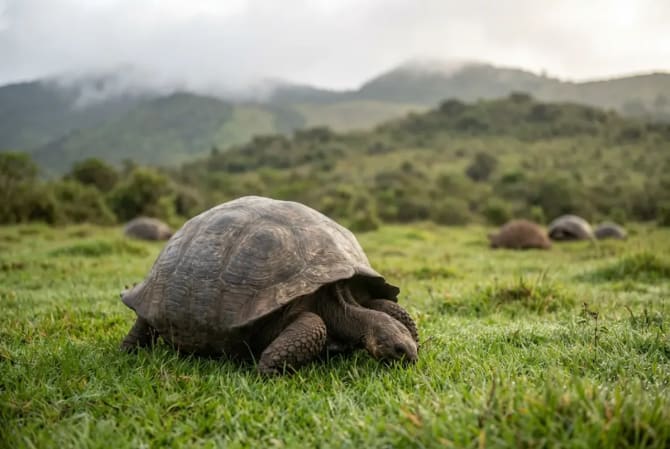
- Giant tortoises (Chelonoidis niger): 12 species, 20,000–27,000 wild animals, up to 200 kg and 200 years old. The Española tortoise is considered one of the greatest conservation success stories in the world — from 14 survivors, the population has grown to over 1,000.
- Marine iguanas (Amblyrhynchus cristatus, endemic): the only marine iguanas in the world, dive up to 30 minutes, feed exclusively on seaweed. Scientifically particularly fascinating: during El Niño events, they can reversibly shrink up to 20% of their body length — the only known adult vertebrate with this ability (Natural History Museum, peer-reviewed).
- Flightless cormorant (Phalacrocorax harrisi, endemic): the only flightless cormorant species among 29 cormorant species worldwide. Only 2,085 individuals, exclusively on Fernandina and Isabela.
- Galápagos penguin (Spheniscus mendiculus, endemic): the only penguins north of the equator. 1,200–2,000 animals, IUCN status 'Endangered'. 90% live on Fernandina and the west coast of Isabela.
- Wave albatross (Phoebastria irrorata, endemic): 25,000–35,000 birds, nearly the entire world population breeds on Española between April and December. Wingspan up to 2.5 meters.
- Blue-footed booby: not endemic, but a characteristic bird of the archipelago. The blue foot color directly depends on carotenoid intake — an honest courtship signal.
These animals know no flight distance because they grew up over millennia without land predators. That makes Galápagos perhaps the most intimate wildlife experience on Earth — and that explains the uncompromising biosecurity rules of the national park: minimum distance two meters, no flash photography, only marked paths, no feeding, no imported organic goods. Entering Galápagos means entering a laboratory.

This image was generated with AI.
Cruise vs. island hopping — the fundamental decision
The most important decision when planning any Galápagos Islands trip is made before booking: cruise or island hopping? Both travel styles have clear strengths, and the right choice depends less on budget than on your priorities.
Galápagos cruise. 70% of the visitor zones permitted in the national park are only accessible by ship. This includes the most ecologically spectacular spots: Fernandina (largest marine iguana colony, flightless cormorants), Española (wave albatrosses), Genovesa ('Birdwatcher's Paradise' with red-footed boobies), Bartolomé (Pinnacle Rock), and the northern islands Darwin and Wolf. On a classic 8-day route, you visit 5–8 islands, sailing at night and starting first in the morning at the visitor points. A maximum of 16 guests per guide — this rule ensures intimate nature experiences. Three cabin classes determine the price: Economy (350–500 USD per person per day), First Class (600–800 USD), and Luxury (1,500 USD and up). All meals, activities, and guides are included. Ideal for travelers with limited time, a high wildlife priority, and no issues with night travel.
Galápagos island hopping. You stay in hotels on Santa Cruz, Isabela, and San Cristóbal, book day tours, and move between the islands by speedboats (2–2.5 hours, 35 USD one way). This is about a third cheaper than a comparable cruise, gives you your own pace, local restaurants, and contact with the island's population. Three of the islands are inhabited and allow for town, beach, and highlands programs: Puerto Ayora with the Darwin Research Station, Puerto Villamil with the Giant Tortoise Breeding Center, and Sierra Negra, Puerto Baquerizo Moreno with Kicker Rock and sea lion colonies at Playa Mann. Ideal for travelers with more time, an active vacation style (surfing, kayaking, mountain biking), seasickness, or the desire to experience everyday island life.
|
| Cruise | Island hopping |
|---|---|---|
| Access to islands | 5–8 islands including Fernandina, Española, Genovesa | 3 islands (Santa Cruz, Isabela, San Cristóbal) |
| Wildlife density | Very high (70% more visitor zones) | High but limited to inhabited islands |
| Price (8 days, on-site) | from 2,800 USD (Economy) to 12,000+ USD (Luxury) | from 2,100 USD |
| Flexibility | Fixed (route specified) | High |
| Seasickness | Possible (night trips) | Only with inter-island ferries |
| Minimum age | mostly 6 years, partly 8–12 | none |
| For whom | Max. wildlife, little time | Active travelers, families, budget |
The elegant third solution: Combination.4–5 days cruise for the western and southeastern islands, followed by 3–4 days on land in Santa Cruz or Isabela. This way, you cover both worlds. Our detailed comparison: Galápagos cruise vs. island hopping — which is better?
A practical booking tip: dive cruises to Wolf and Darwin Island (liveaboards) should be booked 12 to 18 months in advance — the 16 spots per ship are in high demand. Classic expedition yachts in the high season (June–August, December–January) 9 to 12 months. In the low season (February–March, September–October) there are regular last-minute discounts of up to 40%.
Wildlife calendar — what to see when
Galápagos wildlife follows two seasons: the warm season (December–May) and the cool season (June–November). What animals you see where and in what activity largely depends on the month. An overview for travel planning.
| Month | Water | Wildlife highlights | Visitors |
|---|---|---|---|
| January | 23–26 °C | Land iguana nesting season on South Plaza, sea turtle egg laying, flamingo courtship, green vegetation after initial rains | high |
| February | 24–26 °C | Marine iguana courtship with intense red-green coloring, giant tortoise hatching begins | medium |
| March | 24–26 °C | Sea turtle hatching, calm sea, best underwater visibility (up to 25 m), peak rainy season (short showers) | medium |
| April | 23–25 °C | Waved albatrosses return to Española, sea turtles hatch, green marine iguanas finish breeding | medium |
| May | 22–24 °C | Transition month — waved albatross courtship begins, blue-footed booby courtship dance begins, fewer visitors | low |
| June | 20–23 °C | Humboldt current brings nutrient-rich water: whale sharks appear (up to Nov), humpback whales pass through, hammerhead shark schools densify | very high |
| July | 19–22 °C | Peak season for hammerhead and whale sharks Wolf/Darwin, blue-footed booby courtship in full swing, breeding season for flightless cormorants begins | very high |
| August | 19–22 °C | Sea lion births begin, humpback whale sightings, dry, clear skies, Garúa fog in the highlands | very high |
| September | 19–22 °C | Penguin activity at its highest on Bartolomé, sea lion pups, best diving season, little rain | medium |
| October | 20–23 °C | Numerous sea lion pups, lava lizard courtship, continued whale shark opportunities, last-minute discounts frequent | low |
| November | 21–24 °C | Transition month — brown noddies breeding, sea calms down, sea lions still active, few visitors | low |
| December | 22–25 °C | Giant tortoise egg laying, water temperatures rise, snorkeling season begins, Christmas/New Year rush from mid-December | high |
Contradictory sources are consciously transparent: for hammerhead shark schools and whale sharks, June–November is often cited (highest animal concentration due to cold, nutrient-rich current), but some dive operators mention January–April (warmer water, better visibility). Both windows are justified — the June–November season is valid for maximum hammerhead contact, January–April for the best underwater visibility.
Detailed monthly calendar: Galápagos wildlife calendar — what to see when

This image was generated with AI.
When to travel to Galápagos
Galápagos is accessible all year round — the climate does not switch between summer and winter, but between two oceanographic regimes.
| Season | Months | Water | Land | Character |
|---|---|---|---|---|
| Warm season | Dec – May | 23–26 °C | 24–27 °C | Calm sea, good visibility, giant tortoise hatching, marine iguana courtship colors, occasional short showers, high season around Christmas |
| Cool season | Jun – Nov | 20–23 °C | 21–24 °C | Humboldt current, dry, Garúa fog in the highlands, best diving season, blue-footed booby courtship, humpback whales, sea lion pups |
Our recommendation by travel type:
- Families with children and snorkeling focus: December to April. Warm water, calm sea, giant tortoise hatching. Hotel prices in the high season (Dec 20 - Jan 5) significantly higher — the time around mid-January to mid-February offers almost all advantages at lower prices.
- Divers and wildlife enthusiasts: June to November. Hammerhead shark schools, whale sharks (Jun–Nov), humpback whales, sea lion pups, penguin activity. Cooler water (5mm or more wetsuit recommended).
- Photography and exclusivity: May and November. The transition months combine active wildlife with calm seas, clear visibility, and the fewest visitors. Cruise lines often offer discounts here.
Insider tip — May and November as "Best of Both Worlds". The two transitional months are considered by Galápagos experts to be the perfect travel time. The sea calms down, visibility underwater is excellent, wave albatrosses arrive at Española or are currently raising their chicks, blue-footed boobies are courting, and at the same time, the hammerhead shark schools are already moving to the northern reefs or are still there. And: The yachts are not fully booked, and prices are noticeably below high season levels.
In detail: Best travel time for Galápagos
Diving and snorkeling in Galápagos
The waters of Galápagos are among the most species-rich diving areas in the world. The reason is the three converging ocean currents and the 133,000 km² marine protected area, supplemented since 2021 by the 60,000 km² Hermandad Marine Reserve. The highest concentration of sharks in the world has been documented in these waters — around 90% of hammerhead movements stay within the protected zone.
Wolf and Darwin Island in the north are the legendary liveaboard destinations. Schools of hundreds of hammerheads per dive, whale sharks from June to November (in some years also April–May), manta rays, Galápagos sharks, silky sharks. These islands are only reachable by dive cruise — land visits are not allowed. Reservations are required 12–18 months in advance. Minimum requirement: Advanced Open Water plus 50 logged dives, sometimes higher. Currents can be strong, and the spots are not for beginners.
Land-based diving is possible from Santa Cruz and San Cristóbal. The classics: Gordon Rocks (Santa Cruz, hammerheads, strong currents), Kicker Rock / León Dormido (San Cristóbal, hammerheads, Galápagos sharks, sea turtles), North Seymour (whitetip reef sharks, rays). These day tours are aimed at certified divers (AOWD recommended, 25+ dives).
Snorkeling is world-class even without a diving certificate. Kicker Rock, Los Tuneles in Isabela (lava tunnels with seahorses and whitetip sharks), Bartolomé (Pinnacle Rock with penguins), Devil's Crown at Floreana and Champion Islet are among the best snorkeling spots on Earth. You swim with sea lions, sea turtles, marine iguanas, and penguins — often at arm's length.
Water temperatures vary significantly between seasons: warm season 23–26 °C (3mm wetsuit for longer sessions), cool season 19–22 °C, at Wolf and Darwin cooler year-round due to the deeper currents (5–7mm wetsuit recommended).
More on the topic: Diving in Galápagos — Cruise Guide · Island hopping in Galápagos
Insider tip — Last-minute discounts in the off-season. February, March, September, and October are the cheapest months for Galápagos cruises. Shipping companies offer discounts of up to 40% for unbooked departures — sometimes six to eight weeks before departure. Those who are flexible in timing and can decide quickly get a first-class yacht for an economy price. We have access to these contingents with our partner shipping companies.
Guidebook Galápagos
For detailed planning, we have outsourced the most important topics into standalone guides: best travel time with monthly wildlife calendar, cruise decision aid with comparison of shipping companies, island hopping planning with ferry schedules, giant tortoise guide with the best observation spots, cost and budget overview, as well as entry and park rules with the current fee structures since August 2024 and May 2025.
More inspiration
For those wanting to dive deeper, our magazine features detailed background articles on the most common questions before a Galápagos trip — from direct comparisons of cruise vs. island hopping to the monthly wildlife calendar to comparisons between Galápagos and Pantanal for wildlife travelers weighing the two premium destinations.
Frequently asked questions about traveling to Galápagos
We have summarized the most important questions from our clients before a Galápagos Islands trip in the FAQ block above — from travel and costs to the best travel time and the cruise vs. island hopping decision to wildlife, family trips, and entry requirements. For anything beyond that — extensions to Peru or Costa Rica, special wildlife windows, honeymoon trips, dive cruises to Wolf and Darwin — you can reach us personally . We respond within one business day.
Reise- und Sicherheitshinweise
Für alle anderen Fragen stehen wir Ihnen gerne zur Verfügung.

- Speaks languages: German, English, Spanish
- Phone number: +49 211 975 333 234
- Email address: nils@takememories.com
What makes us special
With us you always come first!
Frequently asked questions
There are no direct flights from Europe. The flight to Galápagos always goes through Quito (UIO) or Guayaquil (GYE) with a domestic flight to Baltra (Santa Cruz, code GPS) or San Cristóbal (SCY). LATAM and Avianca operate the route, and domestic flights cost 450–600 USD (one way and back). Total travel time from Frankfurt: 22–23 hours. All details on entry and travel
Our Galápagos trips start at €6,900 per person for 7–10 days including flights from Europe, accommodations or cruises, and personal support. On-site, the national park fee (200 USD cash, since August 2024) and the Transit Control Card (20 USD, online, since May 2025) are additionally required. Economy cruises range from 350–500 USD per person per day; luxury yachts start at 1,500 USD. Complete cost breakdown
Galápagos is open for travel all year round. December to May is the warm season with 23–26 °C water temperature — ideal for snorkeling, families, and photography. June to November is the cool season with 20–23 °C — the best time for diving with hammerheads and whale sharks, humpback whales, and blue-footed booby courtship. May and November are transitional months with calm seas, active wildlife, and fewer visitors. More on the best travel time
Cruise: access to 70% more visitor zones (including Fernandina and Española), maximum wildlife density, all meals included, maximum 16 guests per guide. Island hopping: about one third cheaper, more flexibility, local cuisine, better for seasickness. Combination possible — 4–5 days cruise plus 3–4 days land-based. The complete comparison in the blog
The Galápagos Islands have the highest endemism rate in the world: 97% of reptiles and 80% of land birds live nowhere else. The stars include giant tortoises (12 species, up to 200 years old), marine iguanas (the only sea-adapted lizards in the world), blue-footed boobies with courtship dances, the endangered Galápagos penguin (1,200–2,000 individuals), the flightless cormorant (only 2,085 individuals), sea lions, wave albatrosses at Española, and hammerhead schools around Wolf and Darwin Island.
Yes, although most cruise operators require a minimum age of 6 years (some shipping companies 8 or 12 years). There is no age limit for island hopping. The warm months from December to May are ideal with calm seas and good snorkeling conditions. For families, we recommend a combination of land-based days on Santa Cruz and Isabela (tortoise highlands, Giant Tortoise Breeding Center, quiet beaches) plus possibly a short cruise. Sea lions and marine iguanas up close delight all ages.
German, Austrian, and Swiss citizens can travel visa-free for up to 90 days. Requirements include: a valid passport (minimum of 6 months), return flight ticket, Transit Control Card (20 USD, online since May 2025), and the national park fee (200 USD, cash only in USD, since August 2024). Special vaccinations are not required for Galápagos; standard vaccinations (tetanus, diphtheria, hepatitis A) should be up-to-date. Yellow fever is recommended since May 2025 for Ecuadorian Amazon areas — not required for the islands. All organic goods will be checked upon arrival (biosafety). All entry details
You might also like this

Snorkeling with Sea Lions on the Galápagos Islands
There are travel experiences that you never forget. For Nele, snorkeling with sea lions on the Galápagos Islands is definitely one of them – a moment that belongs on every bucket list and about which Nele shares more in this blog article....
Ecuador's great natural stage
From Cotopaxi to the Galápagos Islands There are trips that impress. And there are trips that resonate long after. Our journey through Ecuador clearly belonged to the second category. Within just a few days, we moved between two completely different worlds: the heights of the Andes and the island world of the Galápagos....

Colombia: Land of the Bird World — 1,950 species awaiting
It is 5:30 in the morning. The misty forest cloaks everything in damp gray. The truck struggles up an unpaved mountain road while the engine works against the incline. Then, with the first light, it begins — a concert of whistles, chirps, and sounds you've never heard before. Dozens of voices, everywhere at once. And suddenly, among the dripping wet leaves, a shadow in colors that don't fit in any German forest: bright orange, turquoise, scarlet red. Welcome to Colombia — the country with the richest birdlife on Earth....