

This image was generated with AI.
Tayrona National Park
Caribbean beaches in the rainforest — Colombia's most visited national park
Caribbean beaches in the rainforest — Colombia's most visited national park
34 Caribbean beaches, dense tropical rainforest, and the iconic Cabo San Juan: Tayrona is one of the most visited national parks in Colombia — and one of the few in the world that closes three times a year for indigenous ceremonies.

Best travel time
December to April
Why Tayrona? — Colombia's most spectacular natural jewel
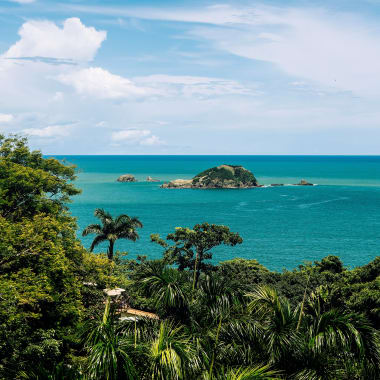
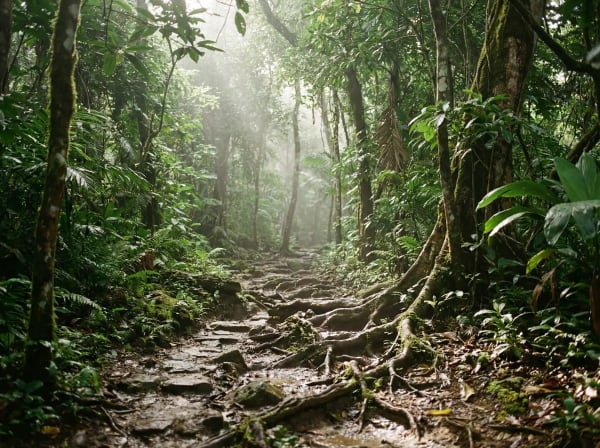
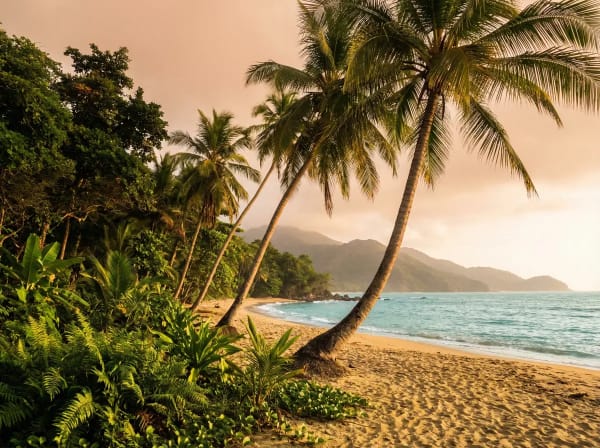
The jungle path ends abruptly. Amidst man-high roots, the view opens up to a bay where turquoise water meets golden-brown sand. Palm trees lean over the beach as if they want to reach into the sea. Somewhere above the treetops, a monkey roars — and you understand why Tayrona National Park is one of the most impressive nature experiences Colombia has to offer.
150 square kilometers of tropical rainforest, 30 square kilometers of marine protected area, 34 beaches, and a biodiversity that surprises even experienced nature travelers: over 300 bird species, 108 mammal species, plus coral reefs with hundreds of marine species. Only 34 kilometers from Santa Marta — and yet another world.
Protected since 1964, Tayrona is now one of the most visited national parks in Colombia . And one of the few in the world that closes three times a year: The Kogi, Wiwa, Arhuaco, and Kankuamo, the four indigenous peoples of the Sierra Nevada, manage this land together with the national park authority. What poses a logistical challenge for travel planners makes Tayrona National Park a place where nature conservation is not a mere slogan — but practiced reality for centuries.
Anyone planning a Colombia tour and traveling through the north of the country cannot miss Tayrona. A maximum of 6,900 visitors are allowed in the park per day — an online reservation in advance is mandatory.
Note the closing times for 2025/2026
Tayrona National Park closes three times a year: February 1–15, June 1–15 and October 19 – November 2. Additionally, extraordinary closures are possible — the park was last closed in February/March 2026 due to security concerns beyond the regular closing time. Always check the current status before your trip at parquesnacionales.gov.co.
When does Tayrona National Park open? Closing times 2026
The three annual closing periods at a glance
Tayrona National Park closes each year for a total of 45 days — three times for two weeks each. The dates have been constant for years and are already set for 2026:
| Period | Date | Indigenous Ceremony | Meaning |
|---|---|---|---|
| 1st Closure | February 1–15 | Kugkui Shikasa | Time of renewal of the earth |
| 2nd Closure | June 1–15 | Saka Juso | Time of female renewal |
| 3rd Closure | October 19 – November 2 | Nabbatashi | Time of the animals |
Background: Why does the park close?
The closures are not a bureaucratic act. They have deep spiritual roots. The four indigenous peoples of the Sierra Nevada — Kogi, Wiwa, Arhuaco, and Kankuamo — consider the Tayrona area as sacred land of their ancestors. During the closing periods, their spiritual leaders, the Mamos, conduct cleansing rituals and Pagamentos (ceremonial offerings) to thank nature and restore spiritual balance.
This shared management model between environmental authorities and indigenous communities is recognized internationally as a model for intercultural nature conservation. The Global Sustainable Tourism Council (GSTC) has acknowledged the approach as groundbreaking — and indeed, nature recovers measurably during these periods of rest.
Extraordinary closures
In addition to the regular closing times, the park can be closed at short notice for safety or environmental reasons. This last occurred in February/March 2026 when Tayrona National Park remained closed beyond the regular February closure until early March. Check the current status before your trip at parquesnacionales.gov.co.
Entrance and tickets — online booking step by step
Since 2021, online reservations via reservas.parquesnacionales.gov.co have been mandatory for Tayrona National Park. No entry without prior booking — cash payments on site are not possible.
Tayrona National Park — entrance
- Entrance off-season — 77,500 COP (about 17 EUR) + 7,000 COP insurance
- Entrance high season — 92,000 COP (about 20 EUR) + 7,000 COP insurance
- Opening hours — Daily 8:00 AM–5:00 PM, last entry El Zaino 4:00 PM
- Booking — Mandatory via reservas.parquesnacionales.gov.co
Prices: Foreigners vs. Colombians (as of March 2026)
Foreigners pay a higher entrance fee than Colombian citizens — a valid passport must be presented at the entrance (a clearly readable copy is sufficient). The high season includes June 15 to July 15, December 15 to January 30, and the Semana Santa (Holy Week). The cheaper off-season rate applies at all other times.
Important: The ticket is valid for the entire duration of your stay in the park as long as you do not leave. Anyone leaving the park and wishing to re-enter the next day must purchase a new ticket.
How to book at reservas.parquesnacionales.gov.co
- Visit the website and choose "Tayrona" as the destination
- Enter travel date and number of people
- Provide passport details for each visitor
- Complete payment by credit card within 48 hours — otherwise, the reservation expires
- Secure booking confirmation as a screenshot and present it at the entrance
Insider tip
From experience: The booking system occasionally has technical issues. Reserve a few days in advance and secure the booking confirmation as a screenshot on your phone. During the high season (Christmas/New Year), tickets are often sold out weeks in advance — the daily capacity of 6,900 visitors is quickly reached.
Getting to Tayrona National Park from Santa Marta
Santa Marta is the natural starting point for Tayrona National Park. The main entrance El Zaino is located 34 km northeast of the city — depending on traffic, it takes 45 to 60 minutes to drive along the coastal road.
From Santa Marta to Tayrona National Park Santa Marta → Entrance El Zaino (Tayrona)
The park has four entrances: El Zaino (main entrance, recommended), Calabazo (western entrance, rarely visited), Palangana and marine access by boat from Taganga.
Insider tip
Our tip — the Calabazo entrance: Rarely known and rarely visited. Just tell the bus driver "Calabazo" — the stop is ten minutes before El Zaino. From here you can reach the park without the usual crowds. Only downside: the last entry is already at 2:00 PM (El Zaino: 4:00 PM).
Further details on flights to Colombia and entry and visa can be found in our guides.
The best beaches in Tayrona National Park
The Tayrona National Park has 34 beaches — but only 7 of them are officially open for swimming. The currents along the Caribbean coast should not be underestimated. Here are the most important beaches at a glance:
Cabo San Juan del Guía — Tayrona's Icon
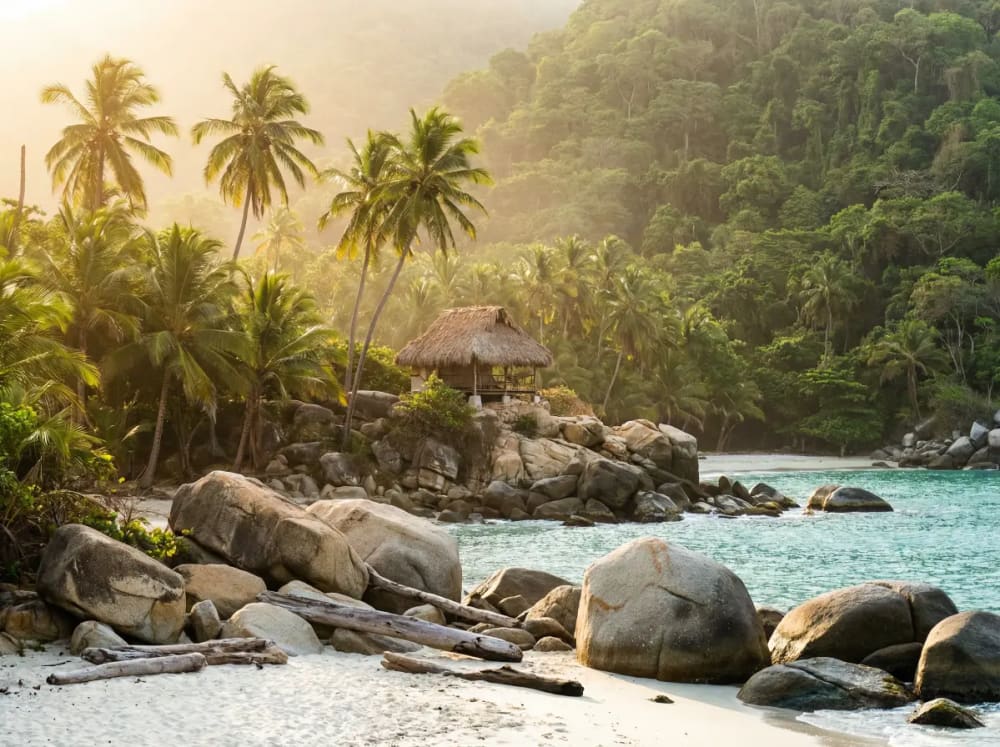
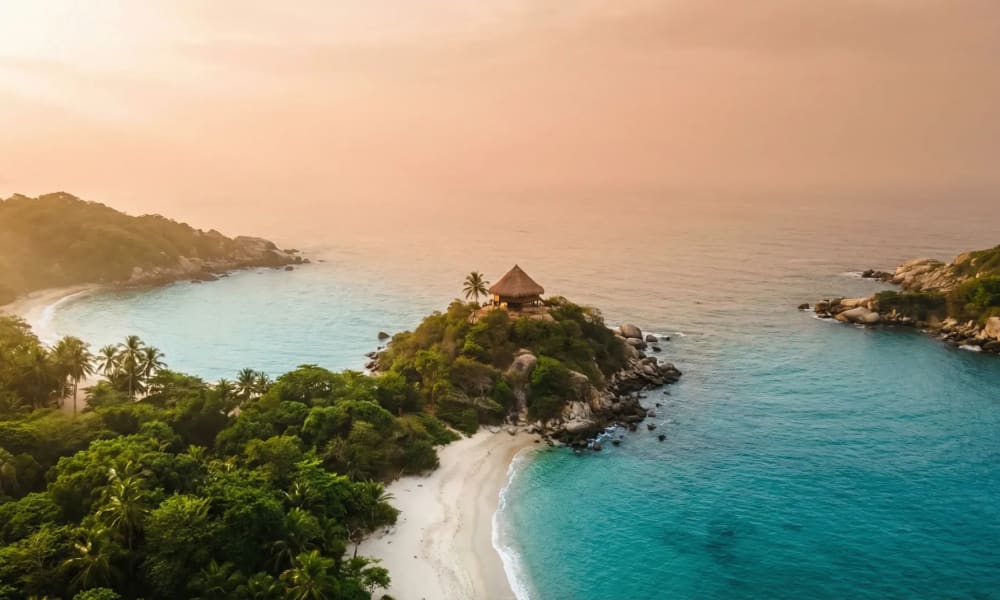
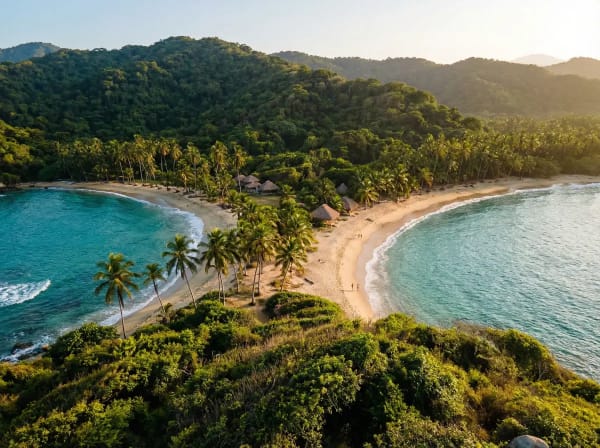
Two small bays, separated by a rocky outcrop with the famous palm hut — Cabo San Juan is the most photographed motif of Tayrona National Park and for many travelers, the reason to come here. Both bays are open for swimming, the water shimmers in a turquoise that no filter could improve. Anyone who stays here — in a hammock or tent — experiences the sunrise at around 5:45 am almost alone, before the first day tourists arrive. From the main entrance El Zaino it is about 12 kilometers and 3 to 3.5 hours of jungle trekking.
La Piscina — best swimming water in the park
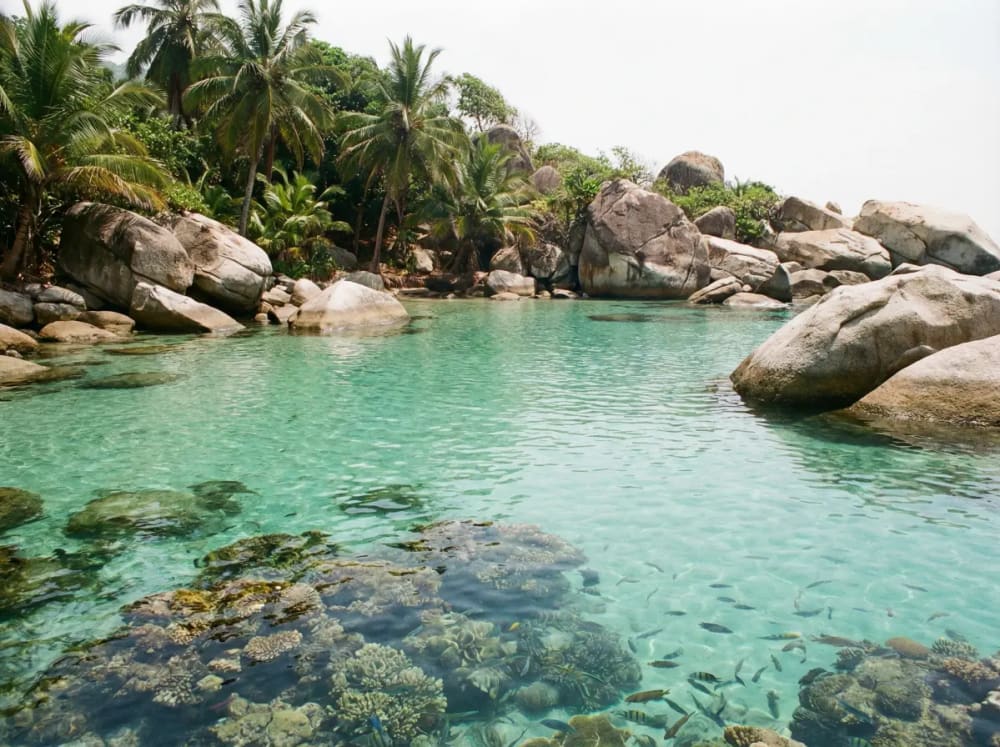
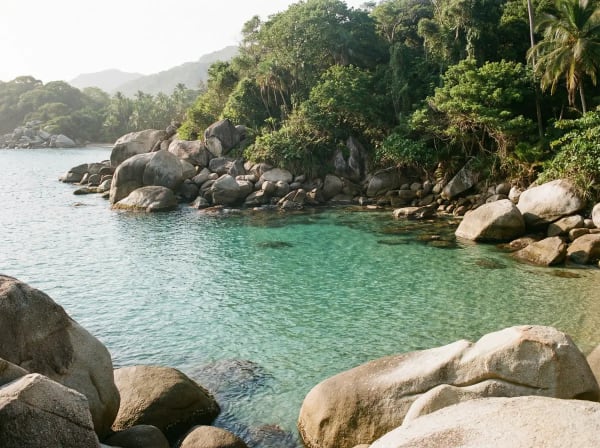
A small lagoon protected by a natural coral reef with clear water — ideal for swimming and snorkeling in Colombia . La Piscina is halfway between Arrecifes and Cabo San Juan. Many hikers simply pass by without stopping — a mistake. The water here is calmer and clearer than at Cabo San Juan, and the remnants of coral host tropical fish that you can see while wading.
Arrecifes — photo motif, no swimming!
Swimming prohibited at Arrecifes
At Arrecifes, swimming is strictly prohibited — dangerous rip currents have already claimed lives here. Additionally, crocodiles can be found in the lagoon parallel to the beach. The beach is spectacular for photography, but certainly not suitable for bathing.
Arrecifes is the first major beach that hikers reach from the entrance El Zaino. The dramatic surf and the vast sand make it an impressive photo spot — but nothing more. The swimming prohibition signs should be taken seriously.
Playa Chengue and Bahía Concha
Less visited beaches in the western part of Tayrona National Park, accessible via the Calabazo entrance or by boat. Quieter, more idyllic, and with significantly less infrastructure — just right for travelers who want to avoid the main flow. Bahía Concha can also be reached as a day trip from Santa Marta by taxi or boat.
Staying in Tayrona National Park — accommodations and prices
Those who stay in Tayrona National Park experience something fundamentally different from day visitors. After 5 pm, when the last day tourists begin their return journey, Cabo San Juan transforms into an almost private Caribbean beach. The sounds of the jungle become louder, the light softer — and the park belongs to you almost alone for a night.
Ecohabs Tequendama
Nature-friendly comfort on the beach of Cañaveral
From 185 EUR / night
- Thatched bungalows
- Ocean view
- Restaurant & Spa
- Breakfast included.
Hammock Cabo San Juan
The iconic Tayrona experience
From 9 EUR / night
- Palm hut on the rock
- First come, first served
- Sunrise included
- Mosquito net available
Prices as of March 2026. 1 EUR ≈ 4,500 COP. No ATM in the park — bring sufficient cash.
Insider tip
The coveted hammocks in the palm hut on the rock of Cabo San Juan are allocated on-site — there is no online booking system. Those wishing to sleep there should be on the campsite before 9 am. The Ecohabs at Cañaveral, however, must be reserved 2 to 3 months in advance during the high season — via ecohabsantamarta.com.
We know these accommodations from personal experience and plan your stay in Tayrona National Park individually — accommodation, transport, and activities from a single source. Let us plan your trip .
Hiking in Tayrona — routes and times
Main route: El Zaino → Cabo San Juan
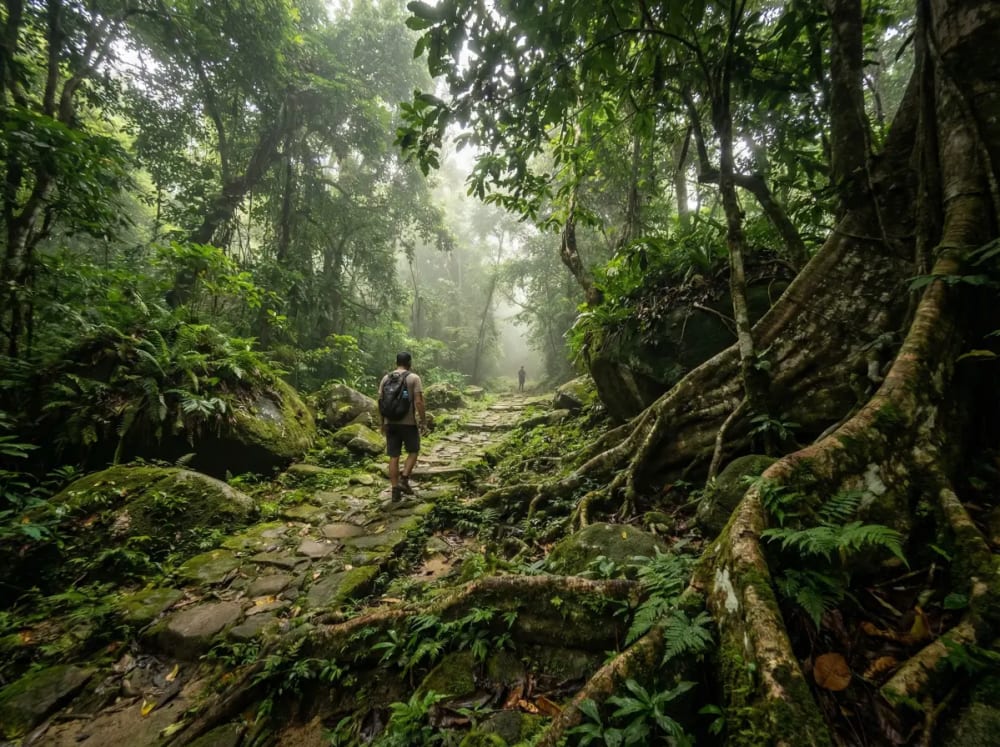
The most popular route in Tayrona National Park leads from the main entrance El Zaino through dense rainforest over Cañaveral and Arrecifes to Cabo San Juan. The distance is about 12 kilometers, with about 205 meters of elevation gain — moderate, but quite demanding at 30 degrees Celsius and high humidity. Walking time: 3 to 3.5 hours without breaks.
The path is well marked and leads through changing landscapes: dense secondary forest, open beach sections, shady jungle paths with roots and rocks. At several points, mules or horses can be rented for luggage transport (approx. 20,000–40,000 COP, as of March 2026).
Pueblito Chairama — pre-Columbian ruins in the jungle
Insider tip: Pueblito Chairama
From Cabo San Juan, a challenging path leads uphill in 2 to 3 hours to the pre-Columbian stone terraces of the Tairona civilization. The archaeological site is managed by the Kogui community and has been officially closed to visitors since 2019 — however, the hike to the site is still possible. Along the way, you will encounter hardly any other hikers.
Pueblito Chairama is among the most significant settlement remnants of the Tairona culture. The stone terraces and paved paths remind us that this coast was home to a highly developed civilization for centuries — long before the Spaniards arrived. Those who have an extra day in Tayrona National Park should start the ascent early in the morning: The path is steep, but the silence in the rainforest and the view on the return to Cabo San Juan compensate for every drop of sweat.
Activities and wildlife in Tayrona National Park
Birdwatching — over 300 species in the park
Over 300 bird species live in Tayrona National Park, including rare species like the Military Macaw, the Blue-headed Parrot, and the Boat-billed Flycatcher. For Birdwatching in Colombia the park is one of the most accessible locations — the density of species per square kilometer is remarkable. Learn more about Colombia's 1,950 bird species in our blog.
Snorkeling at La Piscina and Cabo San Juan
The conditions for snorkeling at La Piscina and in parts of Cabo San Juan are good: coral reef remnants and tropical fish in protected, clear water. Snorkeling gear can be rented in the park (approx. 20,000–30,000 COP, as of March 2026). More on the topic of Snorkeling and diving in Colombia .
Howler monkeys, capuchin monkeys, and cotton-top tamarins
The howling of the howler monkeys can be heard up to five kilometers away — it is part of the acoustic background noise of Tayrona and surprises the first time. Monkeys are the most commonly sighted mammals in the park. Particularly valuable: The cotton-top tamarin is endemic to Colombia and endangered. Tayrona is considered one of the best areas to observe these distinctive little monkeys with their characteristic white hair crown in the wild. The best chances are in the morning and at dusk.
Health and safety in Tayrona National Park
Yellow fever vaccination — proof required since May 2025
Yellow fever vaccination proof since May 2025
Since May 3, 2025, a yellow fever vaccination certificate is mandatory for entry to Colombian national parks — including Tayrona National Park. Those who cannot present a vaccination certificate must sign a written consent form on-site. We generally recommend the vaccination for trips to Colombia. All details in our guide Vaccinations and health .
Swimming bans and rip currents
Only 7 of the 34 beaches in Tayrona National Park are officially open for swimming. The current conditions along the Colombian Caribbean coast are unpredictable — rip currents have already claimed lives here. Adhere strictly to signage and never swim at beaches marked with a red flag.
Insect repellent with a high DEET content belongs in your luggage — mosquitoes and sandflies (jejenes) are ubiquitous, especially at dusk. More information on Safety in Colombia and in our article Traveling safely in Colombia — the truth .
Best time to travel to Tayrona National Park
The dry season from December to April offers the best conditions for Tayrona National Park: dry hiking trails, sunny weather, and calmer seas. However, December and January are absolute high season — crowded beaches, fully booked tickets, and higher entry prices.
Our tip: March and April are the sweet spot. Dry season, but after the high season peak. Quieter, more relaxed, and the park is open. Note the February closure (February 1–15), which falls during the European winter holiday period.
The rainy season from May to November has its own charm: richer green, fewer visitors, lower prices — but muddy pathways and occasionally heavy tropical showers. The so-called "little dry season" in July can bring surprisingly good weather.
Detailed information on the best time to travel to Colombia in our guide.
Combining Tayrona and Santa Marta — our recommendation
Santa Marta — Colombia's oldest city — is the natural starting point for Tayrona National Park. We recommend connecting both destinations. Three days are enough to experience the main aspects of this region:
Day 1 — Explore Santa Marta
Day 2 — Tayrona — Hiking and overnight
Day 3 — Tayrona — Pueblito and return
Note: A day trip to Tayrona National Park is possible, but staying overnight in the park makes all the difference — after the day tourists leave at 5 pm, Cabo San Juan transforms into an almost private Caribbean beach. Those with more time can add a fourth day for Minca in the Sierra Nevada: coffee, hummingbirds, and fog forest at 650 meters altitude.
Costs and budget — Tayrona National Park at a glance
All prices as of March 2026. 1 EUR ≈ 4,500 COP. There are no ATMs in the park — bring sufficient COP cash.
Good to know — rules and equipment for Tayrona
Note
In Tayrona National Park, there is a strict ban on single-use plastics.Reusable water bottles are mandatory - refill options are available at springs and in the restaurants along the way. Also good to know: no mobile network in the park, no ATM, food and accommodation must be paid for in cash in COP.
What you should bring:Sturdy footwear (hiking shoes or stable sandals with a profile), reusable water bottle (at least 2 liters for the hike - there are only a few refill stations along the way), insect repellent with a high DEET content, sunscreen, headlamp for overnight stays, sufficient cash in COP and your passport or a clearly readable copy. Our Colombia packing list helps with the preparation.
Discover Colombia further
The Tayrona National Park can be excellently combined with other stops on a Colombia round trip Our round tripColombia Nature: Tayrona & Amazonasconnects the Caribbean coast with the most impressive natural experiences in the country. Alternatively, combine Tayrona with theCoffee & Caribbean round tripor theColombia Intensive Round Trip (3 weeks)for those who want to experience the country in its full depth.
Santa Marta - Gateway to Tayrona - oldest city in Colombia
Cartagena - Colonial jewel on the Caribbean
Caño Cristales - The most beautiful river in the world
To book a trip or for more information, contact us. We'll help you plan and guide you through your upcoming adventure!
Frequently Asked Questions
The Tayrona National Park closes three times a year for 15 days each: February 1-15 (Kugkui Shikasa), June 1-15 (Saka Juso) and October 19 - November 2 (Nabbatashi). These closures allow the indigenous peoples of the Sierra Nevada - Kogi, Wiwa, Arhuaco and Kankuamo - to conduct spiritual ceremonies for the renewal of nature. In addition, short-term extraordinary closures for safety or environmental reasons are possible. You can find the current status at parquesnacionales.gov.co.
As of March 2026: The entrance fee for foreigners is approximately 77,500 COP (approximately 17 EUR) in the low season and approximately 92,000 COP (approximately 20 EUR) in the high season. In addition, there is a mandatory insurance fee of 7,000 COP per person per day. Online booking via reservas.parquesnacionales.gov.co has been mandatory since 2021 - cash payment on site is not possible.
Yes - and we highly recommend it. Only after day tourists leave at 5 PM does the Tayrona National Park reveal its special character. Options: Ecohabs Tequendama at Cañaveral (thatched roof bungalows from approx. 185 EUR/night, as of March 2026), hammocks at Cabo San Juan (9-13 EUR, first come first serve, no advance reservation) or your own tent at the campsites at Arrecifes and Cabo San Juan.
As of May 3, 2025, a yellow fever vaccination certificate is required for entry to Colombian national parks - including Tayrona. Alternatively, a written consent form can be signed on-site. We generally recommend vaccination for trips to Colombia. All details in our guide vaccinations and health Colombia.
By bus from Mercado Público in Santa Marta (heading to Palomino/Riohacha, approx. 2.20 EUR, 1 hour) or by taxi (approx. 13 EUR, 45 minutes) to the main entrance El Zaino. Alternatively, by motorboat from Taganga directly to Cabo San Juan (approx. 11 EUR, 50 minutes - only recommended in calm seas).
We recommend at least 2 days with an overnight stay in the park. A day trip is possible, but the actual experience begins after 5 PM when the day tourists leave Tayrona National Park. Three days are ideal: hiking and beach on the first day, Pueblito Chairama and return on the second and third day.
Of 34 beaches, only 7 are officially approved for swimming. The most important ones: Cabo San Juan (both bays), La Piscina (calmest water, ideal for snorkeling), and Bahía Concha. Swimming is strictly prohibited at Arrecifes due to dangerous rip currents and crocodiles in the adjacent lagoon.
Yes, since 2021 an online reservation via reservas.parquesnacionales.gov.co is mandatory for Tayrona National Park. No entry without prior booking. Payment must be made within 48 hours via credit card - otherwise, the reservation expires. In the high season (Christmas, New Year's Eve, Semana Santa), you should reserve weeks in advance: The daily capacity of 6,900 visitors is quickly reached.