


Santa Cruz
The heart of the Galapagos archipelago
The heart of the Galapagos archipelago
Discover Santa Cruz Galapagos: Charles Darwin Research Station, free-roaming giant tortoises in the highlands, Tortuga Bay, and Puerto Ayora. Diving at Gordon Rocks and day trips from the hub island.

Best travel time
Year-round, ideal December–May (warm) or June–November (diving)
Why Santa Cruz is the focal point of every Galapagos trip
The ferry arrives, the bus winds through the moist highlands, and suddenly a giant tortoise stands by the roadside — motionless, ancient, and unimpressed. This is how the majority of travelers begin their arrival on Santa Cruz Galapagos. Not with a hotel check-in, but with an encounter that dictates the rhythm of the archipelago: Here, nature determines who makes way for whom.
Santa Cruz is the second largest island of the Galapagos Islands and at the same time its most populous — around 18,000 people live here, most of them in Puerto Ayora Galapagos, the largest town of the archipelago. Baltra Airport is located on the small neighboring island to the north, and from here, practically all cruises and island hopping routes.
But those who treat Santa Cruz merely as a transit point miss out on the island where Galapagos can be experienced most fully. Six distinct vegetation zones — from the arid coastal zone to dense Scalesia forest and the misty highlands — make it the ecologically most diverse in the entire archipelago. Here stands the Charles Darwin Research Station, the scientific heart of species conservation. In the highlands, giant tortoises roam freely over pastures and field paths. At Tortuga Bay, a beach opens up that is protected by no entrance fee, as marine iguanas take care of that more reliably than any fence. And at Gordon Rocks — 45 minutes by boat — schools of hammerhead sharks move through an underwater crater that humbles even experienced divers.
Science, wilderness, and everyday culture in one place: Santa Cruz is not only the logistical hub of the archipelago — it offers the most complete experience.
Charles Darwin Research Station — free of charge and essential
Fifteen minutes on foot from the center of Puerto Ayora, along Avenida Charles Darwin, lies the most important scientific institution of the archipelago. The Charles Darwin Research Station was founded in 1964 and has since been the centerpiece of Galapagos conservation — a facility that has made the difference between extinction and survival for entire populations. Admission is free. The visit is part of the must-do on every trip to Santa Cruz Galapagos.
What to expect at the Darwin Station
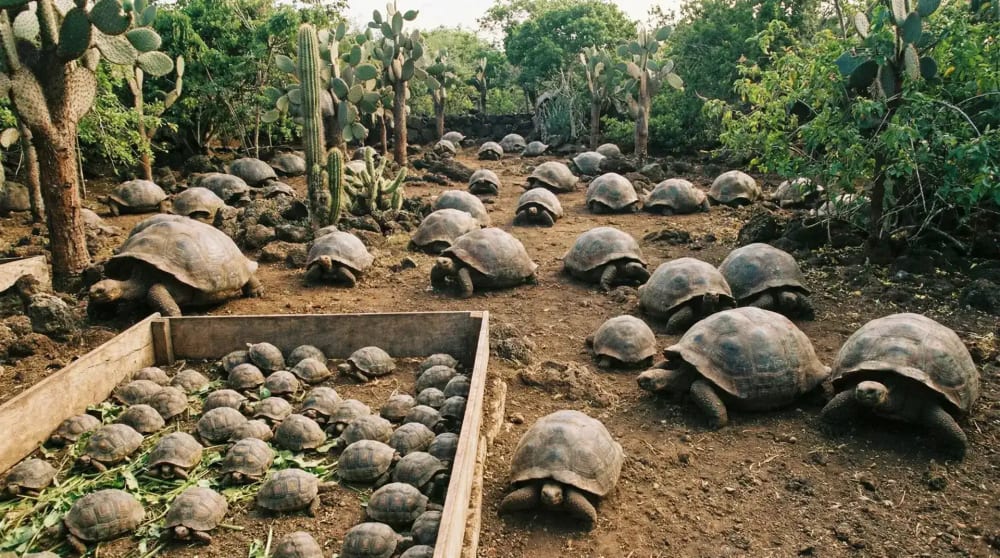
In the core area, the Fausto Llerena Tortoise Breeding Center, species conservation becomes tangible. In tiered enclosures, you observe Galapagos giant tortoises at all stages of growth: freshly hatched young that fit in a palm, beside fully grown specimens with over a meter of shell diameter. The breeding program has significantly contributed to several populations returning from the brink of extinction — thousands of tortoises have been raised here and released into the wild.
At the end of the tour, there is silence. Behind a glass panel stands the mounted specimen of Lonesome George — the last giant tortoise of the Pinta Island subspecies, who died on June 24, 2012. Over a hundred years old, alone, without offspring. With his death, an entire subspecies disappeared from this planet. Lonesome George became a global symbol for species conservation — and many visitors turn back too early before his memorial. Go through the tour until the end.
In addition to tortoises, the station also breeds land iguanas that were nearly exterminated in the 1970s due to introduced dogs and rats. A visitor center with exhibitions on evolution and the history of the archipelago, a souvenir shop, and a small cafeteria round out the visit.
Charles Darwin Research Station
- Duration — 1–2 hours
- Location — 15 min. on foot from the center of Puerto Ayora, Avenida Charles Darwin
- Opening hours — Daily 08:00–18:00, also on holidays
- Admission — Free (optional tour approx. 10 USD)
Be there before the cruise groups
Visit the station right after 08:00 in the morning. From around 10:00, the cruise passengers arrive and it gets crowded. Alternatively, in the afternoon from 15:00, when the groups are back on board. And: Go through the tour until the end — the Lonesome George memorial is at the end and is overlooked by many.
Giant tortoises in the highlands — free-roaming and close
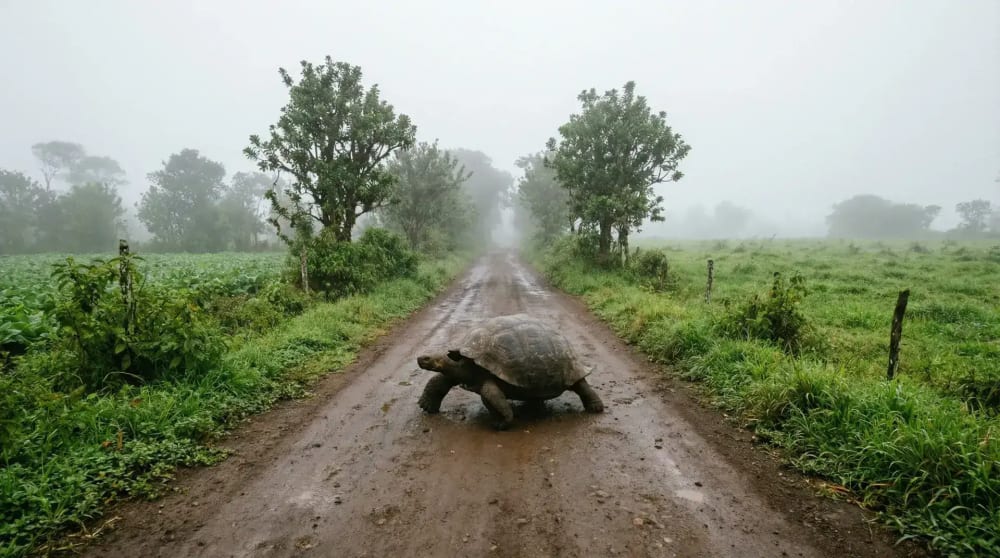
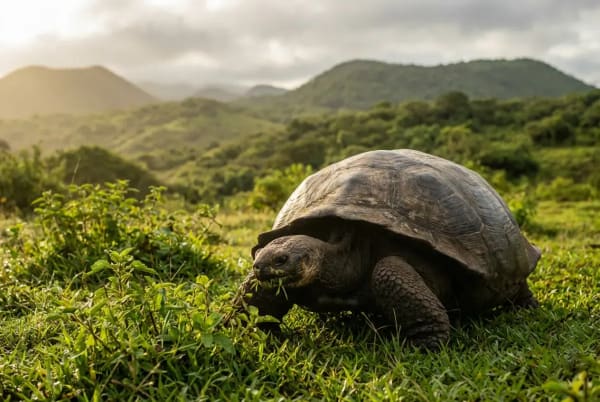
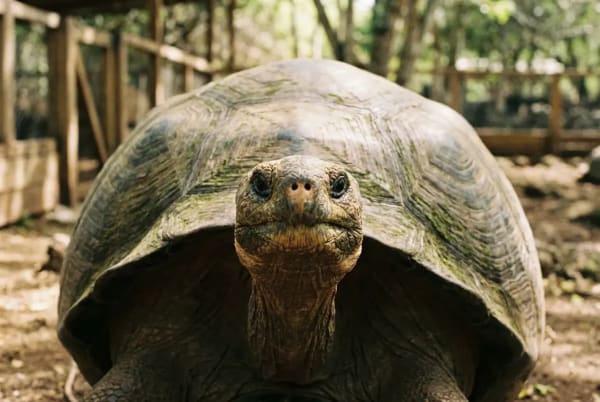
The Darwin Station shows tortoises in enclosures. The highlands of Santa Cruz show them in freedom. Twenty minutes north of Puerto Ayora, everything changes: The dry coastal zone gives way to lush grassland, mist drapes between the trees, and then — right on the dirt path — it stands. A Galapagos giant tortoise, weighing a hundred kilos, lifting its head slowly. No fence, no enclosure, no guide that brought it here. It was already here before the road came.
In the highlands of Santa Cruz, two endemic subspecies live: the Western Santa Cruz tortoise (Chelonoidis porteri) with about 3,400 adults and the Eastern Santa Cruz tortoise (Chelonoidis donfaustoi) — recognized as a separate species only in 2015, with just about 250 specimens one of the rarest tortoises in the world. GPS studies over twelve years have shown that these animals undertake seasonal migrations: starting in December, they move to lower elevations, and from June they return to the moist highlands — along fixed routes that researchers refer to as tortoise highways.
El Chato Reserve
El Chato is the most well-known tortoise refuge in the highlands of Santa Cruz. Hundreds of hectares of natural highland pasture and dense Scalesia forest, in which the animals roam freely. The most famous spot: a pond where dozens of giant tortoises gather in the cool water, heads just above the surface — the most photographed motif on the entire island. Among the pastures, the bright red vermilion flycatcher and several species of Darwin finches can be seen. The grounds also feature well-lit lava tubes that are accessible.
Private farms — Rancho Primicias and Rancho Manzanillo
For travelers looking to avoid crowds: Rancho Primicias and Rancho Manzanillo are located on the main road and offer the same tortoise experience — often significantly quieter and cheaper. Both farms also have lava tubes on their grounds.
Los Gemelos — twin craters in the Scalesia forest
On the way to the highlands lie Los Gemelos: two large sinkholes, surrounded by the endemic Scalesia forest — a giant daisy bush plant that grows to ten-meter high trees. A 500-meter trail leads through this unique forest, where eight out of the thirteen species of Darwin finches can be observed. Early in the morning, the rare short-eared owl can also be seen here. The visit is free.
Highlands Santa Cruz — El Chato & Los Gemelos
- Duration — Half day (3–4 hours including travel time)
- Location — About 22 km north of Puerto Ayora (20 min. by taxi)
- Best time — June–November (tortoises in the highlands are most numerous)
- Price — El Chato: approx. 10–15 USD | Rancho Primicias: 3–5 USD | Los Gemelos: free
Optimally plan half a day
El Chato and Los Gemelos can be perfectly combined in half a day. The taxi driver is happy to wait and gives a flat rate (approx. 40–50 USD including waiting time). Rancho Primicias is often quieter than El Chato during the week — ideal for those who want to experience tortoises without other tourists. Anyone wanting to dive deeper into the biology of the Galapagos giant tortoises will find everything about species, conservation status, and evolution on our Explore page.
Tortuga Bay — best beach in Galapagos with no entrance fee
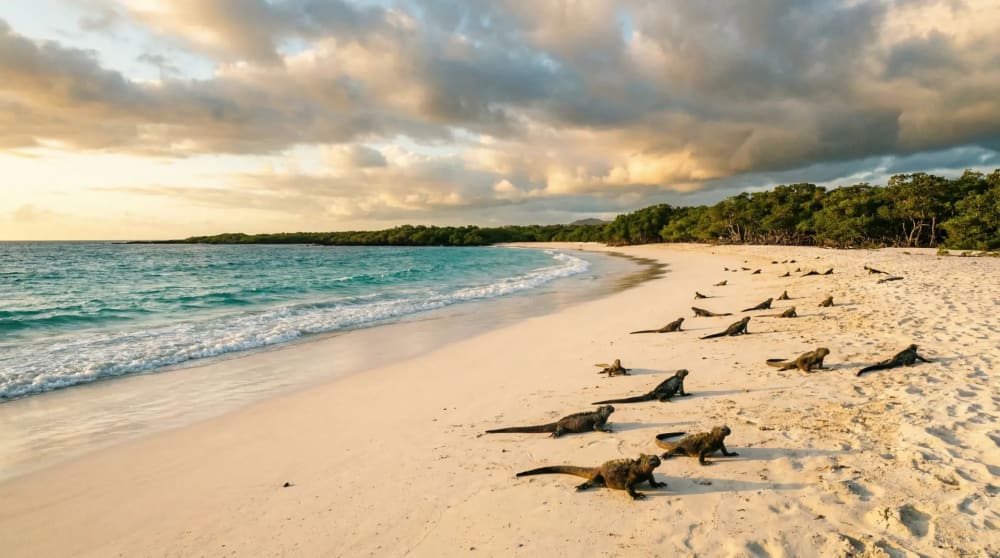
The path begins where Puerto Ayora ends: at the end of Avenida Charles Binford, behind the national park sign. A paved path leads through an ancient lava field, past gnarled palo santo trees and man-high opuntia cacti. It smells of dry wood and salt. After 2.5 kilometers — thirty to forty minutes on foot — Tortuga Bay opens up. Free, accessible daily, no tour necessary.
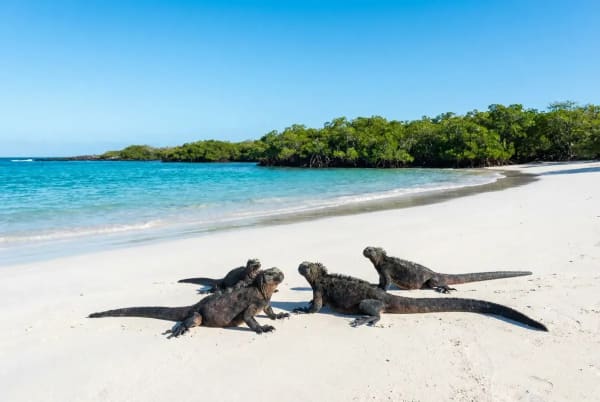
The beach consists of two sections. The Playa Brava stretches as a long white sand strip in front of turquoise sea — spectacular to look at, but not suitable for swimming, the current is too strong. Instead, hundreds of marine iguanas sun themselves on the sand — prehistoric-looking creatures that only exist in Galapagos, motionless like stone figures, until they suddenly glide into the water. Behind the mangroves lies the Playa Mansa: a calm lagoon with turquoise shallow water, ideal for swimming and snorkeling. Sea turtles glide silently through the shallow water, pelicans plunge into the water after fish, and with a bit of luck, the shadow of a young reef shark glides over the sandy bottom.
Tortuga Bay
- Duration — Half day (30–45 min. walking each way + beach time)
- Access — On foot from the end of Avenida Charles Binford, Puerto Ayora
- Opening hours — Daily 06:00–17:00 (registration at the entrance)
- Admission — Free | Water taxi return: approx. 25–30 USD
Start early, bring snorkeling gear
Leave right after 06:00 — in the morning, the path is cool, the beach almost empty, and the marine iguanas are most active. Bring your own snorkeling gear, as there are no rental stations on the beach. Also water and sunscreen: there are no facilities at the beach. For the return, you can take a water taxi directly from Playa Mansa to Puerto Ayora.
Puerto Ayora — liveliest place in Galapagos
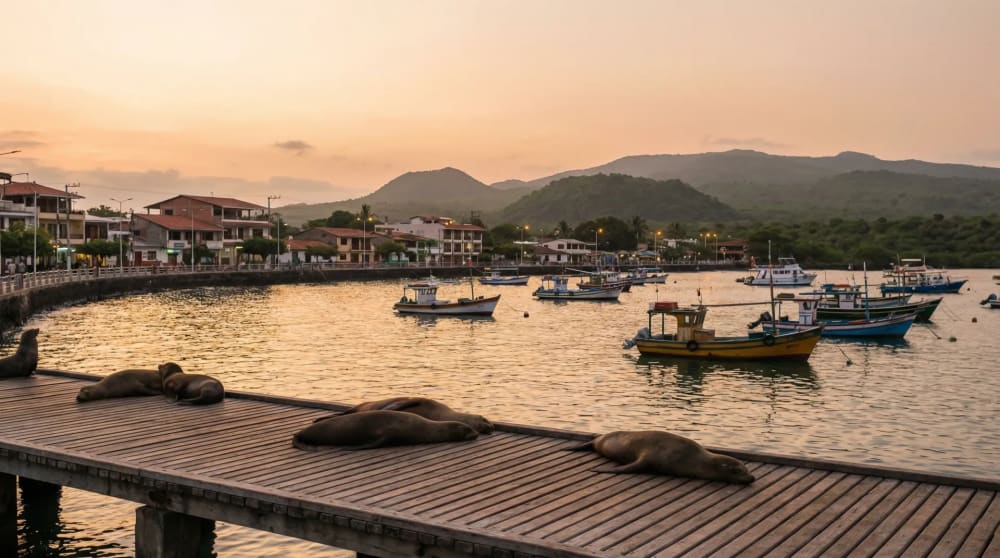
Puerto Ayora Galapagos is the opposite of what you would expect on a conservation island — and that’s exactly what makes it charming. Over 12,000 people live here, in a city with paved streets, restaurants, bars, and souvenir shops along Avenida Charles Darwin. And yet, in the midst of this everyday life: sea lions lie on the park benches by the malecon, as though the seats belonged to them. Pelicans perch on the fishing boats. Marine iguanas bask on the sidewalks. Puerto Ayora is the liveliest place in Galapagos — and one of the few in the world where wildlife and city life share a sidewalk.
Fish market — wildlife experience for zero euros
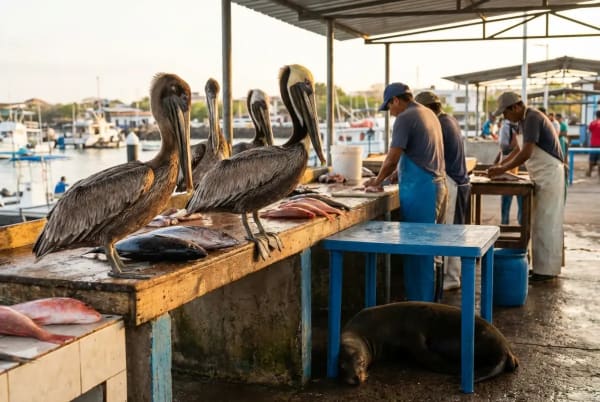
The fish market at the city dock is a spectacle every morning that no entrance fee in the world could offer. Local fishermen lay their fresh catch on the counter, pelicans position themselves with the patience of professional waiters, and sea lions lounge under the sales tables as if the fish market was invented for them. Those who come early — from around seven o'clock — experience the most authentic wildlife encounter in Puerto Ayora without spending a dollar.
Las Ninfas — hidden lagoon in the middle of the city
Just a few minutes' walk from the national park entrance lies Las Ninfas: a saltwater lagoon surrounded by mangroves, where marine iguanas, tortoises, and occasionally sharks swim. Free, quiet, and overlooked by most tourists.
Kioscos — the culinary heart of Galapagos
In the evenings, the corner of Avenida Baltra and Charles Binford is closed to cars, plastic chairs are placed on the asphalt, the scent of grilled fish and garlic fills the air — and Puerto Ayora transforms. The kioscos offer the best value for money in all of Galapagos: freshest seafood for 5 to 25 USD. Ceviche, Encocado (fish in coconut sauce), Arroz con Mariscos — and in season (August to February) lobsters for around 25 USD. El Kiosco de Renato and K.F. William are regarded by the residents of Puerto Ayora as the best stalls.
For those who want a more upscale dining experience: The ANKER (mar to table) focuses on a zero-waste concept and a creative tasting menu with local Galapagos products — the leading gourmet restaurant on the islands.
Diving and snorkeling from Santa Cruz
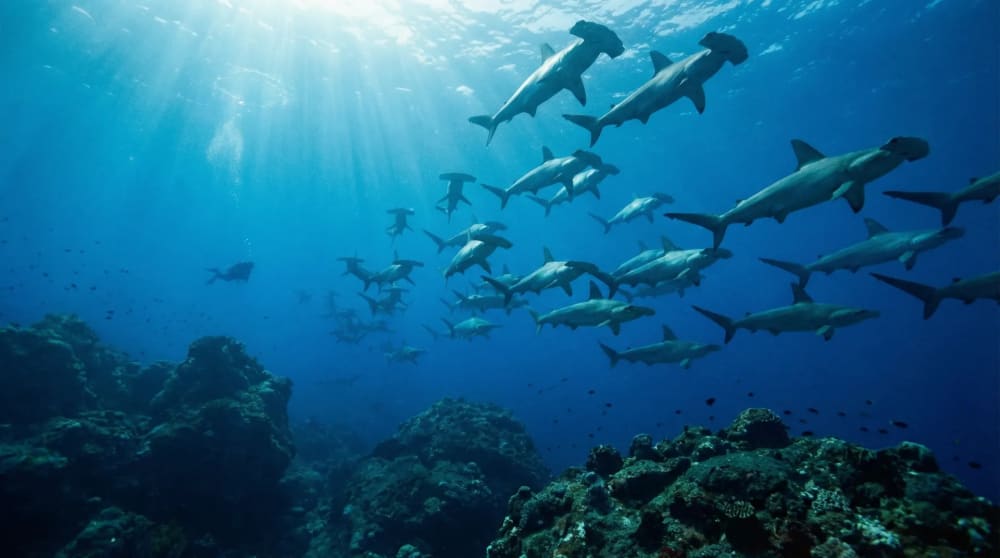
Those looking to dive in Santa Cruz Galapagos do so because of a name: Gordon Rocks. 45 minutes by boat from Puerto Ayora lies a submerged volcanic crater that divers call The Washing Machine — and the name is the program. Strong currents, changing thermoclines, visibility that changes from minute to minute. And in between: schools of 50 to 100 hammerhead sharks glide through the blue in slow formations. Along with white-tipped and black-tipped reef sharks, eagle rays, sea turtles, and in the cooler months, the rare ocean sunfish (Mola mola). Santa Cruz is the main starting point for dives in Galapagos — Gordon Rocks is the reason for that.
Important: Gordon Rocks is suitable only for experienced divers — at least 25 completed dives. Some providers require an evaluation dive at easier sites as a prerequisite. Renowned dive centers in Puerto Ayora: Scuba Iguana, Academy Bay Diving, and Elite Diving Academy.
For snorkelers and less experienced divers, Las Grietas are recommended — a rock crevice with crystal clear fresh-saltwater mix, five minutes by water taxi and twenty minutes on foot from Puerto Ayora. Or Santa Fe as a day trip: calm currents, snorkeling with sea lions and turtles in turquoise shallow water.
Gordon Rocks dive trip
- Duration — Full day (2 dives, each 50–60 min.)
- Location — 45 min. boat ride from Puerto Ayora
- Best time — June–November (hammerhead peak, better visibility)
- Price — Approx. 180–250 USD including equipment and lunch
For experienced divers only
Gordon Rocks has earned its nickname The Washing Machine — the currents are strong and unpredictable. At least 25 completed dives are a prerequisite. Beginners should instead choose Guy Fawkes Rocks or Punta Carrion as an entry point. Suitable for all levels: snorkeling in Galapagos with turtles and sea lions at calmer spots.
Day trips from Santa Cruz to neighboring islands
In the morning at seven, Puerto Ayora’s harbor is still in half-sleep — but the excursion boats are already warming up. Santa Cruz is the logistical hub of the archipelago and thus the perfect starting point for day trips to the surrounding islands. All tours start early in the morning and return in the afternoon.
| Destination | Travel time | Price (approx.) | Highlight | For whom? |
|---|---|---|---|---|
| North Seymour | 45 min. | 160–180 USD | Frigate bird courtship, blue-footed booby, sea lions | Bird lovers, all levels |
| Bartolome | 2 hours | 195–425 USD | Pinnacle Rock, snorkeling with penguins | Photographers, active travelers |
| Santa Fe | 45–60 min. | 130–160 USD | Snorkeling with sea lions, endemic land iguanas | Families, snorkelers |
| South Plazas | 45 min. | 130–160 USD | Land iguana colony, seabirds, yellow Sesuvium vegetation | Nature lovers |
From Santa Cruz, you can also reach the sister islands by speedboat Isabela (2 hours, 30–35 USD), San Cristobal (2–2.5 hours, 30–35 USD) and as a day trip Floreana . Whether a cruise or island hopping is the better choice for your route is clarified by our detailed comparison.
Book day trips in advance
The official visitor numbers per national park site are limited. Book day trips at least 1–2 days in advance, even earlier during high season (July–August, December–January). You can find tour agencies along Avenida Charles Darwin in Puerto Ayora.
Best travel time for Santa Cruz
Santa Cruz is visitable year-round — but the question is not whether, but for what. The best travel time for the Galapagos Islands depends on Santa Cruz on what you want to experience. Each season has its own character.
| Month | Highland turtles | Diving (Gordon Rocks) | Tortuga Bay | Special feature |
|---|---|---|---|---|
| Jan.–Mar. | In lowlands (less in highlands) | Good (warm, 25–26 °C) | Very good (warm) | Turtle babies hatch at Darwin Station |
| April–June | Transition, return migration begins | Good to very good | Pleasant | Blue-footed booby mating peak |
| July–Sept. | Best time (numerous in highlands) | Excellent (hammerhead shark peak) | Good (cooler, 22 °C) | Best overall combination, whale shark season |
| Oct.–Dec. | Good (still in highlands) | Very good | Good | Fewer visitors, cheaper prices |
Our tip: For most travelers, December to February offers the most attractive combination — warm water for snorkeling, turtle babies at Darwin Station, and sunny weather. Divers and hammerhead fans plan for July to October. You can find a detailed overview in the Galapagos Wildlife Calendar.
Getting to Santa Cruz — Baltra and the ferry
Getting to Santa Cruz has its own rhythm. Baltra Airport (IATA code: GPS) is located on a separate island north of Santa Cruz — and the transfer to Puerto Ayora passes through three climate zones and across a channel. Sounds cumbersome, but it's organized and is one of the first Galapagos moments that stay.
Getting to Santa Cruz Baltra Airport → Puerto Ayora
Total costs for public transport: approx. 11 USD per person, total duration approx. 1.5 hours. Alternatively: Private shuttle from approx. 45 USD per person.
Speedboats to Isabela and San Cristobal
Daily speedboats connect Puerto Ayora with Isabela (Puerto Villamil) and San Cristobal (Puerto Baquerizo Moreno). Travel time: each 2 to 2.5 hours, price: approx. 30–35 USD per person one-way. Departure times: 07:00 and 14:00–15:00. Tickets must be purchased at least 2–3 days in advance, maximum luggage 23 kg.
Don’t forget cash and TCT
At Baltra Airport, the Galapagos National Park fee (200 USD since August 2024) and the TCT card (20 USD, at the mainland airport in Quito or Guayaquil) are checked — both can only be paid in cash (USD). A total of 220 USD mandatory expenses. ATMs in the Galapagos are unreliable — withdraw sufficient cash on the mainland. All details on fees and formalities: Entry rules for Galapagos .
Hotels in Puerto Ayora — from budget to boutique
Puerto Ayora offers the largest selection of accommodations in the entire Galapagos archipelago — and the range is astonishing: from simple hostels near the harbor to exclusive lodges in the highlands, where giant tortoises pass by your room before breakfast.
| Category | Price range | Examples | Location |
|---|---|---|---|
| Budget | 30–50 USD/night | Hostels in the center | City center, within walking distance to everything |
| Mid-range | 80–150 USD/night | Hotel Acacia, central hotels | 1–2 blocks from Avenida Charles Darwin |
| Boutique | 150–300 USD/night | Ikala Galapagos Hotel, Semilla Verde | Center (Ikala) / near highlands (Semilla Verde) |
| Luxury | 400–600+ USD/night | Finch Bay Hotel, Pikaia Lodge | Punta Estrada by water taxi (Finch Bay) / highlands (Pikaia) |
The Finch Bay Hotel is the only beach hotel in Puerto Ayora — five minutes by water taxi from the city center, with a pool and its own excursion program. The Pikaia Lodge in the highlands is the most exclusive land hotel on Santa Cruz: 14 rooms, all-inclusive with private yacht and giant tortoises right outside the room. For travelers with a mid-range budget, a central location is recommended — everything is within walking distance, and the kiosks, fish market, and city pier are just minutes away.
Detailed budget planning can be found in our Galapagos Costs and Budget Guide.
Costs in Santa Cruz — what you should plan for
As of March 2026. National park fee is paid at Baltra or San Cristobal airport, only cash (USD). Credit cards are increasingly accepted in Puerto Ayora, but not everywhere — cash is recommended.
Santa Cruz in your Galapagos trip
Santa Cruz deserves at least two to three full days. The island offers enough for a week, but the main experiences — Darwin Station, highland turtles, Tortuga Bay, and a day trip — can be experienced in three well-planned days. Here is what your schedule could look like:
Day 1 — Arrival, Darwin Station, and Puerto Ayora
Day 2 — Tortuga Bay and highland turtles
Day 3 — Day trip and onward travel
Note: If you have a fourth day: Bartolome day trip (Pinnacle Rock, penguins) in the morning or Garrapatero Beach — a quiet, less-visited beach north of Puerto Ayora.
Three days are enough to experience the main places on Santa Cruz Galapagos — as part of a Galapagos island hopping trip or as an extension of a cruise . We know the island from personal experience and will advise you personally on the combination of islands, accommodations, and activities that suit your interests — whether you want to look for hammerheads at Gordon Rocks, experience giant tortoises in the highlands, or simply want to forget the time at Tortuga Bay. Let us help you plan your Galapagos trip together — inquire now without obligation .
Discover more Galapagos islands
Isabela — The wildest island of the Galapagos
Floreana — Post-Tonne, Mysterium & Devil's Crown
San Cristobal — Sea Lion Island and Darwin's Landing Site
Read more: Cruise or island hopping? — our detailed comparison helps with the decision for your route. In the Galapagos wildlife calendar you will learn which animals you can observe when on which island. And for practical preparation: our packing list for Latin America trips.
To book a trip or for more information, contact us. We'll help you plan and guide you through your upcoming adventure!
Frequently Asked Questions
The entrance to the Charles Darwin Research Station is free. The station is open daily from 08:00 to 18:00, even on holidays. Optionally, you can book a guided tour for about 10 USD per person. The station is located 15 minutes on foot from the center of Puerto Ayora on Avenida Charles Darwin.
In three steps: 1. Bus from Baltra to the Itabaca Channel (5–10 min., 5 USD). 2. Ferry across the channel (5 min., 1 USD). 3. Bus or taxi to Puerto Ayora (45 min., bus 5 USD or taxi 25 USD for 4 people). Total public cost: about 11 USD per person, total duration about 1.5 hours. Alternatively: private shuttle from 45 USD per person.
In the highlands of Santa Cruz, about a 20-minute taxi ride north of Puerto Ayora. The best places: El Chato Reserve (10–15 USD entrance, free-ranging tortoises in pastures and lava tubes), Rancho Primicias (3–5 USD, often quieter) and Rancho Manzanillo (3–5 USD). Best time: June to November, when the tortoises return to the highlands. At the Darwin Station in Puerto Ayora, you can see tortoises in the breeding station — free of charge.
Tortuga Bay is a free natural beach on Santa Cruz, consisting of two sections: Playa Brava (white sandy beach, not for swimming — strong currents, but marine iguana colonies) and Playa Mansa (calm lagoon, ideal for swimming and snorkeling). Access is on foot: paved path from Puerto Ayora, 2.5 km, 30–45 minutes. Open daily 06:00–17:00. Registration at the entrance required (free). Bring your own water and sun protection — there are no facilities at the beach.
About 2 hours by fast ferry from Puerto Ayora to Puerto Villamil on Isabela. Price: 30–35 USD per person one way. Two departures daily at 07:00 and 15:00. Tickets should be purchased at least 2–3 days in advance. The channel can be rough — seasickness tablets are recommended. Isabela also charges an additional 10 USD pier entry fee.
No. Gordon Rocks ('The Washing Machine') has strong and unpredictable currents and is only suitable for experienced divers with at least 25 logged dives. Beginners should consider Guy Fawkes Rocks or Punta Carrion. Snorkelers can alternatively book day trips to Santa Fe or Bartolome — conditions there are calm and suitable for all levels.
Mandatory expenses: 200 USD national park entry + 20 USD TCT card = 220 USD per person (cash only). Budget travelers can manage with about 80–100 USD per day (hostel, local food, free activities). Mid-range budget: 200–300 USD per day (mid-range hotel, restaurants, one day trip). Luxury travelers: 500–1,000 USD per day. Excluding international flights. Details: Galapagos Cost and Budget Guide.