



Colombia Safety: What really is true — and what is not
Facts instead of clichés: What German-speaking travelers really need to know.
Facts instead of clichés: What German-speaking travelers really need to know.
"Colombia? Isn't it dangerous?" — This question is guaranteed to come up when you tell family or friends about your travel plans. The images in their heads come from Narcos series and headlines from the 1990s. But the Colombia of 2026 has as much to do with these clichés as today's Berlin does with the fall of the Wall.
6.7 million international visitors traveled to Colombia in 2024 — a new record. This corresponds to the entire population of Switzerland. In 2025, over 10.2 million international travel movements were even registered. These people did not come despite the security situation, but because the country has fundamentally changed.
Is Colombia safe? The honest answer: Yes, on the common tourist routes. But there are regions you should avoid and risks you need to know about. This article provides both — without downplaying and without panic.

- Is Colombia really dangerous? The numbers behind it
- Bogotá, Medellín, Cartagena & Co. — how safe are the tourist destinations?
- The regions you should avoid — and why
- The real risks — concrete and without drama
- My personal experiences on the trip to Colombia
- Practical safety checklist before departure
Is Colombia really dangerous? The numbers behind it
6.7 million tourists in 2024 — what that means
The numbers speak a clear language. Colombia set a new tourism record in 2024: 6,696,835 international visitors — an increase of 8.5 percent compared to the previous year. The self-imposed goal of 6 million was exceeded by 12 percent. Consequently, Colombia is the leading tourist destination in South America and the third most popular in all of Latin America, after Mexico and the Dominican Republic.
An estimated 80,000 to over 200,000 visitors travel from Germany to Colombia each year. The conservative figure of 80,000 comes from older surveys — the actual number is likely much higher, as Germans make up about 2 percent of total visitors. Would anyone travel to a country that is really as dangerous as some believe?
For those interested in costs: Colombia is the budget-friendliest destination in the region with an average tourist spending of 1,890 USD — significantly cheaper than Mexico (2,345 USD), Panama (2,680 USD), or Costa Rica (2,910 USD). More on this in our article about the cost of a Latin America trip.
What the Foreign Office really says (and what it does not say)
The Foreign Office issues a Partial Travel Warning. This means: There is no warning against traveling to the entire country. The warning only concerns certain regions — and none of them are on a common tourist route.
For the main tourist destinations Bogotá, Medellín, Cartagena, and the coffee region, there is only a notice for increased caution. This is a normal standard that popular travel countries like Mexico, Brazil, or South Africa also receive.
Partial Travel Warning vs. Travel Warning — the difference
A Partial Travel Warning means: Certain regions of a country are problematic, the rest is accessible. A full Travel Warning would mean: The whole country is too dangerous. For Colombia, the former applies — and the affected regions are border areas and conflict zones that tourists would not visit anyway. Always check current advice directly with the Foreign Office .
For comparison: The US State Department classifies Colombia at Level 3 (“Reconsider Travel”) — not at Level 4 (“Do Not Travel”). The US classification is generally stricter than the German one. Mexico and Brazil also receive similar ratings.
Honesty also includes this: The overall security situation has worsened in some regions. The peace process with the FARC dissidents and ELN has been suspended, and since early 2025, armed conflicts have occurred between organized groups. However, these conflicts are concentrated in border regions and rural areas, far from tourist routes.
Crime in context: Colombia's national murder rate was 25.4 per 100,000 inhabitants in 2024 — the lowest level in the last four years. Ecuador, which many consider an unproblematic travel destination, had a rate of 44 per 100,000 in 2024. The tourist cities of Bogotá and Medellín each have rates of around 14 per 100,000, significantly lower than the national average — Bogotá has a lower violence rate than Indianapolis in the USA.
Bogotá, Medellín, Cartagena & Co. — how safe are the tourist destinations?
Bogotá: Between myth and modernity
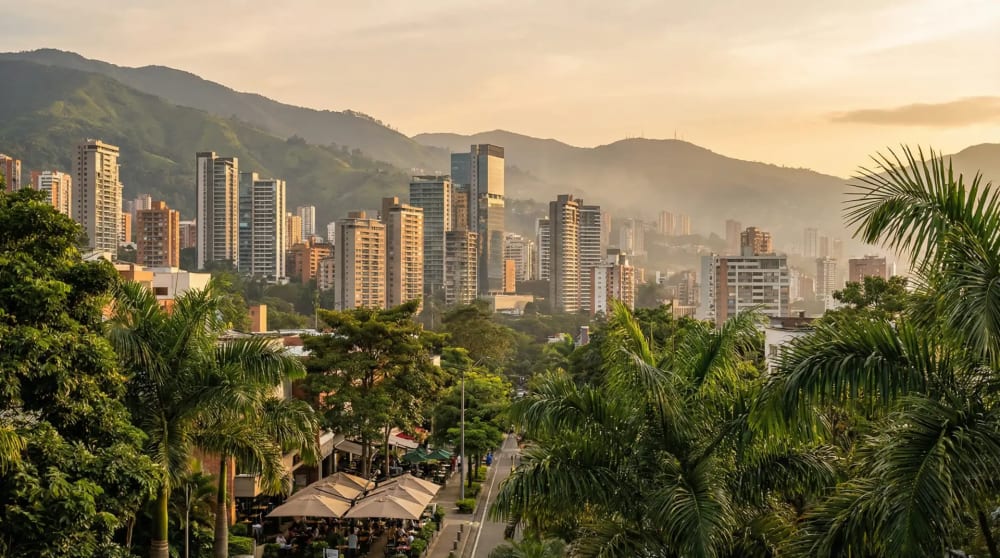
Bogotá is safer than its reputation. The neighborhoods Usaquén, Chapinero, Zona Rosa, Parque 93, and Teusaquillo are considered very safe for tourists. The entire area between Calle 67 and Calle 140 offers a relaxed atmosphere with restaurants, parks, and shops — here, you move as if in a European metropolis.
La Candelaria, the historic center with its museums and famous street art, is ideal for sightseeing during the day. In the evening, the rule is: take an Uber or taxi back, do not walk through dark alleys. This is not a Colombia-specific rule — you would do the same in many South American major cities.
To avoid: Ciudad Bolivar in the southwest, the Martires district, and the area around El Bronx south of downtown. These areas are off the beaten tourist path — you won't end up there by accident.
Learn more about the capital on our page about Bogotá .
Medellín: The transformation of a city
The transformation of Medellín is one of the most impressive urban success stories in the world. In 1991, the murder rate was 395 per 100,000 inhabitants — Medellín was the most dangerous city in the world. In 2023: 13 per 100,000. A decrease of 97 percent in 32 years. In 2024, Medellín registered the lowest level of serious crimes in 40 years — a decrease of 44 percent compared to the previous year. No other major city on the continent has changed so fundamentally in such a short time.
El Poblado and Laureles are the preferred neighborhoods for international travelers. Both have a strong police presence and a vibrant gastronomy and culture scene. Time Out Magazine awarded Laureles as the “coolest neighborhood in the world" in 2023. Discover more about Medellín — City of Eternal Spring Temperatures .
Important warning: Dating apps in Medellín
In 2024, eight American tourists were killed in Medellín — all had arranged meetings with strangers through dating apps. This specific risk is real and documented. Do not meet unknown people from the internet in private spaces. If you want to meet someone, do so in public, crowded places — never alone in a stranger's apartment.
Cartagena: Safe in the tourist center
The old town (Ciudad Amurallada) and Getsemaní are lively around the clock, well-lit, and have a strong police presence. Bocagrande is also safe. However, street robbery and express kidnappings are increasing even in tourist areas — in 2024, a tourist was forced to an ATM and robbed in the old town. Such incidents are not the rule, but they happen.
The rules are simple: Do not wear valuables openly, stay in groups at night, use app taxis. Those who adhere to these rules will experience Cartagena and the Caribbean old town as what it is — one of the most beautiful colonial cities on the continent.
Coffee region and Salento: Relaxed exploration on your own
The coffee region is considered one of the safest travel destinations in Colombia. In the 1970s, this region was a FARC territory — today it has completely transformed. Several tour operators call it “absolutely safe for tourists." Boyacá, Santander, San Agustín, and the Colombian Amazon are also considered easy to travel.
Anyone wishing to explore the Coffee region and Salento can do so relaxed and on their own. The atmosphere is more reminiscent of a quiet mountain village than the Colombia of the headlines — wax palms, coffee farms, fresh mountain air. Even as a solo traveler, you feel comfortable here.
Tayrona National Park and Santa Marta: What you need to know
Currently (March 2026): Tayrona National Park reopened on March 5, 2026, after a five-week closure under “special monitoring.” Carabineros units monitor access points and hiking trails. The background is a territorial conflict involving armed groups on the Caribbean coast — a conflict that does not directly affect tourists but requires increased vigilance.
For tourists in the city center of Santa Marta and in the tourist areas, normal visits continue to apply. Before visiting Tayrona Park, you should check the current status.
Tayrona National Park: Check the current status
The park has regular closures — for conservation and occasionally for security reasons. Before your trip, check the current status on the official website of the national park administration ( parquesnacionales.gov.co ). As of March 2026: open with increased security presence.
| Region | Colombia Safety for Tourists | Recommendation |
|---|---|---|
| Cartagena Old Town | High | Tourist center, very safe during the day |
| Medellín El Poblado / Laureles | High | Use Uber, avoid dating apps |
| Bogotá Zona Rosa / Usaquén | High | Taxi in the evening, La Candelaria only during the day |
| Coffee region / Salento | Very high | Relaxed atmosphere, low crime |
| Tayrona / Santa Marta | Medium-High | Check the current park status |
The regions you should avoid — and why
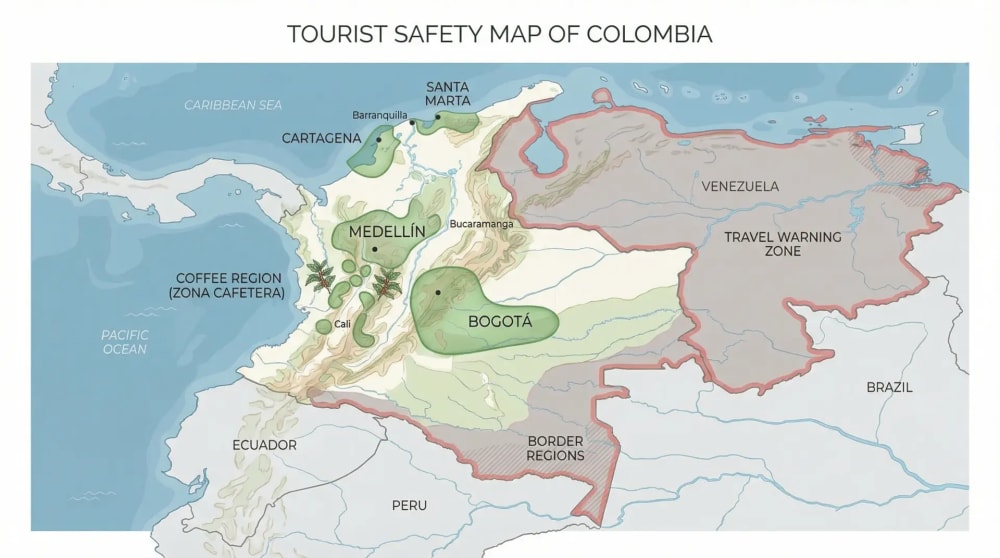
Current Partial Travel Warnings from the Foreign Office (as of March 2026)
The Foreign Office warns against traveling to the following regions: Norte de Santander (Catatumbo, border area Venezuela), Arauca, Vichada, Guainía, Guaviare, Caquetá, eastern and southern parts of Meta, Putumayo, Nariño, Cauca, western Valle del Cauca, Chocó (overland), rural regions of Antioquia, southern Córdoba, and southern Bolívar.
The list is long. But look where these regions are located: mostly in the southeast of the country, along the borders with Venezuela and Ecuador, or in hard-to-reach jungle areas. No standard travel guide will take you there.
Catatumbo, Arauca, border areas: What this means for tourists
The main message: None of these regions are on a common tourist route. A standard Colombia itinerary — Bogotá, Medellín, coffee region, Cartagena, Tayrona — does not come closer to these areas than 500 kilometers. The regions with travel warnings are undeveloped border areas, jungles, and conflict zones.
In Catatumbo (Norte de Santander), heavy fighting broke out between ELN and FARC dissidents in early 2025. The Colombian government declared a state of emergency. There were large movements of refugees among the civilian population. For tourists, this region is entirely irrelevant — there are neither hotels nor tourist infrastructure there.
Exception Chocó Coast:The air access to Nuqui and Bahia Solano (diving, whale watching) is considered safe. Only the overland route through the jungle is dangerous. The clear recommendation: travel exclusively by plane.
The real risks — concrete and without drama
Traveling safely in Colombia does not mean that there are no risks. It means knowing the right risks and preparing for them. Most can be reduced to a minimum with simple behavioral rules.
Pickpocketing and petty crime
Pickpocketing is the most common risk for tourists in all Colombian cities. The typical method: moped drivers snatching phones or bags from your hands as they pass by — especially while you're on the phone in the street. No physical confrontation, just a quick grab-and-go. It happens in seconds, and then the phone is gone.
No dar papayas — the Colombian basic rule
No dar papayas is a Colombian saying and literally means: "Don’t give papayas" — meaning: don’t make yourself a target. Put your phone in your bag, carry no visible cash, wear no flashy jewelry, keep your laptop in your backpack instead of in your hand, and close open bags. This one rule explains the Colombian security philosophy better than any travel guide. Those who follow it drastically reduce the risk of petty crime.
Scopolamine (Burundanga): What is true, what is exaggerated
Scopolamine is a psychoactive drug from the angel's trumpet bush that makes victims submissive and cooperative. The Foreign Office confirms a sharp increase in these assaults in Bogota and Medellin, often in connection with online acquaintances. The drug is mixed into drinks, food, or cigarettes. Higher doses can be fatal — this is no trifling matter.
The myth: Scopolamine makes you submissive just by inhaling or a hand touch. That is false. Absorption almost always occurs through oral intake — i.e., through tampered drinks or food.
The protection: Do not accept drinks from strangers. Never leave your drink unattended. Be particularly cautious with dating apps and nightlife contacts with strangers. This covers almost all scopolamine risks.
Taxis and transportation: The most important rule
Never hail a street taxi. This is the one security rule emphasized by all sources equally — the Foreign Office, the German Embassy, security experts, and every experienced traveler. Street taxis are the main risk for express kidnappings, where victims are forced to withdraw cash from ATMs.
The safe alternative: Uber (widely used and tolerated, although technically not fully legalized), InDriver (price negotiable, widespread), or Cabify (officially licensed). All three apps offer GPS tracking and fixed prices. A simple measure with a big effect.
Uber in Colombia: legal gray area, but a safe choice
Uber is not officially licensed in Colombia — this merely means taxi drivers are lobbying against the platform. For you as a user, there is no risk or penalty. Security experts and the German Embassy recommend app taxis equally as the safest option. If Uber is not available: use Cabify or InDriver.
Nightlife: When caution is really required
Parque Lleras in Medellin and Zona Rosa in Bogota are lively, well-lit nightlife areas with police presence. They are essentially safe places as long as you go out in groups, never leave your drink unattended, and take an app taxi home.
The increased risk in nightlife mainly concerns two scenarios: scopolamine in bars and clubs — and dating app meetings with strangers. Both risks can be significantly reduced with conscious behavior.
Plain speaking about drug tourism: Cocaine possession and purchase are illegal and strictly prosecuted. The police respond particularly harshly to foreigners. Engaging in drug tourism brings you into the circles that this article warns against. This is not a moral lecture — it is practical safety information.
My personal experiences on the trip to Colombia
Before the first trip to Colombia, the tension was real. The images in my head, the well-meaning warnings from friends, the nighttime Google search for "Colombia dangerous" — everything confirmed the prejudices. And then you land in Bogota, take an Uber to your hotel, walk through Usaquén, drink the best coffee of your life — and realize: this is not the Colombia from the news. It is a completely different country.
After two to three days, you no longer think about safety. That is the experience that almost all German-speaking travelers share. Stephan Stober, a German who has lived in Bogota for years, sums it up in an interview: "In everyday life, I honestly rarely think about safety."
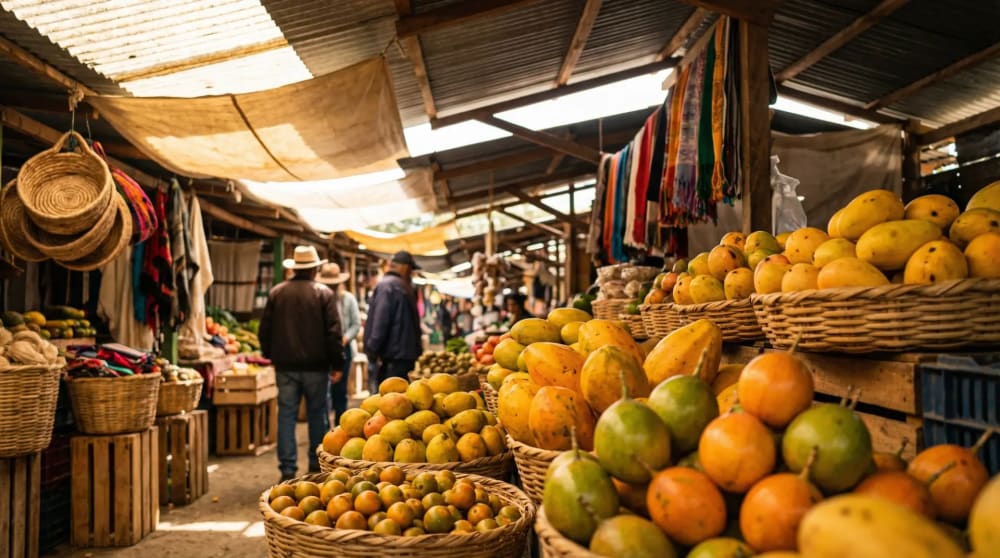
What surprises is the normality of everyday life. You go to restaurants, visit markets, ride the cable car over Medellin, hike through the coffee mountains — and everything feels normal. Not dangerous, not threatening, but alive and warm. A German family traveled in December 2024 with an 8-year-old child and rental car through Colombia — Bogota, coffee region, Medellin, Caribbean coast — and felt safe everywhere. A couple of travelers compared the experience to Brazil and were "surprised at how safe they felt" — they walked significantly more in Colombia than in Brazilian cities.
The warmth of Colombians is the strongest impression that travelers take away. People are open, helpful, and genuinely interested in whether visitors like their country. It is this warmth that makes the difference between statistics and experience. Travel blogger Vanessa Bulla summarizes it like this: "Colombia — the only risk is that you want to stay."
If you are enthusiastic about nature, you will find in our article on Colombia's bird life with 1,950 species another reason to visit the country.
Practical safety checklist before departure
Travel insurance and emergency contacts
The statutory health insurance does not cover treatments or repatriations in Colombia not. A foreign health insurance with repatriation coverage is not an option but a must — for about 10 to 20 euros for 3 to 4 weeks it’s not a significant expense.
Emergency numbers — save before traveling:
- Police Colombia: 123
- German Embassy Bogota (On-call service): +57-320 8653717
- German Embassy regular: (+57) 1 423 26 00
ELEFAND registration and German Embassy
ELEFAND: Registered in 5 minutes
The free ELEFAND registration with the Foreign Office allows the authorities to quickly contact you in crises and organize consular assistance if needed. The registration takes 5 minutes, works as an app, and should be done right before departure.
The German Embassy in Bogota is located at Calle 110 No. 9-25, Piso 11, Torre Empresarial Edificio Pacifico. Opening hours: Mon–Thu 07:15–16:30, Fri 07:30–13:30. In case of emergency, you can reach the on-call service around the clock.
What to pack
- A copy of the passport (digital and physical) — original in the hotel safe
- Proof of foreign health insurance
- Offline maps (Google Maps or Maps.me) — work without mobile internet
- Smartphone with Uber, InDriver, or Cabify pre-installed
- Take only small amounts of cash (50–100 euros), prefer to use ATMs in shopping centers
What else you should pack can be found in our Packing list for Colombia and the Packing list for Latin America.
The 5 most important safety rules for Colombia at a glance:
- Never street taxis — always Uber, InDriver, or Cabify
- Do not accept drinks from strangers and never leave your drink unattended
- Do not carry valuables visibly — no dar papayas
- Only travel by bus during daylight into the interior
- ELEFAND registration with the Foreign Office before departure
For medical preparation, we recommend our guide to Vaccinations and health precautions for Colombia . Everything about Entry to Colombia can also be found in our guides.
Frequently asked questions about Colombia safety
Yes, on the common tourist routes. 6.7 million international visitors traveled to Colombia in 2024. The Foreign Office does not issue a general travel warning — only partial travel warnings for remote border regions that no tourist visits. Bogota, Medellin, Cartagena, and the coffee region are considered safe as long as basic rules like using app taxis and being attentive with valuables are observed.
In the neighborhoods of Usaquén, Chapinero, Zona Rosa, and Teusaquillo yes. La Candelaria is ideal for sightseeing during the day; in the evening you should return by Uber or taxi. Avoid Ciudad Bolivar and the Martires district. Bogota has a murder rate of 14 per 100,000 inhabitants, lower than many US cities.
El Poblado and Laureles are safe tourist areas with a strong police presence. Medellin's murder rate has decreased by 97% since 1991 — from 395 to 13 per 100,000 inhabitants. The greatest risk: dating app contacts with strangers and scopolamine in nightlife. Avoid street taxis, use app taxis, and stay in groups at night.
Scopolamine is a real and increasing risk — the Foreign Office confirms the rise. The drug is mixed into drinks or food and makes victims submissive. The myth that mere inhalation or a hand touch works is false. Protection: Do not accept drinks from strangers, never leave your drink unattended, especially beware of online acquaintances.
Yes, in tourist areas, traveling alone is generally possible. Increased caution in nightlife, always going out in groups, and using only app taxis. During the day, Bogota, Medellin, Cartagena, and especially the coffee region are safe for solo female travelers. Many female travel bloggers report positive experiences.
The border area with Venezuela (Norte de Santander, Catatumbo), Arauca, Choco (only overland — air access to Nuqui is safe), Putumayo, and eastern Meta. These regions are off any tourist route. A standard Colombia trip (Bogota, Medellin, Cartagena, coffee region, Tayrona) does not come closer than 500 km from these areas.
Your dream holiday, tailor-made by true connoisseurs.
From the first spark of inspiration to the moment you return home full of stories, we’re by your side – whether by phone, email or WhatsApp, whenever you need us. Every journey we design is as unique as you are: individually crafted with exclusive privileges and exceptional arrangements that make your experience truly unforgettable.
Experts for your trip

You might also like this
Ecuador's great natural stage
From Cotopaxi to the Galápagos Islands There are trips that impress. And there are trips that resonate long after. Our journey through Ecuador clearly belonged to the second category. Within just a few days, we moved between two completely different worlds: the heights of the Andes and the island world of the Galápagos....

My adventure in Corcovado National Park
One of my most unforgettable travel experiences was a guided hike of about 20 kilometers through Corcovado National Park in Costa Rica – right through dense jungle, without paved paths, but with plenty of mud. And with the most unsuitable shoes possible. If you want to know what a day in Costa Rica's wildest national park really feels like, I'll take you along on this tour....

Colombia: Land of the Bird World — 1,950 species awaiting
It is 5:30 in the morning. The misty forest cloaks everything in damp gray. The truck struggles up an unpaved mountain road while the engine works against the incline. Then, with the first light, it begins — a concert of whistles, chirps, and sounds you've never heard before. Dozens of voices, everywhere at once. And suddenly, among the dripping wet leaves, a shadow in colors that don't fit in any German forest: bright orange, turquoise, scarlet red. Welcome to Colombia — the country with the richest birdlife on Earth....