


Medellin
The city that has reinvented itself
The city that has reinvented itself
Medellín trip — Discover the city of eternal spring: Comuna 13, Metrocable, boutique hotels in El Poblado, and insider tips

Best time to visit
December to March
Why Medellín will surprise you
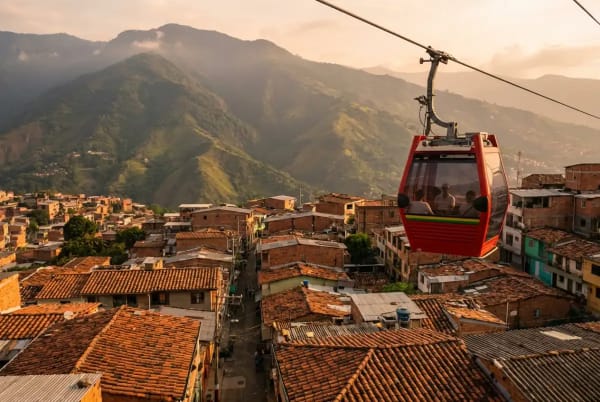
Above the rooftops of Medellín, a gondola floats through the morning mist. Below, a sea of red brick roofs stretches to the green slopes of the Aburrá Valley. In the alleys of Comuna 13, graffiti artists transform once terrifying spaces into vibrant murals, while schoolchildren play among monumental bronze sculptures in Plaza Botero. Those planning a trip to Medellín enter a city that has rewritten its own history.
In 1991, Medellín had 381 murders per 100,000 inhabitants — the highest rate in the world. In 2024, this number dropped to 11, a decrease of over 97 percent. Behind this statistic lies the story of a city that has reinvented itself through education, architecture, and public infrastructure. In 2013, the Wall Street Journal and Citi named Medellín the most innovative city in the world — ahead of New York and Tel Aviv. In 2016, it received the Lee Kuan Yew World City Prize for exemplary urban planning.
However, this transformation is only part of what makes a Medellín-Colombia holiday so special. It is the mild climate year-round that has earned the city the name "City of Eternal Spring". It is the specialty coffee roasteries in Laureles, the molecular cuisine of El Cielo, the salsa nights at El Tibiri. Medellín is a place that gently but firmly flips your expectations on their head — also read our Colombia experiences for a personal impression.
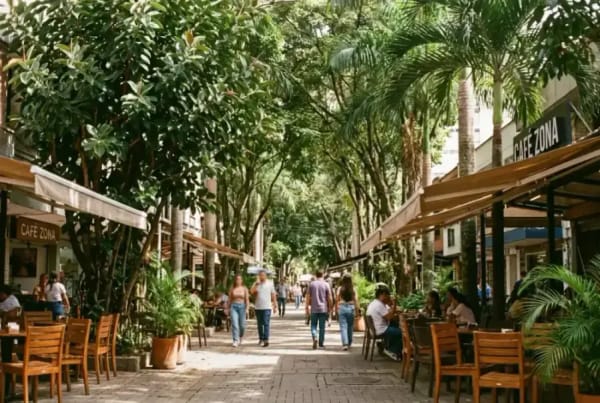
The most beautiful sights in Medellín
Comuna 13 — From a crisis zone to an open-air museum
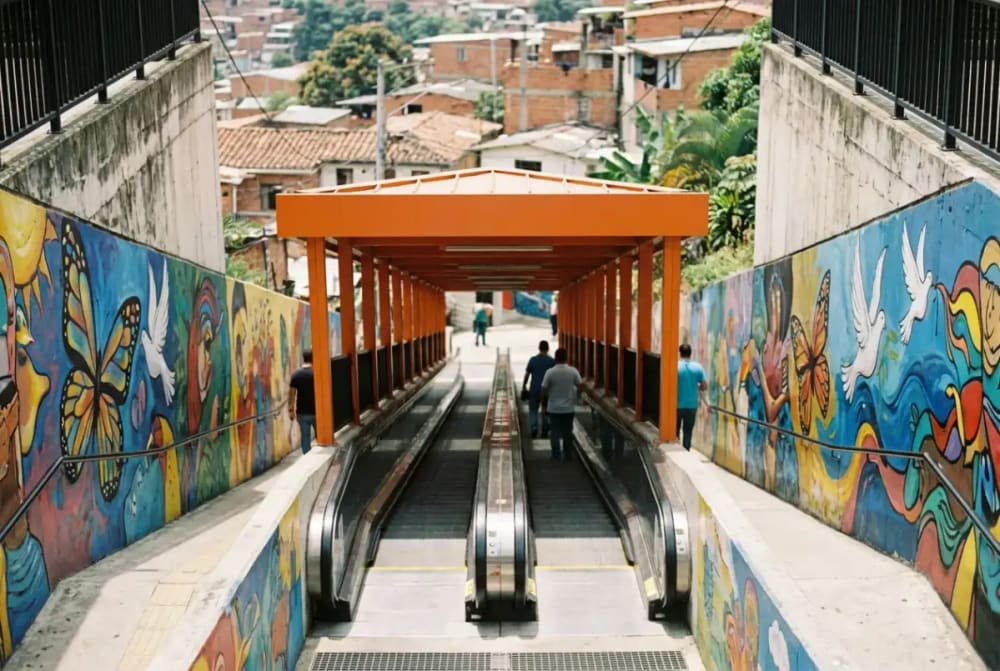
The story of Comuna 13 is Medellín's story in miniature. Until the early 2000s, the neighborhood on the steep western slope of the city was surrounded by paramilitaries, guerrillas, and drug cartels. In 2002, the military intervened with "Operación Orión" — a traumatic chapter for the residents.
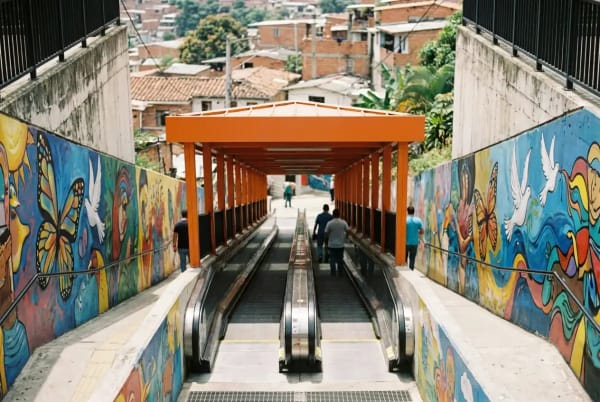
What happened next is remarkable: In 2011, the city installed the world's only free public escalators in a residential area — a $3.5 million investment that replaced over 350 steps and fundamentally changed the daily lives of the residents. Today, the walls along the escalators are covered with colorful murals that change every year. Local dance groups like Casa Kolacho perform hip-hop and breakdance daily.
A guided tour with local guides who grew up in the neighborhood lasts about three to four hours and costs from 70,000 COP (approx. 16 EUR) per person. Those visiting Comuna 13 should come in the morning when it's quieter on weekdays. And: Ask residents for permission before taking photos, support local microbusinesses — buy empanadas, fresh fruit, and handmade souvenirs directly.
Comuna 13
- Guided tour — from 70,000 COP (approx. 16 EUR)
- Duration — 3–4 hours
- Directions — Metro Line B to San Javier, then taxi or 15 min walk
- Tip — Come in the morning, quieter on weekdays
Plaza Botero and Museo de Antioquia
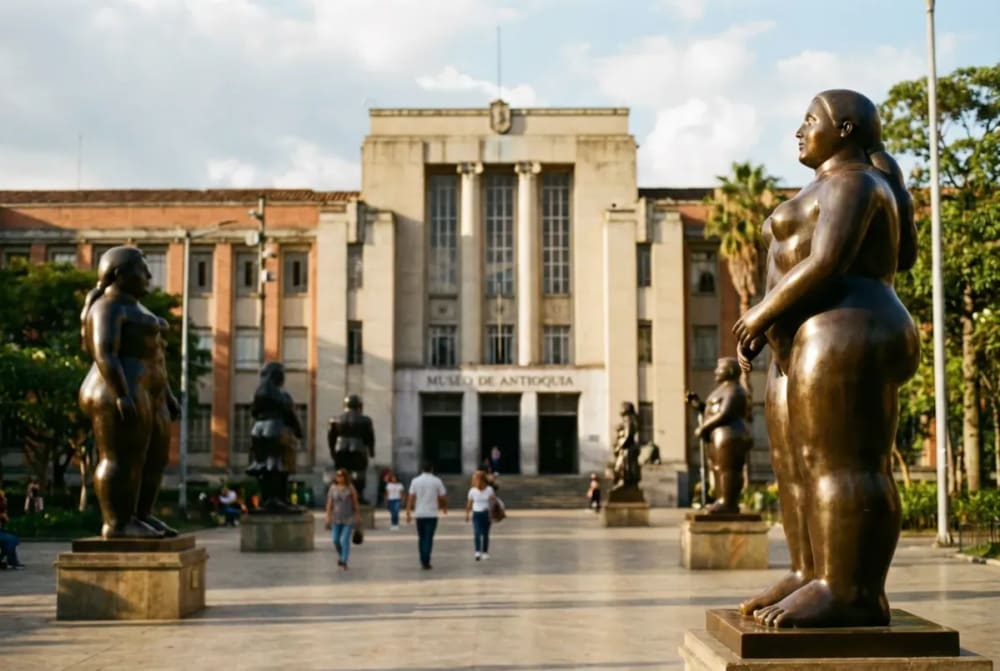
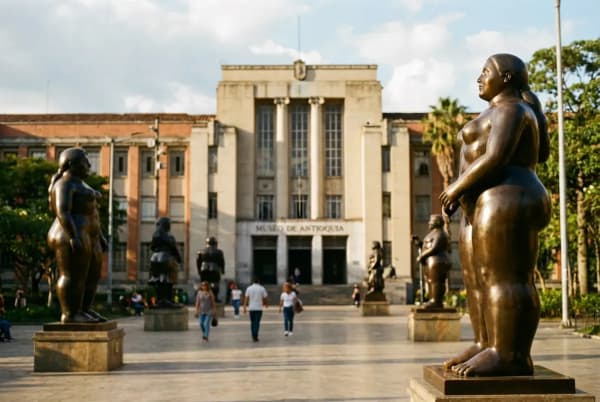
In Plaza Botero, over 20 oversized bronze sculptures by Fernando Botero, Medellín's most famous son (1932–2023), stand tall. His voluminous figures — be it a woman, horse, or hand — have long become the city's landmark. Access to the plaza is free and open at all times.
Right at the square is the Museo de Antioquia with the largest collection of Botero works in the world, complemented by pre-Columbian artifacts and contemporary art. Admission for international visitors is 18,000 COP (approx. 4 EUR), and seniors over 60 get a 50 percent discount. It is open Monday to Saturday from 10:00 AM to 5:30 PM, Sundays until 4:30 PM.
Museo de Antioquia
- Admission — 18,000 COP (approx. 4 EUR), seniors 50%
- Opening hours — Mon–Sat 10:00–5:30, Sun until 4:30
- Directions — Metro Station Parque Berrío, a few minutes walk
- Tip — Early morning for less congestion in the plaza
Metrocable — Experience Medellín from above
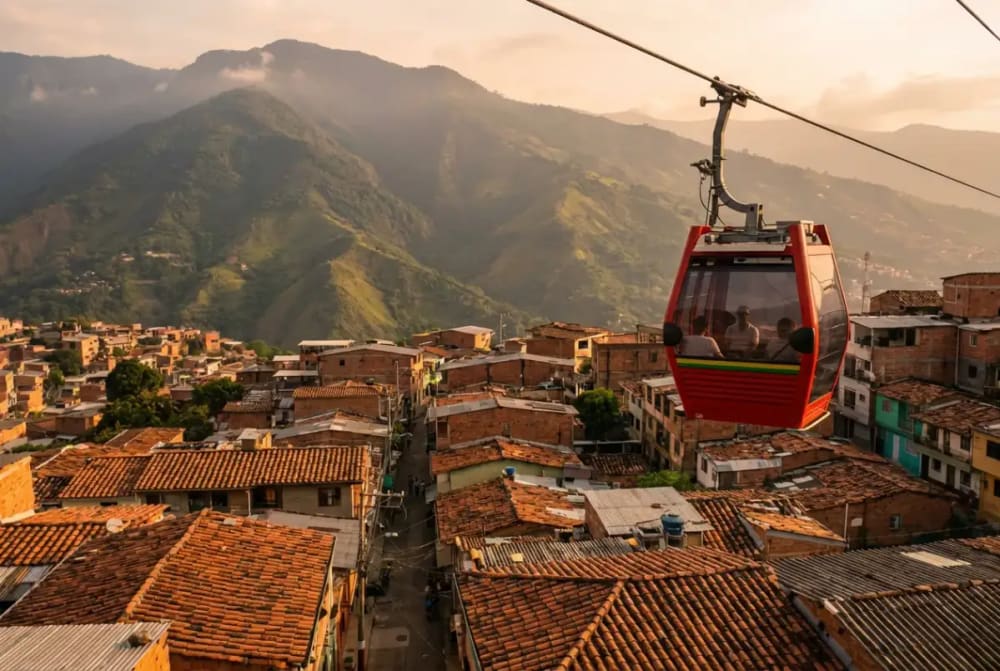
The gondola silently rises above the tiled roofs, the view expanding over the entire Aburrá Valley. The Metrocable system is much more than a means of transport: six cable car lines connect isolated mountain neighborhoods with the center — a core project shaping Medellín's transformation through "social urbanism."
We recommend the route via Line K from Acevedo station up to Santo Domingo, then transfer to Line L to Parque Arví — a nature reserve with over 80 kilometers of hiking trails amidst the fog forest. The ride to Parque Arví takes about 20 minutes and costs 13,700 COP (approx. 3 EUR). Regular rides in the metro and Metrocable system cost only 3,430 COP (approx. 0.78 EUR) with a personalized Cívica card.
Insider tip
Avoid rush hour between 5 PM and 7 PM. Travel to Parque Arví in the morning — the park has limited capacity and may close early on weekends.
Metrocable to Parque Arví
- Fare — 13,700 COP (approx. 3 EUR) to Parque Arví
- Travel time — about 20 minutes
- Route — Line K from Acevedo → Santo Domingo → Line L
- Regular metro — 3,430 COP (approx. 0.78 EUR) with Cívica card
El Poblado — Medellín's green heart
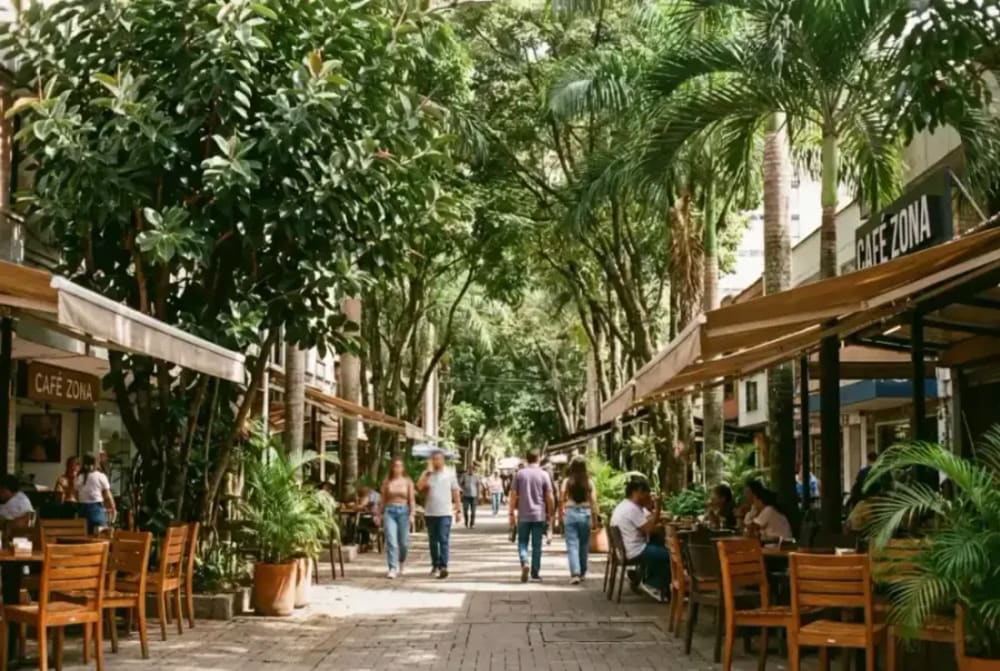
El Poblado is the preferred neighborhood for international travelers, and for good reason: The combination of upscale dining, boutique hotels, a safe atmosphere, and tree-lined streets makes it an ideal starting point. At its heart lies Parque Lleras, surrounded by restaurants, bars, and cafés.
Here you will also find Medellín's most exciting culinary addresses: Carmen, one of the top 50 restaurants in Latin America, serves contemporary Colombian cuisine in an elegant retro atmosphere with a garden terrace. At El Cielo, expect molecular cuisine from chef Juan Manuel Barrientos — a 10-course tasting menu (from about 250,000 COP / 57 EUR), with each course staged as a "moment." The menu changes every three months.
El Poblado
- Directions — Metro Line A to Poblado station, then 20 min uphill or taxi
- El Cielo Tasting — from 250,000 COP (approx. 57 EUR), 10 courses
- Restaurant tip — Carmen — Top 50 Latin America, reservation recommended
Jardín Botánico and Parque Explora
The botanical garden spans 14 hectares in the heart of the city — and admission is free. The architectural highlight is the Orchideorama: an award-winning wooden lattice canopy with ten hexagonal tree structures that collect rainwater and house an orchid collection. The butterfly house (Mariposario) costs 8,000 COP (approx. 2 EUR).
Right next door is Parque Explora, an interactive science museum with the largest freshwater aquarium in South America — 29 tanks with over 300 species, including 41 endemic Colombian fish species. Admission: 42,000 COP (approx. 10 EUR). Both attractions can be excellently combined as a half-day program.
Jardín Botánico & Parque Explora
- Jardín Botánico — Free (butterfly house 2 EUR)
- Parque Explora — 42,000 COP (approx. 10 EUR)
- Open — Tue–Sun (closed on Mondays)
- Directions — Metro Station Universidad (Line A), right next door
Let's plan your Medellín trip — we know each of these places from personal experience and will create your customized program. Schedule a consultation now .
Medellín insider tips — off the beaten path
Laureles — Where the Paisas live
While El Poblado forms the tourist center, many consider Laureles to be the more authentic Medellín. Time Out Magazine named the neighborhood the "coolest neighborhood in the world" in 2023. Unlike the hilly El Poblado, Laureles is flat, lined with tree-lined streets and bike paths.
Here lies the Pergamino Café with its idyllic courtyard — for many, the best specialty coffee in the city. At Ama Cocina Casera you can get a 3-course lunch menu (almuerzo) for about 6 to 8 EUR. And at night, the Paisas flock to Carrera 70 — Laureles' "party boulevard" with bars and clubs open late into the night.
Insider tip
Laureles is even safer than El Poblado in some safety indices — and restaurant and café prices are significantly lower than in the tourist district.
Culinary: From Bandeja Paisa to Fine Dining
The Bandeja Paisa is Antioquia's national dish — a hearty plate with red beans, rice, minced meat, chicharrón, fried banana, arepa, avocado, fried egg, and chorizo. You will find it most authentically at Mondongo's in Laureles, an institution since 1976 (from 15,000 COP / approx. 3.40 EUR).
On the other side of the culinary spectrum is the Mercado del Río: a food hall in a warehouse style with restaurants from around the world — from Italian to Mexican to local craft breweries. A lively place to sample the culinary diversity of the city.
For a special lunch, we recommend ON SITE in the botanical garden: minimalist architecture made of white concrete and glass, contemporary Colombian cuisine, surrounded by a tropical garden atmosphere.
Library parks — architecture as a tool of transformation
The library parks are a core element of Medellin's transformation strategy: Five architecturally ambitious libraries were built in the most neglected neighborhoods — education and culture as a response to violence and exclusion.
The most famous, the Biblioteca España (now Biblioteca Santo Domingo Savio) with its three iconic rock buildings, has been closed since 2015 due to structural problems. A reopening date has not been set. However, the distinctive buildings can be seen from the Metrocable line K.
The Parque Biblioteca Fernando Botero in San Cristóbal is active and shows how architecture can strengthen community: A horizontal building made of locally sourced brick and oak wood that adapts to the topography.
Your perfect stay — three days in Medellín
Day 1 — Culture and transformation
Day 2 — Nature and enjoyment
Day 3 — Day trip to Guatapé
Note: For history enthusiasts: Instead of Guatapé, a day trip to Santa Fe de Antioquia — founded in 1541, capital of the province for 242 years, with eight churches and the historic Puente de Occidente. Just an hour by taxi (approx. 150,000 COP / 34 EUR).
Boutique hotels in Medellín — Stay in style
We recommend two houses that we know personally and that make the difference between a good trip and a special one:
The Charlee Hotel
Modern and vibrant
From 200 USD / night
- Rooftop pool
- 42 rooms
- El Poblado
- Breakfast included.
Patio del Mundo
Quiet and personal
From 144 USD / night
- Tropical garden
- 13 rooms
- Near Provenza
- Jacuzzi
Let's find the accommodation that best suits your preferences together — we know these houses and their features from personal experience. Submit a request .
Good to know
Best travel time for Medellín
Medellín's climate is pleasant year-round — the average temperature remains constant at 22 to 23 degrees Celsius with minimal fluctuation. The driest months are December to February (approx. 65 mm of precipitation) and a second relatively dry phase from June to August. October is the wettest month. Whoever travels during the best travel time for Colombia is also correct for Medellín.
Note
The Feria de las Flores in early August is Colombia's largest flower festival with the famous Silleteros parade — a special highlight, even if August is not the driest time.
Arrival and flights
José María Córdova Airport (MDE) is located about 29 kilometers east of the city. The travel time to the center is 45 to 60 minutes.
Transfer airport MDE → city center José María Córdova Airport → El Poblado / city center
The altitude of 1,495 meters is more pleasant than Bogotá (2,640 m) — acclimatization is usually not necessary. More information on flights to Colombia .
Safety in Medellín
The security situation has fundamentally changed — the murder rate has fallen by over 97 percent since 1991 to the lowest level in over 80 years. El Poblado and Laureles are considered safe neighborhoods with a strong police presence.
Basic caution
Use official taxis or ride-hailing apps (Uber, Didi), do not accept drinks from strangers, and do not leave your drinks unattended. Keep jewelry and expensive electronics discreet, use ATMs in banks or shopping centers.
Detailed and up-to-date information on safety in Colombia .
Getting around locally
Medellín's Metro system is the only one in Colombia and is excellently developed: Two metro lines (A and B), six Metrocable gondola lines, and an integrated bus system. A single ride with a personalized Cívica card costs 3,430 COP (approx. 0.78 EUR). The metro operates Monday to Saturday from 4:30 AM to 11:00 PM.
Insider tip
The Cívica card is worth it from the second trip — single tickets without a card are more expensive. The card is available at every metro station.
Note
During the weekly Ciclovía on Sundays, dozens of kilometers of streets are closed to motor traffic (7:00 AM–1:00 PM) — cyclists, joggers, and walkers take over the city.
Entry prices and costs at a glance
Prices as of March 2026. 1 EUR ≈ 4,400 COP.
Discover more of Colombia
Medellín can be excellently connected with other stops on a Colombia round trip . You can reach Bogotá or the colonial jewel Cartagena by domestic flight in an hour. The coffee region around Salento is accessible by bus or short flight.
Cartagena — colonial jewel on the Caribbean
Bogotá — Colombia's vibrant capital
Salento & coffee region — wax palms and coffee plantations
Our round trip Colombia Classics: Coffee & Caribbean connects Medellín with the most impressive regions of the country. Or discover our Round trip cities & nature, which combines Medellín with Colombia's natural treasures.
More information on entry and visa as well as vaccinations and health can be found in our Colombia travel guides.
To book a trip or for more information, contact us. We'll help you plan and guide you through your upcoming adventure!
Frequently asked questions
Medellín has changed significantly — the murder rate has fallen by over 97 percent since 1991. El Poblado and Laureles are considered safe neighborhoods. As in any large city, it applies: do not wear valuables openly, use official taxis or apps, do not accept drinks from strangers (Scopolamine risk). With normal caution, Medellín is now well-travelable.
We recommend three to four days: one day for culture and urban development (Plaza Botero, Comuna 13), one day for nature (Jardín Botánico, Metrocable, Parque Arví), and one day for a day trip to Guatapé. A fourth day is worth it for Laureles, the gastronomy scene, and the Ciclovía on Sunday.
Due to its altitude of 1,495 meters, Medellín has pleasant year-round temperatures of 22–23 °C. The driest months are December to February and June to August. October is the rainiest month. A special experience is the Feria de las Flores in early August — Colombia's largest flower festival.
By domestic flight in about an hour (multiple connections daily). José María Córdova Airport (MDE) is 29 km east of the city, and the journey to the center takes 45-60 minutes by bus (approx. 3.50 EUR) or taxi (approx. 25 EUR).
El Poblado offers the largest selection of boutique hotels and restaurants with good security. Laureles is the more authentic, quieter alternative with a lower price level — chosen as the coolest district in the world by Time Out Magazine in 2023. Both districts are well connected to the metro system.
Definitely. The rock El Peñol with its 740 steps and the panoramic view over the reservoir are among the most impressive experiences in Colombia. The bus ride takes about two hours, and the entrance fee is about 6 EUR. Leave early to avoid the crowds.
Medellín offers an excellent price-performance ratio: A metro ride costs under 1 EUR, a bandeja paisa starts at 3.40 EUR, fine dining restaurants start at 14 EUR per course. Boutique hotels range from 144–350 USD per night. Detailed budget information can be found in our Colombia cost overview.
Basic knowledge is helpful — in El Poblado and tourist areas, you can get by with English, but outside it is mostly Spanish that is spoken. The Paisas (inhabitants of Medellín) are known for their hospitality and are patient in helping, even when communication is a bit difficult.
You might also like this
This image was generated with AI.
This image was generated with AI.