



Colombia: Land of the Bird World — 1,950 species awaiting
1,950 species. 86 endemics. The country with the richest birdlife on Earth.
1,950 species. 86 endemics. The country with the richest birdlife on Earth.
It is 5:30 in the morning. The misty forest cloaks everything in damp gray. The truck struggles up an unpaved mountain road while the engine works against the incline. Then, with the first light, it begins — a concert of whistles, chirps, and sounds you've never heard before. Dozens of voices, everywhere at once. And suddenly, among the dripping wet leaves, a shadow in colors that don't fit in any German forest: bright orange, turquoise, scarlet red. Welcome to Colombia — the country with the richest birdlife on Earth.

If you are planning birdwatching in Colombia, you will find in our detailed birdwatching guide all the practical details — from packing lists to the best lodges. This article shows you why Colombia is the destination that no birder can miss.
Why Colombia? The unbeatable world record in numbers
Over 1,950 documented bird species in an area eight times smaller than the USA. Nearly a fifth of all known birds in the world live in this one country. For comparison: In all of Germany, about 527 bird species have been documented historically. Colombia surpasses that number in a single day.
This is no exaggeration. On Global Big Day 2025 — the world's largest ornithological counting day, organized by the Cornell Lab of Ornithology — Colombian birdwatchers again took first place: 1,560 documented species within 24 hours. Peru followed with 1,399, Brazil with 1,245 species. Colombia has been winning this competition year after year.
The reasons lie in the geography. Five climatic zones in a compact area — from the Caribbean coast through three Andean ranges and the Pacific rainforest to the Amazon lowlands — create a diversity of habitats that is unparalleled worldwide. Every altitude, every slope, every river valley brings forth its own species.
| Country | Bird Species | Endemics |
|---|---|---|
| Colombia | 1,950+ | 86 |
| Peru | 1,890+ | 113 |
| Brazil | 1,800+ | 270+ |
| Ecuador | 1,680+ | 40+ |
| Costa Rica | 930+ | 7 |
| Germany | 527 | 0 |
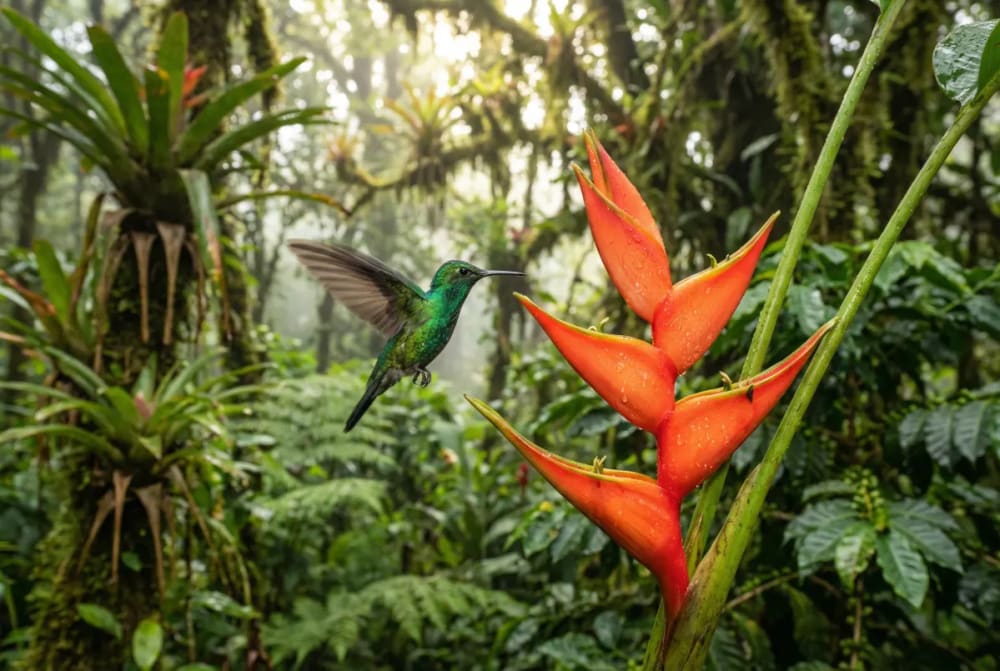
Especially impressive: Of the approximately 360 hummingbird species worldwide, 165 live in Colombia — almost half of all hummingbirds in the world. And 86 endemic bird species occur exclusively here, nowhere else on Earth. Those who wish to see these birds must travel to Colombia.
The 5 best birding regions in Colombia
Sierra Nevada de Santa Marta & Minca — Endemic hotspot No. 1
The Sierra Nevada de Santa Marta rises directly from the Caribbean coast to 5,775 meters — the highest coastal mountain range in the world. Millions of years of isolation have shaped a habitat that ornithologists describe as the most important site for endemic birds on the entire planet. 36 bird species exist exclusively here. Not in another country, not on another continent — only on this one mountain massif.
In the El Dorado Bird Reserve, the flagship reserve of the Colombian conservation organization ProAves, a single birding morning can yield 20 endemic species and over 100 sightings in total. Highlights include the Santa Marta parakeet, the Santa Marta pygmy owl — recognized as its own species only in 2007 — and the white-tailed starfrontlet hummingbird.
Traveling on a smaller budget? Start in Minca. This small town at 650 meters offers excellent birding with 365 documented species, including toucans, macaws, and up to 20 species of hummingbirds. The El Dorado Reserve at 2,800 meters is the premium option for dedicated birders — starting at 190 USD per night with meals and guided tours.
Coffee Region (Salento, Cocora Valley) — Hummingbirds and misty forests
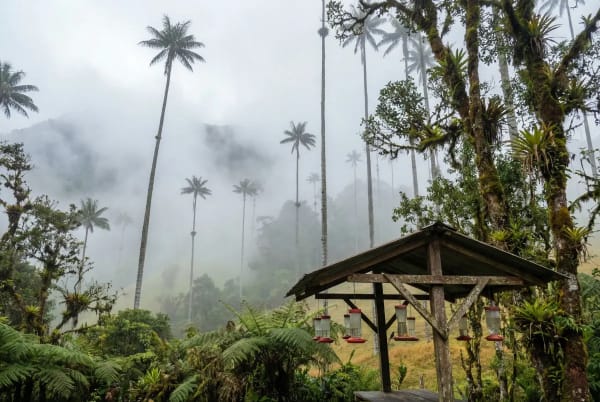
In the Acaime Reserve, a small hummingbird house in the misty forest of the Cocora Valley, up to 8 different hummingbird species hover around the feeding stations. They are so tame that they sometimes land on your outstretched hand. For the equivalent of 2 USD entry, you experience one of the most accessible birdwatching experiences in all of Colombia — no special equipment, no hours of waiting.
The coffee region turns birdwatching into a pleasure experience: hummingbirds in the misty forest in the morning, an afternoon tour of the coffee plantations in Salento. The wax palms of the Cocora Valley — reaching up to 60 meters high, the tallest monoecious plants in the world — are also the only habitat of the endangered yellow-eared parrot. Fewer than 1,000 individuals of this endemic species still exist.
Tatama National Park & Montezuma — Misty forest for the advanced
Tatama is located in the Choco biome, one of the wettest and most biodiverse ecosystems on Earth, extending from Panama to Ecuador. Over 620 bird species have been documented here, including 16 Colombian endemics. Cerro Montezuma is considered by experienced birders to be one of the best single locations worldwide — nearly 100 species in 24 hours is realistic.
You can observe the Andean cock-of-the-rock here quite easily: There is a lek directly at the town's edge. However, Tatama is not for beginners — the journey over unpaved roads is arduous, and the weather in the Choco biome is unpredictable. Those who take the trouble will be rewarded with a species density that is unmatched worldwide. Tatama is one of the most beautiful national parks in Latin America.
Amazon (Leticia) — Macaws, toucans, and the living fossil
The region around Leticia is home to over 500 bird species. And one of the most curious birds of all: the hoatzin. Its chicks have claws on their wings — a prehistoric feature that recalls dinosaurs. It digests leaves through fermentation like a cow, and its distinctive smell has earned it the nickname 'stinkbird.' A fossil from the Miocene was discovered in the Colombian Magdalena Valley. The hoatzin is a living fossil — and you can observe it from a boat, just a few meters away.
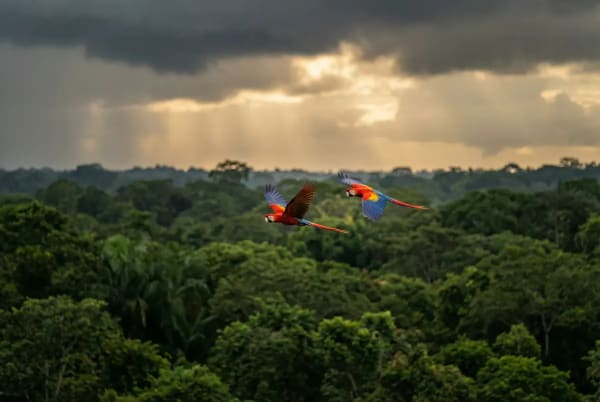
In Colombia, there are 7 macaw species, including the scarlet macaw and the blue-and-yellow macaw. From the boat, you can see flocks of 20 or more parrots flying over the treetops. The best time for the Amazon is the dry season from June to October when the rivers drop and rare river island species become visible on the exposed sandbanks.
Bogotá and surroundings — Birdwatching as a day trip
You don't have to travel days into remote areas to see spectacular birds. From Bogotá, you can reach Chingaza National Park in two hours, where Andean condors with 3.2 meters wingspan circle above the paramo. And at the La Calera hummingbird observatory — just 9 kilometers from the capital — you can observe 14 to 20 different hummingbird species, including the swallow-tailed sylph with its long blue-green tail, one of the most photogenic hummingbirds of all.
The Bogotá swamp rail, an endemic bird that occurs only on the high plateau of the capital, makes Bogotá one of the few places in the world where you can observe an endemic species right in a million-person city. A perfect introduction to the Colombian bird world — right after landing.
Best birding time
The first two hours after sunrise (around 6:00 to 8:00 AM) are the most active bird time. In Colombia, the sun rises year-round between 5:45 and 6:15 AM — getting up early is worthwhile. Download the free Merlin Bird ID app (Cornell Lab) with the Colombia pack. The sound ID feature recognizes birds in real-time through your phone's microphone — you don't even need to see the bird to identify it.


These are the bird species you should have seen in Colombia
Colombia is home to some of the most spectacular birds in the world. Six species you shouldn't miss — from the scarlet dancer to the stinking fossil.
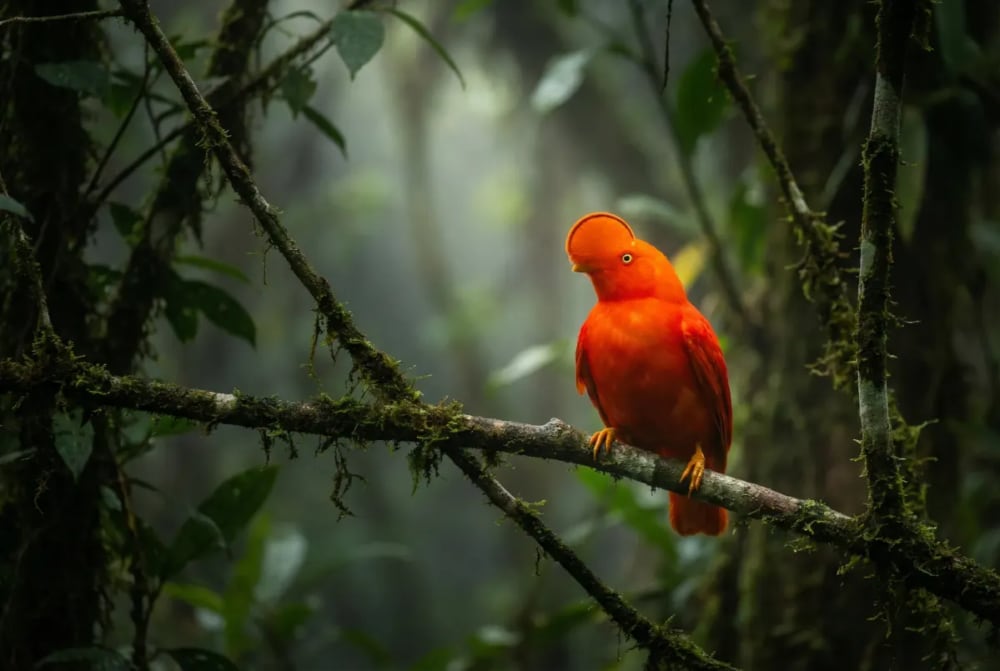
Andean cock-of-the-rock (Rupicola peruvianus) — The scarlet males with their distinctive crescent comb perform spectacular dances at leks: bowing, jumping, loud squealing. In Jardin (Antioquia), you can reach such a lek just a few hundred meters from the town center. For the equivalent of 2.50 USD, you can see up to 20 males dancing simultaneously — the easiest and cheapest access to this spectacle in the world.
Sword-billed hummingbird (Ensifera ensifera) — The only bird in the world whose bill is longer than its body: 8 to 12 centimeters. Over thousands of years, it co-evolved with the Passiflora-mixta plant — a fascinating example of mutual adaptation that can be observed in the Andes' misty forests.
Andean condor (Vultur gryphus) — With a wingspan of 3.2 meters, it is the largest flying bird on Earth. Critically endangered in Colombia, but can be seen with some patience in Chingaza National Park near Bogotá. A reintroduction program has currently released 71 birds — every sighting counts.
Multicolored tanager (Chlorochrysa nitidissima) — This endemic species of the western and central Andes wears colors that no watercolor could capture: yellow face, chestnut-brown ears, turquoise underside. Colombia is home to over 150 tanager species — the most colorful bird group in the world.
Hoatzin (Opisthocomus hoazin) — The 'living fossil' with wing claws, fermentation digestion, and a distinctive smell. A bird that stinks, sweats, and has claws on its wings — the Amazon time capsule in feathered form.
Keel-billed toucan (Ramphastos sulfuratus) — Its oversized colorful bill is lighter than it looks and is used for temperature regulation. Commonly seen along the Caribbean coast and in Minca — the bird that is essential in any Colombia album.
When is the best time to travel for birdwatching in Colombia?
Colombia is suitable for birding year-round — there is no bad month. Two dry seasons are considered optimal: December to March and July to August. Then paths are drier, roads more passable, and visibility in the misty forest clearer. A detailed overview can be found in our article on the best travel time for Latin America.
| Region | Best months | Highlight |
|---|---|---|
| Coffee region / Cocora | Dec–Feb, Jul–Aug | 40+ hummingbird species, tanagers |
| Sierra Nevada / Minca | Dec–Apr | 36 endemics, 365 species around Minca |
| Amazon / Leticia | Jun–Oct (dry season) | Aras, Tucans, Hoatzins |
| Tatama / Montezuma | Year-round (less rain in Jan–Feb) | 620+ species, Choco endemics |
| Bogota / Chingaza | Dec–Mar, Jul–Aug | Andean condors, 20 species of hummingbirds |
| Llanos (Eastern plains) | Jan–Mar (Dry season) | Thousands of waterfowl |
From October to April, additional North American migratory birds can be found in Colombia — a bonus for birders looking to add as many species to their list as possible. Those who want to experience the Global Big Day (every year in May) travel in an almost festive birding mood: Then the whole country counts together — and the enthusiasm is contagious.
Combining bird watching — these routes work
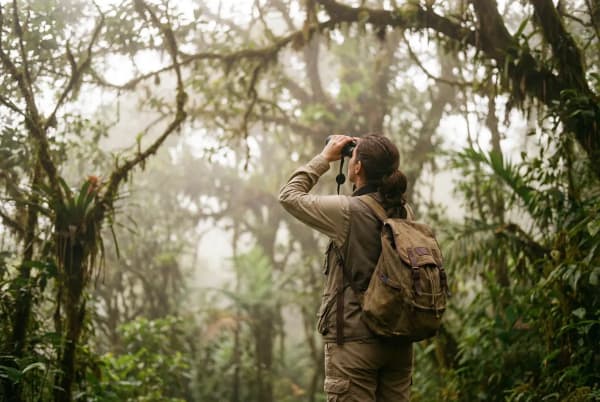
Bird watching can be perfectly combined with a classic trip to Colombia. You don’t have to be a hardcore birder to enjoy the birdlife — a good pair of binoculars and curiosity are enough. Three route suggestions, graded by intensity:
Beginner route (7 days): Santa Marta as a base, 3–4 days in Minca and El Dorado Reserve for the most spectacular endemic experience in the shortest time. Additionally, 2–3 days in Cartagena or Tayrona for beach and culture. Perfect for anyone wanting to combine birdwatching with a trip to Colombia for the first time.
Enthusiasts route (14 days): Bogota (2 days Chingaza + La Calera) → Jardin (2 days, Andean cock-of-the-rock) → Salento/Cocora (2 days, hummingbirds) → Cali/Tatama (3 days, Choco endemics) → Santa Marta/Minca (3 days, Sierra Nevada endemics). Four climate zones, four completely different bird worlds.
Hardcore route (21 days): The 14-day route plus 4–5 days in Leticia/Amazon and optional 2–3 days in Llanos for the waterfowl spectacle. More details in our article on the 3-week nature trip through Colombia.
Are you still considering which country is right for you? Our Comparison of Pantanal and Galapagos helps with the decision — or check out our Decision aid for Latin America.
Birdwatching as a peace project
Birding tourism has a significance in Colombia that goes beyond mere nature experiences. Former conflict zones have transformed into ecotourism destinations. Local guides, who once had no economic perspective, now earn a living from the nature they protect. Every birding trip directly supports the preservation of habitats and strengthens local communities.
Equipment, guide, and costs
A local birding guide is the best investment of your trip. The guides recognize birds by their calls, know the best lookout points, and lead you to spots that you would never find on your own — especially in remote areas like Tatama or the Amazon, they are indispensable. Regarding safety in remote areas, we recommend our article Traveling safely in Colombia .
What birding trips cost:
- Day tours from Bogota: approx. 80–150 USD per person
- Multi-day tours (7–11 days): from 2,200–4,600 USD including accommodation and guide
- Birding lodges: from 70 USD/night (La Minga) to 190 USD/night (El Dorado)
- Andean cock-of-the-rock lek in Jardin: 2.50 USD entrance
Equipment for birdwatching in Colombia:
- Binoculars 8x42 — wider field of view and more brightness in dense cloud forest than a 10x42
- Merlin Bird ID app with Colombia pack (free, works offline)
- Field guide: Field Guide to the Birds of Colombia by Miles McMullan
- Layering system for clothing: In Leticia it’s 30 degrees, in Chingaza it can be 5 degrees
What else you should pack, you can find in our Packing list for Latin America.
Frequently asked questions about birdwatching in Colombia
Over 1,950 documented species — more than any other country in the world. Of these, 86 species are endemic, meaning they occur only in Colombia worldwide. On Global Big Day 2025, 1,560 species were counted in a single day — more than Germany has ever documented.
Strongly recommended. Local birding guides recognize birds by their calls, know the best lookout points, and significantly increase your sighting rate. Day tours from Bogota cost about 80–150 USD per person, a local guide around 40–60 USD per day.
No. The coffee region (Acaime hummingbird house) and Minca are perfect for beginners — good infrastructure, tame birds, easy accessibility. With the free Merlin app, you can automatically identify birds by sound. The special thing about Colombia is: Even those who have never been interested in birds will be thrilled here.
Colombia is suitable year-round. The optimal dry seasons are from December to March and July to August. For the Amazon, the best time is from June to October. North American migratory birds are present from October to April and further increase the species count.
Absolutely. The coffee region combines birding with coffee culture, Minca is right by Santa Marta and the beaches, and Bogota offers birding day trips without extra travel. Birdwatching is a natural part of any nature trip through Colombia.
Your dream holiday, tailor-made by true connoisseurs.
From the first spark of inspiration to the moment you return home full of stories, we’re by your side – whether by phone, email or WhatsApp, whenever you need us. Every journey we design is as unique as you are: individually crafted with exclusive privileges and exceptional arrangements that make your experience truly unforgettable.
Experts for your trip

You might also like this

Colombia Safety: What really is true — and what is not
"Colombia? Isn't it dangerous?" — This question is guaranteed to come up when you tell family or friends about your travel plans. The images in their heads come from Narcos series and headlines from the 1990s. But the Colombia of 2026 has as much to do with these clichés as today's Berlin does with the fall of the Wall. 6.7 million international visitors traveled to Colombia in 2024 — a new record. This corresponds to the entire population of Switzerland. In 2025, over 10.2 million international travel movements were even registered. These people did not come despite the security situation, b...
Ecuador's great natural stage
From Cotopaxi to the Galápagos Islands There are trips that impress. And there are trips that resonate long after. Our journey through Ecuador clearly belonged to the second category. Within just a few days, we moved between two completely different worlds: the heights of the Andes and the island world of the Galápagos....

My adventure in Corcovado National Park
One of my most unforgettable travel experiences was a guided hike of about 20 kilometers through Corcovado National Park in Costa Rica – right through dense jungle, without paved paths, but with plenty of mud. And with the most unsuitable shoes possible. If you want to know what a day in Costa Rica's wildest national park really feels like, I'll take you along on this tour....