

Salvador De Bahia
The Afro-Brazilian Heart of Brazil
The Afro-Brazilian Heart of Brazil
Salvador de Bahia — the first capital of Brazil, UNESCO World Heritage Site Pelourinho, origin of Capoeira and Candomblé. The cultural epicenter of the Afro-Brazilian heritage.

Best travel time
September to March — dry season with stable weather; September to November is particularly recommended (fewer tourists, more moderate prices).
Why Salvador de Bahia?
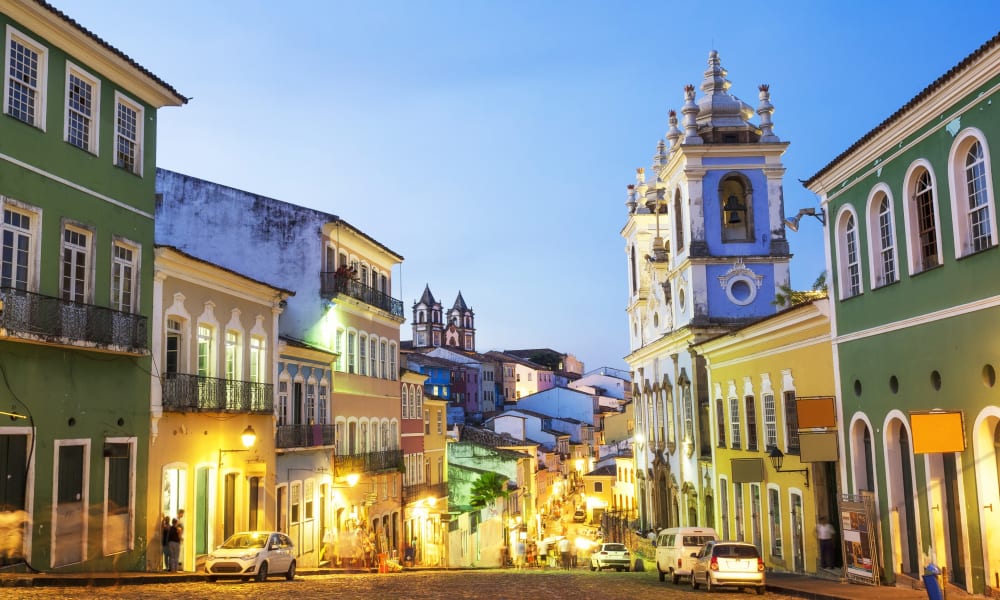
When the sun sets over All Saints Bay, the Cidade Alta starts to glow. The pastel-colored colonial facades of Pelourinho — canary yellow, coral, turquoise green — absorb the warm light, the heat of the day rises from the cobblestones, and from somewhere over the rooftops comes the sound of a Berimbau through the streets. In front of the Igreja de Nossa Senhora do Rosário dos Pretos, Baianas in white lace dresses set up their oil pots, where fresh Acarajé will soon be sizzling. It is Tuesday evening, and Salvador does what it has done best for centuries: turning history into music.
Salvador was the first capital of Brazil from 1549 to 1763 — for over 200 years the administrative, economic, and cultural center of Portuguese America. Today, around 2.9 million people live here; about 80 percent of them are of Afro-Brazilian descent. No other major city outside of Africa carries its African heritage so unfiltered into its daily life. Internationally, Salvador is thus called the "Black Capital of Latin America" — a title that the city does not carry as marketing but as an obvious identity.
This identity has its roots in a dark history. Over 37 percent of all enslaved people brought from Africa came to Brazil, and Salvador was one of the first and largest hubs of this trade. The word Pelourinho means pillory — enslaved Africans were sold and punished in its central square. That this very place has today become the vibrant center of a proud, lively culture speaks volumes about the strength of the people who live here.
For German-speaking travelers, Salvador is one of the most rewarding stops on a tour of Brazil — compact enough for two to three days, while also an ideal starting point for the Northeast: the Chapada Diamantina is about 420 kilometers inland, the Lençóis Maranhenses and Fernando de Noronha are reachable by domestic flight.
Pelourinho — Heart of the Upper Town
The historic center of Salvador was declared a UNESCO World Heritage Site in 1985. It is considered the largest contiguous baroque ensemble in South America — a city from the 16th to 19th centuries, restored, inhabited, and played in. The systematic renovation began in 1990 with UNESCO support. The fact that at that time the previous residents were relocated to new housing outside of Salvador in 1991 is still a critically discussed process — a Harvard analysis speaks of the danger of a "museumification" of the neighborhood. Anyone visiting Salvador should take this layer into account.
The Largo Terreiro de Jesus is the focal point of Pelourinho. Around the square are the Catedral Basílica de Salvador (cathedral since 1933, previously a Jesuit church), the Igreja São Pedro dos Clérigos, the Igreja São Domingos Gusmão and the Museu Afro-Brasileiro (MAFRO), the most important museum of Afro-Brazilian culture and the Candomblé Orixás. Admission is 10 Real (around 2 Euros), open Monday to Friday from 9 AM to 5 PM. The collection is manageable, but it places the city in context like no other place.
A few steps further stands what usually tops every travel list: the Igreja e Convento de São Francisco. Its interior is adorned with around 800 kilograms of gold — one of the most magnificent baroque rooms in the New World. Important note for 2026: On February 5, 2025, parts of the ceiling collapsed; one person died, five were injured. The church has since been closed for restoration work, and a reopening date has not been set. The neighboring Ordem Terceira de São Francisco with its impressive stone facade remained accessible until recently — definitely gather current information before the visit. We continuously update our recommendations.
The most emotionally impactful building in the neighborhood for us is another: the Igreja de Nossa Senhora do Rosário dos Pretos at Largo do Pelourinho. It was built by enslaved Africans in the few free hours they were given — the construction took about a hundred years. It is the church of the Pretos, the Black people, and to this day a place for syncretic services where Catholic saints and Candomblé Orixás find a common space.
Since December 8, 1873, the Elevador Lacerda has been operating — the world's first public city elevator. 73.5 meters in 22 seconds, four cabins in two towers, over 28,000 trips daily. The fare is 15 centavos, equivalent to less than three cents. At the top awaits a view over the Baía de Todos os Santos, the ocher palace of the former governors, and the Pelourinho is a five-minute walk away. Below begins the Mercado Modelo (Mon–Sat 9 AM–7 PM, Sun 9 AM–2 PM) with handicrafts, silver, and spices.
Insider tip: The Pelourinho in the late afternoon, from around 5 PM. Then the squares fill up, the colonial houses absorb the golden light, and the first Rodas de Capoeira begin. On Tuesday evening — in Salvador it is called Terça da Bênção, the blessed Tuesday — the neighborhood transforms into an open-air stage: starting with a syncretic mass in Rosário dos Pretos, followed by Capoeira, Olodum drumming on Praça Tereza Batista, street music, Acarajé stalls. Much of this is free or only costs a small donation. For us, it is the culturally densest evening of the week.
Experience Afro-Brazilian culture
In Salvador, Afro-Brazilian culture is not folklore, but everyday life. Three traditions particularly shape the city's experience: Capoeira, Candomblé, and the cuisine of the Baianas.
Capoeira is probably the best-known export of Bahia. Enslaved Africans developed it as a combat technique and disguised it as a dance to escape persecution. Two main styles can be distinguished: Capoeira Angola, the traditional, earthier form preserved by Mestre Pastinha, and Capoeira Regional, developed by Mestre Bimba in the 1930s. Bimba's legendary performance before the governor of Bahia led to the repeal of the prohibition in effect since 1890 — a political act, not a dance festival. On November 26, 2014, UNESCO declared Capoeira an intangible cultural heritage. The Fundação Mestre Bimba in Pelourinho hosts public Rodas from Tuesday to Saturday from 7 PM to 8 PM; a small donation is expected. Those who want to experience the stage version should reserve an evening for the Balé Folclórico da Bahia at Teatro Miguel Santana (Mon/Wed/Fri 7 PM to 8 PM, admission around 90 Real, cash only).
Candomblé is the religion in which Salvador's African heritage shines most clearly. It combines West African traditions of the Yoruba, Fon, and Bantu with elements of Catholicism and venerates Orixás — forces embodying the sea, wind, rivers, and human characteristics. The ceremonies take place in Terreiros, sacred sites, some of which, like Terreiro do Gantois or Casa Branca, allow visitors. Anyone wishing to participate in a ceremony should do so only with a local guide, wear covered clothing, and strictly respect the ban on photography and filming. We are happy to connect you with trusted companions who provide the necessary context — without making the sacred a spectacle.
The iconic festival of Candomblé is the Festa de Iemanjá on February 2. Since 1923, it has attracted around 200,000 participants to Rio Vermelho every year. At 4:45 AM, fireworks at Casa de Iemanjá open the celebration. Dressed in white, devotees bring flowers, mirrors, perfumes, and jewelry in decorated baskets as offerings to the sea goddess; at noon, boats depart to sink the gifts far out at sea. For culturally interested travelers, Iemanjá is more intense than Carnival: less noise, more spirituality, a rarely experienced side of Salvador.
The third major tradition stands at every corner: the Cuisine of the Baianas de Acarajé. Acarajé are fried balls made from black-eyed peas, filled with Vatapá (shrimp-peanut cream) and soaked in Dendê palm oil. Enslaved women once sold them on the streets to raise money for their freedom. Today, around 3,500 Baianas work in Salvador; their craft was registered as an intangible cultural heritage of Brazil (IPHAN) in 2005, and since 2017 "Baiana de Acarajé" has been an officially recognized profession. An Acarajé at the stand costs 15 to 20 Real — from origin to the first bite, one of the most honest stories one can eat while traveling.
More modern, but still Bahian: Olodum, the samba-reggae group founded in 1979 in Pelourinho, whose drumming Michael Jackson brought to Salvador in 1996 for "They Don't Care About Us." Terça do Olodum on Tuesdays at Praça Tereza Batista from 8 PM and the Sunday rehearsal in the afternoon are the best opportunities to experience the group live (around 70 and 50 Real admission, respectively).
Beaches and Coast around Salvador
Salvador is not a classic beach town — its strength lies in culture, history, and rhythm. But anyone who plans half a day for the sea will be rewarded.
Praia Porto da Barra in the Barra neighborhood is the most popular city beach: a sheltered bay with calm water, beach restaurants, and a sunset that with the Farol da Barra delivers one of the most photographed motives in the city. From Pelourinho, it is about a 15-minute Uber ride (around 15–20 Real).
For a whole day, a trip to the Coast of Praia do Forte, about 70 kilometers north of Salvador, is worthwhile. There lies the project Tamar, the largest sea turtle conservation project in Brazil — a visit that excites both families and biodiversity enthusiasts. The offshore All Saints Bay (Baía de Todos os Santos) is the largest bay in Brazil at around 1,100 square kilometers; day trips by catamaran to Morro de São Paulo or to the island Itaparica are a classic second-day trip from Salvador.
Best travel time and festivals
Salvador is warm year-round. Temperatures range from 25 to 33 degrees Celsius, and humidity is high. The dry season from September to March is the most reliable travel time. Our favorite months are September to November: stable weather, fewer tourists than in the high season around Christmas, more moderate prices.
The Carnival of Salvador takes place every year in the six days leading up to Ash Wednesday — in 2026 from February 12 to 18. On March 4, 2025, the Guinness World Records team officially recognized Salvador as the world's largest "trio-elétrico" carnival: in 2025, about 3.5 million people attended, and the economic turnover was 7 billion reais. Those wanting to experience the carnival should understand three things:
- Abadá: the official shirt of a Blocos. Those who wear it celebrate within the cordoned-off ropes of a specific parade with a live band. Price: 500 to 2,150 reais per day, depending on the bloco.
- Pipoca: "popcorn" — the revelers without Abadá participating outside the ropes. Free, energetic, but also crowded and chaotic. Leave daypacks and valuables at home.
- Camarote: lounges with catering overlooking the parade route. Premium option, 700 to 4,235 reais per evening. For travelers seeking atmosphere without a crowd, this is the most pleasant option.
Hotels during Carnival cost two to three times as much, and the best places are booked three to six months in advance. As a cheaper alternative, the pre-Carnival days Fuzuê and Furdunço the weekend before are worthwhile.
Other significant festivals include the Festa de Iemanjá (February 2), Lavagem do Bonfim (the second Thursday in January — the famous washing of the Bonfim church steps by white-clad Baianas) and the São João festival in June.
Getting there and logistics
Getting to Salvador has become easier than many travel guides portray. Two direct flight options from Europe:
- Condor: seasonal direct flights Frankfurt (FRA) → Salvador (SSA), about three connections per week during the winter season. For German-speaking travelers, this is usually the most comfortable option; we recommend booking early.
- TAP Air Portugal: nonstop Lisbon (LIS) → Salvador (SSA) in about 8.5 hours, three connections per week (as of April 2026). From Germany, Austria, and Switzerland with a layover in Lisbon — often faster than the detour via São Paulo.
Alternatively, you can fly via São Paulo (GRU) or Rio de Janeiro (GIG) with domestic layovers. The Luís Eduardo Magalhães Airport (SSA) is located about 28 kilometers northeast of the city.
Transfer to the hotel: Uber or a private transfer (30–45 minutes, depending on traffic) are the most convenient options. The public bus 1001 goes to the center for 5.20 reais but takes about 75 minutes. We can organize a German-speaking meet-and-greet service upon request — especially a relaxing solution for the first night after the long-haul flight.
Within Salvador, you can explore the Pelourinho entirely on foot. For longer distances — Barra, Rio Vermelho, Airport — we recommend Uber. Taxis are generally fine, but the fare should be agreed upon in advance.
Overnight — Upper Town or Lower Town? The recommendation is clear: Pelourinho (Cidade Alta) for cultural density and short distances, or Barra for a quiet atmosphere and proximity to the beach. Our favorite in Pelourinho is the Casa do Amarelindo on Rua Portas do Carmo — ten rooms, rooftop terrace with a view of the All Saints Bay, rooftop bar, family-run. Those who prefer to stay by the sea will find high-quality houses in the mid-range to premium segment in Barra.
Safety in Salvador
Salvador has a worse reputation than it deserves. Between January and July 2024, around 5.2 million tourists visited the city, and the vast majority travel without incidents. Nevertheless, honest categorization is important: pickpocketing is possible in crowds, caution is advised in certain neighborhoods outside tourist zones, and a relaxed attitude does not replace basic rules.
What specifically helps:
- Leave valuables in the hotel safe. Only take what you truly need when out — ideally in a fanny pack under your shirt.
- Do not carry smartphones openly on the street. Take photos deliberately and quickly, not constantly with the camera in hand.
- Do not walk alone through deserted alleys after dark. In Pelourinho, Barra, and Rio Vermelho, you can walk in busy streets at night; for routes between neighborhoods, use Uber.
- Do not withdraw cash demonstratively. The Bradesco ATM at Pelourinho (opposite the Elevador Lacerda) is considered one of the most reliable.
DELTUR — the tourist police maintains two stations in Salvador with multilingual staff (Portuguese, English, French, Spanish): in Pelourinho at Largo do Cruzeiro de São Francisco and in Barra on R. Augusto Frederico Schmidt. Both are staffed around the clock and present at tourist hotspots. The general emergency numbers are 190 (police), 192 (ambulance), 193 (fire department).
Our honest assessment from personal travel experience: Salvador is a big city with urban issues — no more, no less. Those who follow the usual rules and take guided tours in less-known neighborhoods will experience one of the friendliest and most open cities in Brazil.
Incorporating Salvador into a Brazil round trip
Salvador is worth visiting as a standalone destination for two to three nights — the main experiences can be arranged calmly within this time. The journey becomes even more delightful if you connect Salvador with other regions in the Northeast. From Salvador, you can reach the Chapada Diamantina with its tabletop mountains and waterfalls in about six hours by car or with a domestic flight — a scenic counterpoint to the heat of the coast. The Lençóis Maranhenses with its turquoise lagoons between white sand dunes are accessible by flight, as is the underwater paradise Fernando de Noronha. For travelers wanting to experience culture and nature simultaneously, Salvador is the natural hub.
Talk to us if you would like us to suggest an itinerary tailored to your travel pace, interests, and time of year. Our Brazil consultants know Salvador from their personal experiences on the ground — we plan your trip as if it were our own vacation. Schedule a consultation .
To book a trip or for more information, contact us. We'll help you plan and guide you through your upcoming adventure!
Frequently Asked Questions
Two to three days is a good guideline. Day one belongs to Pelourinho with MAFRO, Rosário dos Pretos, Elevador Lacerda, and a sunset in the upper town. Day two can be used for Capoeira, Candomblé context, and Olodum — ideally a Tuesday, because of the *Terça da Bênção*. A third day is suitable for Barra, Praia do Forte, or a catamaran trip in All Saints Bay. Those wanting to experience the Carnival or the Festa de Iemanjá should plan for additional days.
Salvador is safe for attentive travelers. Tourist districts like Pelourinho, Barra, Rio Vermelho, and Porto da Barra are patrolled around the clock by the DELTUR tourist police, which has multilingual staff. The common issues are pickpocketing in crowds and high prices at unofficial taxis — both can be avoided with simple precautions. After dark, use Uber between neighborhoods, leave valuables in the hotel, and opt for a fanny pack instead of a wallet.
The Carnival of Salvador was officially recognized as the world's largest trio-elétrico carnival (Guinness World Records) on March 4, 2025. Six days, around 3.5 million participants, three forms of participation: *Abadá* (500–2,150 reais for the official bloco shirt with a protected area), *Pipoca* (free, without ropes, energetic and crowded) and *Camarote* (700–4,235 reais per evening for served VIP lounges). Hotels cost two to three times as much and should be booked three to six months in advance. Date 2026: February 12 to 18.
Absolutely — provided the context is right. Public *Rodas* of the Fundação Mestre Bimba in Pelourinho (Tue–Sat 7–8 PM) or a visit to the Balé Folclórico da Bahia convey Capoeira at a respectful level. Candomblé ceremonies should only be visited with a local guide who instructs you in dress codes and etiquette — photography and filming are strictly prohibited. We can facilitate contacts with trusted companions who will guide you as an observer into a public terreiro.
The recommendation is clear: **Upper Town (Pelourinho)** for those seeking culture, music, and short distances. Boutique hotels like Casa do Amarelindo offer colonial charm and rooftop terraces with bay views. **Barra** is the second good choice — quieter, located by the beach, with hotels in all categories and vibrant nightlife. We advise against using the lower town as an overnight location: it is the commercial district, not the residential or nightlife part of the city.
For Pelourinho during the day, a city map and good footwear are sufficient. When it comes to Candomblé, Capoeira context, the history of slavery, or excursions into less touristy neighborhoods, a local guide makes the difference between sightseeing and understanding. Good guides explain why the Igreja de Rosário dos Pretos is more significant than its golden neighbors, why a Baiana de Acarajé works in white, and what a *Terça da Bênção* means beyond the tourist show. We provide German- or English-speaking guides who grew up in Salvador.