


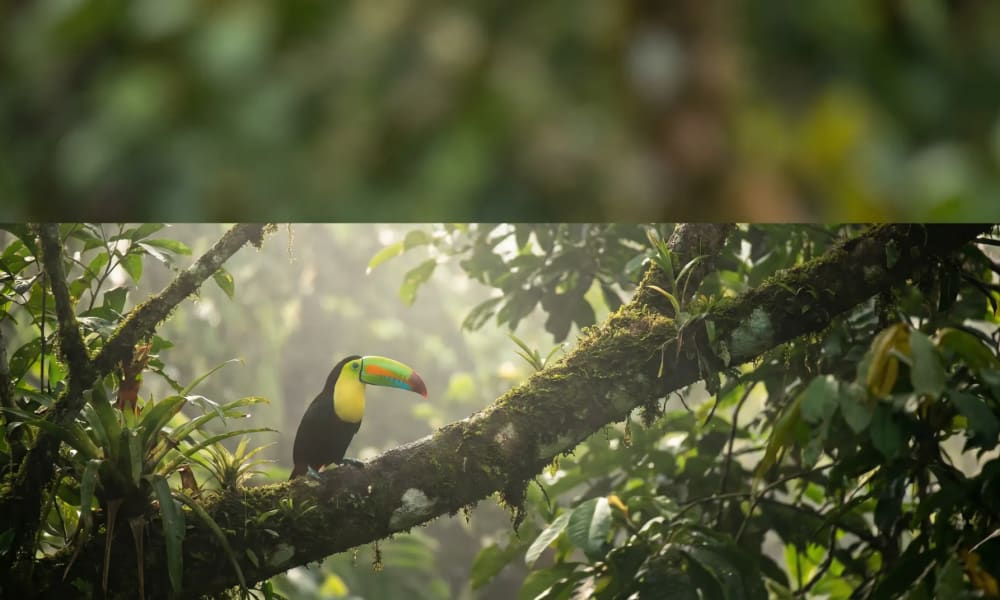
This image was generated with AI.
Birdwatching in Colombia
1,950+ species, 86 endemics & the best birding spots
1,950+ species, 86 endemics & the best birding spots
In the early morning at half past five, when the fog forest of the Sierra Nevada is still shrouded in mist, a concert begins that is unmatched. Hundreds of voices simultaneously — some melodic and clear, others so strange that even experienced birders reach for the identification book. Colombia sounds different from any other country in the world. Because here live more bird species than anywhere else on Earth: over 1,950 documented species, 86 of them endemic, that is found only here in the world.
On the Global Big Day 2025, observers counted 1,560 different bird species in Colombia in one single day — more than were historically documented in all of Germany (about 527 species). Almost every second hummingbird in the world lives here: 165 out of 360 known species. In our blog article Colombia: Land of Birdlife — 1,950 species await we tell the whole story behind these numbers. This guide focuses on practical planning: where to observe, when to travel, what to bring — and what it costs.

What makes Colombia special for birders
One fifth of all known bird species in the world lives in a country that is eight times smaller than the USA. How is that possible? Five climatic zones in close proximity create a diversity of habitats that is unparalleled in the world: Caribbean coast, Pacific rainforest, three parallel Andean ranges, the vast Llanos savannas, and the Amazon lowlands. Each zone is home to its own species, its own voices, its own colors — and 86 endemics that do not occur anywhere else on Earth.
| Country | Bird species | Endemics | Global Big Day 2025 |
|---|---|---|---|
| Colombia | ~1,950 | 86 | 1,560 |
| Peru | ~1,890 | 113 | 1,399 |
| Brazil | ~1,800 | 270 | 1,245 |
| Ecuador | ~1,680 | 40 | 1,103 |
| Costa Rica | ~930 | 7 | — |
| Germany | ~527 | 0 | — |
For context: Colombia has more than twice as many bird species as Costa Rica — a country known to many German travelers as a nature destination. And almost four times as many as Germany.
The best birding regions of Colombia
Sierra Nevada de Santa Marta & Minca — Endemic hotspot No. 1
The highest coastal mountain range in the world rises directly above the Caribbean and forms an isolated habitat that has been producing its own species for millions of years. 23 of the 86 Colombian endemics — over a quarter — are found exclusively in the Sierra Nevada. A total of 628 bird species are documented here. Just around the mountain town of Minca at 650 meters elevation, 365 species can be observed, including toucans, macaws, and up to 20 hummingbird species.
The El Dorado Bird Natural Reserve (ProAves) on the San Lorenzo Ridge protects 22 endemic bird species and carries an award that underscores the importance of this site: The IUCN has designated it as the "most irreplaceable site on Earth" among 173,000 protected areas worldwide. On a single birding morning here, you can discover 20 endemic species and over 100 species in total.
El Dorado Bird Reserve (ProAves)
- Location — San Lorenzo Ridge, 2h from Santa Marta (4x4)
- Lodge — From USD 190/person/night
- Stay — 2-3 nights recommended
- Feature — IUCN 'most irreplaceable site on Earth'
- Booking — conservation.co / WhatsApp +57 322 209 0501
Minca as an accessible alternative
Not every birder needs the lodge at El Dorado Reserve. Minca is just 45 minutes by taxi from Santa Marta (about 20,000-30,000 COP) and offers excellent birding with 365 documented species. Local guides like Minca Birding (mincabirding.co) will take you to the best spots for around USD 40-60 per day. Tip: The field guide "Birds of MINCA" is available locally and covers the region accurately.
Coffee region & Cocora Valley — Hummingbirds and gentle introduction
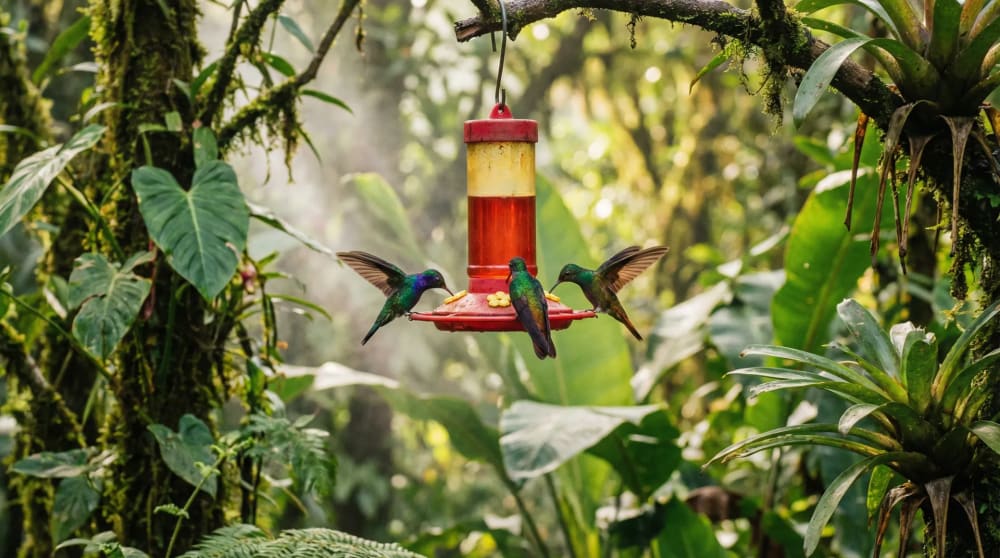
The coffee region near Salento is the perfect introduction for those who have never picked up binoculars for birds. In the Acaime Hummingbird Reserve (Reserva Natural Acaime), up to 8 different hummingbird species hover around the feeding stations — so tame that they land on visitors. No special knowledge is required, no extreme early rising.
The wax palms of the Cocora Valley rise up to 60 meters into the sky — the national tree of Colombia and the only habitat of the Yellow-eared Parrot, of which fewer than 1,000 individuals remain. Three hours from Medellin lies Jardin, the best location in the world for the Andean Cock-of-the-rock: Just a 10-minute walk from the edge of town, up to 20 scarlet males dance simultaneously at their lek — daily, reliably, impressively.
Reserva Natural Acaime — Hummingbird Reserve
- Location — Cocora Valley, 40 min hike from the parking lot
- Entry — 20,000 COP (~5 USD, including hot drink)
- Birding time — 6-9 AM and 3-5 PM
- Getting there — Jeep taxi from Salento, about 5,000-8,000 COP
Nature and coffee in one day
Morning birdwatching in Cocora Valley and Acaime, followed by an afternoon coffee farm tour with a freshly roasted cup in hand. The coffee region combines birding in Colombia with cultural experience — ideal for travelers who don't want to look through binoculars all day.
Los Llanos — Waterbird spectacle in the savanna
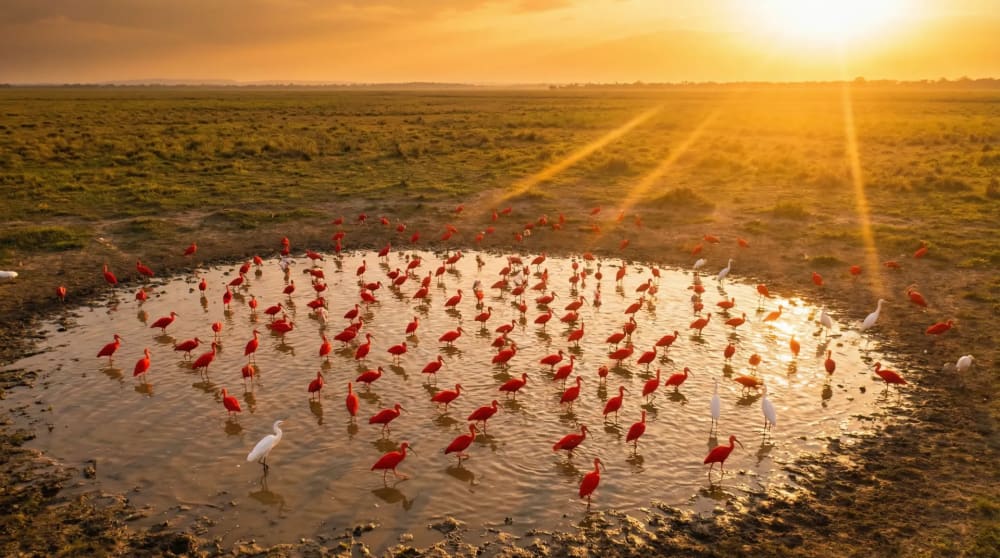
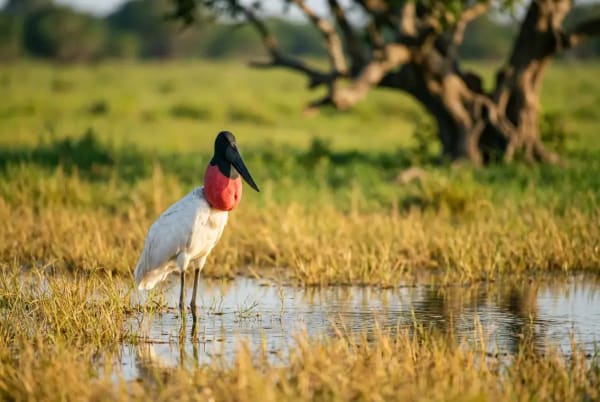
The Llanos savannas in eastern Colombia transform during the dry season (January to March) into a spectacle that experienced travelers compare to the Okavango Delta. Tens of thousands of ducks, herons, storks, and brightly colored scarlet ibises concentrate at shrinking waterholes. Among them the majestic Jabiru Stork — the largest flying bird in South America with a wingspan of 2.8 meters and a bright red throat pouch. Macaws circle freely over the savanna, and with a little luck, jaguars, capybaras, and anacondas may make an appearance.
Los Llanos — Hacienda Lodges
- Location — Eastern plains, 3-4h from Villavicencio
- Lodge — From about 60-120 USD/night (full board + excursions)
- Best time — January to March (dry season)
- Getting there — Short flight Bogota-Villavicencio (from about 40 USD)
Amazon (Leticia) — Lowland rainforest and living fossils
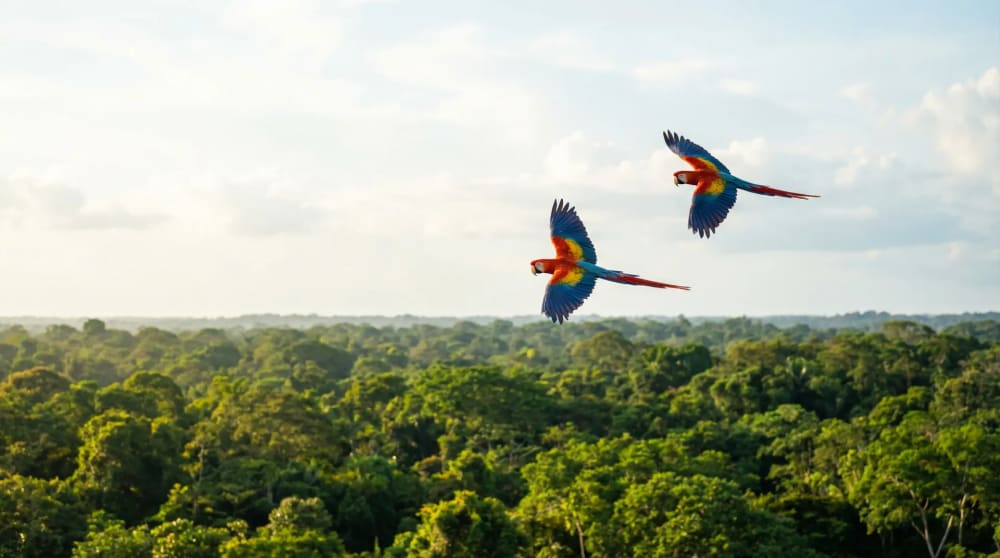
Over 750 bird species live in the region around Leticia and Puerto Narino — about a third of all Colombian birds on a fraction of the country's area. Macaws and toucans are a common sight here. The real curiosity is the Hoatzin: a living fossil that digests leaves like a cow through fermentation, whose chicks carry prehistoric claws on their wings — and smells surprisingly strong. A bird you won't forget. More about the region in the Amacayacu National Park .
Leticia & Puerto Narino — Amazon Birding
- Location — Southernmost point of Colombia, border Peru/Brazil
- Lodges — From about 50-120 USD/night
- Best time — June to October (dry season)
- Access — Flight Bogota-Leticia (2.5h), no road connection
Tatama National Park & Cerro Montezuma — for advanced birders
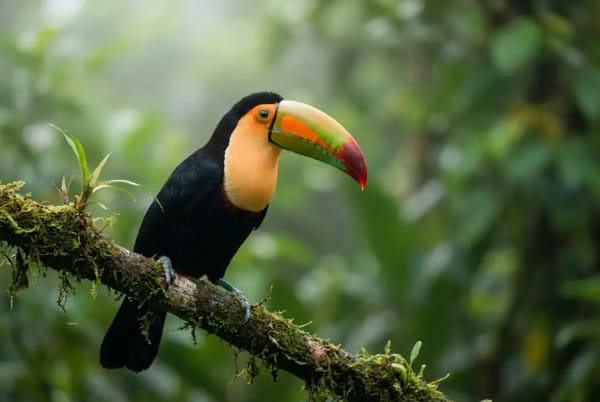
Cerro Montezuma is considered by experts to possibly be the best single location for birdwatching in all of Colombia: over 620 documented species, 15-16 endemics, and on good days nearly 100 species in 24 hours. The Tatama National Park is located in the Choco biome — one of the most species-rich and humid ecosystems on Earth, stretching from Panama to Ecuador. Choco endemics like the toucan-barbet, the golden-tanagers, and the Tatama tapaculo make this region a must-visit for ambitious birders.
Tatama National Park & Cerro Montezuma
- Location — Western Cordillera, 2-3h from Pereira
- Lodges — 60-120 USD/night (Montezuma Rainforest Lodge)
- Best time — Jan-Feb and Jul-Aug (less rain)
- Important — 4x4 recommended, not for beginners
Bogota & Chingaza — Birding from the capital
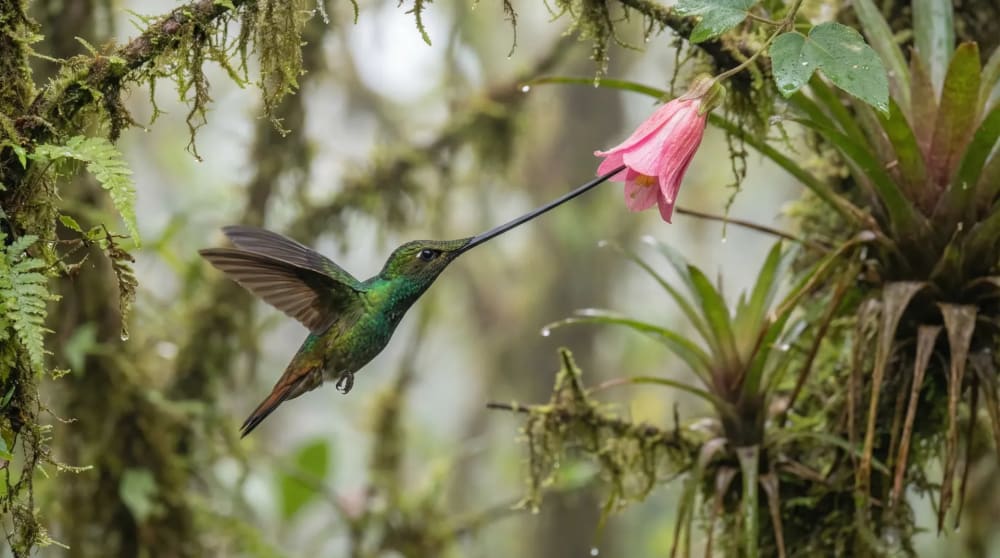
You land in Bogota and can experience Colombia's bird life already the next morning. In the Hummingbird Observatory La Calera, only 9 km from the capital, you can observe 14 to 20 hummingbird species up close — including the sword-billed hummingbird, the only bird in the world whose beak is longer than its body. Perfect also for absolute beginners.
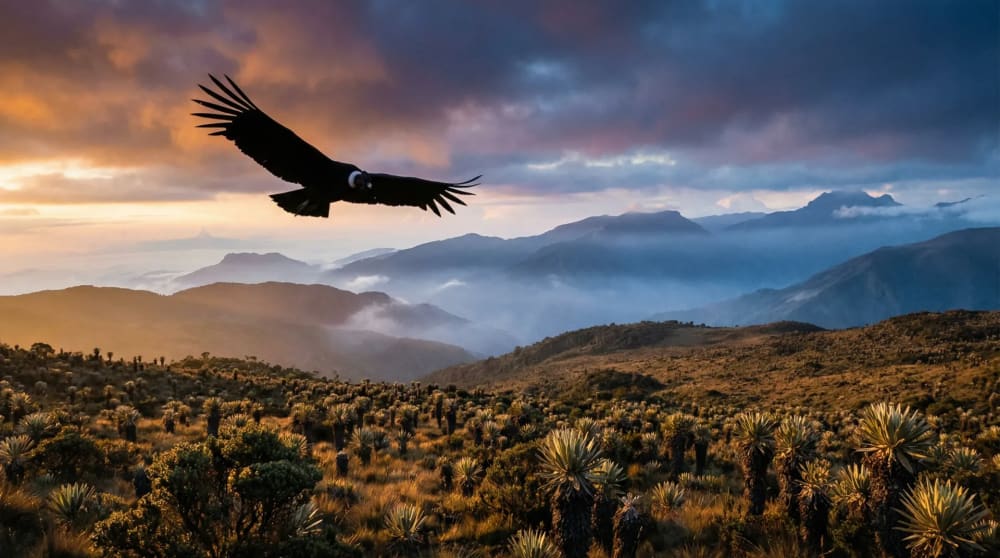
In the nearby Chingaza National Park (1.5 hours from Bogota) Andean condors with a wingspan of 3.2 meters, paramo specialists, and the endemic Bogota rail live — a bird that occurs only on the high plateau around the capital. About 3,700 individuals remain.
Chingaza National Park — Day trip from Bogota
- Location — 1.5h from Bogota (2,800-3,400 m)
- Entrance fee — About 50,000 COP (~12 USD)
- Day tour — About 80-150 USD/person including guide + transport
- Provider — Bogota Birding ( bogota.birding@gmail.com )
These bird species you should have seen
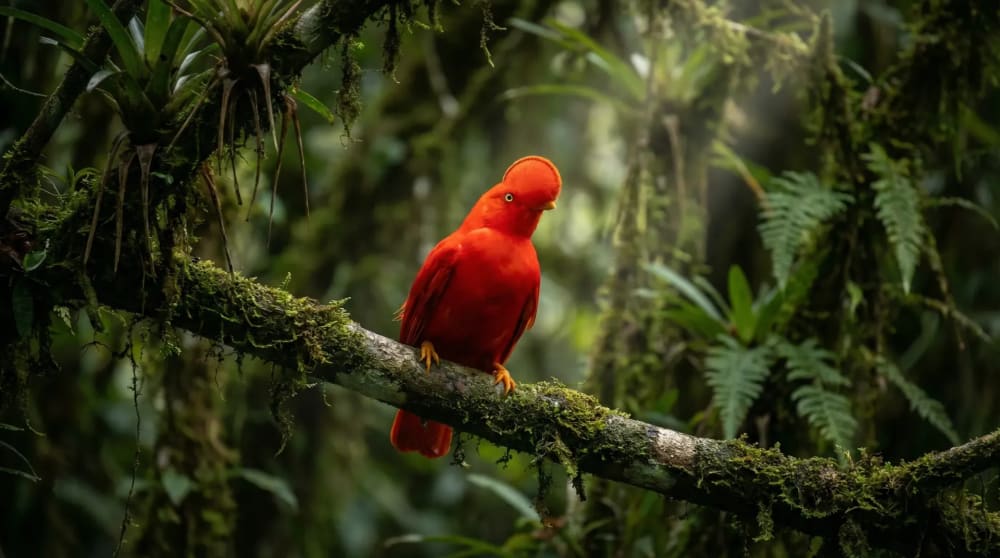
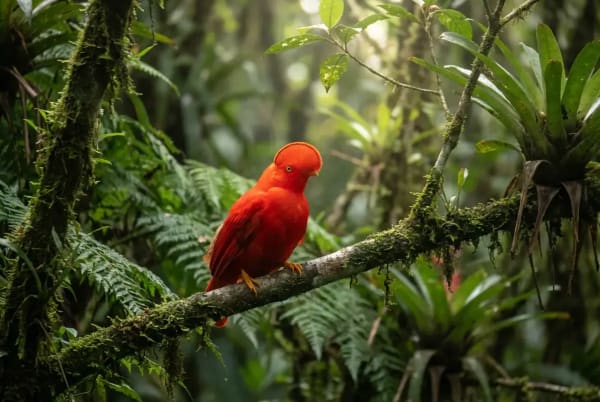
- Andean cock-of-the-rock (Rupicola peruvianus) — Bright scarlet with a rounded crest. In Jardin, up to 20 males simultaneously dance at their lek (10 min from the town, 12,000 COP entrance, best time 15-17 o'clock). A spectacle that you won't forget quickly.
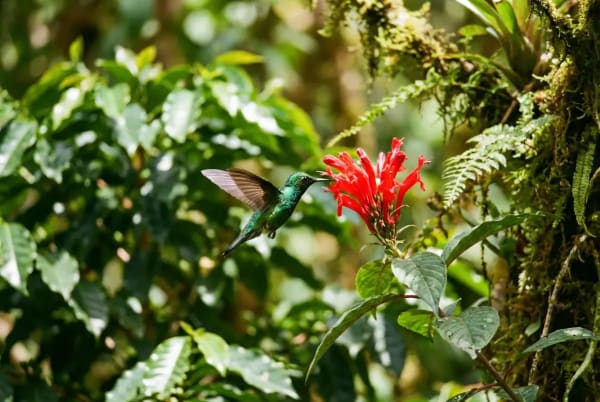
- Sword-billed hummingbird (Ensifera ensifera) — The only bird in the world whose beak is longer than the rest of its body (8-12 cm). Co-evolved over millennia with Passiflora mixta — a flower that only it can reach. Can be observed in La Calera near Bogota and in the coffee region.
- Andean condor (Vultur gryphus) — 3.2 meters wingspan, the largest flying bird on Earth. Unfortunately critically endangered in Colombia. Best chances in Chingaza National Park and in the paramo regions of the Andes.
- Hoatzin (Opisthocomus hoazin) — A living fossil: digestion through fermentation like a cow, prehistoric claws on the wings of the chicks — and a smell you won't forget. Common in the Amazon near Leticia.
- Yellow-billed parrot (Ognorhynchus icterotis) — Endemic, fewer than 1,000 individuals. Lives exclusively in wax palm forests in Cocora Valley and near Jardin. The conservation program by ProAves has stabilized the population — a success story in Colombian conservation.
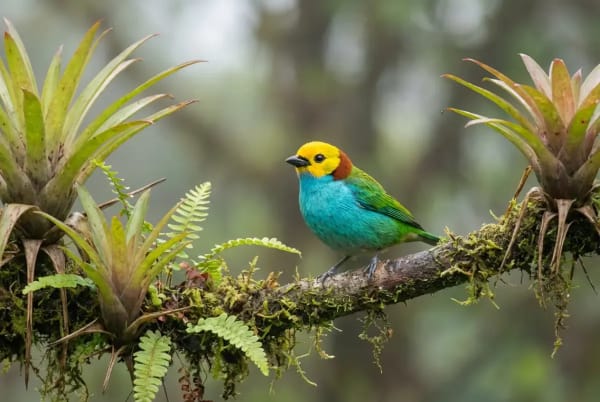
- Colorful tanager (Chlorochrysa nitidissima) — Endemic to the Western Andes. Yellow face, turquoise blue underparts, chestnut-brown ears — as if someone studied color theory before designing this bird. Best chances at Tatama and around Cali.
- Jabiru stork (Jabiru mycteria) — The largest flying bird in South America: 2.8 meters wingspan, bright red throat pouch. Regularly seen in the Llanos from January to March when it hunts at the watering holes of the savanna.
Best travel time for birdwatching
Birdwatching in Colombia is possible all year round — there is no bad month. The two dry seasons generally offer the most comfortable conditions. However, during the rainy season, many species are more active and vocal during their breeding season. North American migratory birds stay in Colombia from October to April.
| Region | Jan | Feb | Mar | Apr | May | Jun | Jul | Aug | Sep | Oct | Nov | Dec |
|---|---|---|---|---|---|---|---|---|---|---|---|---|
| Sierra Nevada/Minca | ++ | ++ | ++ | + | + | o | + | + | o | o | + | ++ |
| Coffee region | ++ | ++ | + | + | + | + | ++ | ++ | + | + | + | ++ |
| Los Llanos | ++ | ++ | ++ | + | o | o | + | + | o | o | o | + |
| Amazonas/Leticia | o | o | o | + | + | ++ | ++ | ++ | ++ | ++ | + | o |
| Tatama | ++ | ++ | + | o | o | + | ++ | ++ | + | o | o | + |
| Bogota/Chingaza | ++ | ++ | ++ | + | o | o | + | ++ | + | o | o | ++ |
Legend: ++ Ideal conditions | + Good | o Limited (rainy season)
Global Big Day in May
Every year in May, Colombia celebrates the Global Big Day — the world's largest bird counting day, organized by the Cornell Lab of Ornithology. In 2025, Colombia counted 1,560 species in a single day and once again won first place worldwide. Throughout the country, accompanying birding events take place, and local guides offer special tours. If you want to experience this spectacle: travel to Colombia in early May.
For more information on optimal travel planning, see our guide to the best time to travel to Colombia .
Combine bird watching with your Colombia round trip
You don’t have to be an avid birder to experience Colombia’s birdlife. These three routes show how bird watching can be integrated into a Colombia round trip — from a taster experience to a three-week intensive tour.
Beginner route (7 days) — approx. 60-80 species
Day 1 — Bogota — Chingaza & La Calera
Day 3 — Coffee region — Salento & Cocora Valley
Day 6 — Jardin — Andean cock-of-the-rock
Note: This route can be ideally combined with our Coffee & Caribbean round trip. Inquire now without obligation.
Enthusiast route (14 days) — approx. 150-250 species
Day 1 — Bogota — Chingaza & La Calera
Day 3 — Coffee region — Salento & Cocora
Day 6 — Jardin & Medellin
Day 8 — Tatama / Cerro Montezuma
Day 11 — Cali & Western Andes
Note: Suitable for our Colombia Intensive 3-week round trip — with a birding extension. Inquire now without obligation.
Hardcore route (21 days) — approx. 300-450 species
Day 1 — Bogota — Chingaza
Day 3 — Coffee region
Day 6 — Tatama & Montezuma
Day 9 — Sierra Nevada & Minca
Day 14 — Los Llanos
Day 17 — Amazonas — Leticia
Day 20 — Bogota — Departure
Note: We will plan this route individually for you — tailored to your desired species and your pace. Inquire now without obligation.
Insider Tip
Do you want to combine birdwatching with the classic highlights of Colombia? Our Nature Round Trip Tayrona & Amazonas or the Colombia Intensive 3 Weeks offer the ideal basis for a birding extension. Talk to us — we will customize every route to your interests. Inquire now without obligation .
Equipment, Guide & Costs
A local birding guide is the best investment for your trip. The guides know the best vantage points, identify birds by their calls, and significantly increase your sighting rate. Colombia has built a growing network of professional birding guides in recent years — we are happy to connect you with the best in each region.
Equipment Checklist:
- Binoculars: 8x42 for forest birding (wide field of view, more brightness). The most versatile choice for Colombia's diverse habitats
- Merlin App: Free (Cornell Lab). Download Colombia Pack offline before departure — the sound ID identifies birds via microphone in real-time, even if you can't see the bird
- Field Guide: "Field Guide to the Birds of Colombia" by Miles McMullan (standard work, about 600 pages)
- Clothing: Layering system is essential (Leticia at 90 m vs. Chingaza at 3,400 m). Quick-drying, waterproof jacket, sturdy hiking shoes
- Insect Protection: DEET or Picaridin for lowland regions and Amazonas. More details in our Colombia Packing List
Birdwatching in Colombia — Costs Overview All prices are as of 2024/2025. Conversion approx. 4,300 COP = 1 EUR. All information without guarantee.
Birdwatching as a Peace Project
Since the peace treaty in 2016, former conflict areas have become birding hotspots. In regions like Guaviare and Anori (Antioquia), former fighters now work as birding guides — trained by conservation organizations and supported by international programs. A study estimates the potential for over 7,500 jobs and 9 million USD in economic output. Booking there directly invests in peace work. More on the current situation in our Safety Guide .
More Travel Information for Colombia
- Best Travel Time — When the optimal months are for each region
- Vaccinations and Health — Yellow fever and other mandatory vaccinations
- Safety — Current situation and practical tips
- Arrival and Flights — Flight connections and domestic flights
- Entry and Visa — Entry requirements for Germans
- Packing List — What you need for your trip to Colombia
- National Parks — Tayrona, Cano Cristales and the best nature destinations
- Diving & Snorkeling — Two oceans, one diving area
Your dream holiday, tailor-made by true connoisseurs.
From the first spark of inspiration to the moment you return home full of stories, we’re by your side – whether by phone, email or WhatsApp, whenever you need us. Every journey we design is as unique as you are: individually crafted with exclusive privileges and exceptional arrangements that make your experience truly unforgettable.
Experts for your trip

You might also like this

This image was generated with AI.
This image was generated with AI.

This image was generated with AI.