


Riviera Maya & Caribbean Coast
The quiet side of the Mexican Caribbean
The quiet side of the Mexican Caribbean
Tulum, Bacalar, Holbox, and Cozumel — the quiet side of the Mexican Caribbean: Maya ruins above the sea, a lagoon in seven shades of blue, whale sharks from May to September, and the second largest barrier reef in the world. Four days minimum, completely without a hotel zone.

Best travel time
November to April
Why the Caribbean coast beyond Cancún is different
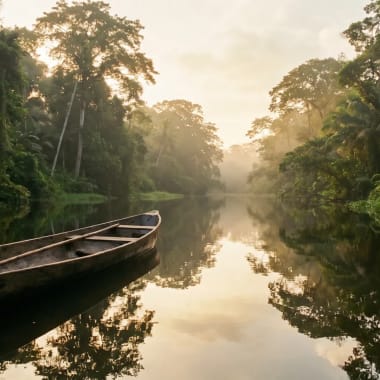
Just before seven in the morning, the lagoon of Bacalar lies still as glass. The light changes in minutes from pearl gray to a turquoise that stretches in seven shades to the horizon, and the only sound is the dripping from the kayak paddle. Later, the air over the cliffs of Tulum smells of salt and warm limestone, and frigatebirds circle in the wind.
Most Mexico travelers land at Cancún Airport, drive to a resort, and see exactly that from the Caribbean coast: a resort. What they miss is the quiet side of the Riviera Maya — the Mesoamerican reef off Cozumel, considered by WWF to be the second largest barrier reef in the world, the Sian Ka'an Biosphere Reserve (UNESCO World Heritage since 1987), a car-free island where whale sharks migrate from mid-May to mid-September, and cenotes where light falls like through church windows.
We intentionally exclude the hotel zone of Cancún, Playa del Carmen, and Isla Mujeres — those who want to experience the Caribbean quietly will find it in Tulum, Bacalar, Holbox, and underwater off Cozumel. Anyone planning a Mexico road trip should plan at least four days for this coast — as a start after the long-haul flight or as a conclusion.
Tulum, Bacalar, Holbox, Cozumel — the quiet side of the Riviera Maya
Four places, four characters — and up to 300 kilometers apart. A trip therefore sensibly combines two or three of them.
Tulum — ruins by the sea and the Parque del Jaguar
Tulum was built as a trading port directly on a cliff above the Caribbean and flourished in the 13th to 15th centuries. The Castillo and Temple of the Frescoes can be seen in an hour; the real experience is the view from the cliff over the water. According to INAH statistics, Tulum was the third most-visited ruin site in Mexico in 2025, with over 790,000 visitors after Chichén Itzá and Teotihuacán — come at the opening at eight o'clock, then the site almost belongs to you alone.
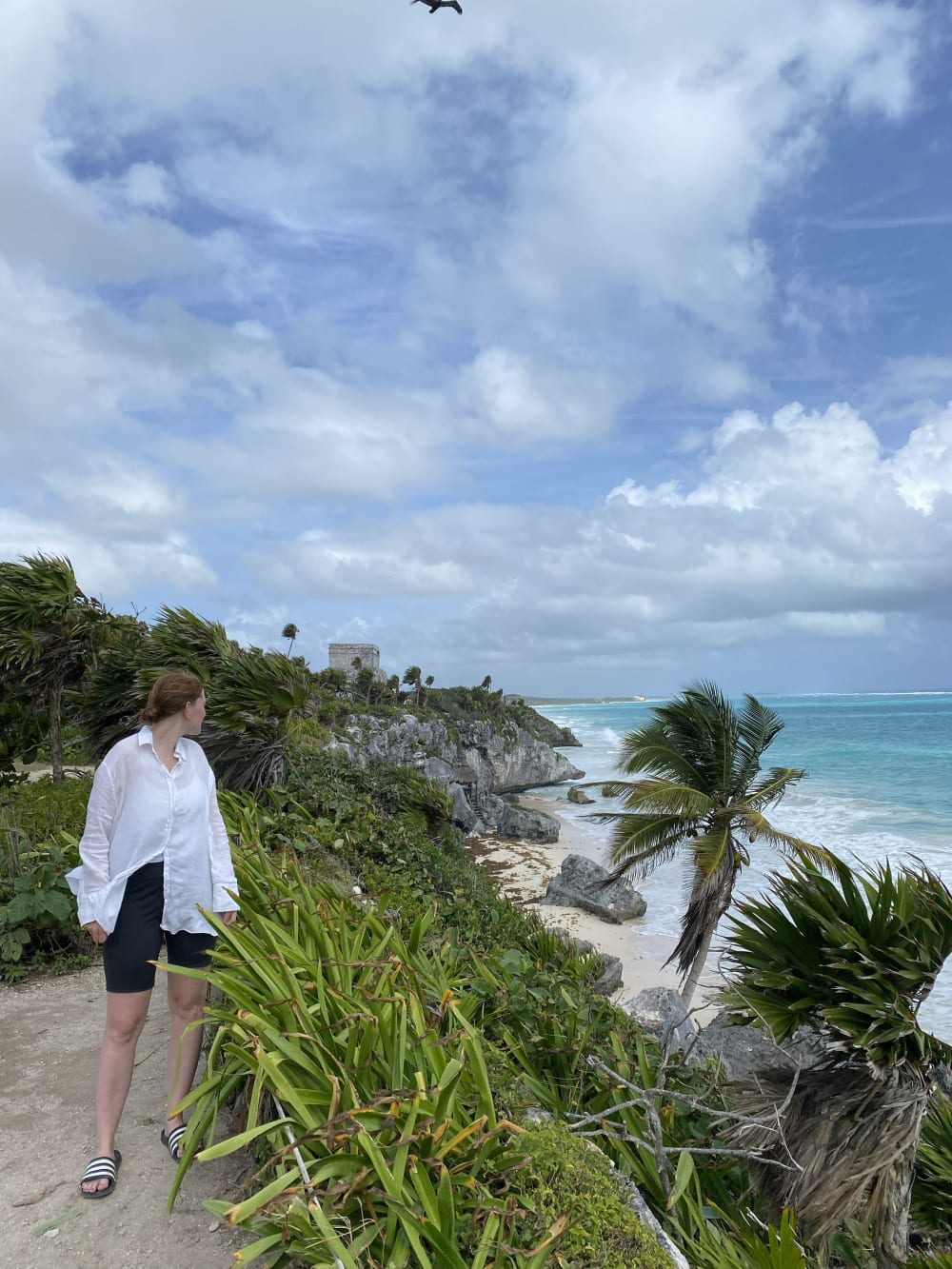
Since September 2024, the ruins are in the Parque del Jaguar, a protection area of about 2,900 hectares made up of dunes, mangroves, and beach. Tulum itself consists of two worlds: the Pueblo on the road to Cobá with taquerías and fair prices — and the Zona Hotelera, a twelve-kilometer beachfront road with boutique hotels and beach clubs. We recommend eating in the Pueblo and sleeping on the beach.
Tulum — ruins and Parque del Jaguar
- Admission — about 515 MXN (about 26 EUR) for foreigners: INAH 100 MXN, CONANP wristband 120 MXN, park fee 295 MXN — is regularly adjusted
- Opening hours — daily 08:00–17:00, last entry 15:30
- Location — Carretera 307, 3 km north of Tulum Pueblo
- Tip — Bring cash in pesos — card terminals at the cash registers regularly fail
Sian Ka'an — Biosphere Reserve south of Tulum
Twenty minutes by car south of Tulum begins Sian Ka'an, "Origin of Heaven" in Yukatek Maya — a UNESCO World Heritage site since 1987, over 5,000 square kilometers of mangroves, lagoons, and reef. The easiest access is Muyil: a small ruin site, a wooden boardwalk through the mangroves, then by boat over two lagoons to a canal that the Maya dug over a thousand years ago. There, you put on the life jacket and float for half an hour with the current — among orchids, herons, and the smell of marsh grass.
Insider tip
Muyil instead of Punta Allen: The day trip to Punta Allen costs 170 to 250 USD and three hours of gravel road. The Muyil variant can be done in half a day: admission to the reserve about 70 MXN, ruins about 65 MXN, wooden boardwalk 50 MXN, and 1,000 MXN (about 50 EUR) for boat and float — all together under 65 EUR.
Bacalar — the lagoon of seven colors
Three hours by car south of Tulum lies Bacalar, a Pueblo Mágico since 2006, on a 42-kilometer long freshwater lagoon, whose white limestone bottom makes the water glow in seven shades of blue. At the shores, living stromatolites grow — calcium structures made up of cyanobacteria, which are among the oldest life forms on Earth; according to a study published in the journal Sedimentology (Gischler, Gibson & Oschmann, 2008), the more than ten-kilometer-long occurrence belongs to the largest freshwater stromatolite colonies in the world. Touching is prohibited.
Worth seeing at the shore: the Cenote Azul, an approximately 90-meter-deep basin on the road (35–50 MXN, daily 10–18), and the Fuerte de San Felipe from 1733, built against English pirates, now a small museum (Tue–Sun 09–19, 110 MXN). The pirates also gave the Canal de los Piratas its name — a sandbank where you stand in water up to your hips.
Insider tip
Kayak or sailboat instead of motorboat. The lagoon has no drainage — sunscreen and motor oil stay in the water. Therefore, we book sailing catamarans or kayaks: four hours with stops at Cenote Negro, Canal de los Piratas, and stromatolites for 800–1,500 MXN (about 40–75 EUR) per person. Best start: 07:00, when the water is glassy smooth.
Holbox — car-free island and whale sharks in summer
Holbox is a 42-kilometer long, two-kilometer wide sandy island between the Gulf of Mexico and the Caribbean — without cars, without asphalt, with golf carts on sandy roads. It belongs to the Yum Balam protection area, where flamingos wade at Punta Mosquito, and on summer nights the sea glows: From April to November, most intensely from June to August during the new moon, the water glimmers bluish with every step.
The reason we include Holbox in summer is the whale sharks: From mid-May to mid-September, the up to twelve-meter-long giants gather off the island — boats leave at half-past six in the morning, and you swim two at a time with a guide next to the largest fish in the world.
Holbox — ferry and whale shark season
- Ferry — Chiquilá–Holbox 330 MXN (about 17 EUR) one way, 25 minutes, 06:00–21:30 every 30 minutes
- Whale sharks — mid-May to mid-September, best density July and August; group tour 3,150 MXN (about 160 EUR) per person
- Location — Chiquilá is about 145 km northwest of CUN Airport, about 2 hours drive
- Tip — Leave rental car in the supervised parking lot in Chiquilá (100–200 MXN per day)
Cozumel — Palancar, Columbia, and the Mesoamerican Reef
When Jacques Cousteau dove off Cozumel in 1961, he simply called the Palancar Reef "Paradise". The island's reefs belong to the Mesoamerican Reef, considered by WWF to be the second largest barrier reef in the world, and have been protected since 1996 as Parque Nacional Arrecifes de Cozumel. All dives are drift dives: You drift along the walls of Palancar Gardens, Columbia Deep, and Santa Rosa Wall, with visibility of 25 to 35 meters, among eagle rays and turtles; snorkelers can find five to ten meters depth in Palancar Shallows.
The ferry from Playa del Carmen (Ultramar, Winjet) takes 30 to 40 minutes (280–330 MXN one way); the wristband for the marine national park costs 225 MXN per day.
Insider tip
Sunday is Cozumel day. In the high season, up to eight cruise ships dock daily on the west coast — almost none on Sundays. Those who choose a Sunday for their dive day and select the reefs south of Punta Sur will almost have Palancar to themselves. Best visibility from November to March, calmest sea from May to September.
Cenotes of the coast — Dos Ojos and Gran Cenote
The Yucatán Peninsula has no rivers. Rainwater seeps into the limestone and reappears at collapsed spots as cenotes — sacred entrances to the underworld for the Maya, glistening freshwater basins at 24 degrees for you. We describe the famous cenotes of the interior at Yucatán ; two are located directly off Tulum.
Dos Ojos — two eyes beneath the jungle
Dos Ojos consists of two cenotes connected by a cave and is part of the Sac Actun system, which the Gran Acuífero Maya project mapped as the longest known underwater cave system in the world in 2018. Snorkelers see stalactites just below the water surface, while cave divers follow the lines into the darkness; the highlight of the snorkeling tour is the Bat Cave with bats under the ceiling.
Cenote Dos Ojos
- Admission — 400 MXN (about 20 EUR) including life jacket; guided snorkeling tour with Bat Cave 800–850 MXN
- Opening hours — daily 08:00–17:00
- Location — Carretera 307, about 20 minutes drive north of Tulum
- Tip — Cash only in pesos; arrive before 09:30, afterwards the tour buses arrive
Gran Cenote — turtles in the open basin
The Gran Cenote on the road to Cobá is the most open of the coastal cenotes: a semicircular basin with sunlight, water lilies, and freshwater turtles — ideal for your first cenote visit. The rules are strict: Showering before entry is mandatory, chemical sunscreen and insect spray are prohibited.
Gran Cenote
- Admission — about 500 MXN (about 25 EUR); snorkel rental set 100–150 MXN
- Opening hours — daily 08:00–17:00
- Location — 4 km northwest of Tulum Pueblo, about 8 minutes by taxi
- Tip — UV shirt instead of sunscreen
Your Riviera Maya program — four days
Four days are enough for Tulum with cenotes and Sian Ka'an plus a second location. Which one is determined by the travel season: From mid-May to mid-September choose Holbox because of the whale sharks; otherwise, Bacalar.
Day 1 — Arrival and Tulum in the evening
Transfer with our driver from CUN or TQO Airport to the beach hotel, first walk by the sea, dinner in the Pueblo — tacos al pastor on Avenida Tulum, paid in pesos.

Day 2 — Ruins at sunrise, cenotes in the afternoon
At eight o'clock at the ruins, when the light falls flat over the Castillo. Afterwards, Gran Cenote or Dos Ojos, lunch at Tikin Xic, the achiote-marinated grilled fish of the coast.
Day 3 — Sian Ka'an and onward to Bacalar
Early to Muyil, float through the Maya canal, then three hours south. Arrival in Bacalar at sunset, which colors the water from turquoise to copper to violet.
Day 4 — Sailing tour on the lagoon, return trip
Sailing catamaran from seven o'clock to stromatolites, Cenote Negro, and Canal de los Piratas. In the afternoon, continue via Chetumal Airport (40 minutes) or with the driver back to CUN Airport.
Holbox variant: You swap days 3 and 4 for the trip to Chiquilá, the whale shark tour early in the morning, and one night on the island. Those who have six days can connect all three locations with Cozumel as a dive day in between.
Where to stay — Mayakoba and Tulum
The three hotels we book most frequently on this coast are located in the Mayakoba resort area north of Playa del Carmen — 600 hectares of mangroves, freshwater channels, a kilometer of beach, and the El Camaleón golf course, which hosted the first PGA Tour event outside the U.S. and Canada from 2007 to 2022. 45 minutes to CUN Airport, 50 minutes to Tulum, ten to the Cozumel ferry. We know all three houses personally:
Private pool villas between mangroves and sea
From about 900 EUR / night
- 163 villas, each with its own pool
- Roughly 100 million USD renovation, completed 2025
- Asian-influenced spa, six restaurants
- Lagoon and beach villas for families
Number one in the Riviera Maya according to U.S. News 2026 — suites by the lagoon and beach
From about 900 EUR / night
- Travel + Leisure World's Best 2026: 15th place among resorts in Mexico
- Forbes Travel Guide 2026: Five-Star Resort and Five-Star Spa
- Suites with plunge pool and boat dock on the canal
- Zapote Bar: North America's 50 Best Bars 2025
New since February 2026 — wellness and craftsmanship instead of glitter
From about 550 EUR / night
- 182 rooms and suites, some with plunge pool
- Formerly Andaz, completely remodeled
- Spa Alila with temazcal ceremonies
- Most affordable entry of the three Mayakoba houses
In Tulum, we recommend boutique hotels in the Zona Hotelera — 20 to 40 rooms, palapa roofs, the beach at the door, 350 to 800 EUR per night in the high season. In Bacalar, the prettiest houses have their own dock on the water (150–450 EUR), while in Holbox, small beach hotels (200–500 EUR).
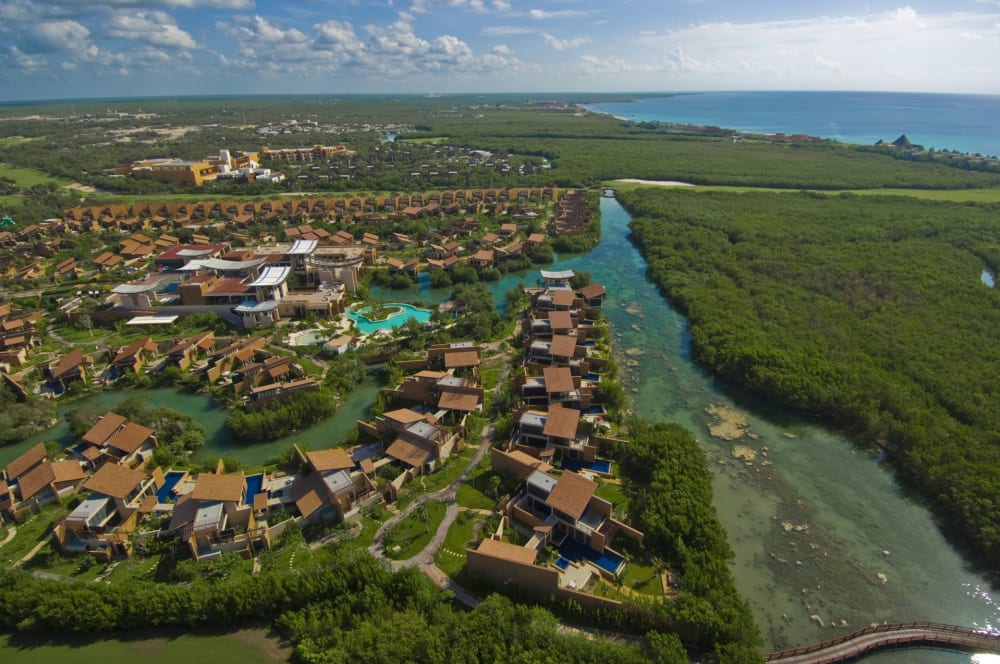
Let us find the accommodation that suits your expectations — we know which villas in Mayakoba are located on the canal and which rooms in Tulum do not hear the generator. Make a request .
Good to know
Best travel time for the Riviera Maya
The dry season from November to April is the classic travel time: 24 to 29 degrees, little rain, clearest water off Cozumel, hardly any sargassum; December to February are high season. The rainy season from May to October brings short afternoon showers, warm water at 29 degrees — and whale sharks off Holbox. Hurricane season is from June to November, with the highest risk from August to October. Detailed in our guide to the best travel time for Mexico .
Sargassum — honestly considered
From May to October, peaking in June and July, brown algae are drifting to the Caribbean coast; the Oceanography Lab of the University of South Florida predicted a record year in 2026. The eastern beaches of Tulum are mainly affected, while Holbox, the west coast of Cozumel, and the freshwater lagoon of Bacalar are hardly affected. Those traveling in summer should plan their beach days there — the cenotes are algae-free anyway.
Arrival — Cancún (CUN) and Tulum (TQO)
Cancún Airport (CUN) is the region's hub: Condor and Discover Airlines fly nonstop from Frankfurt in about twelve hours. Since December 1, 2023, there is also Tulum Airport (TQO), 25 kilometers south of the city — often the shorter option for domestic flights from Mexico City or Oaxaca. More in our guides to flights to Mexico and to the entry .
Safety in the Riviera Maya
The Yucatán Peninsula with the state of Quintana Roo is considered safe in a national comparison; the tourism corridor is visibly protected, with pickpocketing being the main risk. Tulum, Bacalar, Holbox, Cozumel, and Mayakoba are well-traveled — our guests have been moving around without incidents for years. A few habits help: pre-booked driver or hotel taxi, not walking alone on the unlit beach road of Tulum at night, keeping valuables in the room safe instead of the rental car, and making long-distance trips during the day. The Foreign Office recommends the app "Guest Assist" — the latest information is summarized in our guide to safety in Mexico .
Basic caution
Only use pre-booked transfers or hotel taxis — no street taxis; Uber and DiDi work only partially on this coast. Withdraw cash only from ATMs in banks or shopping centers, and do not leave drinks unattended in beach clubs. And take the sun seriously — UV exposure is extreme year-round.
Getting around locally
For Tulum, Bacalar, and the cenotes, a driver is the most relaxed solution — we organize transfers and day trips. A rental car is worthwhile for three days (approx. 45–70 EUR per day including compulsory liability); Highway 307 is well developed. The Tren Maya connects the airport CUN twice daily in approximately 1:45 hours with Tulum (tourist class 449.50 MXN) and continues to Bacalar; ADO buses take 2 to 2.5 hours (300–420 MXN). What to pack is outlined in our packing list for Mexico .
Costs at a glance
- Ruins Tulum incl. Parque del Jaguar — approx. 515 MXN (approx. 26 EUR)
- Cenote Dos Ojos / Gran Cenote — 400 MXN (approx. 20 EUR) / approx. 500 MXN (approx. 25 EUR)
- Sian Ka'an from Muyil — entries approx. 185 MXN (approx. 9 EUR) + boat 1,000 MXN (approx. 50 EUR)
- Sailing tour Bacalar — 800–1,500 MXN (approx. 40–75 EUR) per person
- Ferry Chiquilá–Holbox — 330 MXN (approx. 17 EUR) per trip
- Whale shark tour Holbox — 3,150 MXN (approx. 160 EUR) per person
- Ferry to Cozumel — 280–330 MXN (approx. 14–17 EUR) per trip, park wristband 225 MXN (approx. 11 EUR)
- Private transfer Airport CUN–Tulum — approx. 2,300 MXN (approx. 115 EUR) per vehicle; ADO bus 300–420 MXN (approx. 15–21 EUR)
- Boutique hotel Tulum / Mayakoba resort — from approx. 350 EUR / from approx. 550 EUR per night
Prices as of September 2026. 1 EUR ≈ 19.6 MXN. At the cenotes and in Chiquilá: cash only in Pesos.
Discover more of Mexico
The Caribbean coast is the natural start or end of a Mexico round trip . In two hours by car, you can reach Valladolid and Chichén Itzá from Tulum, and in five hours Palenque in the Chiapas rainforest from Bacalar. Those starting inland can fly from Mexico City or Oaxaca to the coast in two hours and conclude their journey by the sea.
Yucatán — Mérida, Chichén Itzá, Valladolid, and the cenotes of the interior
Chiapas — Palenque, San Cristóbal, and waterfalls in the rainforest
Mexico City — Roma, Condesa, Polanco, and Teotihuacán
Oaxaca — Mezcal, markets, and the Pacific coast of Puerto Escondido
Let us put together your Riviera Maya program — with whale shark appointment, sailboat on the lagoon, and the right room on the beach. Schedule a consultation .
To book a trip or for more information, contact us. We'll help you plan and guide you through your upcoming adventure!
Frequently Asked Questions
Yes — the Yucatán Peninsula with Quintana Roo is considered safe in a national comparison, and the tourism corridor of the Riviera Maya is visibly protected. Tulum, Bacalar, Holbox, Cozumel, and Mayakoba are well-traveled; the main risk is pickpocketing. Use pre-booked transfers or hotel taxis, travel on long-distance routes during the day, do not leave valuables in the rental car, and install the app "Guest Assist" recommended by the Foreign Office.
Four days are the minimum: two for Tulum with ruins, cenotes, and Sian Ka'an, two for Bacalar or Holbox. Six days allow for all three places plus a dive or snorkeling day on Cozumel. As a start after the night flight, we recommend two quiet nights in Mayakoba or Tulum before heading inland — or vice versa, concluding the coast after Mexico City, Oaxaca, and Chiapas.
November to April: dry, 24 to 29 degrees, clearest water, and least sargassum. For Holbox, there is an exception — the whale sharks are only present from mid-May to mid-September, with the highest density in July and August. Bacalar is ideal year-round, as the freshwater lagoon is algae-free. Hurricane season runs from June to November, with the highest risk from August to October.
Foreign visitors currently pay around 515 MXN (approx. 26 EUR): 100 MXN INAH ticket, 120 MXN CONANP wristband, and 295 MXN fee for the Parque del Jaguar, where the ruins will be located since 2024. Open daily from 08:00 to 17:00, last entry at 15:30. Bring cash in pesos — card terminals often fail — and arrive at opening time to be ahead of the tour buses.
From mid-May to mid-September, most reliably in July and August. Boats depart around 06:30 from Holbox and travel about an hour out; in the water, there are two guests with one guide each, touching is prohibited. A group tour costs 3,150 MXN (approx. 160 EUR) per person including breakfast and lunch, a private boat for up to six people starts at 20,200 MXN. We reserve spots for you several weeks in advance.
Yes, seasonally. From May to October, peaking in June and July, brown algae drift to the east-exposed beaches of Tulum and the Riviera Maya; in 2026, according to the University of South Florida, a particularly strong year is expected. Holbox on the north coast, the west coast of Cozumel, and the freshwater lagoon of Bacalar are little affected. From November to February, the beaches are usually clear. Hotels clean daily, and the cenotes are anyway algae-free.
Most conveniently with a pre-booked private transfer (approx. 2,300 MXN / 115 EUR per vehicle, 1:45 to 2 hours), which we organize for you. The Tren Maya runs twice daily from the airport station in about 1:45 hours to Tulum (449.50 MXN tourist class), the ADO bus every one to two hours in 2 to 2.5 hours (300–420 MXN). Those arriving from Mexico City or Oaxaca have been flying directly to Tulum Airport (TQO) since December 2023, 25 kilometers south of the city.
Boutique hotels on the beach of Tulum start in the high season at about 350 EUR per night, good houses range from 500 to 800 EUR. In Bacalar, for a room by the water, you pay 150 to 450 EUR, on Holbox 200 to 500 EUR. The three resorts in Mayakoba — Alila, Banyan Tree, and Rosewood — start at around 550 to 900 EUR per night, depending on the season. We know the room categories personally.