


Oaxaca
Culinary capital, artisan villages and a coast without hotel zones
Culinary capital, artisan villages and a coast without hotel zones
UNESCO World Heritage since 1987, the cuisine of the seven moles with 26 restaurants in the Michelin Guide 2026, more than 80 percent of Mexican mezcal — and 200 kilometers of Pacific coast between the surf beaches of Puerto Escondido and the nine bays of Huatulco.

Best travel time
November to April
Why Oaxaca — Mexico's cuisine, crafts and a coast without hotel zones
Shortly after 7 a.m., the Calle Macedonio Alcalá smells of charcoal and roasted cocoa. In front of Santo Domingo, a woman sweeps the green cantera stone, and above the Sierra Norte, there is a light that is only so clear at 1,550 meters. In the evening of the same day, you can sit by the Pacific — 45 flight minutes to the south, where the sun sets behind Zicatela into the sea.

Most Mexico travelers know Oaxaca as a name on a mezcal bottle. What they miss: a historic center that has been a UNESCO World Heritage site since 1987 with the Zapotec city of Monte Albán; a cuisine that was inscribed in the UNESCO Intangible Cultural Heritage as the essence of Mexican food culture in 2010 and is represented by 26 restaurants in the Michelin Guide Mexico 2026; villages that weave, pottery and produce more than 80 percent of Mexican mezcal. And 200 kilometers of Pacific coast where hotels remain small.
Anyone planning a Mexico round trip will find in Oaxaca the chapter that connects city, countryside, and sea in one week.
Sights in Oaxaca — city, central valleys and Pacific coast
Oaxaca City — Santo Domingo, markets and mezcalerías
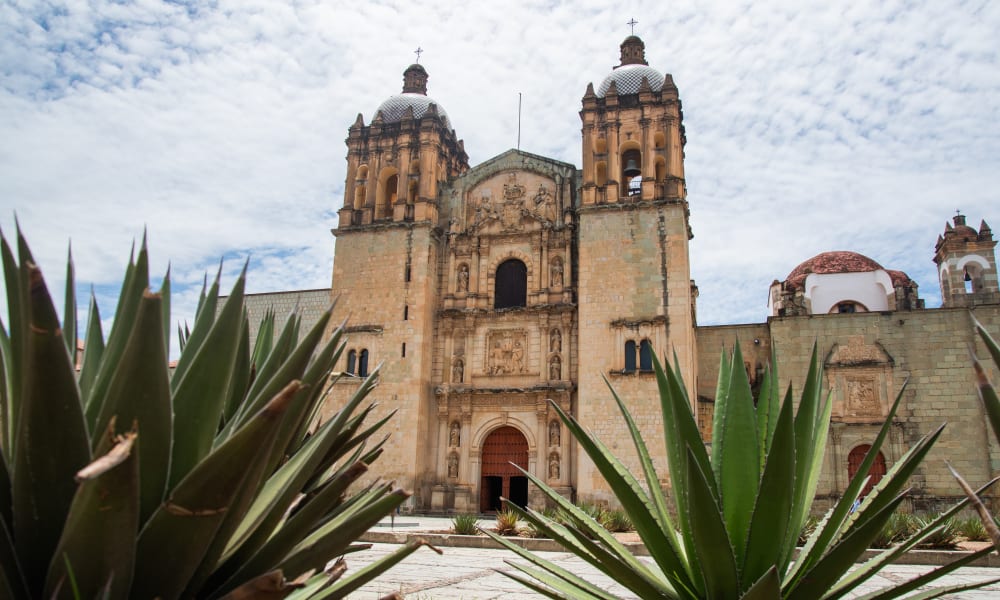
The historic center is a chessboard of single-storey colonial houses in ochre, pink and cobalt blue. Its centerpiece is the Santo Domingo Monastery (1572-1608) with a gilded rosary chapel; the Museo de las Culturas shows the treasure from tomb 7 of Monte Albán in the convent. The Alcalá leads to the Zócalo and the markets; for the evenings, we recommend the districts of Jalatlaco and Xochimilco and the mezcalerías where espadín and tobalá are served in the jícara bowl.
Museo de las Culturas de Oaxaca
- Admission — 210 MXN (approx. 11 EUR); free on Sundays only for Mexicans and residents
- Opening hours — Tue-Sat 10:00-17:30 (last entry until 17:00), Sun 10:00-15:30, Mon closed
- Location — Macedonio Alcalá / Adolfo Gurrión, in the former convent of Santo Domingo
- Tip — The Jardín Etnobotánico behind is only accessible with a guided tour — in English Tue, Thu, Sat at 11:00 (100 MXN, approx. 2 hours), in Spanish Mon-Sat 10:00, 12:00, 17:00 (50 MXN)
Two dates shape the year: the Guelaguetza, the dance festival of the 16 indigenous peoples of Oaxaca, on July 20 and 27, 2026, along with the Feria del Mezcal from July 17 to 28 — and the Día de Muertos from October 31 to November 2 with comparsas and night vigils in the cemeteries — in 2025, Sectur Oaxaca reported 88 to 90 percent occupancy in five-star hotels.
Insider tip
Día de Muertos — book the hotel six to nine months in advance; the central boutique hotels are fully booked from mid-August. The cemetery of Xoxocotlán is crowded on the night of November 1; quieter are Atzompa and the villages of the central valleys. Come with flowers, not with flash.
Monte Albán, Mitla and the central valleys
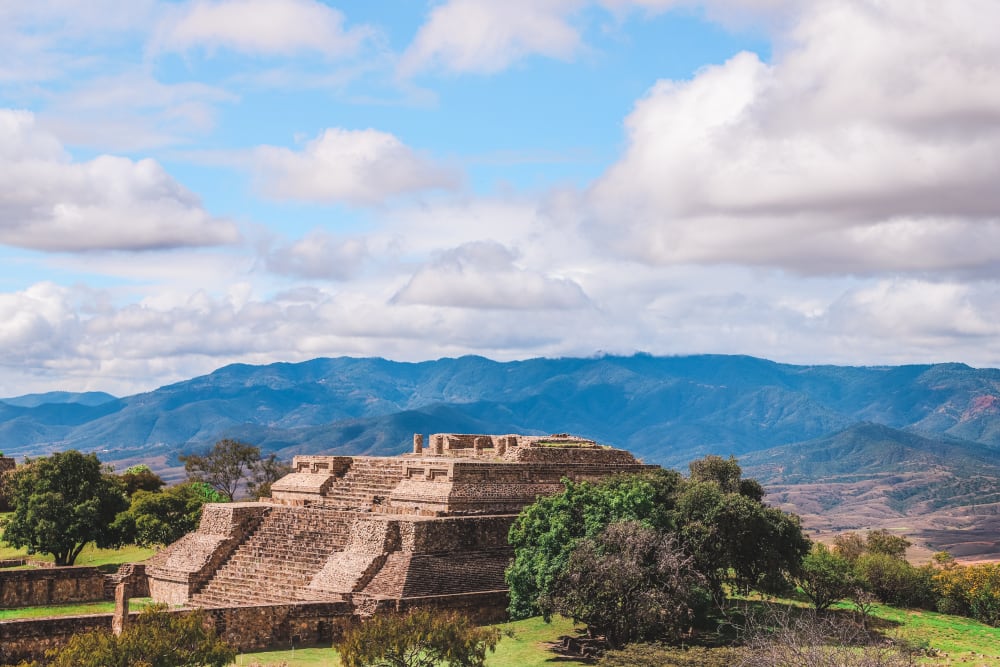
Ten kilometers to the west lies Monte Albán on a flattened ridge 400 meters above the valley: the capital of the Zapotecs, founded around 500 B.C., featuring the 300-meter-long Gran Plaza, the ball court, and the reliefs of the 'Danzantes'. At eight in the morning, the view is clearest, and by ten o'clock, you have the plaza almost to yourself.
Monte Albán
- Admission — 210 MXN (approx. 11 EUR) including site museum (INAH Category I, 2026 tariff); Mexicans and residents 105 MXN
- Opening hours — Daily 08:00-17:00, last entry 16:00
- Location — 10 km west of the historic center, about 25 minutes
- Tip — First go to the south platform — the best view over the Gran Plaza
To the east, the villages of the central valleys line the road to Mitla: Santa María del Tule with the Árbol del Tule, a 2,000-year-old cypress with a circumference of 42 meters (20 MXN); Teotitlán del Valle, where Zapotec families dye wool with cochineal and indigo and weave rugs; Mitla with stone mosaics made of thousands of grecas — 210 MXN, daily 08:00-17:00, last entry 16:30. On Sundays, Tlacolula, the largest weekly market of the valleys, is worth a visit.
Hierve el Agua — petrified waterfalls
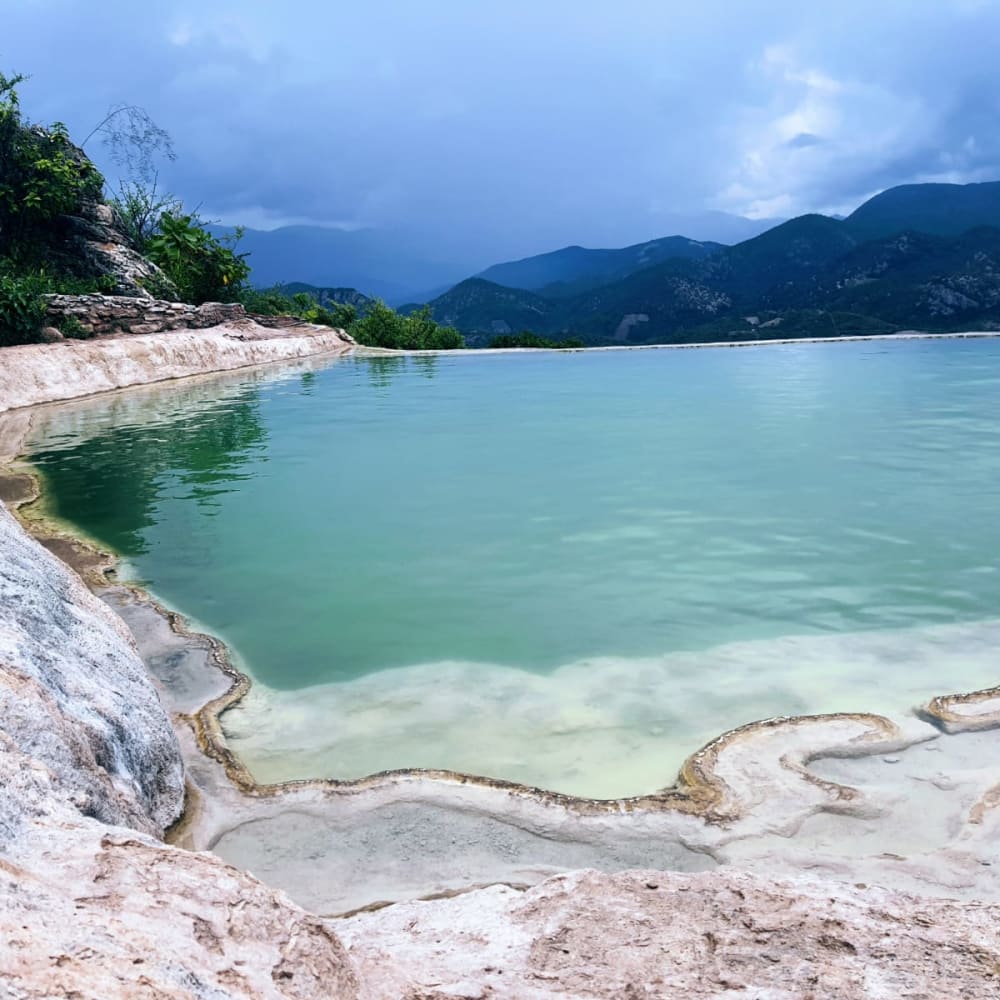
Hierve el Agua, 'the water boils', is a misnomer: The water is cool, but so rich in minerals that it has been depositing lime at the cliff edge for millennia — two white 'waterfalls' of about 30 and 12 meters, above which are natural pools at the edge. From experience: The place belongs to two communities that dispute the management; in 2021, access remained closed for over a year, shorter closures occur without notice. We never schedule the trip on the last day.
Hierve el Agua
- Admission — approx. 50–70 MXN (approx. 3–4 EUR) plus 20–30 MXN access fee from the municipality of San Lorenzo Albarradas; parking approx. 50–100 MXN; cash only
- Opening hours — Daily approx. 09:00-17:00
- Location — approx. 70 km east of Oaxaca via Mitla, 1.5–2 hours
- Tip — Confirm before your visit that access is open — we ask on site. Bring swimwear, arrive before 10 a.m.
Puerto Escondido — Zicatela, La Punta, and the lagoon
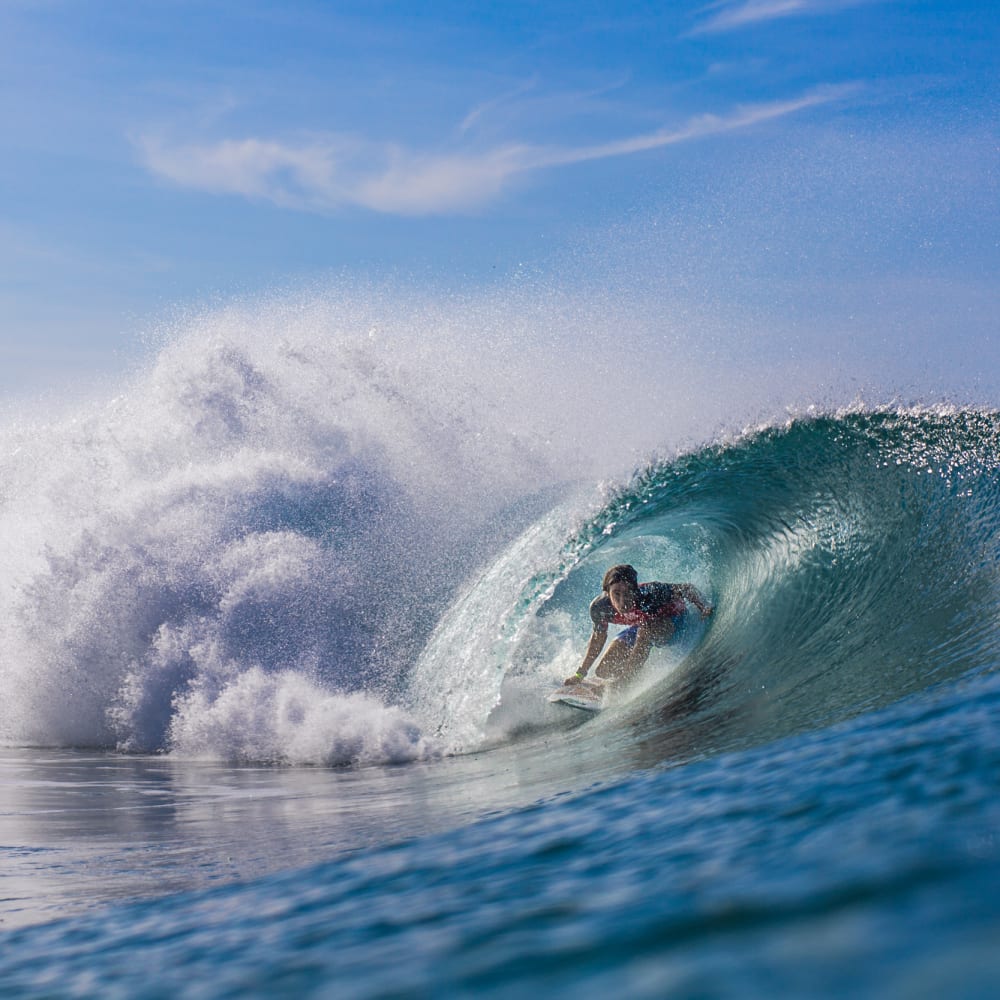
Puerto Escondido is a surf spot, not a resort. Zicatela is known as the 'Mexican Pipeline': From May to October, the large southern swells come in, three to five meters high, for experienced surfers. At the southern end is La Punta with sandy streets, longboards, and three restaurants recommended by the Michelin Guide 2026: Almoraduz, Glou Glou, and Atarraya. For beginners, the Carrizalillo bay is perfect: 157 steps down, gentle waves, surf schools.
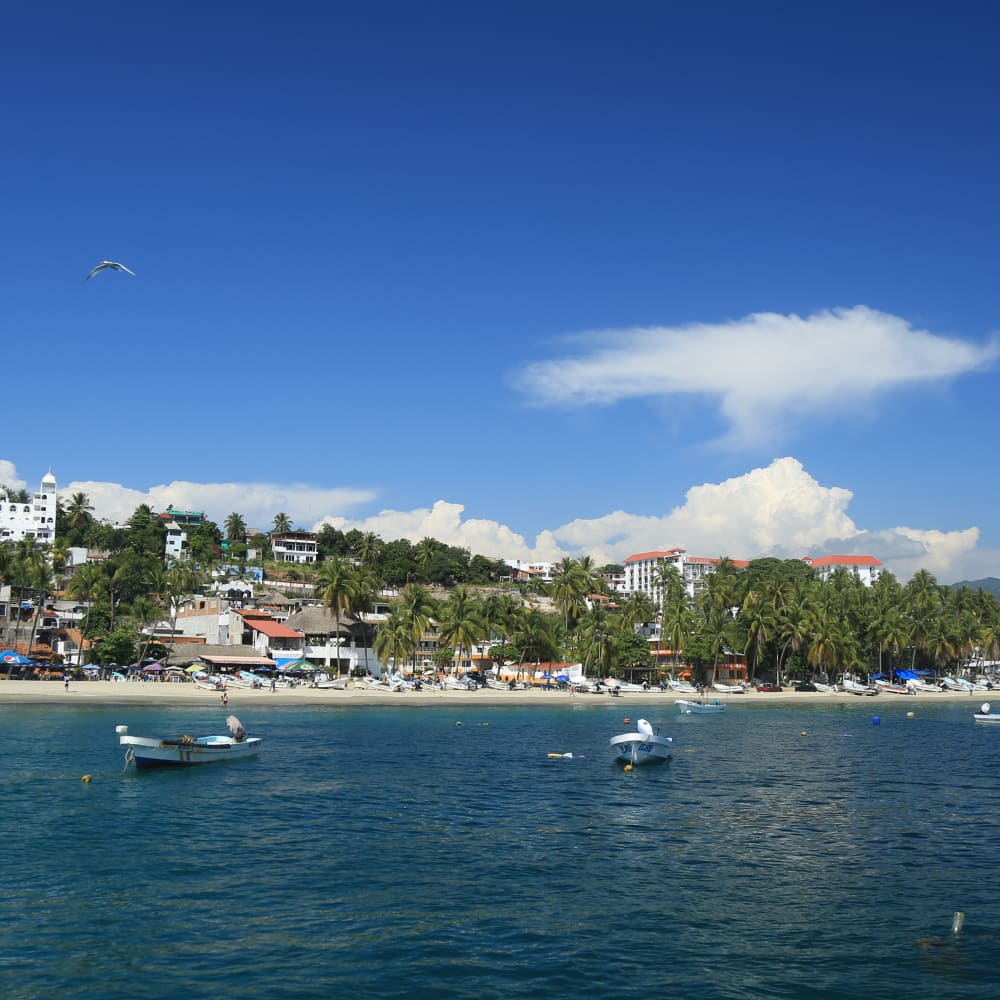
Fifteen kilometers to the west lies the Laguna de Manialtepec, where dinoflagellates cause the water to glow blue at night. And the Escobilla beach, 30 kilometers southeast, is according to CONANP the world's most important nesting beach for the olive ridley turtle — from May 13 to 17, 2026, the authority counted 11,290 nesting females.
Turtles, bioluminescence, and whales
- Turtle release — Playa Bacocho (Vive Mar), daily at 16:30, 200 MXN (approx. 10 EUR) per person
- Bioluminescence — Boat tour from Puerto Escondido 500–900 MXN (approx. 25–45 EUR); most intense from July to November, always at new moon
- Humpback whales — December to March 21, boat tours in the morning
- Tip — Escobilla only with the guides of the cooperative — at night, without light; the strongest arribadas from September to November
Huatulco — nine bays and a national park
Two hours southeast lies Huatulco: nine bays with 36 beaches, five of which are in the national park established in 1998 (11,891 hectares of dry forest and sea). We skip the hotel zone of Tangolunda; the reason to visit lies outside: San Agustín with one of the largest coral reefs of the Mexican Pacific coast and a fishing village without resorts, Cacaluta, El Maguey, and La Entrega for snorkeling. As the first travel destination in Latin America, Huatulco holds the EarthCheck Platinum certificate for sustainable tourism (Fonatur).
Bahías de Huatulco
- Boat tour — Seven bays from Santa Cruz approx. 350–600 MXN (approx. 18–30 EUR) per person, snorkeling equipment approx. 250 MXN, national park fee 60 MXN
- San Agustín — 14 km west of Santa Cruz, by boat approx. 45 minutes or taxi approx. 130 MXN
- Location — HUX airport 15 minutes from Santa Cruz; Puerto Escondido 2–2.5 hours via the coastal road 200
- Tip — Private boat instead of group tour — then you decide how long to stay in which bay for two hours
Cuisine in Oaxaca — seven moles, tlayudas, and the mezcal route
The seven moles and the Pasillo de Humo
Oaxaca calls itself 'Land of the seven moles': Negro, Rojo, Coloradito, Amarillo, Verde, Chichilo, and Manchamanteles — the mole negro alone has up to 30 ingredients, including chilhuacle chilis and chocolate. Alongside tlayudas (roasted 30-centimeter tortillas with bean paste, quesillo, and tasajo) and chapulines with lime and chili. The most authentic place for this is the Pasillo de Humo in Mercado 20 de Noviembre, daily from 10:00 to 17:00: You choose tasajo, cecina, and chorizo at the stand, the meat comes from the grill — a tlayuda costs about 80–150 MXN.
Restaurants — from Michelin-starred to comedores
The Michelin Guide México 2026 lists 26 establishments in Oaxaca: Levadura de Olla by Thalía Barrios García has held the star since 2024; Los Danzantes on the Alcalá carries a star and green star. Bib Gourmand are La Olla, Las Quince Letras, Tierra del Sol, Labo Fermento, and Xaok — main dishes approx. 250–400 MXN. Also Criollo by Enrique Olvera, Casa Oaxaca with a rooftop terrace opposite Santo Domingo, and Itanoni with tortillas made from native corn varieties. Book the starred restaurants two to three weeks in advance.
Mezcal Route — Santiago Matatlán and the palenques
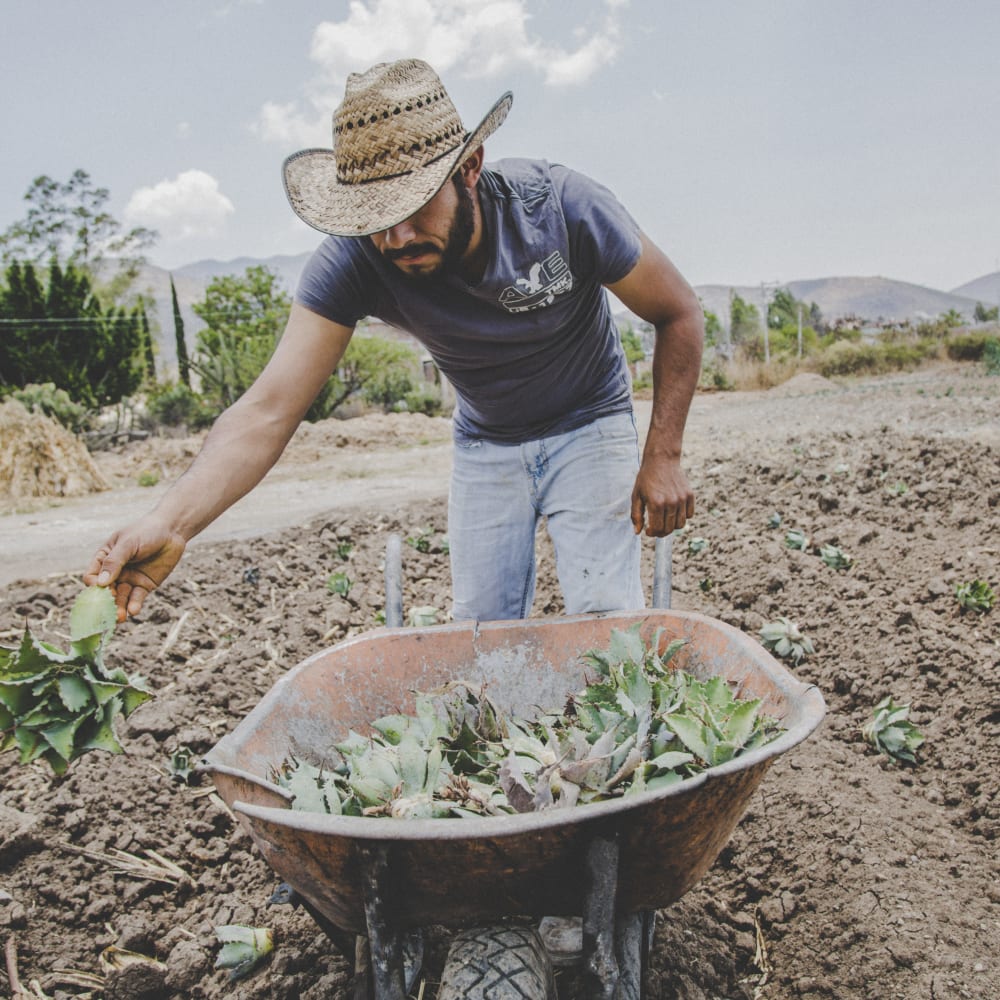
Mezcal has had a protected designation of origin since 1994, with more than 80 percent of certified production coming from Oaxaca. The center is Santiago Matatlán, 45 kilometers east, 'World Capital of Mezcal': Agave hearts are roasted in earth pits, fermented, and distilled in copper or — like in Santa Catarina Minas — in clay pot stills. Espadín takes seven years to harvest, while wild tepeztate can take up to 25. Group tours cost about 700–1,000 MXN, private tours with a sommelier around 1,800–2,400 MXN per person. Our recommendation: two palenques, not five.

Your Oaxaca program — four days
Day 1 — Historic center, Santo Domingo and the Pasillo de Humo
Santo Domingo and the Museo de las Culturas, at 11 a.m. an English tour through the Jardín Etnobotánico, noon Pasillo de Humo, evening mezcal in Jalatlaco and dinner at Los Danzantes.
Day 2 — Tule, Teotitlán, Mitla and Hierve el Agua
Departure 08:00 a.m. with driver: Árbol del Tule, dyeing demonstration in Teotitlán, Mitla, then Hierve el Agua in the early afternoon, return via a palenque in Matatlán. On Sundays, the market of Tlacolula replaces the stop in Tule.

Day 3 — Monte Albán in the morning, flight to the coast
At 08:00 a.m. entry to Monte Albán, two hours with a guide, then the 45-minute flight to Puerto Escondido or Huatulco. Sunset on the beach, dinner in La Punta.
Day 4 — Waves, turtles, and bioluminescence
Morning surf lesson in Carrizalillo or snorkeling in Huatulco, at 16:30 the turtle release at Playa Bacocho, after dinner the boat tour to Laguna de Manialtepec — during new moon. A fifth day is for doing nothing or, from December to March, for humpback whales.
Where to stay in Oaxaca — city and coast
On the coast, there are two properties of Grupo Habita in Punta Pájaros, about 40 minutes northwest of Puerto Escondido, neighbors of the art foundation Casa Wabi by Tadao Ando. We know both personally:
Hotel Escondido — 16 bungalows with private pool on the empty beach
Palapa-roofed bungalows among cacti and agaves, each with its own pool and ocean view; a beach where no one is in the morning. Adults only. From approx. 280 EUR per night per person.
- 16 bungalows with private pool and hammock, architect Federico Rivera Río
- Long Pacific beach without neighboring buildings — strong currents, swimming is in the pool
Hotel Terrestre — Alberto Kalach's solar hotel between sea and mountains
Opened in 2022, built by Alberto Kalach from concrete and adobe bricks: 14 villas with private pool, no air conditioning and no grid connection — electricity comes solely from the sun. From approx. 280 EUR per night per person.
- 14 villas with private pool and rooftop terrace with views of the Sierra
- 100 percent solar-powered, outdoor restaurant, spa, and temazcal
Boutique hotels in the city — Colonial houses with 8 to 30 rooms in the Centro Histórico and in Jalatlaco, courtyard and small pool. Approx. 150–350 EUR per night.
Let's find the accommodation that fits your route — we know which bungalows have the unobstructed view to the west. Make an inquiry .
Good to know
Best travel time for Oaxaca
Oaxaca City is located at 1,550 meters and has a spring climate all year round: 26 degrees in the afternoon in January, 30 in May. The dry season from November to April is the best travel time for city and coast — there, humpback whales migrate from December to March. From May to October, it rains in the afternoons, most heavily from June to September. All regions compared in our guide to the best travel time for Mexico .
Traveling — airports OAX, PXM, and HUX
There are no nonstop flights from Germany to Oaxaca. Lufthansa flies daily from Frankfurt to Mexico City (approx. 12 hours), from there it takes about 60 minutes to Oaxaca (OAX, 20 minutes from the center) with Aeroméxico, Volaris, or VivaAerobus. Puerto Escondido (PXM) and Huatulco (HUX) are also directly reachable from Mexico City. Details in our guides Flight to Mexico and Entry and visa .
City–coast: road or flight
Since February 2024, the Barranca Larga-Ventanilla highway connects Oaxaca with Puerto Escondido in 3 to 3.5 hours instead of the previous six — toll 490 MXN, ADO bus 250–500 MXN; it takes 4.5 to 5 hours to Huatulco. The alternative: Aerotucán flies twice daily in a Cessna Caravan in 40-45 minutes to Puerto Escondido and Huatulco, from approx. 1,400–2,500 MXN per trip with 15 kg luggage.
Safety in Oaxaca
Oaxaca City, the Central Valleys, and the coast have been travel destinations for decades; the advisories from the Foreign Office relate in this state to the Isthmus around Juchitán — not the regions of this page. In the Mexico Peace Index 2026 from the Institute for Economics & Peace, Oaxaca is in the middle of the states, with improvement from the previous year. Centro Histórico, Jalatlaco, and Reforma are lively and well-lit in the evenings; along the coast, this applies to La Punta, Rinconada, and La Crucecita.
The usual rules apply: In Oaxaca, there is no Uber — use DiDi or hotel taxis; do not walk alone at night through deserted streets, keep valuables in the hotel safe, and take long-distance journeys during the day. Roadblocks ("bloqueos") are a political means of expression in Oaxaca, not directed against travelers, but they can be time-consuming — we plan buffers before flights. More in the guide Safety in Mexico with the assessment of the Foreign Office.
Traveling with peace of mind
The biggest risks are the sun and the current at the Pacific: Zicatela and the beaches of Punta Pájaros are not swimming beaches — swim in Carrizalillo, Puerto Angelito, or the bays of Huatulco and pay attention to the flags. Emergency call 911 applies nationwide.
Transportation — Drivers, Taxis, and Rental Cars
In the historic center, you walk. For the Central Valleys, we recommend a private driver (day trip from approx. 3,500 MXN). A rental car is worthwhile on the coast — from approx. 800–1,200 MXN per day including comprehensive insurance; the coastal road 200 is winding and is only driven during the day.
Altitude, Mosquitoes, and Health
1,550 meters are hardly felt by most — a quiet first afternoon is enough. Along the coast, mosquito repellent should be in every bag during the rainy season; dengue occurs from June to October. There are no mandatory vaccinations. More in our guides Vaccinations and Health and Packing List Mexico .
Discover Mexico further
On a Mexico round trip we usually connect Oaxaca with the highlands before and Chiapas afterwards:
Chiapas — San Cristóbal, Palenque, and the waterfalls of Agua Azul
Puebla & Pueblos Mágicos — Talavera, Cholula, and Atlixco via land from Mexico City
Mexico City — Museums, Roma Norte, and Teotihuacán, an hour's flight away
Let's put together your Oaxaca program — with the right day for Hierve el Agua, the flight to the coast, and the bungalow with a view to the west. Schedule a consultation .
To book a trip or for more information, contact us. We'll help you plan and guide you through your upcoming adventure!
Frequently Asked Questions
Yes — Oaxaca City, the Central Valleys, and the coast between Puerto Escondido and Huatulco are established travel regions; the advisories from the Foreign Office relate in the state to the Isthmus around Juchitán, not these areas. In the Mexico Peace Index 2026, Oaxaca is in the middle, with improvement from the previous year. The usual rules apply: DiDi or hotel taxis instead of street taxis (there is no Uber), do not walk alone at night through empty streets, keep valuables in the safe, and take long-distance journeys during the day with a driver. Roadblocks take time, not security — we plan buffers.
Four days is the minimum: one day in the historic center with Santo Domingo, Jardín Etnobotánico, and Pasillo de Humo, one day in the Central Valleys with Tule, Teotitlán, Mitla, and Hierve el Agua, then Monte Albán in the morning and a 45-minute flight to the coast for two days in Puerto Escondido or Huatulco. With six to seven days, add a mezcal day in Matatlán, the Sunday market in Tlacolula, and a quiet day at Hotel Escondido or Terrestre — for us, the most beautiful week in Mexico.
Both work. The Barranca Larga–Ventanilla highway opened in 2024 gets you to Puerto Escondido in 3 to 3.5 hours (toll 490 MXN; ADO bus 250–500 MXN), to Huatulco it takes 4.5 to 5 hours. Faster is Aerotucán: twice daily in 40–45 minutes in a Cessna Caravan to Puerto Escondido or Huatulco, from approx. 1,400–2,500 MXN per leg with 15 kg of luggage. We recommend flying to Puerto and taking the highway back with a driver — this way you see the Sierra Sur once from above and once from the road.
Generally yes — daily from about 09:00 to 17:00, entrance approx. 50–70 MXN plus a 20–30 MXN path fee for the municipality of San Lorenzo Albarradas, parking approx. 50–100 MXN, all in cash only. Because two municipalities have been disputing management for years, access is sometimes closed without notice; in 2021 it remained closed for over a year. We will confirm in the week before your visit that the access is open, and we never schedule the trip for the last day.
November to April: dry, 26 to 30 degrees in the afternoon in the city, clear views from Monte Albán, small waves for beginner surfers along the coast and from December to March humpback whales off Puerto Escondido and Huatulco. From May to October, it rains in the afternoons, most heavily from June to September — for this, the valleys are green, the Guelaguetza takes place on July 20 and 27, 2026, and the bioluminescence in Manialtepec is strongest from July to November.
Six to nine months in advance. The five-star hotels in the city reported 88 to 90 percent occupancy for the Muertos days 2025 according to Sectur Oaxaca, the centrally located boutique hotels are fully booked for the nights from October 30 to November 2 from mid-August. The Comparsas parade through the historic center starting October 31, and the night watches at the cemeteries of Xoxocotlán and Atzompa take place on the night of November 1. Those who prefer it quieter can spend the night in a village of the Central Valleys — with flowers and without flash.
Puerto Escondido is a surfing spot with a village character: Zicatela for pros, Carrizalillo for beginners, La Punta for evenings with three Michelin recommendations, plus the turtle release at Playa Bacocho and the bioluminescence in Laguna de Manialtepec. The hotels Escondido and Terrestre are located 40 minutes northwest on the empty beach. Huatulco is quieter and more orderly: nine bays, a national park, snorkeling in San Agustín and La Entrega, HUX airport is 15 minutes away. Those who want both can drive the two-hour coastal road in between.
Since January 1, 2026, Monte Albán, as an INAH site of Category I, costs 210 MXN (approx. 11 EUR) for foreign guests, 105 MXN for Mexicans and residents; children under 13, students, and teachers pay nothing, free Sundays apply only to Mexicans and residents. The site museum is included in the ticket. It is open daily from 08:00 to 17:00, last admission at 16:00. The same 210 MXN apply for Mitla, Yagul, and the Museo de las Culturas in Santo Domingo; Lambityeco and Dainzú cost 145 MXN.
You might also like this
This image was generated with AI.
