

This image was generated with AI.
Tortuguero
The Amazon of the Caribbean coast — and the most important turtle nesting beach in the western hemisphere
The Amazon of the Caribbean coast — and the most important turtle nesting beach in the western hemisphere
No parking, no traffic jams, no roads. You can only reach Tortuguero by boat or small plane — and that is exactly what makes Costa Rica's Caribbean national park one of the few places in Latin America where rainforest, canal labyrinth, and the most important nesting beach for the green sea turtle are condensed into the smallest space.

Best travel time
July to October (Green sea turtle) or March to April (Leatherback turtle)
Why Tortuguero?
No parking. No traffic jams. Only boat, rainforest, and silence. Tortuguero is located on the northern Caribbean coast of Costa Rica, between lagoons and dense lowland rainforest, and is only accessible by two routes: by boat through the canal system or by small plane from San José. This inaccessibility is what makes the park what it is — one of the last large coastal rainforests in Central America where wildlife can still live without a backdrop.
The metaphor of the "Amazon of Costa Rica" is not just marketing. 76,937 hectares of protected area — 26,653 hectares of land and 50,284 hectares of sea — spread out into eleven different habitats: mangroves, swamp forests, lagoons, beach forests, canals, open sea. Documented are 442 bird species, 138 mammal species, 118 reptile species, and 58 amphibian species, plus over 400 tree species. Those who have traveled to the Colombian or Peruvian Amazon will recognize the silence — only you can reach it here in just a few hours from San José.
And despite this remoteness, Tortuguero is not off the beaten path but right in the middle. Since 1953, the Sea Turtle Conservancy has been studying the 35-kilometer long black sand beach where tens of thousands of green sea turtles lay their eggs each year — the most important nesting beach of this species in the entire western hemisphere. The park, first protected in 1970 and officially designated as a national park in 1975, is therefore not just a travel destination but a piece of living conservation history.
Turtle nesting season — what you can expect
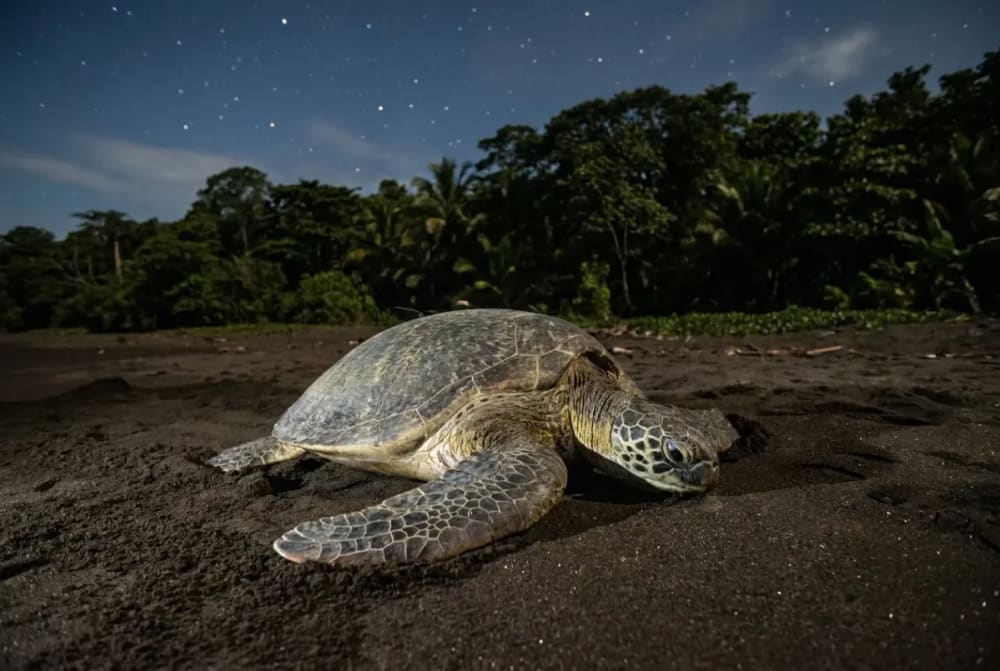
In Tortuguero, four of the seven species of sea turtles found worldwide nest. The green sea turtle (Chelonia mydas) comes to the beach from July to October, peaking in August and September. The leatherback turtle (Dermochelys coriacea) — weighing up to 600 kilograms and two meters long — nests from February to May, with its peak in March and April. The hawksbill turtle (Eretmochelys imbricata) and the loggerhead turtle (Caretta caretta) complete the picture, but are rarer.
The numbers for the green sea turtle make it clear why Tortuguero has a special status: On average, 15,000 to 20,000 females lay their eggs here annually, and in peak years up to 50,000 animals have been counted. Over 37 years of long-term monitoring, the Sea Turtle Conservancy documented an average of 78,695 nests per year. Since the designation of the protected area in 1975, the nesting population has grown by around 500 percent — one of the great success stories of international species conservation.
However, this story has a present that calls for urgency. Since 2008, the population has shown a declining trend, which according to scientific long-term studies is mainly due to commercial fishing in the foraging areas of Nicaragua. Researchers documented even a decline in leatherback nests on Tortuguero beach of 67.8 percent between 1995 and 2006. Those traveling now will see one of the largest turtle colonies in the world — but not a given.
Guided night tours take place between 7 PM and 10 PM, strictly regulated by the park administration: a maximum of 15 people per group, certified guides only, no flash photography, no white light flashlights, dark clothing, no touching of the animals, no photos. The time slots are drawn in a lottery on the afternoon of the tour day. Experienced guides work with infrared light and utilize the fact that nesting females fall into a kind of trance state during egg-laying — a careful observation from a few meters away is possible without disturbing the animal.
There is no guarantee of sightings. Even in the high season, a night can pass without a nesting female. If you want to reliably experience what makes Tortuguero special, plan for two to three nights — and you also have the chance to witness one of the few combinations this place offers: In August and September, mothers nest, and the first hatchlings from the early season emerge simultaneously. A few meters away, hatchlings dig their way out of the sand to the sea — while behind you another turtle buries its clutch.
Insider tip: March and April are overlooked by most travelers. The leatherback turtle season falls in the quieter tourist time — empty lodges, moderate prices, fewer boats on the canals. And encountering an animal that reaches the size of a small car is one of the most intense nature experiences ever.
The Sea Turtle Conservancy — 66 years of conservation history
The story of Tortuguero as a protected area is inextricably linked to the name Archie Carr. The American biologist began his research on the beach in 1953, started the world's first turtle marking program in 1955, and made the place internationally known with his 1956 published book The Windward Road. In 1959, Joshua B. Powers founded the Caribbean Conservation Corporation based on this work — the first organization in the world dedicated solely to the protection of sea turtles. In 2010, it was renamed the Sea Turtle Conservancy and in 2023 was recognized as the most effective marine conservation organization by the Endangered Species Coalition.
The monitoring program on the beach of Tortuguero has been running uninterrupted since the 1950s — it is the longest continuous sea turtle research in the world. Since 1994, the STC has operated the John H. Phipps Biological Field Station in the village with a public visitor center and a small museum. The visit lasts 30 to 45 minutes, costs a few dollars, and complements every night tour with scientific background. Those who stay longer can directly participate in fieldwork through the STC volunteer program.
Canal tours — wildlife on the water
Tortuguero is not just a turtle place. Those who only arrive during the nesting season underestimate what the canal system offers outside these weeks. A vast network of natural and artificial waterways extends around the village and the park, with a total length of around 460 kilometers — the artificial sections were created in the 1960s to make the area accessible. Today, they are the only way to get deep into the rainforest without stepping on a single path.
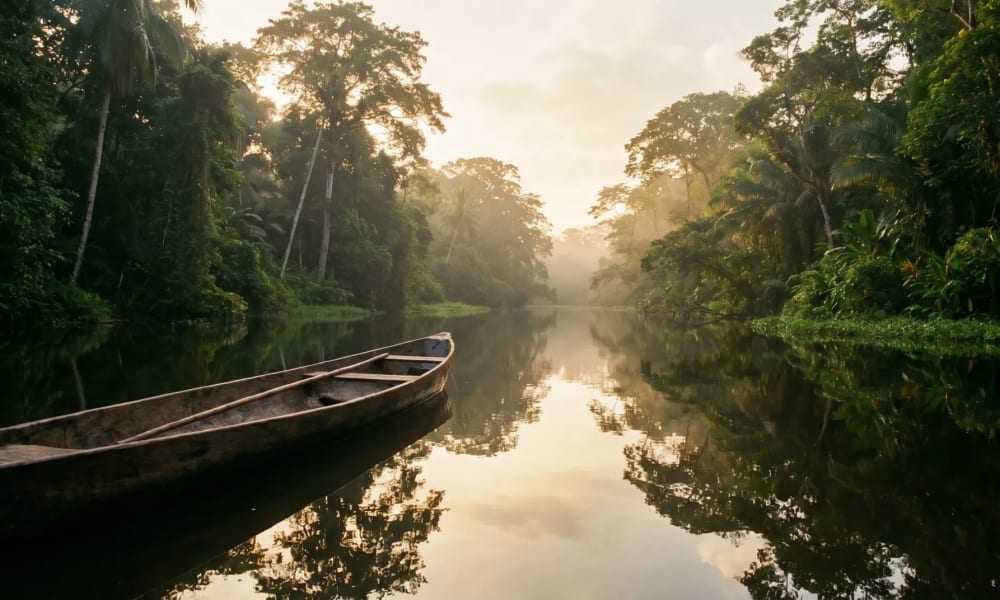
A typical day on the canal begins at six in the morning. The air is cool, the water is glassy smooth, and fog hangs over the shore trees. Guides like Marvin or Elias — most have lived in the village for decades and know every bend — silently steer into the narrower side arms. In the Cecropia trees sit howler monkeys, sending their deep roars over the forest long before sunrise. Three-toed sloths hang on branches above the water — their slowness makes them unexpectedly easier to see than most faster animals.
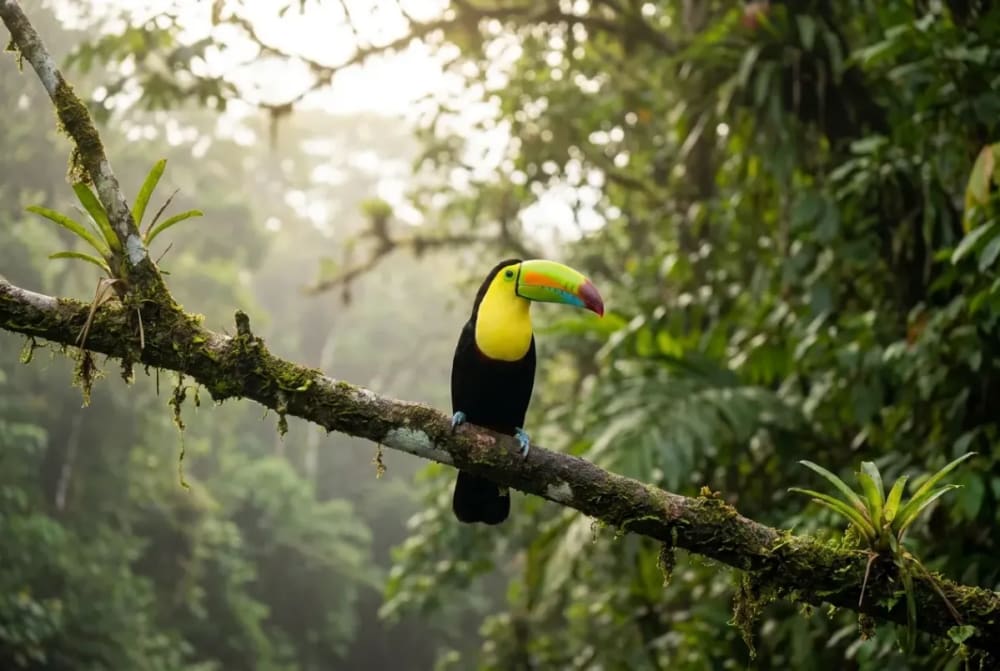
Among the species that can be observed from the boat are the toucan with its colorful beak, the great green macaw, the spectacled caiman, the basilisk iguana — also known as the "Jesus lizard" because it literally runs across the water surface — and three of the four species of monkeys living in the park (howler monkey, white-faced capuchin monkey, spider monkey; the squirrel monkey is rarer). In the southern lagoons of the park live West Indian manatees. Sightings are not guaranteed, but guides who regularly go to this area know the most likely spots. Jaguars, tapirs, and pumas have also been documented but remain shy and nocturnal.
The most important decision: motorboat or kayak. Motorboat tours are included in almost every lodge package and are convenient. However, if you want to experience the canal ecosystem in all its density, book a quiet kayak or canoe tour. In the narrower canals, motorized boats are prohibited — precisely there where sloths, caimans, and birds can be least disturbed. A two-hour kayak tour with a guide costs 30 to 45 US dollars per person, and self-rentals are around 10 to 15 US dollars per hour.
Insider tip: The Dorling Bakery in the village opens at five in the morning. A coffee and a fresh bread before the six o'clock canal tour — this is the unhurried ritual of the Tortuguero regulars before the day tourists from the large lodges set off in groups.
The village of Tortuguero
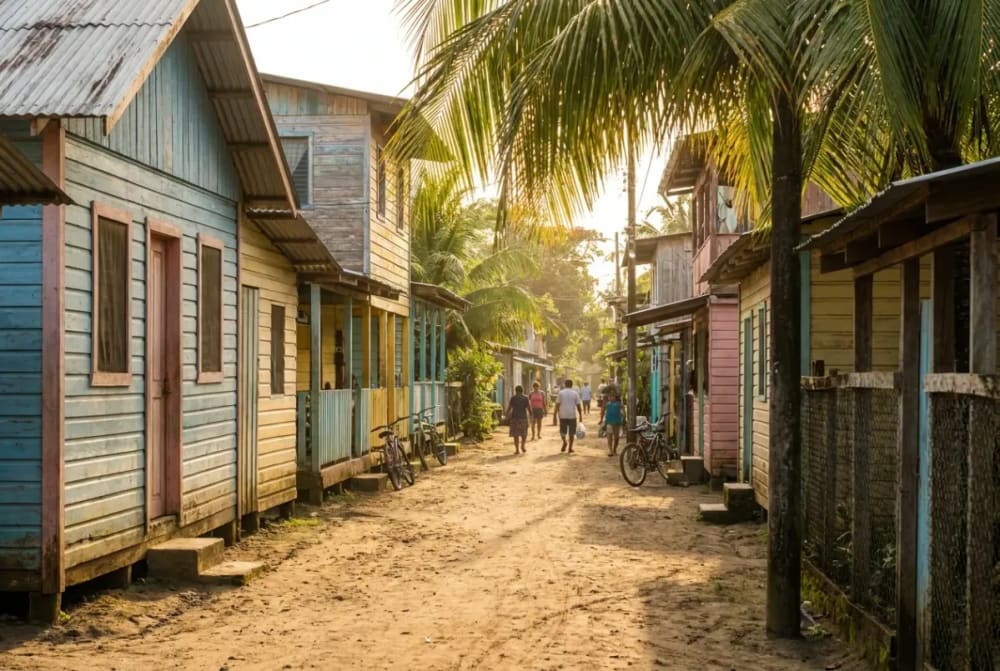
The village is situated on a narrow peninsula between the main canal and the Caribbean coast. Depending on the source, between 500 and 1,300 people live here — the numbers fluctuate because some residents work seasonally in the surrounding lodges. What remains constant is: no cars, no paved roads. Only sandy paths, a paved main path along the canal, a soccer field as a social center, a few restaurants with Caribbean cuisine — Rondón soup, plátanos, fresh fish — and a handful of souvenir shops.
The population is predominantly Afro-Costa Rican. You can tell by the music, the rhythm of the English many locals speak alongside Spanish, and dishes that are closer to Jamaica than to San José. Strolling through the village after the canal tour, visiting the museum at the STC visitor center, and eating at one of the simple restaurants — this is the antithesis to the all-inclusive lodge bubble on the other side of the canal.
At the edge of town rises Cerro Tortuguero — a 119-meter high, long-inactive volcanic hill with its own SINAC sector. The hike up is short (about 2.5 kilometers round trip, 30 to 60 minutes) but steep: over 400 steps lead through the rainforest to the viewing platform. At the top, a 360-degree panorama opens up over the canal system, the black sand beach, the Caribbean, and the rainforest behind it. The ascent early in the morning, before the day's heat sets in, is one of the most beautiful, least advertised experiences in Tortuguero. Entrance is seven US dollars, separate from the main park ticket.
An important note: Swimming on the Caribbean beach of the village is not recommended due to strong currents and the presence of bull sharks. The beach is for observing, not for swimming. The canal, on the other hand, belongs to the caimans.
Best travel time — turtles vs. wildlife
Tortuguero can be visited year-round — the question is only what you want to see. The region has over six meters of annual rainfall, making it one of the rainiest areas in Costa Rica, and rain falls in every month. The Caribbean coast has a reverse rainfall pattern compared to the Pacific: September and October are comparatively drier than other coastal sections.
Roughly, there are two main seasons. July to October is the time of the green sea turtle with a peak in August and September — during which nesting females and freshly hatched young can be observed in a single night. December to April is the relatively dry period with less rain, better visibility, and the main season for migratory birds — the most interesting phase for birders. February to May is also the leatherback turtle season, peaking in March and April.
Our differentiation based on travel type: Those coming first for the green sea turtle choose August or September. Those who want to experience impressive animals away from the crowds choose March or April for the leatherback turtle. Those who want to see canals and wildlife in the foreground and take the turtle theme as a bonus travel during the dry season from January to April. No month is wrong — just different.
Getting there — boat, shuttle, or small plane
Tortuguero has no road connection. There are three ways to get there — and the choice shapes the character of your trip.
Route 1 — La Pavona (our standard recommendation): From San José or La Fortuna by shuttle or bus to Cariari and then to La Pavona (about 2.5 to 3 hours), from there by boat in 1 to 1.5 hours through the rainforest canal to Tortuguero. The boat ride itself is already a safari: caimans on the shore, herons, toucans, and occasionally sloths. Departures from La Pavona at 7:30 AM, 11:00 AM, 1:00 PM, and 4:30 PM, and the boat price varies between three and 15 US dollars per person depending on the provider. Parking at the dock is about twelve US dollars per day. By plane, you miss exactly this part — which is why we almost always recommend Pavona.
Route 2 — Moín near Puerto Limón: Boat ride directly from the Caribbean coast, about 80 kilometers through the canal system, three hours, about 35 US dollars per person. This is sensible if you are coming from Puerto Viejo, Cahuita, or the southern Caribbean coast. Departure is usually at 10 AM, early booking recommended.
Route 3 — SANSA small plane: From San José (SJO) to the small airstrip in Tortuguero (TTQ) in 25 to 30 minutes. Up to two flights daily, price between 100 and 327 US dollars depending on when you book. The previously offered Nature Air connection has not existed since January 2018 — some older travel guides have not yet updated this. Those with little time can gain half a safari day by flying. Those who want to maximize the experience will travel by boat.
One logistical point that is often underestimated: The park ticket (17 US dollars for adults, five US dollars for children aged 2 to 12 years) must be booked in advance online through the SINAC system. There are no ticket counters at the entrance. Without an online ticket, there is no entry.
Safety notice: As of December 2024, the Foreign Office warns of increased violent crime in the areas of the port cities Moín and Limón; isolated reports of robberies on tourist buses have been received for the route to La Pavona. In the village of Tortuguero itself and in the national park, there are no specific security problems. We generally organize your transfer through verified shuttle providers or direct lodge transfers — not through public buses on this segment.
Accommodations — village or lodge on the canal
Tortuguero knows two fundamentally different types of accommodation. In the village, small guesthouses and simple hotels range from 45 to 120 US dollars per night. Air conditioning is rare, but you are close to social life, restaurants, the STC visitor center, and have full flexibility in choosing tours. If you prefer to travel individually and experience village life, this is the right choice.
The eco-lodges on the canal, often with their own docks and small fleets of boats, mostly work with all-inclusive packages. A classic two-night package costs 200 to 300 US dollars per person and includes transportation from San José, all meals, several boat tours, park fees, and guides. Pachira Lodge, Evergreen Lodge, and Aninga Lodge belong to the same group and offer comparable packages; Tortuga Lodge (Costa Rica Expeditions) is more upscale and one of the oldest addresses in the region. Mawamba Lodge and Laguna Lodge are particularly attractive located on the narrow land bridge between the canal and the Caribbean beach.
When calculated for the total price — transfers, tours, guides, meals — lodge packages are often not more expensive than the individual combination in the village. They are simpler. The village option is more flexible and authentic. Which solution fits better depends on the travel style and is one of the questions we clarify in personal consultation.
Planning Tortuguero individually
Tortuguero is not a place to just pass through. It requires two to three nights, the right season for your interest, and a combination of transfer, accommodation, and tours that matches your travel style. We plan your route personally — with verified shuttle partners, carefully selected lodges on the canal or guesthouses in the village, local guides that we have known for years. Tortuguero can be well connected with Arenal and La Fortuna and the Pacific regions of Costa Rica — together, they create a round trip that connects volcano, rainforest, Caribbean, and Pacific in a single arc.
For personal consultation and a tailored offer contact our Costa Rica team — we usually respond within 24 hours.
To book a trip or for more information, contact us. We'll help you plan and guide you through your upcoming adventure!
Frequently Asked Questions
Green sea turtles nest from July 1 to October 15, with a peak in August and September. Leatherback turtles come to the beach from February to May, peaking in March and April. In August and September, nesting females and freshly hatched young can be observed in a single night — the sweet spot for travelers who want to experience both. A sighting is not guaranteed even in the high season; we recommend two to three nights on site.
The absolute minimum is two nights or three days. This allows for a canal tour, a night tour, and a morning in the village. For a relaxed program with two boat tours, one night tour, Cerro Tortuguero, and time in the village, we recommend three nights. Those who want to photograph should plan more — animal sightings require patience and repetition.
Yes and no. The tours are heavily regulated: a maximum of 15 people, certified guides, no white light, no flash, no photography, dark clothing. It feels like a strict framework — but exactly this rigor makes the encounter possible without disturbing the animals. Those who experience a nesting green sea turtle from just a few meters away in infrared light describe the moment almost unanimously as an exceptional experience that stays in memory.
Almost the whole year. From December to April, the canals are drier, visibility is better, and migratory birds from North America fill the forest. March and April bring the impressive leatherback turtles — few tourists, moderate prices, and up to 600 kilograms of animals on the beach. Anyone wanting to see the canal ecosystem with monkeys, sloths, toucans, and caimans does not need the nesting season.
Yes. The village can be reached independently — bus and boat from San José can be done for about ten US dollars, and the travel time is around five to six hours. You can book guesthouses, tours, and guides on-site. If you do not want to handle the arrangements yourself, choose a lodge package or let us put together the components individually. Both have their merits; both we can tailor to your wishes.
The village of Tortuguero and the national park itself are considered safe; the Foreign Office does not issue a specific warning for the region. Attention is warranted on the travel route to La Pavona and around the port cities of Moín and Puerto Limón, where isolated reports of robberies on tourist buses have been documented (as of December 2024). We organize your transfer exclusively through verified shuttle partners or lodge transfers — not through public buses. In the village itself, you move around easily on foot, even in the evenings.
You might also like this
This image was generated with AI.
This image was generated with AI.