


Puebla & Magical Towns
Baroque, Talavera and Volcano View — two hours from the capital
Baroque, Talavera and Volcano View — two hours from the capital
Puebla — Baroque city and UNESCO World Heritage site since 1987, two hours from Mexico City: the largest pyramid in the world in Cholula, Talavera workshops since 1824, and three Magical Towns amidst volcanic views, flower fields, and cloud forests.

Best Travel Time
November to April
Why Puebla is more than a day trip
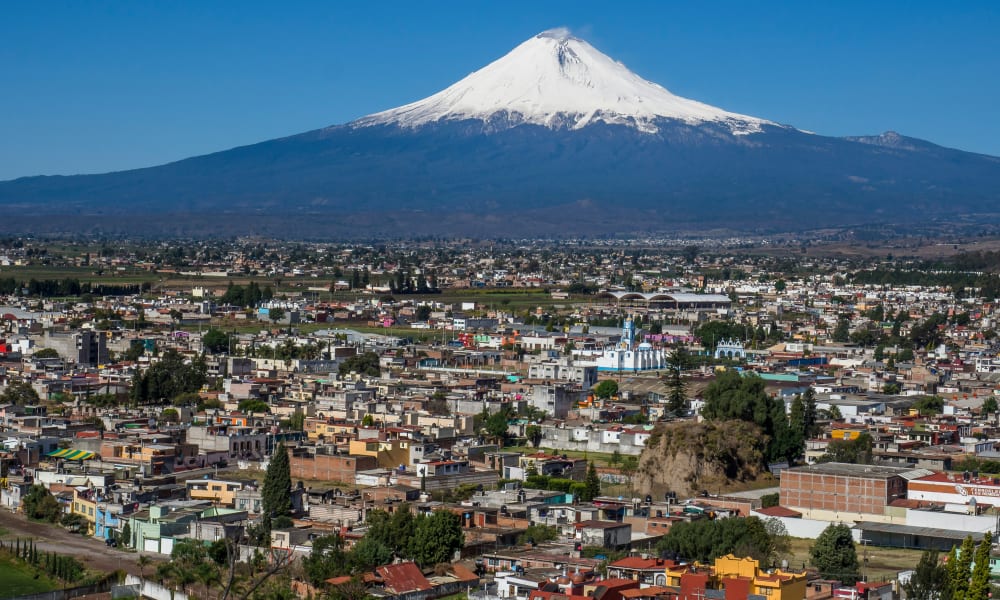
In the late afternoon, the light falls flat over the Zócalo of Puebla, and the Talavera tiles on the facades — cobalt blue, yellow, white — begin to glow. From the portal of the cathedral wafts incense and organ music, at the corner women roast pumpkin seeds for the mole, and on clear days in the west stands the snow-capped cone of Popocatépetl above the rooftops. Baroque, volcano, and cuisine in one image.

Most travelers to Mexico visit Puebla in a day from the capital — cathedral, mole, return. What they miss: a historic city center with more than 2,600 protected buildings, UNESCO World Heritage since 1987, the largest pyramid in the world by volume in Cholula (Guinness World Records), and three Magical Towns in three completely different landscapes — Cholula, Atlixco, and Cuetzalan.
That’s why we plan Puebla with two to three overnight stays: one day for the city, one for Cholula and Atlixco, and whoever has time continues to the cloud forest of Cuetzalan. Two hours from Mexico City, the region is the quietest chapter of a Mexico tour — and one of the strongest gastronomically.
What are Magical Towns?
Magical Towns — „magical villages“ — is a program of the Mexican Ministry of Tourism SECTUR that has been awarding small towns since 2001 for preserving extraordinary cultural, historical, or scenic heritage. The idea: to direct visitors from the large destinations to the outskirts so that crafts, festivals, and cuisine create income in the villages themselves. Currently, 177 places carry the title (SECTUR, 2026); new designations are suspended until 2026.
A place must have a historic center, living traditions, a “symbol” — a festival, a craft, a legend — and a tourism plan with local involvement; the title is regularly reassessed. For you, this means: restored squares, markets with regional crafts, and often only a few other visitors during the week. Cuetzalan was designated as Puebla's first Magical Town in 2002, Cholula followed in 2012, Atlixco in 2015 (SECTUR).
Note
Weekend or weekday? — Magical Towns near the capital fill up with day-trippers from Mexico City on Saturdays and Sundays. You experience Cholula and Atlixco most relaxed from Tuesday to Friday. Cuetzalan is the exception: Sunday is particularly worth it with the market and Voladores.
Puebla, Cholula, Atlixco, Cuetzalan — four places, four characters
Puebla — Baroque, Talavera, and the first library in the Americas
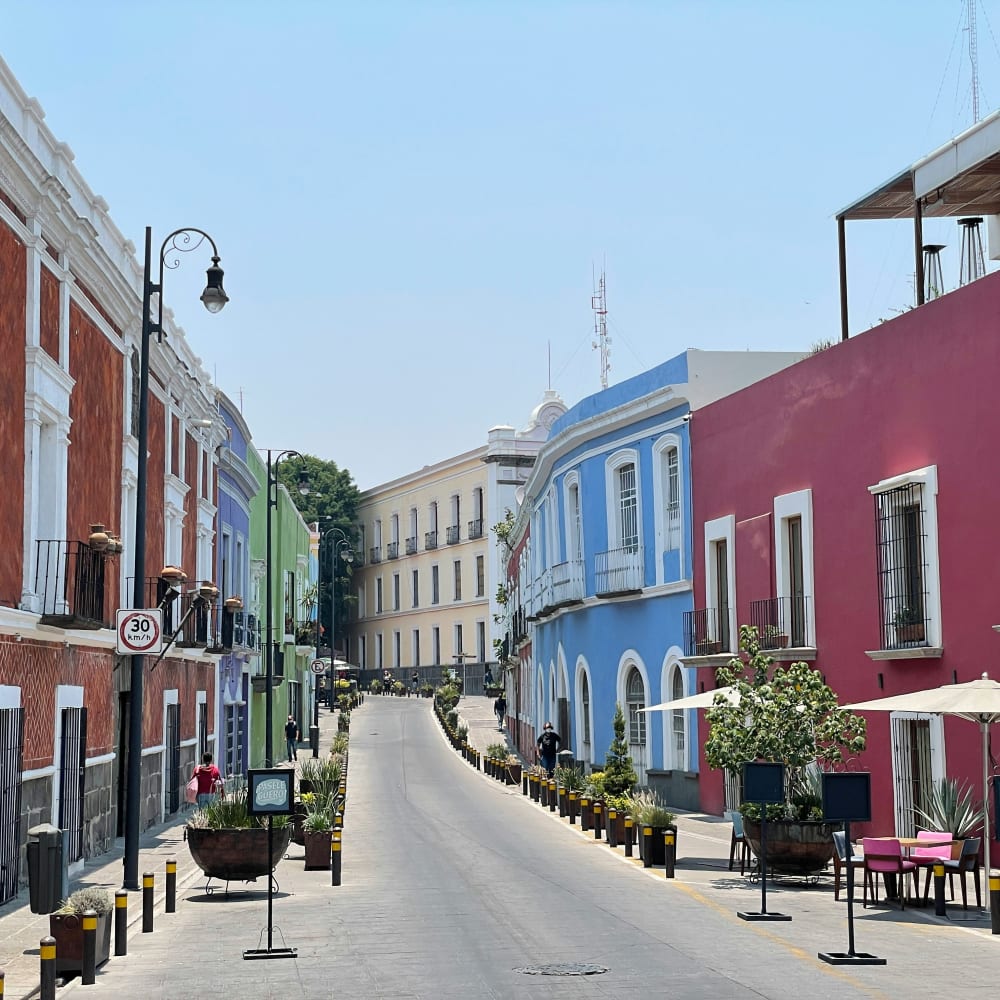
Puebla was founded in 1531 by the Spaniards on the drawing board — a chessboard of colonial palaces, churches, and monasteries from three centuries. The cathedral at the Zócalo, built between 1575 and 1690, features towers of 73 meters, among the tallest church towers in Mexico (Periódico Central, 2020). Two blocks away lies the highlight of Baroque: the Capilla del Rosario, completed in 1690 in the Templo de Santo Domingo, covered in gilded stucco, onyx, and Talavera — open daily from 10:00 AM to 12:15 PM and 4:30 PM to 6:00 PM, free admission.
Opposite is the Biblioteca Palafoxiana: In 1646, Bishop Juan de Palafox y Mendoza donated his 5,000 volumes with the stipulation that anyone who can read may do so — the first public library in the Americas (INAH), recognized as UNESCO World Documentary Heritage since 2005, today with around 45,000 volumes.
Biblioteca Palafoxiana
- Admission — 45 MXN (about 2.50 EUR), free on Sundays
- Opening Hours — Tue–Thu 10:00 AM–5:00 PM, Fri–Sun 10:00 AM–6:00 PM, closed on Mondays
- Location — 5 Oriente 5, upper floor of the Casa de la Cultura, behind the cathedral
- Tip — Mornings during the week, the hall is almost empty — 30 minutes is enough
The city's second heritage is Talavera: tin-glazed ceramics that came with the Spaniards from Talavera de la Reina — UNESCO Cultural Heritage since 2019. The Uriarte workshop, founded in 1824, still operates today as it did in the 16th century: two firings, six permitted mineral colors, all by hand. For museums, here are two addresses: the Museo Amparo with pre-Columbian and viceroyal art (85 MXN, about 4.50 EUR, Wed–Mon 10 AM–6 PM) and the Museo Internacional del Barroco by Toyo Ito (105 MXN, about 5.50 EUR, Tue–Sun 10 AM–7 PM).
Insider Tip
Visit Uriarte Talavera — the workshop tour (4 Poniente 911) lasts about 50 minutes, Mon–Fri 10:00 AM–3:00 PM for 100 MXN (about 5 EUR), Saturdays 200 MXN; maximum twelve people, so we will make a reservation for you.
Cholula — the largest pyramid in the world with a church on top
Twelve kilometers to the west lies Cholula, recognized as a Magical Town since 2012 and inhabited for more than 2,000 years. What looks like a wooded hill with a yellow church on the summit is Tlachihualtépetl, the “man-made mountain”: 450 by 450 meters in ground area, 4.45 million cubic meters in volume — according to Guinness World Records, the largest monument ever built, nearly twice the mass of the Cheops Pyramid (Infobae, 2026). In 1594, the Spaniards built the pilgrimage church Nuestra Señora de los Remedios on top — today the best viewpoint in the region: on clear mornings between November and March, Popocatépetl (5,426 meters) is within reach.
Zona Arqueológica de Cholula
- Admission — 210 MXN (about 11 EUR), free on Sundays for Mexicans and residents — then very crowded
- Opening Hours — Wed–Sun 9:00 AM–5:00 PM, closed on Mondays and Tuesdays (INAH rate 2026)
- Location — Entrance Avenida Morelos / 8 Norte, San Pedro Cholula; the ascent to the church is free and possible daily
- Tip — The 800 meters of tunnels inside will be reopened in 2026 after six years — we will clarify before your trip whether access is possible
Insider Tip
Santa María Tonantzintla — five minutes by car south of Cholula: Indigenous artisans filled every surface with angels, fruits, corn cobs, and faces in feather ornaments in the 17th and 18th centuries — Baroque from the perspective of the Nahua. Daily 9 AM–6 PM, free admission, photography inside prohibited. Afterwards, San Francisco Acatepec with a completely Talavera-tiled façade.
Atlixco — Flower Town at the foot of Popocatépetl
Thirty kilometers southwest, 300 meters lower and noticeably warmer, is Atlixco, recognized as a Magical Town since 2015 and known as the “City of Flowers”: hundreds of nurseries grow poinsettias and ornamental plants for the entire country, the streets are adorned with flower carpets and painted stairs, and from Cerro de San Miguel you overlook the greenhouses all the way to the volcano.
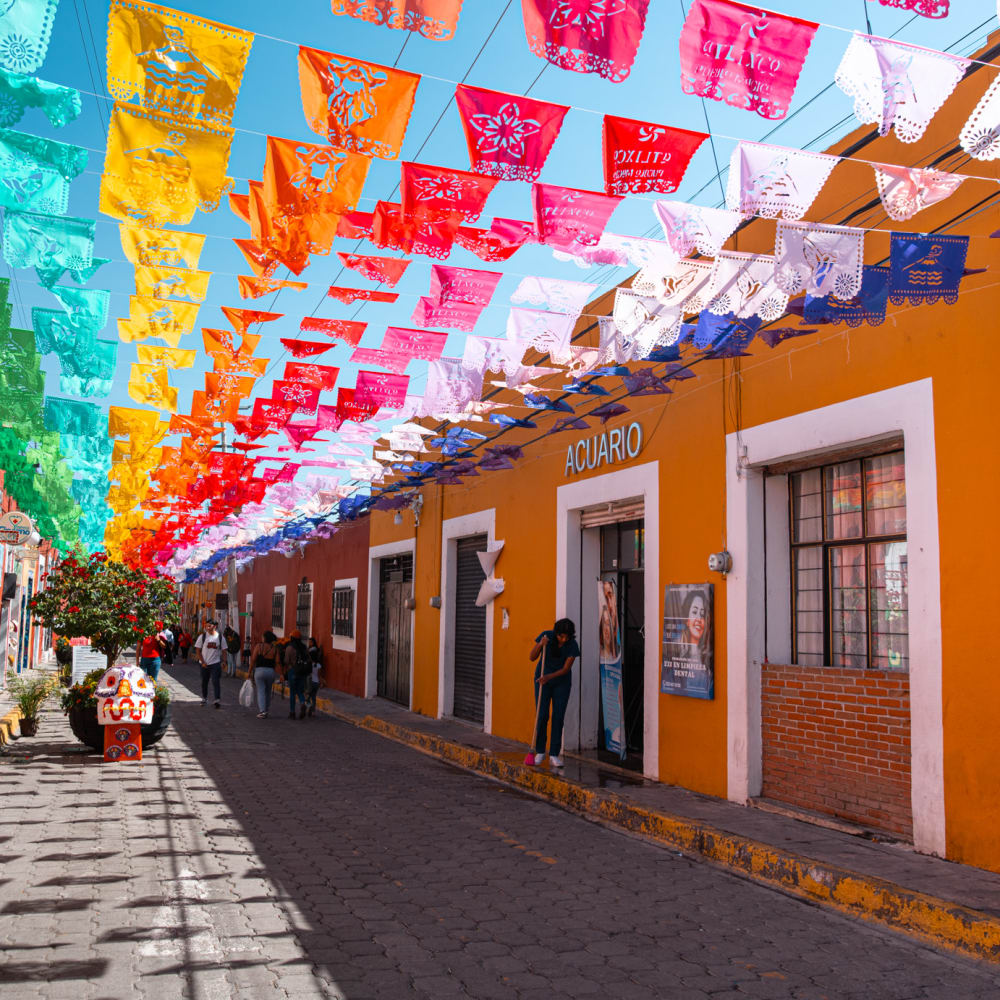
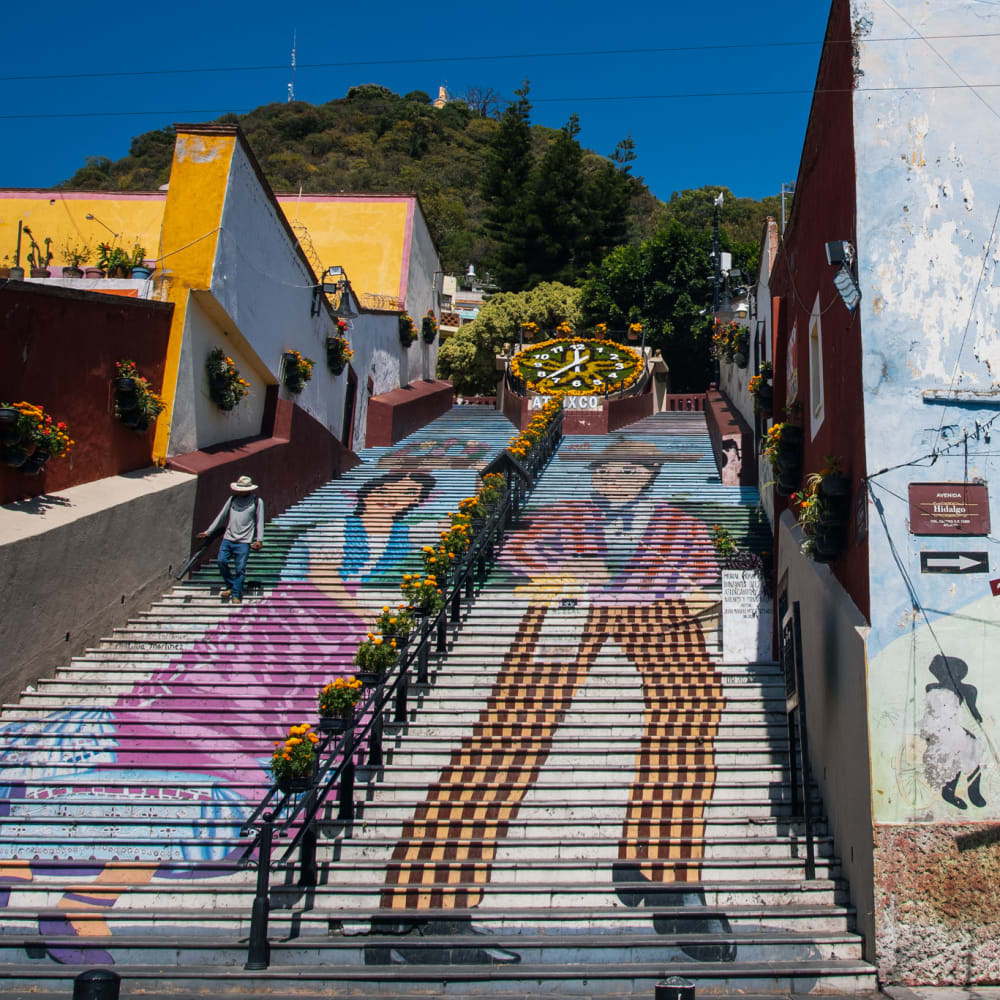
The calendar makes the difference: On the last Sunday of September, groups from all over Puebla dance at the Huey Atlixcáyotl (since 1965) on the mountain. From early October to November 2, the center turns into the Valle de Catrinas with meter-high skeleton figures. And from November 21 to January 7, the Villa Iluminada lights up two kilometers of streets — daily from 6:30 PM, free admission, very crowded on weekends.
Cuetzalan — Cloud Forest, Voladores, and Coffee in the Sierra Norte
Cuetzalan is the other side of Puebla: 176 kilometers and three to four hours along mountain roads to the northeast, at nearly 1,000 meters in the subtropical Sierra Norte, where fog sweeps through the cobbled streets in the morning and coffee grows under shade trees on the slopes. The Nahua and Totonac people in the area still wear Huipiles, and on Sundays they come to the Tianguis at the plaza — that’s why we schedule Cuetzalan over a Sunday.


Around noon, the Voladores rise on the approx. 30-meter pole in front of the parish church: four men plunge headfirst into the depths and circle the trunk thirteen times on ropes, while the fifth plays the flute and drum above — a Totonac ritual, recognized as UNESCO Cultural Heritage since 2009. There is no set time; your hotel knows the details the night before. Seven kilometers away is Yohualichan, a Totonac town with niche pyramids like those in El Tajín, three kilometers outside is the Cascada Las Brisas with a swimming hole.
Zona Arqueológica de Yohualichan
- Admission — 145 MXN (about 7.50 EUR) for international visitors
- Opening Hours — Tue–Sun 9:00 AM–5:00 PM, last entry 4:30 PM
- Location — 7 km northeast of Cuetzalan, by driver or taxi from the Zócalo
- Tip — In the afternoon, the fog comes: Yohualichan in the morning, the waterfalls after that
Let’s create your Puebla program together — we know which combination of the four places fits your travel duration. Schedule a consultation .
Cuisine — Mole Poblano, Chiles en Nogada, and Cemitas
Mole Poblano — the sauce that Puebla invented
According to legend, Mole Poblano was created in the 17th century at the Santa Rosa convent when the nuns mixed everything available in the pantry for a bishop's visit: dried chiles, chocolate, almonds, raisins, sesame, spices — depending on the recipe 20 to 30 ingredients, roasted and ground for hours, dark and shiny over turkey or chicken. For a fair comparison, two addresses: El Mural de los Poblanos (16 de Septiembre 506, daily 8 AM–12 AM) with mole based on a family recipe and Augurio by Ángel Vázquez, who interprets it more lightly. Expect 200–350 MXN (about 10–18 EUR); at market stalls, a plate of mole costs 80–130 MXN.
Chiles en Nogada — the season from July to September
Between July and mid-September, Puebla has a seasonal national dish: Chiles en Nogada, a Poblano chili stuffed with minced meat, fruits, and nuts under white walnut sauce, garnished with pomegranate seeds and parsley in the colors of the flag — supposedly invented in 1821 for Agustín de Iturbide. Because walnuts and pomegranates are only fresh from the volcano during these weeks, the season is strict: 2026 from July 1 to September 16 (Canirac Puebla). Prices range from 199 MXN in small fondas to 595 MXN at El Mural de los Poblanos (about 10–30 EUR).
Cemitas, Tacos Árabes, and the Candy Street
The Cemita is a sesame roll with breaded meat, avocado, Quesillo, chipotle, and the herb Pápalo; Tacos Árabes trace back to Lebanese immigrants — the precursor to tacos al pastor. Sweet treats can be found in the “Calle de los Dulces” (6 Oriente) with camotes and Tortitas de Santa Clara, topped off with a glass of Pasita, the raisin liqueur from Bar La Pasita in the Sapos, since 1916.
Insider Tip
Cemitas at Mercado del Carmen — the best Cemitas are available at the stalls of Mercado del Carmen (21 Oriente) between 11 AM and 4 PM for 70–120 MXN (about 4–6 EUR). Order “milanesa con quesillo y pápalo” and share — the portion is enormous.
Your Puebla Program — two to three days
Day 1 — Historic Center and Talavera
Arrival in the morning with the driver from Mexico City. Zócalo and cathedral, then Biblioteca Palafoxiana and Capilla del Rosario. Mole at El Mural de los Poblanos. In the afternoon, the tour at Uriarte Talavera, then Museo Amparo or the Calle de los Dulces.
Day 2 — Cholula and Atlixco
At 9:00 AM, enter the Cholula archaeological zone at opening, then ascend to the church with a view of the volcano. Continue to Tonantzintla and Acatepec, lunch under the arcades of Cholula. In the afternoon, 45 minutes to Atlixco: nurseries and Cerro de San Miguel. Return to Puebla or — for the Villa Iluminada — dinner in Atlixco and lights from 6:30 PM.
Day 3 — Cuetzalan with Overnight Stay
Early departure, arriving in the Sierra Norte at noon; in the afternoon, visit Yohualichan or the Cascada Las Brisas, in the evening coffee and fog at the plaza. The next morning — ideally a Sunday — market and Voladores, then return to Puebla or directly to Mexico City (four to five hours).
Note
Cuetzalan needs a night — the mountain road does not allow a worthwhile day trip. If you only have two days, skip Cuetzalan and make Puebla a stop on the way to Oaxaca — it’s about four hours from Puebla to Oaxaca City.
Where to stay — Colonial Palaces in the Centro and Haciendas near Cholula
Puebla's hotel scene thrives in restored city palaces from the 16th to 18th centuries — courtyards, Talavera floors, rooftop terraces with views of the church towers. Three categories we recommend:
- Luxury Hotels in the Historic Center — international houses in former convents and palaces with spa and pool, just a few minutes' walk from the Zócalo; from about 300 EUR per night.
- Boutique Hotels in Colonial Houses — 10 to 30 rooms around a courtyard, with breakfast in the patio; from about 120 EUR. Our recommendation for couples.
- Haciendas and Lodges in the Outskirts — Country hotels with gardens and volcano views near Cholula and Atlixco; in Cuetzalan, small lodges and coffee farms in the cloud forest from about 70 EUR.
Let’s find the accommodation that suits you together — we know the houses personally and know which rooms have great views of the cathedral. Submit a request .
Good to know
Best travel time for Puebla
The dry season from November to April is the best travel time: clear days with 21–26 degrees, cool nights around 3–9 degrees at 2,135 meters — and the most reliable volcano views in the morning. From May to October, a strong afternoon shower often falls, while mornings usually remain dry. The rainy season is marked by the Chiles en Nogada season from July to mid-September and October with Valle de Catrinas and coffee fair. How Puebla can be combined with the coasts is outlined in our overview of the best travel time for Mexico .
Getting there — from Mexico City in two hours
Puebla lies 130 kilometers southeast of the capital. With a private driver from your hotel in Mexico City , you need about two hours — upon request with a stop in Cholula. If you prefer the bus: ADO operates every 30 minutes from Terminal TAPO to CAPU bus station (2h 20, 290–440 MXN, about 15–22 EUR), Estrella Roja connects the airport MEX directly with Puebla (from about 270 MXN). All details on flights to Mexico .
Safety in Puebla
Puebla is one of the states for which the Foreign Office mentions no restrictions (as of September 2026), and the historic center is vibrant and well-lit until evening. Cholula, Atlixco, and Cuetzalan are small towns where you can move freely. What counts from our experience: Use Uber or DiDi instead of street taxis, don’t walk alone through deserted streets outside the center at night, and take land trips — especially the mountain road to Cuetzalan — during the day with a driver. More in our guide on safety in Mexico .
Basic Rules in Puebla
Order Uber or DiDi, do not hail a taxi on the street. Store valuables in hotel safes, do not carry smartphones openly, use ATMs in banks. Popocatépetl is active (Yellow Alert Level 2, CENAPRED 2026): Ascents are prohibited, occasional ash fall is possible — for visitors to Cholula and Atlixco, a maximum of one day with overcast skies.
Getting around locally
You explore the Historic Center on foot — everything important is within ten blocks around the Zócalo. For Cholula, Atlixco, and Tonantzintla, we organize a driver for the day; Uber and DiDi work reliably in Puebla and Cholula. To Cuetzalan, you go by driver or bus. Most do not feel the altitude of 2,135 meters much — more in our guide. Vaccinations and Health .
Continue discovering Mexico
Puebla is halfway between the capital and Oaxaca — four hours south with the driver, and you are in the Mezcal region. This is how the region fits into a Mexico tour , which prioritizes culture over beaches.
Mexico City — museums, neighborhoods, and Teotihuacán, two hours away
Oaxaca — Mole Negro, Mezcal, and Hierve el Agua
San Miguel de Allende & Querétaro — colonial city, wine route, and Sierra Gorda
Yucatán — Mérida, Chichén Itzá, and cenotes
Further information on entry and visa can be found in our Mexico travel guide . Let us put together your Puebla program — with the right weekdays for each Pueblo Mágico and a driver who knows the mountain road to Cuetzalan. Schedule a consultation .
To book a trip or for more information, contact us. We'll help you plan and guide you through your upcoming adventure!
Frequently Asked Questions
Yes. Puebla is one of the states for which the Foreign Office does not mention any restrictions (as of September 2026), and the old town is lively, well-lit, and full of locals in the evening. Cholula, Atlixco, and Cuetzalan are small places with a relaxed atmosphere. As everywhere in Mexico, use Uber or DiDi instead of street taxis, keep valuables in the safe, and travel during the day with a driver. With these habits, you can travel in Puebla as relaxed as hardly anywhere else in the country.
Two nights are the minimum: one day for the old town with the cathedral, Biblioteca Palafoxiana, Capilla del Rosario, and Talavera workshop, one day for Cholula and Atlixco. If you want to see Cuetzalan, you need a third night in the Sierra Norte — the mountain road takes three to four hours one way. As a pure day trip from Mexico City, Puebla remains limited to the cathedral, mole, and a view of the pyramid.
A program of the Mexican Ministry of Tourism SECTUR that has been recognizing small towns with special cultural, historical, or scenic heritage since 2001 to bring visitors to the surroundings of major destinations. In 2026, 177 places bear the title. In Puebla, we recommend three: Cholula (since 2012) with the largest pyramid in the world, the flower town of Atlixco (2015), and Cuetzalan (2002) in the fog forest of the Sierra Norte with Voladores and Sunday market.
Yes — the path up to the church Nuestra Señora de los Remedios at the top is freely accessible and possible daily; from the top, you can see Popocatépetl on clear days. The excavation site at the foot with altars and stairs costs 210 MXN (approx. 11 EUR) and is open Wednesday to Sunday from 09:00–17:00. The 800 meters of tunnels through the interior will reopen in 2026 after six years of closure — we will check the status before your trip.
November to April: dry, sunny, daytime temperatures of 21–26 degrees, cool at night, and the clearest views of the volcano in the morning. The rainy season from May to October brings afternoon showers but has its own highlights: Chiles en Nogada from July to mid-September, the Valle de Catrinas in Atlixco in October, and the coffee fair in Cuetzalan in early October. From November 21, the Villa Iluminada in Atlixco shines until January.
Most conveniently by private driver: 130 kilometers via the highway 150D, about two hours, with a stop in Cholula if desired. The ADO bus departs every 30 minutes from the TAPO terminal to CAPU in Puebla (2 h 20, 290–440 MXN). Estrella Roja goes directly from the MEX airport to Puebla (starting at approx. 270 MXN, about two hours) — ideal if Puebla is your first stop. We organize drivers and transfers as part of your tour.
Talavera is the tin-glazed pottery that came to Puebla from Spain in the 16th century; since 2019, the manufacturing process is a UNESCO cultural heritage. Real Talavera comes from certified workshops in Puebla and Tlaxcala, is fired twice, and hand-painted in six mineral colors — recognizable by the embossed stamp with the origin designation and the workshop's signature on the bottom. The Uriarte workshop (since 1824) offers tours on weekdays for 100 MXN.
Definitely — if you invest a night and meet on Sunday. Then the Tianguis of the Nahua and Totonac fills the plaza, around noon the Voladores fly from the mast in front of the church, and you visit the Totonac town of Yohualichan (145 MXN) as well as the Cascada Las Brisas. Cuetzalan is located at nearly 1,000 meters in the subtropical fog forest, 176 kilometers and three to four hours of mountain road from Puebla — a day trip is not worth it.
You might also like this
This image was generated with AI.
This image was generated with AI.
