


This image was generated with AI.
Florianopolis
The Island of Magic — 42 beaches between Azorean heritage and the Atlantic
The Island of Magic — 42 beaches between Azorean heritage and the Atlantic
A 54-kilometer island off Brazil's southern coast, where surf beaches, Azorean fishing villages, luxury beach clubs, and the highest quality of life of any Brazilian state capital meet within remarkably short distances. Floripa, as Brazilians call it, is Brazil's grown-up younger sibling.

Best Time to Visit
October to April
Why Florianópolis?
Some places in Brazil ask you to adapt to them. Florianópolis does the opposite — the city adapts to you. If you breakfast in the Lagoa da Conceição with a view of white dunes, watch the first surfers at Praia Mole at midday, and order fresh oysters in a 180-year-old Azorean fishing village in the evening, you'll have experienced three different Brazils within a single day. And without driving more than 30 kilometers at any point.
The Ilha de Santa Catarina is a 54-kilometer-long, up to 18-kilometer-wide Atlantic island off Brazil's southern coast, connected to the mainland by the Hercílio Luz Bridge from 1926. It has 42 official beaches, around 537,000 residents, and well over 100 coves if you look closely. Brazilians call it affectionately Floripa or Ilha de Magia, the Island of Magic — a description you smile at first and understand after two days.
What sets Florianópolis apart from Rio or Salvador is no secret, but few European travelers know it: the city tops the ranking of Brazilian state capitals for quality of life by a wide margin. Its Indice de Desenvolvimento Humano Municipal (IDHM) sits at 0.847 — first among all 27 state capitals, and third nationally. That's a value on par with Eastern European EU countries. Since 2024, Florianópolis has also been officially designated Brazil's "national startup capital" by Federal Law 14.955: 25 percent of the city's GDP comes from the tech sector — more than any other Brazilian capital. The result is an unusual mix: beach and tech, oyster farming and boutique hotels, Azorean fishing village and co-working loft overlooking the lagoon.
For us, Florianópolis is the contrast program after Rio or the Northeast. Travelers who have spent two weeks crossing loud, pulsing Brazil land here in a city that's quieter, cleaner, and more orderly — without losing its Brazilian character. Most of our guests spontaneously extend their stay by two days.
The 42 beaches — north, east, south, west
Four directions, four entirely different atmospheres. To understand the island, start with its geography.
The north is warm, calm, and family-friendly. The beaches Daniela, Ponta das Canas, and Jurerê offer low-wave water, gently sloping, with summer water temperatures up to 26 degrees. This is also where you'll find Jurerê Internacional — Brazil's answer to Saint-Tropez or Marbella. Beach clubs like P12 and Café de La Musique (founded in 2006) make the beach between December and March one of the most expensive and loudest meeting points for South America's upper class. Minimum spend in the clubs runs from 200 to 500 reais. To experience the atmosphere without spending, simply stroll along the beach.
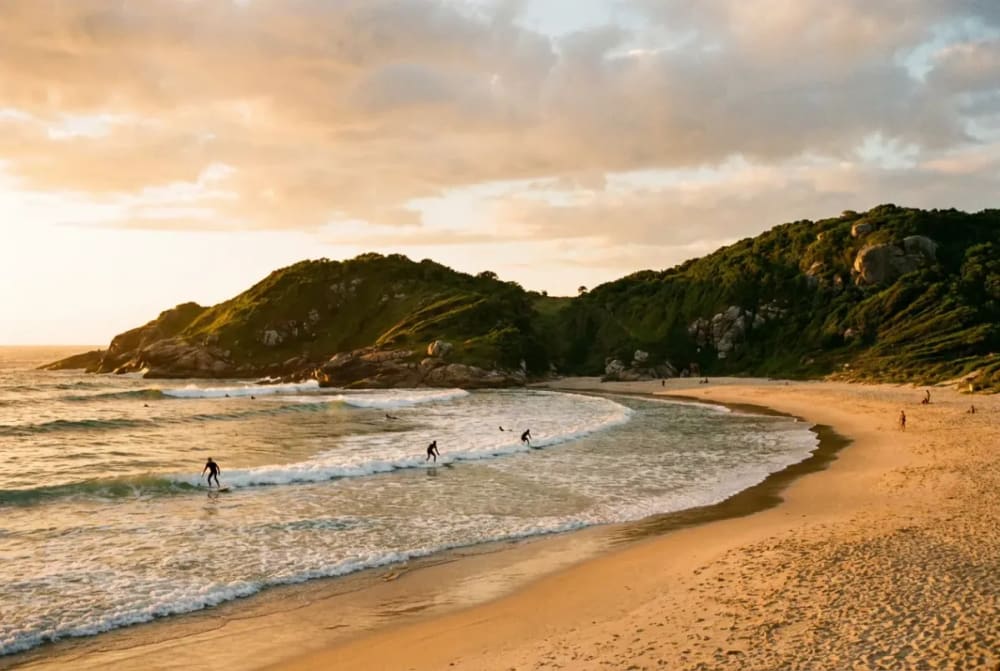
The east belongs to the Atlantic and to surfers. Praia Mole, Joaquina, Barra da Lagoa, and Praia do Santinho line an open stretch of ocean with reliable waves. The island has more than 40 surfable breaks — more than any other major Brazilian city. Praia Mole is the liveliest among them: surfers, an LGBTQ+-friendly atmosphere, and the "Galheta" stretch on the right side, an official nudist beach. Since 2021, the WSL Layback Pro has been held here — the Qualifier Series event that decides World Surf League titles in South America.
The south is the opposite of everything else. Lagoinha do Leste, Naufragados, Pântano do Sul — beaches with no infrastructure, reachable only on foot via jungle hikes of 45 minutes to four hours. If you've been to Brazil before and on your second visit are looking for the empty beaches, this is where you'll find them. Locals consider Lagoinha do Leste the most beautiful beach on the island — and not because it's easy to reach.
The west is the historic counterpart. Sambaqui, Santo Antônio de Lisboa, Ribeirão da Ilha — quiet stretches of coast inside the bay, no Atlantic, no waves. Instead: Azorean colonial architecture, wooden boats, oyster farms, and sunsets over the silhouette of the mainland. For many of our guests, this part of the island is the trip's real surprise.
Which beach for whom? Families with small children head north (Daniela, Jurerê). Surfers and night owls go east (Mole, Joaquina, Barra da Lagoa). Nature lovers and those seeking quiet head south (Lagoinha do Leste, Naufragados). Culture travelers and foodies go west (Ribeirão da Ilha). To see all of it, you'll need a rental car and at least five days.
Lagoa da Conceição — the heart of the island
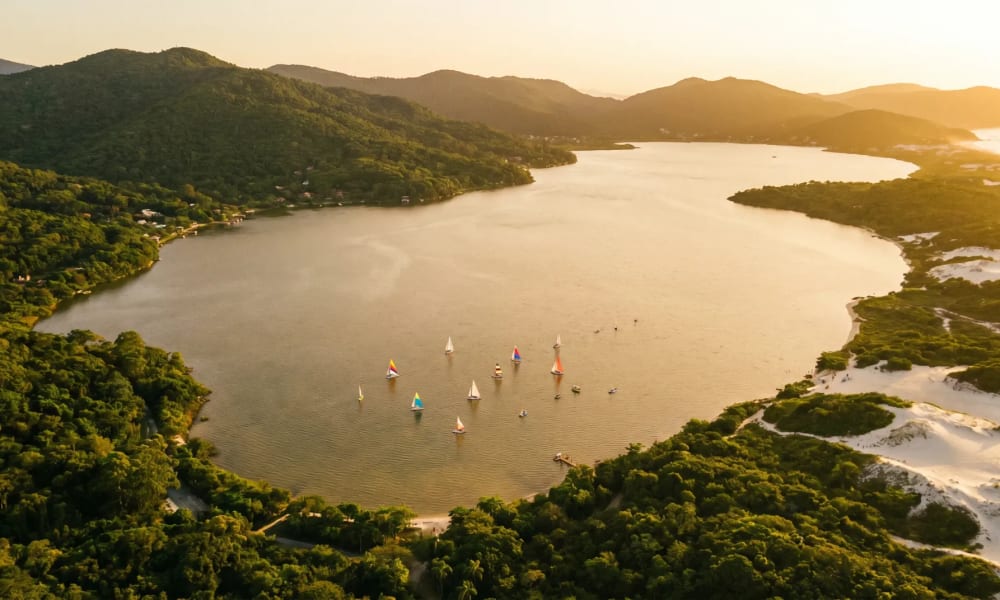
In the middle of the Ilha de Santa Catarina sits a brackish lagoon of 20.65 square kilometers, connected to the Atlantic by a narrow channel. The Lagoa da Conceição is, for us, the most logical accommodation base on the island — central, every beach reachable in 15 to 30 minutes by car, and home to the liveliest dining scene in Florianópolis. Along Rua das Rendeiras, named for the Azorean lacemakers who still work here, restaurants, bars, small galleries, and shops line the street. Evenings are full but not crowded.
The lagoon is one of South America's most important kitesurf and windsurf spots. With northerly winds in summer, it offers beginner conditions that elsewhere only professional schools would allow. Kayak, stand-up paddle, sailing, and classic pedal boats round out the offering — from around 40 reais an hour for equipment.
On the eastern shore of the lagoon, the sand dunes begin and merge into the Dunas da Joaquina — among the largest dune fields in southern Brazil. A fact we ourselves only verified on our last trip: sandboarding was invented in Florianópolis. The Joaquina dunes are considered the cradle of the sport — the first competitions in big air, slalom, bordercross, and speed were held here. You can rent a sandboard for around 20 reais an hour at the stalls at the dune entrance.
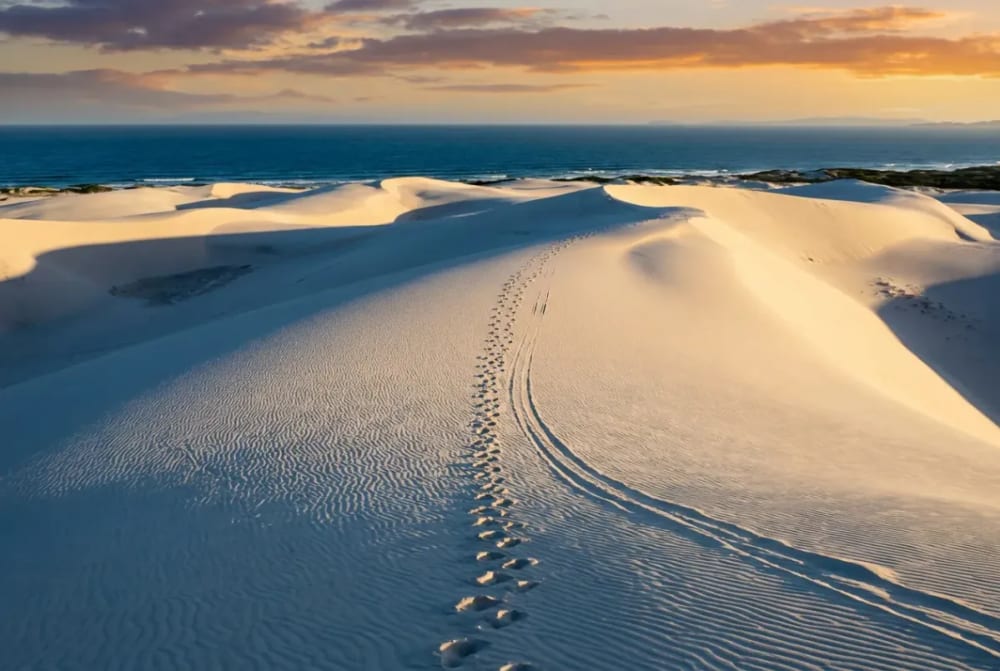
Two kilometers further south lies a second lagoon that doesn't appear in any guidebook but is a local insider's pick: the Lagoa do Peri. At 20.3 square kilometers, it's the largest freshwater lagoon along Santa Catarina's entire coast, a nature reserve since 1981, and the drinking-water source for the island's south. In 2025, it received the Bandeira Azul (Blue Flag) for the tenth time — one of the strictest international environmental certifications for water bodies. Loop trails through the Atlantic Rainforest, no motor traffic, no beach kiosks. If you want a break from the surf beaches, spend half a day here.
Surfing, kitesurfing & water sports
Florianópolis is Brazil's number-one surf spot — and that's not marketing but the result of a story that began in 1986 at Praia da Joaquina. That year, the Hang Loose Pro Contest launched there, a competition that shaped a generation of Brazilian pro surfers across three decades. In 2016, an anniversary edition marked 30 years of history; nine years later, the World Surf League brought the contest back to its original site. Since 2025, Joaquina has once again been a WSL venue.
At Praia Mole, more stories continue to be written. In 2021, then 15-year-old Laura Raupp from Santa Catarina won the Layback Pro — her first pro trophy, in front of a home crowd. Tainá Hinckel, also from the state, took the only perfect 10-point score in the women's class at a later event. For local travelers, surfing isn't a vacation activity but part of one's biography.
For visitors, this means: a surf lesson at a local school costs between 80 and 150 reais. Beginners go to Praia Mole or Barra da Lagoa — the latter a traditional fishing village in the east, more authentic and less expensive than the Lagoa da Conceição, with a direct canal crossing to the natural rock pools of Prainha da Barra. Advanced surfers find their waves at Joaquina, Santinho, or Guarda do Embaú.
One last fact that shows the rank of this coast: Guarda do Embaú, around 50 kilometers south of Florianópolis in the municipality of Palhoça, was named Brazil's first World Surf Reserve in 2017 — one of only nine worldwide. The beach is reachable only by boat or by swimming across the Rio da Madre. For us, it's the finest day trip you can make from Florianópolis.
Kitesurfing concentrates on the Lagoa da Conceição and, when winds pick up, on Praia de Barra da Lagoa. The kitesurf season runs from October to April. Local schools offer multi-day courses from around 1,200 reais.
Azorean heritage — Ribeirão da Ilha & Santo Antônio de Lisboa
Between 1748 and 1756, around 6,000 settlers from the Azores and Madeira established themselves along the coast of Santa Catarina. The Portuguese Crown wanted to secure its South American territory against Spanish claims and recruited families from the Azores and Madeira — the largest migration wave from the Azores in Brazilian history. More than 60 of these families settled in a place known today as Ribeirão da Ilha. The church Nossa Senhora da Lapa do Ribeirão dates from 1806. A walk along the waterfront main street feels as though a Portuguese fishing village from 250 years ago washed up in southern Brazil and stayed.
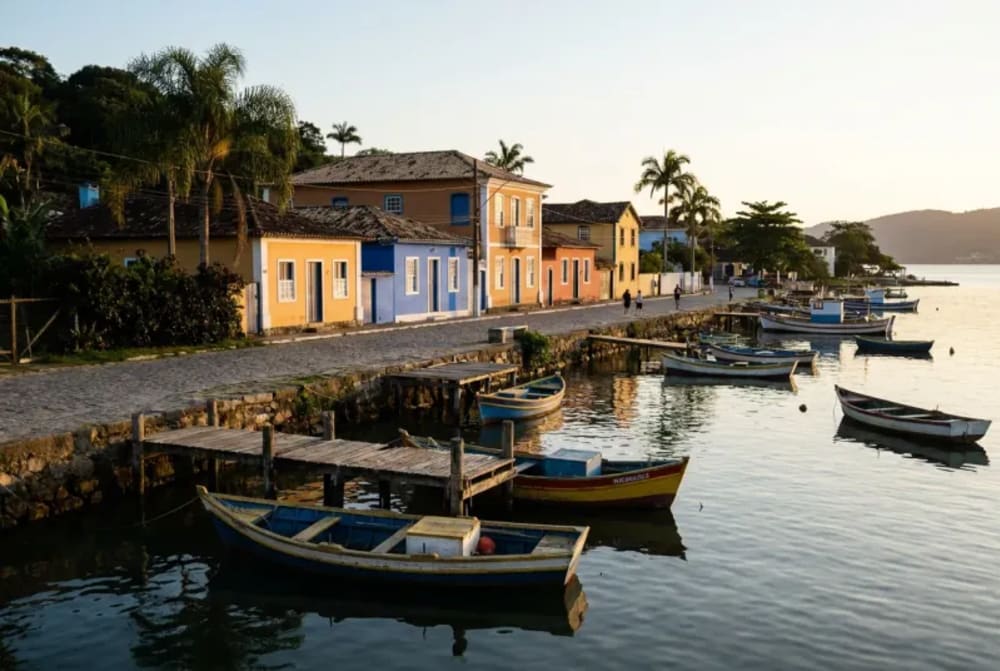
The Azorean heritage isn't just backdrop. Ribeirão da Ilha produces over 50 percent of Brazil's oyster harvest, and the state of Santa Catarina overall produces more than 90 percent of all the country's mollusks. The Rota das Ostras — the Oyster Route along the Rodovia Baldicero Filomeno — strings together dozens of restaurants. The most famous is Ostradamus, with a deck directly over the water. A dozen fresh oysters cost between 60 and 150 reais there. Buy directly from a fisherman and you'll get six oysters from 15 reais — same quality, less atmosphere.
In the north of the island lies the counterpart: Santo Antônio de Lisboa, also founded in 1748, with whitewashed colonial houses, the church Nossa Senhora das Necessidades (1750), and one of the island's finest sunsets over the mainland silhouette. Locals and visitors meet here on weekends in the cafés along the promenade. The Festa do Divino Espírito Santo in May is Florianópolis's most important Azorean cultural festival — a tradition observed without interruption for over 270 years. The Boi de Mamão folk theater with its bull, donkey, and horse figures is part of the living heritage, as is the local dialect that older residents still speak.
Best time to visit & high season
Florianópolis has a subtropical climate, similar to southern Europe's. That means: four distinct seasons, no pronounced rainy season as in Brazil's Northeast, year-round travelable — but with clearly different characters by season.
- December to February (high summer): daytime temperatures 27 to 29 degrees, water 24 to 26 degrees. The most popular and most expensive period. The northern beaches and Jurerê Internacional are dominated in January and February by Argentine and Uruguayan guests — hotel prices are two to three times those of the off-season, and the best properties are booked months in advance.
- March (insider's pick): our favorite recommendation for beach travel. Summer temperatures, water still warm, but the South American high season is over. Prices drop noticeably from Ash Wednesday onward.
- April to June: autumn. Pleasant 18 to 24 degrees, fewer tourists, the best waves on the east coast, affordable accommodations. Ideal for surfers and culture travelers.
- July to September (winter): mild temperatures of 12 to 18 degrees, occasional southerly winds, empty beaches. Between July and October, southern right whales (Eubalaena australis) can be observed off the coast as they come to calve in Santa Catarina's warmer waters. Surf conditions often at their best.
- October and November (our top pick): spring. 20 to 25 degrees, water already warm enough to swim, azaleas and jacaranda in bloom, prices noticeably lower than in the summer high season. The most balanced time of year for guests who want to combine beach, nature, and culture.
Getting there & logistics
The city's only airport is Florianópolis–Hercílio Luz (IATA: FLN), since 2019 housed in a fully rebuilt terminal. Domestic flights are served by GOL, LATAM, and Azul. The most-used route is São Paulo Congonhas (CGH) — Florianópolis with 98 weekly connections and around 75 minutes of flight time. From Rio, Brasília, Curitiba, and Porto Alegre, multiple daily connections are available.
For European travelers, getting there changed fundamentally in 2024: since September 2024, TAP Air Portugal has flown nonstop from Lisbon to Florianópolis — the first direct flight from Europe to this city. Until then, a connection in São Paulo or Rio was mandatory. For our guests from Europe, this is the most comfortable connection the south of Brazil has ever had: change in Lisbon, sleep once, arrive on the island in the morning.
Travelers who fly TAP nonstop from Lisbon to Florianópolis save roughly an entire travel day compared with the classic routing via São Paulo. For trips that combine Florianópolis with the Brazilian south or northeast, we deliberately route the connection through Lisbon — pleasant airport, good hotel options for an overnight layover.
Further international connections exist to Buenos Aires (EZE) and Santiago de Chile — one reason Florianópolis is so heavily booked by Argentine and Chilean guests in summer.
Getting around the island: the public bus network has three main terminals (TIRIO downtown, TILAG at the Lagoa, TICAN in the north), and a single ticket costs 4.50 reais including one transfer. The Floripa no Ponto 2.0 app shows real-time connections. For the south and the hidden beaches, a rental car is practically essential — many of the most beautiful spots are not reachable by bus, or only with significant time investment. Minimum age 21 years, surcharge for drivers under 25. Uber and InDrive work reliably in the city center and along the northern beaches.
Plan Florianópolis individually
Florianópolis rarely makes sense as the sole destination of a Brazil trip — most often it's the recovery or contrast leg within a larger route. Classically, it's combined with Rio de Janeiro to the north (60-minute flight) for a city contrast, or with Iguaçu and the south for a nature-city-beach triangle. With more time, you can add Santa Catarina's Serra (Gramado, São Joaquim) as a mountain extension — a two-hour drive, an entirely different climate, and a German immigrant heritage.
For a Northeast contrast, we recommend pairing it with Salvador de Bahia or the Lençóis Maranhenses — Afro-Brazilian coastal culture or a UNESCO dune landscape as a counterpoint to the European-flavored, orderly Florianópolis. Travelers craving more nature can also add the Pantanal or the Amazon.
For personal advice and a tailor-made proposal, get in touch with us — we know the island firsthand and work with hand-picked pousadas in Lagoa da Conceição, Jurerê, and Ribeirão da Ilha.
To book a trip or for more information, contact us. We'll help you plan and guide you through your upcoming adventure!
Frequently Asked Questions
Three days is the absolute minimum — one day for the north or east coast, one for the Lagoa da Conceição and surroundings, one for the Azorean villages in the west. Four to five days is comfortable: you'll have time for a day trip to Guarda do Embaú or Lagoinha do Leste and a buffer day. Travelers who want to experience the island as a destination in its own right — not just a stopover within a Brazil tour — should plan a week.
For families with small children, the low-wave northern beaches Daniela and Ponta das Canas are ideal. Surfers and night owls go to the east coast: Praia Mole, Joaquina, or — more authentic and cheaper — Barra da Lagoa. Jurerê Internacional requires budget and a taste for the scene. Nature lovers seeking quiet beaches hike south to Lagoinha do Leste or Naufragados. Culture travelers and foodies head west to Ribeirão da Ilha. To see all of it, rent a car and plan five days.
Absolutely — just differently. From June through September, temperatures sit at 12 to 18 degrees, and swimming is for the hardy. In return, the beaches are empty, the surf conditions on the east coast are often at their best, and hotel prices are at their lowest. Between July and October, southern right whales come close to the coast to calve — boat tours depart from Imbituba, about two hours south. For surfers, culture travelers, and wildlife observers, winter is the underrated best time. For classic beach holidays, it isn't.
Our default recommendation for first-time visitors is the **Lagoa da Conceição**: central location, the best dining, every beach reachable in 15 to 30 minutes by car, and a good price spread from guesthouse to boutique hotel. **Jurerê Internacional** is the choice for guests with a party focus and a high budget — wonderful in January, overrated in the off-season. **Campeche** is the quieter, cheaper alternative for surfers and long-stay visitors; the beach stretches 14 kilometers, and infrastructure is less developed. For Azorean flair, stay in a pousada in Ribeirão da Ilha or Santo Antônio de Lisboa.
Yes — clearly yes. The public bus network covers downtown, the Lagoa da Conceição, and the major northern beaches solidly, but many of the most beautiful spots (Ribeirão da Ilha, Lagoa do Peri, Pântano do Sul, Naufragados, Guarda do Embaú) are reachable only with multiple transfers or not at all. A compact car costs from around 100 reais a day in the off-season, double that in peak summer. Minimum age 21 years. Roads are short and well maintained, traffic is mostly relaxed — except on the north-south trunk route on summer weekends.
Rio is the iconic, spectacularly located megacity with Sugarloaf, Copacabana, and favelas — intense, loud, unforgettable, but no beach holiday. Salvador is the Afro-Brazilian heart of Brazil: a colonial center, Candomblé, an intense music scene, with the coast more backdrop than headline. Florianópolis is the grown-up younger sibling: quieter, cleaner, more orderly, with 42 beaches on a single island, European flair from the Azorean migration, and the highest quality of life of any Brazilian capital. For a first trip to Brazil, we recommend a combination — Rio plus Florianópolis is the classic for city travelers seeking beach and quiet as a counterpoint.
You might also like this

This image was generated with AI.
