


Machu Picchu
The real experience away from mass tourism
The real experience away from mass tourism
At 2,430 meters, the Inca citadel looms over the Urubamba Valley — UNESCO World Heritage, one of the New Seven Wonders of the World and the emotional heart of any Peru trip. With the right ticket, the first bus at 5:30 a.m., and the footpath to Inti Punku, you will experience Machu Picchu as the Incas once did — in the morning light, almost alone.

Best travel time
May to October
Why Machu Picchu must be experienced differently
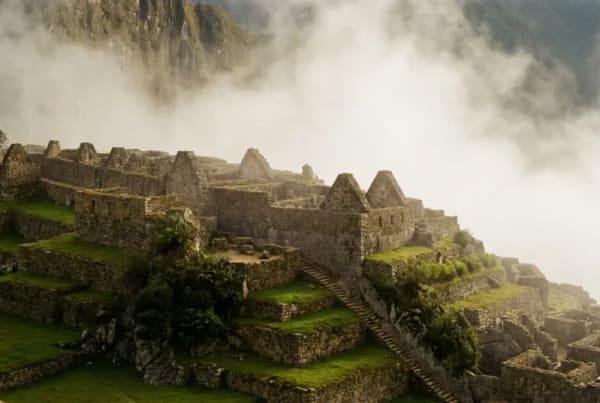
It is just after six in the morning. Fog hangs in the valleys below you, the air is cool and smells of damp earth and misty forest. You stand at Inti Punku — the Sun Gate of the Incas — and gaze down at a site that has rested in this mountainous landscape for over 500 years. No buses, no crowds. Only you, the fog, and the first warm light slowly creeping over the limestone terraces. Just as the Incas entered this city — through the Sun Gate, in the morning light. Just as you should experience it.
The reality looks different for most visitors: arrival with the late bus, crowds on the main paths, photos between hundreds of other smartphones. Over 1.5 million tourists visit Machu Picchu every year — and the Machu Picchu tickets for the first week of January 2026 sold out in just 12 minutes. South America's most visited tourist destination, UNESCO World Heritage since 1983, one of the New Seven Wonders of the World — built around 1450 as the estate of the Inca Emperor Pachacuti, used for about 80 years and then abandoned during the Spanish conquest. In 1911, local Melchor Arteaga led Yale historian Hiram Bingham III to the overgrown ruins — and thus made history.
Between mass tourism and deep experience lies a difference, and it starts with planning. On this page, we show you how to experience Machu Picchu as it is worthwhile: with the right ticket, the right timing, and insider knowledge that makes the difference. When planning your Peru tour Machu Picchu is the emotional heart — and it deserves more than a half-day trip. Ourdetailed planning article goes even deeper.
Machu Picchu tickets — everything you need to know
Book Machu Picchu tickets months in advance
Machu Picchu tickets are strictly limited — in high season (June to August), popular time slots are often sold out 3–4 months in advance. The first five days of January 2026 were sold out in 12 minutes. Book as early as possible through the official platformtuboleto.cultura.pe — not through third parties that charge up to 20% markup.
The ticket system for Machu Picchu has fundamentally changed. Since 2024, three main circuits with a total of ten sub-routes determine which areas of the site you can enter. Each ticket is valid for exactly one route, one time slot, and a maximum stay of four hours. Anyone wanting to see multiple areas needs multiple tickets on different days — a detail that many travelers only learn on site.
The daily capacity is 5,600 visitors in high season (June 19 to November 2) and 4,500 in low season. Of these, 1,000 tickets are sold daily at the Centro Cultural in Aguas Calientes — almost impossible to obtain during high season.
Prices as of 2025/2026. Tickets available only through tuboleto.cultura.pe officially. Non-refundable. Passport required upon entry.
Circuit 1 vs. Circuit 2 — which path is the right one?
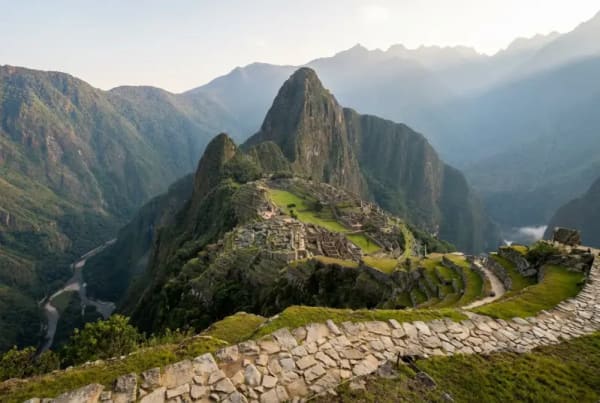
Circuit 1 (Panoramic) leads over the upper terraces and offers the famous postcard view from Casa del Guardian — that shot you know from every guidebook and that has made Machu Picchu the symbol of a lost civilization. Four sub-routes are available: 1A (with Machu Picchu Mountain), 1B (Terraza Superior — the classic viewpoint), 1C (Inti Punku / Sun Gate, only high season) and 1D (Puente Inka / Inca Bridge, only high season). Important: Circuit 1 shows Machu Picchu from above — you do not enter the ruins themselves.
Circuit 2 (Classic) goes through the interior of the Inca city: the agricultural sector, the large urban structures, temples, and plazas. Sub-Route 2B (Terraza Inferior) is the most intensive tour of the site. Anyone wanting to grasp the precision of the Inca stonework with their own hands, enter the temples, and experience the spiritual places up close should choose Circuit 2.
Circuit 3 (Royalty) includes the royal buildings in the lower area and mountain options: 3A (Huayna Picchu ascent), 3B (Ruta Diseñada), 3C (Gran Caverna, only high season) and 3D (Huchuy Picchu, only high season).
Insider tip
Our recommendation for first-time visitors: Circuit 1B (Terraza Superior) for the iconic panoramic photo. If you can secure a second ticket for the following day, combine it with Circuit 2B for the deep tour through the ruins. If you only have one ticket and want to experience the interior, choose Circuit 2.
Huayna Picchu ticket & Machu Picchu Mountain ticket
For both mountain ascents, you need a separate ticket with a mountain surcharge (200 Soles instead of 152 Soles). The Huayna Picchu ticket is limited to 400 spots per day, the Machu Picchu Mountain ticket to about 300. In high season, Huayna Picchu tickets tend to sell out 3–4 months in advance — anyone wanting to experience the famous summit view should plan accordingly.
When to book? The critical lead-time
Machu Picchu tickets are released throughtuboleto.cultura.pe in two monthly windows: from the 1st to the 15th of each month at 7:00 a.m. and from the 16th to the end of the month at 12:00 p.m. For the high season (June to August), we recommend securing your Machu Picchu tickets 4–6 months in advance. Third-party websites are not official sales points — you will pay up to 20% more there.
Important from 2026: The Inca Trail permit no longer includes a Machu Picchu ticket — trekkers must purchase a separate entrance ticket.
Let us secure the right Machu Picchu tickets for you — we know the system from our own experience and know which circuits and time slots suit your travel style. Schedule a consultation .
The first train and Inti Punku — the real experience
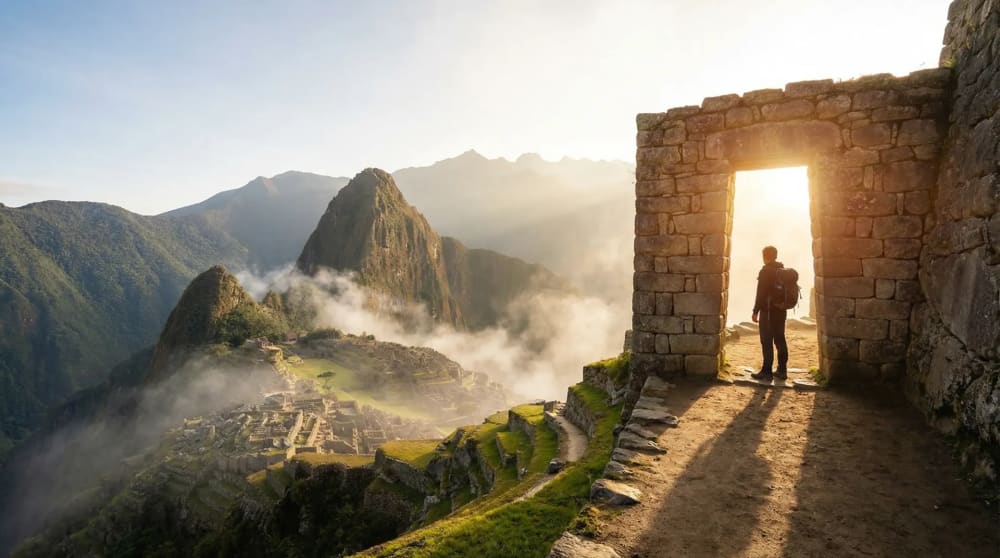
The difference between a good visit and one that sticks with you lies in the timing. Those choosing the earliest time slot (6:00 a.m.) and staying overnight in Aguas Calientes will experience the site in a quietness that disappears within hours as the day visitors arrive. It is this moment — when the fog lifts, the light creeps over the terraces, and the over 150 buildings of the site slowly emerge from the gray — that transforms Machu Picchu from a sight into an experience.
The timing protocol: From Aguas Calientes to the entrance
To gain early entry at 6:00 a.m., you must stay overnight in Aguas Calientes — the first train from Ollantaytambo simply arrives too late. The first bus leaves at 5:30 a.m. and takes about 25 minutes to reach the entrance. Experienced travelers start lining up at the bus stop by 4:30 a.m. to catch the very first bus. Alternatively, there is a footpath upwards — about 2 to 2.5 hours uphill, challenging, but an experience in itself for sure-footed hikers.
Inti Punku: The footpath through the Sun Gate
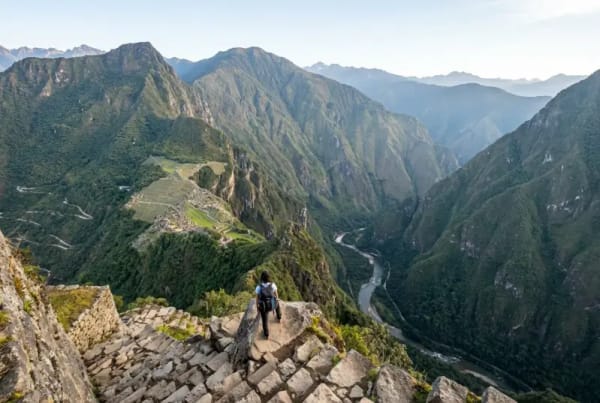
The Sun Gate (Inti Punku) is situated at 2,700 meters — about 300 meters above the main site. The path there is around 2 kilometers long, moderately challenging, and takes 45 to 60 minutes uphill. Upon reaching the Sun Gate, a panorama unfolds that takes your breath away: the entire site at your feet, Huayna Picchu behind it, the Urubamba River winding its way through the valley. It is exactly the view that Inca Trail hikers receive as a reward after four days of trekking — and you can experience it with Circuit 1C (only high season, approximately June to November).
Insider tip
Ideal timing protocol: 5:30 a.m. first bus, 6:00 a.m. entry, hiking directly to Inti Punku. Around 7:00–7:30 a.m., you'll be at the Sun Gate — in the best light, often still in fog, with a view that sticks with you. Between October and March, the morning fog, which slowly lifts from the valleys, creates particularly dramatic moments.
Private guide — which type suits you?
All official Machu Picchu guides are certified by the Peruvian Ministry of Culture and must hold a university degree in tourism. But a guide is not just a guide — and the right one makes the difference between a tour and an experience that truly enriches you.
The archaeological guideunlocks the history behind the stones: connections between buildings, Inca astronomy, the exact function of individual sectors. For anyone who wants more than facts from the guidebook. The naturalist guideshows the flora and fauna of the surrounding cloud forest: orchids, hummingbirds, the ecological significance of this unique ecosystem. And the photography guideknows the best spots, lighting conditions, and angles — ideal for ambitious photographers who want to take home more than smartphone snapshots.
A private guide costs 80 to 150 USD per person for 2 to 3 hours. Guides are also available at the entrance for about 40 USD — though they are often beginners assigned through a lottery system. Experienced guides work with agencies and are booked in advance. We would be happy to connect you with the right expert.
Huayna Picchu or Machu Picchu Mountain? An honest comparison
Both mountains offer impressive views of the Inca citadel — but the experience could hardly be more different. Huayna Picchu is the steep, famous sugarloaf directly behind the ruins — that distinctive peak you know from any Machu Picchu photo. Machu Picchu Mountain is the broader, significantly taller mountain across from it. Both are worthwhile but for different travelers for different reasons.
Huayna Picchu (Waynapicchu)
- Summit height — 2,720 m (290 m ascent)
- Duration — 2 hrs. total (40–60 min. up)
- Difficulty — Medium to hard — steep steps, climbing passages, ropes
- Ticket — 200 Soles / 56 USD (Circuit 3A)
- Availability — Only 400 tickets/day, 2 time slots
Machu Picchu Mountain (Montaña)
- Summit height — 3,082 m (652 m ascent)
- Duration — 3–4 hrs. total (1.5–2 hrs. up)
- Difficulty — Moderate — wider path, less exposed, 1,600 steps
- Ticket — 200 Soles / 56 USD (Circuit 1A)
- Availability — About 300 tickets/day, up to 7 hrs. stay
The Huayna Picchu ascent is the more adventurous option: shorter, steeper, with archaeological highlights like the Gran Caverna (Temple of the Moon) at the foot of the mountain. Not suitable for people with a fear of heights — the stone steps are narrow and exposed, in some places, you need to hold onto steel cables. Minimum age: 12 years. The summit, however, rewards you with a view that feels like standing on the roof of the Inca world.
Machu Picchu Mountain offers the grander 360-degree panorama: views of the citadel, the Urubamba River, and on clear days, the snow-covered peaks of Salkantay and Veronica. The path is wider and less exposed, but the double elevation gain (652 meters, about 1,600 steps) makes it more challenging in terms of fitness. Here it's less about thrills than endurance and reward.
Note
Our recommendation: The Huayna Picchu ascent for fit, sure-footed travelers seeking adventure. Machu Picchu Mountain for hikers who prefer the more comprehensive panorama. If Huayna Picchu is sold out: Huchuy Picchu (Circuit 3D, only high season) offers a similar perspective with only a 1-hour ascent — and is significantly easier to book.
Getting there — Inca Trail vs Bus route to Machu Picchu or train?
Most travelers take the train from Ollantaytambo to Aguas Calientes — 1.5 to 2 hours through the spectacular Urubamba Valley, passing Inca terraces and steep Andean slopes. From Cusco/Poroy it takes 3.5 to 4 hours. Ollantaytambo is the better departure point: shorter travel time, lower prices, and the Inca fortress there is itself an impressive sight as part of Cusco and the Sacred Valley .
Train connection to Aguas Calientes (Machu Picchu) Ollantaytambo → Aguas Calientes
The sporty alternative: Inca Trail or Salkantay Trek. Those who want to reach Machu Picchu on foot have two classic options — and experience a completely different dimension of the journey. The Inca Trail and Salkantay Trek lead through Andean highlands directly to the citadel — 4 to 5 days of hiking through misty forests and over passes at over 4,000 meters, with the Inti Punku as the crowning finale. When deciding between Inca Trail vs bus route to Machu Picchu, it holds true: The trek makes the arrival an emotional climax, the bus route saves time and energy for the site itself. Note: The Inca Trail is closed every year in February (maintenance), and from 2026 the trail permit no longer includes a Machu Picchu entrance ticket.
Insider Tip
Always book train tickets as a round trip — the evening trains from Aguas Calientes sell out quickly during peak season, and without a return ticket, you face a problem. Another tip: Buy the bus ticket for the shuttle to the entrance the night before (office in Aguas Calientes or online at comprar.consettur.com) to avoid the morning queue.
Aguas Calientes — Your base for Machu Picchu
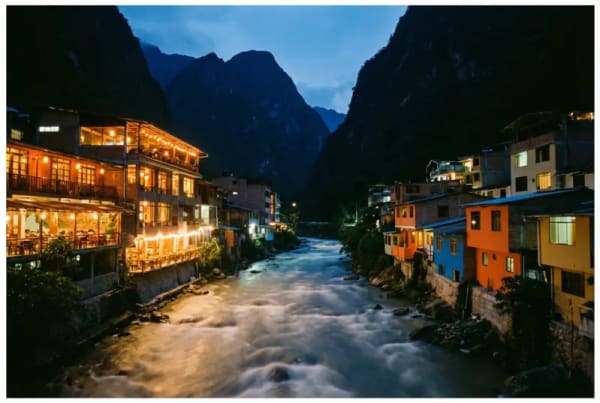
Aguas Calientes (officially Machu Picchu Pueblo) is a small town at the foot of the mountains, wedged between steep slopes and the rushing Urubamba River, accessible only by train or on foot. Here you set up your quarters to secure the earliest entry to Machu Picchu. The town is compact and completely walkable — there are no taxis, you don't need them either. After visiting the citadel, the thermal bath is worth it: six pools with water temperatures of 38 to 44°C, about 750 meters from the center, daily 5:00 am to 8:00 pm for around 20 soles (about 5 USD). The best time: in the morning before 7 am or in the evening after 5 pm, when day visitors have already departed.
Belmond Sanctuary Lodge
The only hotel directly at the entrance to Machu Picchu
From 1,760 USD / night
- Directly at the entrance
- Access before opening
- 31 rooms
- Breakfast buffet included.
Inkaterra Machu Picchu Pueblo Hotel
Boutique lodge in a private cloud forest near Aguas Calientes
From 378 USD / night
- 12 acres of cloud forest
- 85 bungalows
- Guided nature walks
- Spa & bird watching
The Belmond Sanctuary Lodge is the only accommodation directly at the entrance — guests can access the site before the first buses and linger after the departure of day visitors. The price is high, but the exclusive access justifies it for discerning travelers. If you are looking for a premium-level hotel in Aguas Calientes, the Inkaterra Pueblo Hotel is the best alternative: 12 acres of private cloud forest, guided orchid walks, and bird watching right at your doorstep. We know both properties personally and know which rooms offer the best views. Make a request .
Your visit — schedule and daily planning
Day 1 — Day trip from Cusco / Ollantaytambo
Day 2 — Overnight stay in Aguas Calientes (recommended)
Note: Ambitious travelers with two full days can climb Huayna Picchu or Machu Picchu Mountain in the morning (separate ticket) and combine the Panorama Circuit 1B with Inti Punku the next day. This way you experience both the summit view and the classic panorama.
Good to know
Best travel time for Machu Picchu
The best travel time for Machu Picchu falls in the dry season from May to October: minimal rain (about 2 rainy days per month), up to 9 hours of sunshine daily, and daytime temperatures around 20 to 21°C. Nights can be cold — in June and July down to nearly 0°C, so pack a warm layer. July and August are peak season with the most crowds and the fastest-selling Machu Picchu tickets.
The rainy season (November to March) brings almost daily rain showers and 15 to 19 rainy days in January — but also significantly fewer tourists, vibrant greenery, and that dramatic fog which creates the most impressive photos. Some circuits (1C, 1D, 3C, 3D) are closed during the rainy season. The Inca Trail closes completely every year in February.
The sweet spot: May and September. Good weather, noticeably fewer visitors than in the absolute peak season, and in May the vegetation is still particularly green after the rainy season — the terraces shine in a rich green that has already faded by August. More details in our overview of the best travel time for Peru .
Note
Inti Raymi — Winter Solstice Festival: On June 24, Cusco celebrates the largest festival in Peru with over 3,500 participants (tickets 140–210 USD). Machu Picchu tickets are extremely scarce during this week — book at least 5–6 months in advance.
Altitude sickness at 2,430 meters
One detail that surprises many travelers: Machu Picchu is located at 2,430 meters — lower than Cusco (3,400 m). Those who have acclimatized in Cusco or the Sacred Valley for two to three days will hardly have any problems in Machu Picchu. 48 hours of acclimatization reduce the risk of altitude sickness by up to 70 percent. Mate de Coca (coca tea) helps — available everywhere in Peru and officially recommended. The challenge lies not in Machu Picchu itself, but in the journey via Cusco. Detailed information about altitude sickness in Peru and our personal experience with it.
Packing list for Machu Picchu: Reusable water bottle (single-use plastic is prohibited), rain poncho (also in the dry season — the weather can change within minutes), sunscreen (the UV radiation at 2,430 meters is intense), comfortable hiking shoes with good grip, snacks in cloth or paper bags. Backpacks max 5 kg. No drones, no tripods without prior permission. More on our Packing list for Latin America.
Costs at a glance
Prices as of 2025/2026. 1 USD ≈ 3.7–3.9 PEN. All prices per person unless otherwise noted.
More information on costs and budget for Peru and flights to Peru .
Discover more of Peru
Machu Picchu is the emotional center of any trip to Peru — but the country has so much more to offer, and the best trips connect several of these facets. From Cusco, you can reach the Rainbow Mountain as a spectacular day trip — colorful rock layers at 5,200 meters that look as if created by a painter. Lima offers the best restaurant scene in Latin America for a start or conclusion and a gentle introduction without altitude issues. And the Inca Trail and Salkantay Trek take you through Andean highlands, which are memorable, on the way here.
Cusco & Sacred Valley — Inca capital at 3,400 m
Lima — Gastronomy capital of the world
Inca Trail & Salkantay — on foot to Machu Picchu
Rainbow Mountain — Vinicunca at 5,200 m
Our Peru highlights — Lima, Cusco, Machu Picchu connect the three most important stations in a thoughtful route — ideal as an introduction to Peru. For trekking enthusiasts, the Peru trekking — Salkantay & Inca Trail round trip takes you to Machu Picchu on foot. And for those who have more time, experiencing the Peru intensive — Inca, Amazon & Rainbow Mountain gives a full spectrum of this remarkable country.
Still unsure which country in Latin America is right for you? Our decision aid: Latin America — where to travel? helps with the choice. And for a personal insight, read our Peru travel report: Inca & Rainbow Mountain.
To book a trip or for more information, contact us. We'll help you plan and guide you through your upcoming adventure!
Frequently Asked Questions
For the high season (June to August), we recommend securing Machu Picchu tickets 4–6 months in advance, and for Huayna Picchu at least 3–4 months. In the off-season (November to March), often 2–4 weeks is sufficient. For context: Tickets for the first week of January 2026 sold out in 12 minutes. The official and only recommended platform is tuboleto.cultura.pe.
Circuit 1 (Panoramic) goes over the upper terraces and offers the famous postcard view from Casa del Guardian — you do not enter the ruins. Circuit 2 (Classic) goes through the interior of the Inca city with temples, plazas, and residential buildings. For the iconic viewpoint: Circuit 1B. For the intensive tour: Circuit 2B. To see everything, you need two tickets on different days.
Yes, 1,000 tickets are sold daily at the Centro Cultural in Aguas Calientes. However, during the high season (June to August), these are often sold out early in the morning. We strongly recommend online booking through tuboleto.cultura.pe — this is the only way to secure your desired circuit and time slot.
The Huayna Picchu climb (2,720 m) is steeper, shorter (2 hours total), more adventurous with climbing sections and features the Temple of the Moon as an archaeological highlight. Only 400 tickets per day. Machu Picchu Mountain (3,082 m) is higher, wider, less exposed, takes 3–4 hours, and rewards with a comprehensive 360-degree panorama. About 300 tickets per day. In short: Huayna Picchu for adventurous thrill-seekers, Mountain for hikers and panorama lovers.
Machu Picchu opens at 6:00 am, the last entry is at 4:00 pm (with a 30-minute grace period). The earliest time slot (6:00 am) is the best: fewer visitors, best light, cooler temperatures. To do this, you need to stay overnight in Aguas Calientes — the first train from Ollantaytambo is too late for the 6 am slot.
The most common route is by train from Ollantaytambo (1.5–2 hours) or Cusco/Poroy (3.5–4 hours) to Aguas Calientes, then 25 min bus or 2 hours on foot to the entrance. PeruRail and Inca Rail offer different classes (60–650 USD one way). The sporty alternative: Inca Trail (4 days) or Salkantay Trek (5 days) — both lead to the citadel on foot. The Inca Trail is closed every February.
The best time to visit Machu Picchu is the dry season from May to October with only about 2 rainy days per month and up to 9 hours of sunshine daily. July and August are peak season with the most crowds. Our recommendation: May or September — good weather, fewer tourists, better ticket availability. The rainy season (November to March) has significantly fewer visitors and dramatic fog for photos, but some circuits are closed.
Absolutely. An experienced guide reveals connections that no travel guide provides: Inca astronomy, the function of individual sectors, hidden details in the stone structures. A private guide costs 80–150 USD for 2–3 hours. Guides at the entrance (around 40 USD) are often beginners. We recommend booking through a verified agency in advance — and we are happy to connect you with the right expert.