

Cusco Holy Valley
The heart of the Inca Empire between 2,800 and 3,400 meters
The heart of the Inca Empire between 2,800 and 3,400 meters
Cusco at 3,400 m and the Holy Valley at 2,800 m: The Inca capital, Ollantaytambo, Pisac, Moray, and Maras — individually planned with altitude strategy from experts.

Best travel time
May to September (dry season), April and October as quieter shoulder months
Why Cusco & the Holy Valley?
Cusco was not just any capital. The Incas called their city Qosqo — “navel of the world" — and developed it over decades into the political, religious, and astronomical center of an empire that stretched from Colombia to Chile. At 3,400 meters high, framed by the Andes and crowned by the cyclopean fortress of Sacsayhuamán, Cusco remains the cultural focal point of Peru to this day. In 1983, UNESCO included the entire old town in the World Heritage List.
The Holy Valley — Sacred Valley — extends about 600 meters lower, between Pisac and Ollantaytambo. It is warmer, milder, greener. The Urubamba River, whose source area the Incas revered as sacred, flows through terraced fields, colonial villages, and mountain fortresses. Those who plan the region well spend the first nights not in Cusco but down here — with noticeably less headache and significantly more sleep.
Cusco and the Holy Valley together are the indispensable chapter of any Peru trip. Not because they are on every list. But because in this combination they offer a density of history, landscape, and vibrant Andean culture that is unmatched anywhere else on the continent.
Cusco — the Inca capital
The old town of Cusco is a layered architecture: below the precisely fitted Inca walls, above the Spanish colonial arches, balconies, and churches. After the conquest in 1533, the Spaniards built their palaces and monasteries directly on the foundations of the Incas — leaving many of these foundations visibly standing because they proved to be more earthquake-proof than any European construction. The Calle Loreto and the Calle Hatunrumiyoc with the famous twelve-angled stone illustrate this in just a few hundred meters.
In the center of the city lies the Plaza de Armas, framed by the cathedral (built 1560–1654, partly from stones of Sacsayhuamán) and the Jesuit church La Compañía. Inside the cathedral hangs probably the most fascinating painting of the New World: Marcos Zapata's “Last Supper". Christ and the disciples dine at a table where the main course is not lamb or bread, but Cuy — guinea pig, the Andean feast. More syncretism in a single image is hardly possible, and it is one of the reasons why a local guide in Cusco is not mandatory, but a benefit.
A few minutes' walk south is Qorikancha, the former Sun Temple of the Incas. Its gold-covered walls were taken down by the Spaniards to build the Santo Domingo monastery — but the Inca foundation walls made of perfectly hewn andesite blocks still stand today. When an earthquake shook Cusco in 1950, the colonial monastery partially collapsed. The Inca walls below remained intact.
Insider tip Cuy dinner: Marcos Zapata's “Last Supper" in the cathedral is mentioned in most travel guides as a historical footnote. Ask your guide specifically about it — it is one of the clearest pieces of evidence of how Andean culture adapted Catholic imagery instead of submitting to it.
Cusco deserves at least two full days: one for Plaza de Armas, cathedral, Qorikancha, and the San Blas district, another for Sacsayhuamán and the surrounding sites Qenqo, Puka Pukara, and Tambomachay — all four summarized in the Circuit I of the Boleto Turístico.
The Holy Valley at a glance
The Holy Valley begins about 15 kilometers north of Cusco at Chinchero (3,762 m), then descends to Urubamba (2,870 m) and ends at Ollantaytambo (2,792 m), from where the trains to Machu Picchu start. The route is nearly 60 kilometers long, which can be driven by car in just over an hour — but this is precisely where many travel plans fall short: those who “check off” the valley in one day miss its true value.
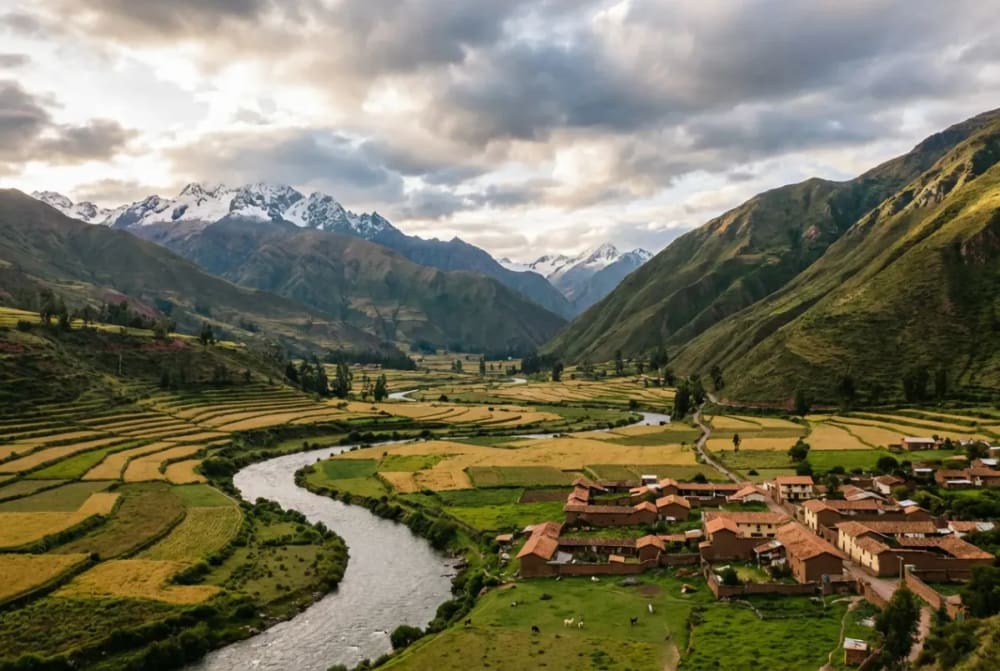
The valley is not an open-air museum but a farming region. Between the ruins lie cornfields, potato terraces (more than 3,000 varieties are cultivated in the area), and Quechua villages where women have been working on the same looms as their grandmothers for generations. In Chinchero a half day is worthwhile, visiting the colonial adobe church, the Inca terraces, and a live weaving demonstration — significantly less touristed than Pisac, and more photogenic.
The valley is 600 meters lower than Cusco, is milder in climate, and better suited for the first two to three nights. Those traveling with this plan reverse the usual order: flight Lima–Cusco, direct transfer to the Holy Valley, two nights for acclimatization, then ascent to Cusco. The altitude headaches are noticeably less.
The most important sites
The entire district is a dense field of archaeological sites. Four of them are must-sees, each telling a different facet of the Inca world.
Sacsayhuamán — Cusco
Sacsayhuamán towers two kilometers above Cusco at nearly 3,700 meters. The three stepped terrace walls are each about 360 meters long — but the real puzzle is the individual blocks. The largest reach nine meters high, five meters wide, four meters deep, and weigh between 125 and 200 tons; some sources cite up to 360 tons for the heaviest stones. They were brought from quarries up to 20 kilometers away and fitted so precisely that even today no sheet of paper fits between the joints. How the Incas accomplished this without wheels, draft animals, and iron tools remains uncertain.
Around 20,000 workers are said to have been involved in the construction for over 50 years. Since 1944, every year on June 24th, the Inti Raymi — the midsummer festival of the Incas — is performed on the esplanade as a two-hour theatrical ceremony. It is considered the second largest cultural event in South America.
Those who want to experience Sacsayhuamán in peace should arrive early. From seven in the morning, the site is largely empty, the light falls flat over the terraces, and the tour buses come later. Qenqo, Puka Pukara, and Tambomachay are nearby and can be visited in the same half day.
Pisac — market and fortress
Pisac is divided. Below in the valley is the colonial village with its famous market — most vibrant on Tuesdays, Thursdays, and Sundays, significantly quieter on other days and better for photography. Above, 600 meters above the town, is one of the most extensive Inca mountain fortresses ever, with residential areas, temples, and an Intihuatana — the “sun binder post". On June 21st and December 21st, the sun rises exactly over certain mountain peaks. The Incas understood astronomy as applied science, not as mysticism.
Those fit enough can hike the ruins from top to bottom (about two hours down). The entrance at the top, by taxi from Pisac village, saves the ascent. The fortress is included in the Boleto Turístico Circuit III.
Ollantaytambo — the living Inca village
Ollantaytambo is the only still-inhabited city whose street grid still follows the original Inca layout. The right-angled alleys, the water channels, the house foundations — all Inca. The Spaniards did not build everything new but occupied.
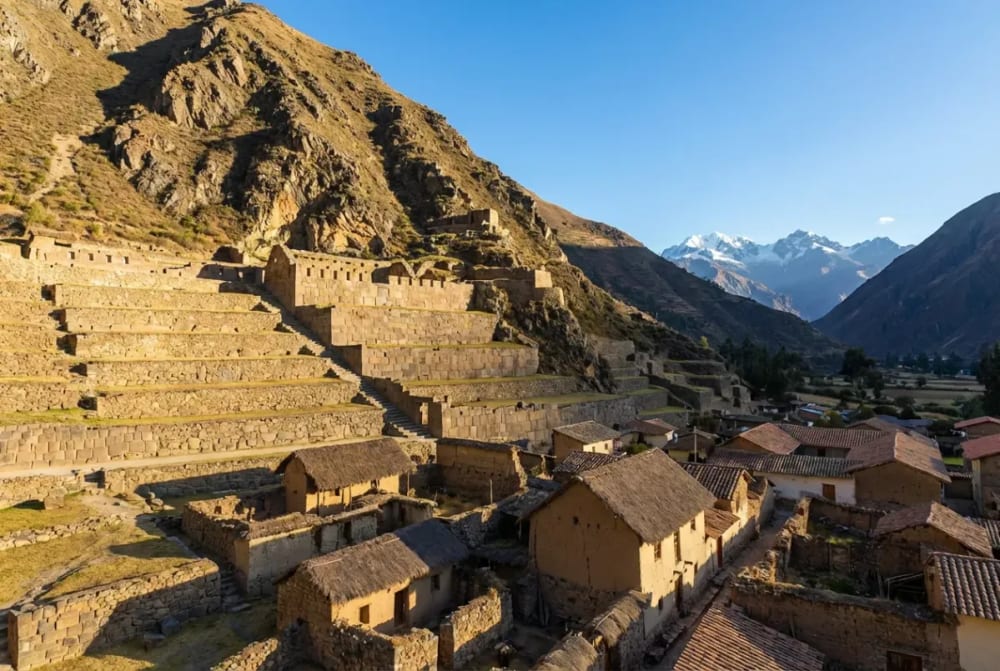
At the edge of the village, the fortress rises steeply up the mountain. Here, Manco Inca defeated a Spanish cavalry unit under Hernando Pizarro in the battle of Ollantaytambo in one of the few open defeats of the Conquista — by flooding the fields below. At the summit stands the unfinished sun temple with six monolithic rose porphyry blocks, each over four meters high, brought from a quarry on the opposite side of the valley.
Ollantaytambo is also the train station for trains to Machu Picchu. Both PeruRail and Inca Rail start here, the journey to Aguas Calientes takes about 1.5 hours. Many travelers spend the night directly in the village — the atmosphere after the departure of day-trippers, with candlelight in the adobe-brick alleys, is one of the quiet highlights of any Peru trip.
Moray & Maras — terraces and salt mines
Moray looks like an amphitheater but was an agricultural laboratory. Three concentric circular terrace systems sink up to 150 meters deep into the plain — the largest is 220 meters wide and 30 meters deep. Between the uppermost and the lowest terrace, there is a temperature difference of up to 15 °C. This exactly corresponds to the climatic differences between highland and jungle's edge in the Inca Empire. Here, the Incas tested over 3,000 potato varieties, along with corn, quinoa, and amaranth — each terrace a unique microclimate. Moray is, plausibly read, the first documented agricultural research center in the world, centuries before the Green Revolution.
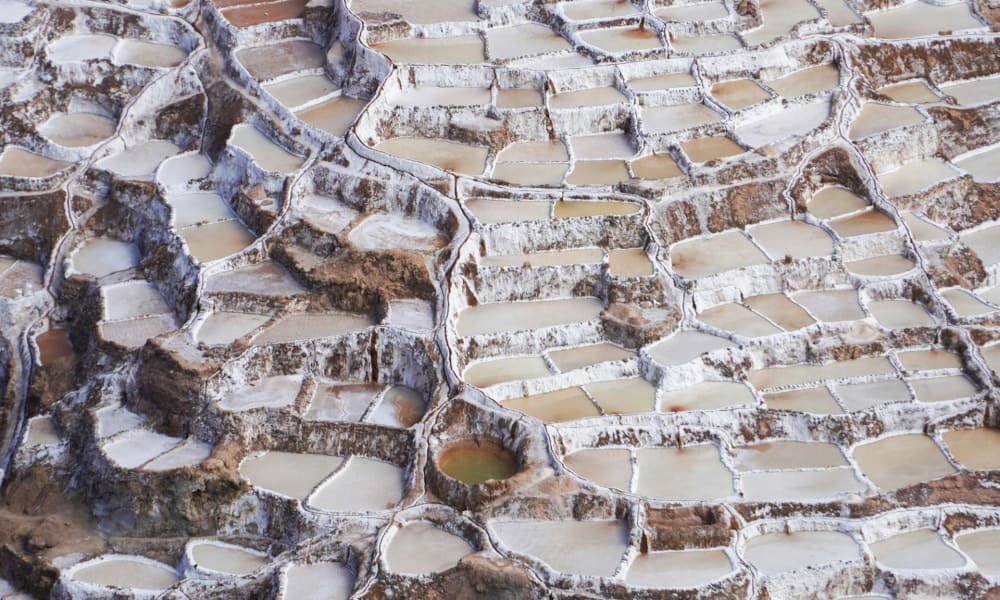
Ten kilometers away are the Salineras de Maras. About 4,500 terraced salt basins cling to the side of a narrow canyon, fed from a hypersaline spring that has emerged from the mountain at the same point for centuries. The water is channeled into the shallow basins, with wind and sun doing the rest — about 150 to 200 kilograms of salt per basin per month in the dry season.
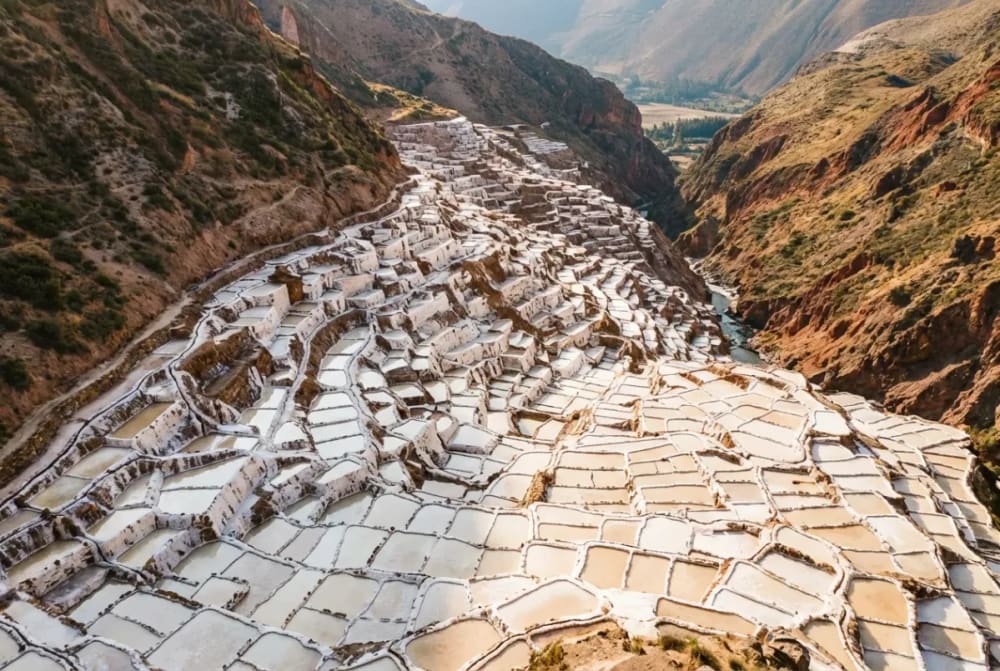
The most interesting fact about Maras is the one that most guidebooks get wrong: The mines were not established by the Incas. They date back to the Wari civilization (500–1100 AD) — so they are at least 400 to 900 years older than the Inca Empire. Today, about 400 families from the villages of Maras and Pichingoto manage the basins; the marketing runs through the cooperative Marasal S.A. The slightly mineral Maras salt is a worthwhile souvenir — already a delicacy in the restaurants of Lima and Cusco.
Moray and Maras can be ideally combined in a half day, best early (from 7 a.m.) and by private vehicle or organized tour.
Altitude adjustment — the strategy
Cusco is at 3,400 meters. Those arriving directly from Lima (sea level) gain more altitude in a 1.5-hour flight than most Alpine tours do in a week. Accordingly, the first symptoms are common: headaches, insomnia, loss of appetite, sometimes nausea. According to a PubMed study on acute mountain sickness (AMS) risk in Cusco, up to 50 percent of newcomers develop mild to moderate symptoms.
The best prevention is not a pill but the correct order. Those who travel directly to the Holy Valley (Urubamba, 2,870 m) after landing in Cusco and spend the first two nights there arrive significantly more gently. Only then does the ascent to Cusco take place — the body has already had 48 hours to produce red blood cells.
Insider tip Holy Valley first: Most standard routes lead from Lima directly to Cusco and only then to the valley. This is convenient for the hotel brokers — but unnecessarily hard on the circulation. Reverse the order: flight Lima–Cusco, transfer to Urubamba, two nights in the valley, then Cusco. The difference is physically noticeable.
A classic local accompaniment is the Mate de Coca, the coca tea, which almost every hotel offers at check-in. Important: Scientific effectiveness against AMS has not yet been proven (the same PubMed study). The tea promotes hydration and subjective well-being but does not replace acclimatization. Those who are sensitive to heights should talk to their family doctor about acetazolamide (Diamox) in advance — starting 24 hours before arrival, not just in Cusco.
Two more concrete rules: The first 48 hours no alcohol, little heavy food, plenty of water (at least three liters per day). And: A single hotel in Cusco, which JW Marriott El Convento Cusco, pumps oxygen into all rooms as the only hotel in the city. For travelers with known altitude sensitivity or cardiovascular preconditions, this is more than marketing.
Best travel time
The dry season from May to September is the most reliable travel period. During the day, temperatures in Cusco range between 18 and 22 °C, at night it can drop to 0 °C — the air is thin and retains heat poorly. Rain is rare, the trails are dry, and visibility is clear. July and August are peak season, hence busier and more expensive.
The month richest in culture is June. Three major events fall within a few weeks: Corpus Christi (June 19, 2026), Inti Raymi on June 24 and the pre-festival activities of the Winter Solstice. Inti Raymi is the highlight — the ceremony begins in the morning at Qorikancha, moves over Plaza de Armas, and ends with the two-hour main performance at Sacsayhuamán. The Qorikancha and Plaza sequences are free, while the seated areas in Sacsayhuamán cost between 80 to 150 USD depending on the sector. Hotels during Inti Raymi week should be booked at least six months in advance.
The rainy season from November to March brings significantly more precipitation, but also empty sites and lush green tones in the valley. The Inca Trail is closed in February. Those traveling flexibly and who can cope with occasional afternoon thunderstorms often find the best conditions in the shoulder season, April and October: almost all trails open, visibility mostly clear, prices noticeably lower.
Getting there & Transfers
Cusco is reachable by flight from Lima — the route is serviced by LATAM, Sky Airline, and JetSMART several times a day, flight time around 1.5 hours, prices typically between 70 and 180 USD one-way. Those flying directly from Europe land at Alejandro Velasco Astete International Airport (CUZ) right in Cusco — a breathtaking approach through the mountain peaks.
In the medium term, the arrival situation is changing noticeably: The new Chinchero International Airport is currently being built in the Sacred Valley, about 30 kilometers from Cusco and at an altitude of 3,762 meters. Terminal construction is ongoing, with the runway bidding taking place in 2025, and the opening is expected by the end of the decade — the schedule is not yet fixed. Direct connections from North and South America are expected to follow. Until then, Lima remains the only hub.
From Cusco Airport to the Sacred Valley is about a 75-minute private transfer (approximately 60–90 USD for up to three people). A day driver from Cusco to the Sacred Valley and back is almost always worthwhile for two to three people (around 100 USD including waiting time) — the flexibility at Moray, Maras, and Pisac is worth the extra cost compared to shuttle buses.
The trains to Machu Picchu depart depending on the service from Ollantaytambo (Expedition and Vistadome by PeruRail, Inca Rail) or from Poroy near Cusco (the only PeruRail service directly from Cusco: the Hiram Bingham by Belmond). The Hiram Bingham is not a train, but a rolling restaurant: Art Deco cars, four-course menu, live music, white-glove service. Price: starting from 480 USD one-way. A travel experience of its own category — the Orient Express of the Andes.
Insider tip Hiram Bingham: The Hiram Bingham does not start in the middle of Cusco, but in Poroy, about a 15-minute taxi ride to the west. The transfer is not automatically included in the premium ticket — plan ahead. For the return journey in the evening, you return to the same station; the return transfer to the hotel can be pre-booked by the hotel.
Accommodations
Cusco and the Sacred Valley are among the best-hotel regions in Latin America. Four houses set the reference:
The JW Marriott El Convento Cusco (146 rooms, two-minute walk from Plaza de Armas) is located in a restored colonial monastery from the 16th century — Inca walls, cloisters, glass display cases with ceramics found during the restoration. The only hotel in Cusco with oxygen supply in all rooms. Starting from around 300 USD per night.
The Tambo del Inka Resort & Spa (Luxury Collection by Marriott, 128 rooms, Urubamba) is the only house in the Sacred Valley with a private train station — guests board the train to Machu Picchu directly on the hotel grounds, without transfer to Ollantaytambo. The Kallpa Spa is considered one of the best in South America, and the organic garden covers 2,000 square meters. Starting from around 480 USD.
Explora Valle Sagrado (50 rooms, 32 hectares estate near Urquillos) pursues a different model: all-inclusive with over 40 guided excursions, no Wi-Fi, no TV in the rooms. The cuisine comes from Virgilio Martínez, whose restaurant Central in Lima was voted the number one in the world by the "World's 50 Best Restaurants" in 2023. Starting from about 700 USD per night including tours and meals — often the most economically sensible choice for active travelers focused on culinary and landscape.
As an alternative in the upper mid-range, we regularly recommend the Sol y Luna Relais & Châteaux near Urubamba (casitas in a tropical garden, own stables) as well as the Inkaterra La Casona in Cusco — 11 suites, one of the most exclusive boutique hotels on the continent, right at Plaza de las Nazarenas.
Planning Cusco & Sacred Valley individually
Cusco and the Sacred Valley are the emotional core of every trip to Peru — and at the same time the region with the most potential for avoidable planning mistakes. Wrong order of altitudes, underestimated distances in the valley, too tight time windows before and after Machu Picchu, missed train tickets: the list is long.
We plan your route with the strategy that works for you — tailored to fitness, altitude sensitivity, interests, and travel time. Including train bookings, Machu Picchu tickets, private guides in Cusco and the valley, and carefully selected accommodations from JW Marriott to Tambo del Inka to Explora.
Two routes are particularly recommended:
- Peru Highlights: Lima, Cusco & Machu Picchu — the classic 10-day route with Sacred Valley strategy
- Peru Trekking: Salkantay & Inca Trail — for active travelers with multi-day trek to Machu Picchu
For a personal conversation and a customized offer contact our Peru team — we typically respond within 24 hours.
To book a trip or for more information, contact us. We'll help you plan and guide you through your upcoming adventure!
Frequently Asked Questions
Sacred Valley first. Cusco is at 3,400 meters, Urubamba in the valley at 2,870 meters — 600 altitude meters difference are noticeable for the first acclimatization step. If you fly from Lima to Cusco in the morning, transfer directly to the valley and spend two to three nights there before ascending to Cusco. Most health side effects of altitude can be significantly reduced this way.
Three days are the minimum: one day in Cusco, one day in the Sacred Valley with Pisac and Ollantaytambo, one day in Machu Picchu. Realistically, we usually plan **five days** — two in the valley (Moray/Maras, Ollantaytambo, acclimatization), one in Machu Picchu, two in Cusco (Sacsayhuamán, old town, San Blas, one free day for side sites like Tipón or Chinchero). Those planning Inti Raymi or the Inca Trail should set aside at least seven days.
By train — there is no road to Aguas Calientes. The Expedition and Vistadome services from PeruRail as well as the trains from Inca Rail depart from **Ollantaytambo** and take about 1.5 hours. Only the **Hiram Bingham** (Belmond luxury train, from 480 USD) departs from **Poroy** near Cusco. From Aguas Calientes, a shuttle bus takes 30 minutes to the entrance of the ruins. Tickets for Machu Picchu and the trains must be booked several months in advance — the system works with daily quotas.
Three things are measurably effective: slow acclimatization (Sacred Valley first), sufficient fluids (three liters of water per day), and no alcohol, little heavy food in the first 48 hours. Those with pre-existing conditions should consult their family doctor about **Acetazolamide** (Diamox) — intake 24 hours before arrival. **Coca tea** is part of the local culture, alleviates subjective well-being and promotes fluid intake — a specific effect against acute mountain sickness is not scientifically proven. In case of persistent severe symptoms (shortness of breath, confusion), the only reliable treatment is: leave the altitude.
Yes, uncomplicated from school age. For toddlers under four years, we advise against it due to the altitude or recommend very cautious route planning with a longer initial phase in the valley (Urubamba, 2,870 m) and short visits to Cusco. Most premium hotels offer family rooms, childcare, and child-friendly programs — especially Tambo del Inka and Sol y Luna cater to families. Children who are unfit for flying in the first 48 hours after a feverish infection should not travel — the Andes are not the place for unresolved colds.
The **General ticket (Integral)** costs **130 PEN** (approximately 35 Euros), is valid for ten days, and covers 16 sites in three circuits: *Circuit I* around Cusco (Sacsayhuamán, Qenqo, Puka Pukara, Tambomachay, one day), *Circuit II* South Valley and museums (Tipón, Pikillaqta, and six museums, two days) as well as *Circuit III* Sacred Valley (Pisac, Ollantaytambo, Moray, Chinchero, two days). Shared tickets per circuit cost around 70 PEN. **Not included** are Machu Picchu, the Cusco Cathedral (around 25 PEN), the Monastery of Santo Domingo, and Rainbow Mountain. Those only visiting the Sacred Valley can save with the Circuit III shared ticket.