


Inca Trail Salkantay
Two ways to Machu Picchu — which one suits you?
Two ways to Machu Picchu — which one suits you?
Four days of classic Inca Trail with arrival at the Sun Gate — or five days Salkantay Trek through five climate zones without permit hurdles. Two routes, the same goal, very different experiences. We show you which trek suits your fitness, travel time, and planning.

Best travel time
May to September — dry season in the Andes with stable conditions for Inca Trail and Salkantay Trek.
Inca Trail or Salkantay — what you really need to know
A few kilometers separate the starting points of the two most famous trekking routes in South America, and yet they lead to very different worlds. The classic Inca Trail is a strict, archaeologically dense path — four days on original Inca paving stones, arrival through the Sun Gate, strictly limited. The Salkantay Trek is the wilder, longer brother: five days through five climate zones, passing the 6,271-meter-high Nevado Salkantay, without permit hurdles, significantly cheaper — but with the tougher altitude pass.
The honest answer upfront: Both paths end in Machu Picchu. Both are physically demanding. And both are — well planned, with a reputable provider and proper acclimatization — feasible for average fit travelers. The crucial difference lies not in difficulty, but in the booking logic: The Inca Trail requires six to nine months in advance during high season, while Salkantay can be arranged even a few weeks before departure.
We have personally walked both routes multiple times, know the guide teams of reputable operators in Cusco, and understand which variant suits which travel profile. On this page, we summarize what most travel guides miss — permit rules, realistic prices for 2026, altitude profiles, equipment recommendations, and the alternatives when the trail is fully booked.
The classic Inca Trail (4 days, 43 km)
The Inca Trail follows for long stretches the original network of paths that the Incas built over 500 years ago from Cusco to the citadel. 43 kilometers, three nights in a tent, four passes — and on the morning of the fourth day the ascent through the Inti Punku, the Sun Gate, with the first glimpse of Machu Picchu, when the day visitors are still on the bus in Aguas Calientes.
Day 1 starts at the checkpoint KM 82 (Piscacucho, 2,600 m), crosses the Rio Urubamba, and leads up moderately to Wayllabamba at 3,100 meters. About twelve kilometers, five to six hours — the easiest day, a good opportunity to find your rhythm.
Day 2 is the hardest day of the trek. The ascent to the Warmiwañusca, the "Dead Woman's Pass," goes to 4,215 meters — the highest point of the classic route. About 900 meters up, then 600 down, ten to twelve hours on the way. Those who are well acclimatized and not rushed arrive comfortably. Those who left Cusco the day before suffer.
Day 3 is archaeologically the richest: The second pass Runkurakay (3,950 m), then the descent through tropical cloud forest past the ruins of Sayacmarca, Phuyupatamarca with still functioning Inca water channels and Wiñay Wayna at 3,580 meters — the “forever young,” the last major complex before Machu Picchu. 16 kilometers, about eight hours.
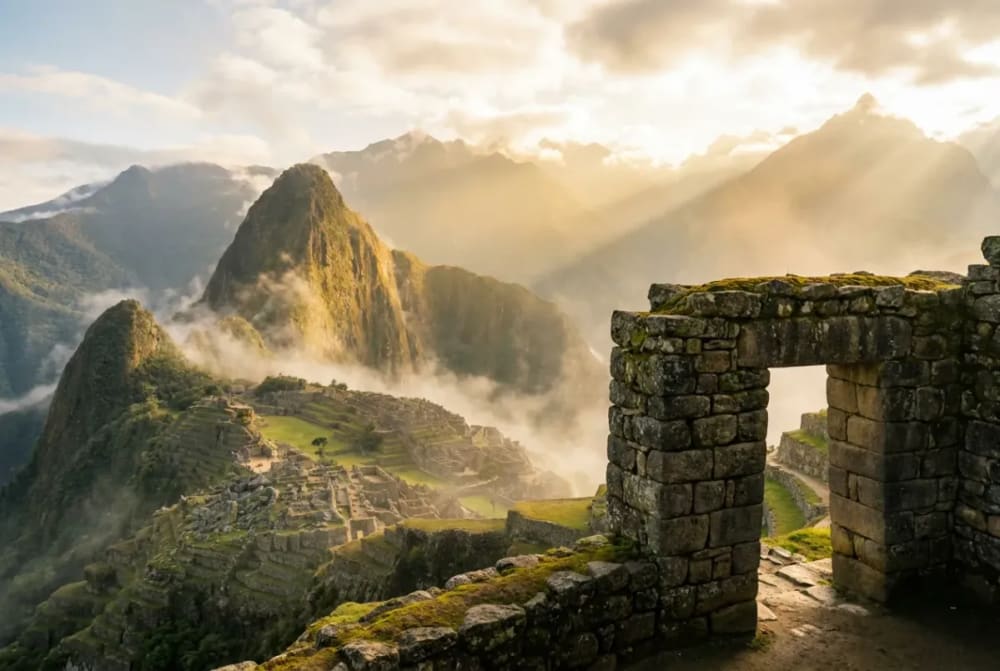
Day 4 starts at four in the morning. The last checkpoint opens at 5:30 AM, after which it’s two to three hours over the original stone steps to Inti Punku. The moment when the morning mist breaks over the mountains and Machu Picchu lies 400 meters below you — exclusive to those who have trekked the trail.
Insider Tip Sun Gate: Do not be the last one or the last of the group. The final ascent to Inti Punku is steep over a staircase with nearly vertical steps — the guides call it "the gringo killer." Those who have a five-minute buffer here can enter the gate calmly, not breathless.
One of the most important permit rules is a number that many travelers misunderstand: A maximum of 500 people may enter the trail daily — but of those, only around 200 are paying trekkers. The other 300 spots are for guides, cooks, and porters. The permit is directly linked to your passport number, is non-transferable, and non-refundable. Booking only through one of the roughly 226 officially licensed operators — nothing is to be gained directly from the state.
An important innovation for 2026: The Ministry of Culture has reintegrated the Machu Picchu Ticket for Circuit 3 back into the permit fee, which was temporarily separated in 2025. So you no longer need to buy a separate entry — access to the citadel upon arrival is included in the package price. Permits for 2026 were released on November 17, 2025.
The Salkantay Trek (5 days, 74 km)
The Salkantay Trek is not only longer, it is more dramatic. 74 kilometers in five days, through five climate zones: High Andes, Puna, cloud forest, subtropical, jungle edge. And on the second day, one of the most impressive backdrops in Peru — the Salkantay Pass at around 4,630 meters (sources give values between 4,600 and 4,650 m, we editorially work with 4,630 m) directly beneath the glaciated 6,271 m summit.
The Nevado Salkantay is the twelfth highest mountain in Peru, the highest of the Cordillera de Vilcabamba — and in Andean cosmology a powerful Apu, a mountain god, protector of the valleys from Limatambo to Machu Picchu. A beautiful archaeoastronomical hint: The main sun ring in Machu Picchu is aligned with the constellation of the Southern Cross, precisely above the Salkantay summit. The Incas oriented their most important citadel before this mountain — this is no coincidence.
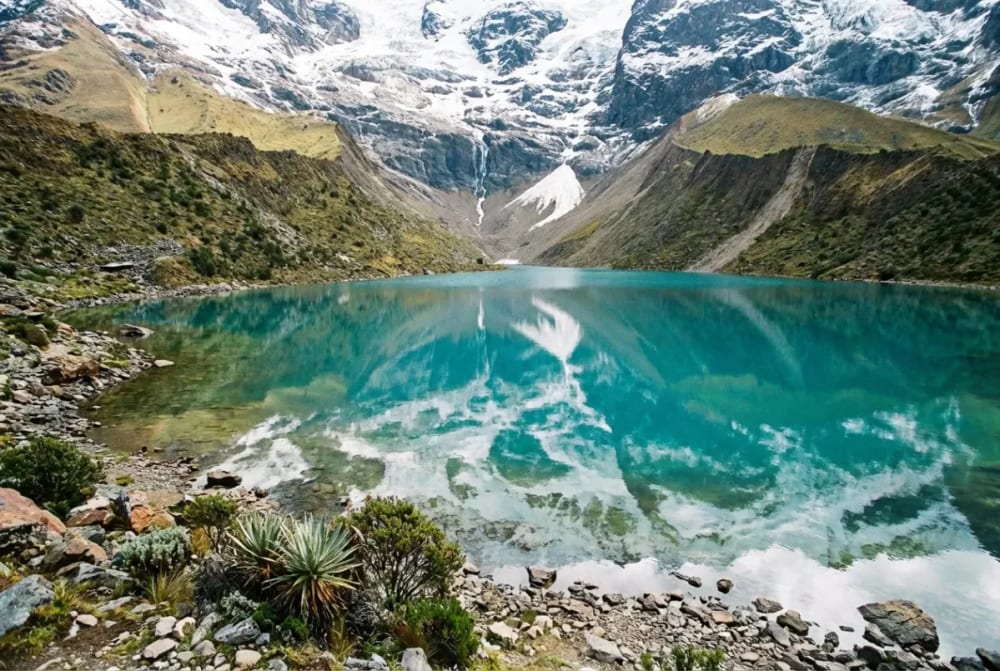
Day 1 goes from Mollepata (2,900 m) to Soraypampa at 3,850 meters — about 13 kilometers. The optional afternoon excursion to the Humantay Lake at 4,200 meters is the first highlight of the trek: an intensely turquoise glacial lake in the meltwater of the Humantay glacier, a ritual site for traditional Pagos a la Tierra, the earth offerings of the Andean communities. Those who can start early do so — after ten o’clock, clouds often come in, and visibility of the glacier wall disappears.
Day 2 is the longest and hardest at 22 kilometers. Ascent to the Salkantay Pass, then a long descent to Collpapampa at 2,900 meters. The climate change is noticeable: In the morning arctic temperatures and whistling wind at the pass, in the afternoon the first hummingbirds in the high valley.
Day 3 and Day 4 bring the tropical side. 16 kilometers descent through cloud forest and coffee plantations to Lucmabamba (1,811 m), the next day 19 kilometers up to the Llactapata ruins at 2,700 meters — with a distant view of Machu Picchu that the classic Inca Trail never shows: from the opposite ridge, over the Urubamba Valley. Overnight in a hotel in Aguas Calientes. Day 5 is the visit to the citadel.
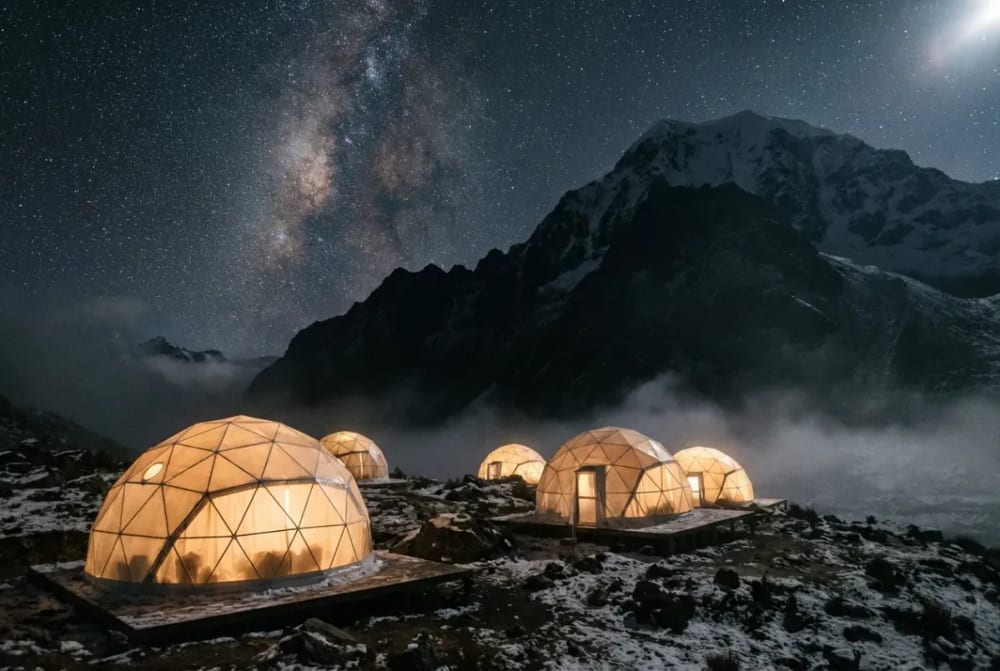
The greatest practical advantage: The Salkantay Trek does not require a permit. Machu Picchu tickets must be booked separately, the trek itself can also be arranged at short notice. Budget travelers theoretically walk it independently for 175 to 200 USD (guesthouses, simple meals, ticket). Realistically for comfort-oriented travelers, guided group treks with camping cost around 400 to 650 USD. A medium level of comfort is provided by the Sky-Dome Lodges: geodesic glass domes with heating, private bathroom, views of the starry sky and the glacier wall — glamping at prices between 1,100 and 2,200 USD per person. The pure lodge-to-lodge premium variant (Mountain Lodges of Peru) costs between 3,500 and 4,700 USD.
The short version — the 2-day Inca Trail
For travelers with limited time or lower fitness there is a third option: the Short Inca Trail from KM 104. Train ride from Ollantaytambo to the checkpoint Chachabamba (2,150 m), then about eleven kilometers ascent on original Inca path to the ruins of Wiñay Wayna and further to the Sun Gate — arrival in Aguas Calientes, overnight in a hotel, Machu Picchu the next morning.
The short trail has its own, separate permit system: 250 spots daily, less competitive than the classic quota, but still to be booked at least two months in advance during high season. Maximum altitude 2,720 m at the Sun Gate — no Dead Woman's Pass, no camping, significantly lower risk of altitude sickness. Group prices start at around 535 USD, private from 950 USD.
Who is it suitable for? Travelers with families, less trekking experience, or ten instead of fourteen days in Peru. You can still feel the experience of reaching the Sun Gate on foot early in the morning with this variant — just without the three nights in the Andean wind.
Altitude profile & difficulty level
The sober comparison of the three options:
- Classic Inca Trail: 43 km, 4 days, maximum altitude 4,215 m, moderate to demanding. Hardest day: ascent to Warmiwañusca.
- Salkantay Trek: 74 km, 5 days, maximum altitude about 4,630 m, medium to difficult. Hardest day: 22 km over the Salkantay Pass.
- Short Inca Trail: 11 km active hiking, 2 days, maximum altitude 2,720 m, easy to moderate. Altitude risk minimal.
Two truths about difficulty: First, the Salkantay is physically more demanding with 22 kilometers and 400 altitude meters more at the pass — but distributed more evenly in the day’s planning. Secondly, experience shows that it is not the untrained who fail on the Inca Trail, but the poorly acclimatized. Those who fly directly from Lima to Cusco and set off two days later make it unnecessarily difficult for themselves.
Our recommendation for the buildup: two to three nights in the Sacred Valley (Urubamba, 2,870 m), then one more night in Cusco, then start the trek. This pattern produces noticeably fewer headaches than the direct route from Lima to the trekking camp.
Booking, permits & lead time
The classic Inca Trail becomes the bottleneck as soon as the travel plans are in place. Permits are released once a year — for 2026, this was on November 17, 2025 — and for the high season in July and August, they are often booked out within hours after release. Our realistic lead time recommendations:
- July / August: 6–9 months before departure
- May / June and September: 4–6 months
- October: 3–4 months
- March / April and November: 1–2 months
A common pitfall: Some operators sell "reservations" before the official release date. This is no permit guarantee — only after the release date can the operator secure the actual permit. We only work with partners who are officially licensed by SERNANP and book for you bindingly after release.
In terms of pricing, reputable operators charge around 840–850 USD per person for the classic 4-day package (group) — including permit, Machu Picchu ticket Circuit 3, guide, cook, porters, food, camping equipment, and train back to Ollantaytambo. Private treks for solo travelers start at about 2,060 USD. Extra porters for personal luggage cost around 160 USD, sleeping bag rental 25 USD, hiking poles 20 USD. The optional ascent to Huayna Picchu costs an additional 85 USD.
The Salkantay Trek is bureaucratically relaxed — only the Machu Picchu ticket must be secured in advance (limited daily quota, in high season, two to four months lead time is also recommended). For the Short Inca Trail, the own permit system with 250 spots daily applies.
Best travel time
The dry season from May to September is the most reliable period for all three trek variants. Daytime temperatures range between 15 and 19 degrees, nights on the Inca Trail drop to 0 to 8 degrees, at the Salkantay Pass, the thermometer can also drop below zero even in the dry season.
Our sweet spots are May and September. In May, the vegetation is lush green after the rainy season, the paths are dry, and the permits are easier to obtain than in July/August. In September, high season is over, the visibility is clearer than ever — however, the vegetation is already somewhat drier and yellower.
July and August provide the most stable conditions, but are also the fullest months: full camps, booked permits, higher prices. October is often an underestimated month — the weather is usually stable, and prices notably lower. November to April is the rainy season with muddy paths, but lush green landscapes and flexible permit availability.
A hard limit: The entire month of February is closed for all Inca Trail variants — both the 4-day trail and the short trail at KM 104. It is the annual maintenance and conservation break. Machu Picchu itself remains open in February, only the hiking trails are not. After the closure in 2026, the trail was reopened on March 1, 2026. The Salkantay Trek has no February closure, but February is the month with the most rain — it is really comfortable only from May to September.
Equipment & health
The packing list is similar for all three variants. Waterproof hiking shoes (broken in — new shoes on the trail are the most common cause of blisters), rain jacket, layered clothing (temperatures fluctuate between minus four and plus twenty degrees), sunscreen with SPF 50+, headgear, headlamp for the early fourth day, reusable water bottle. Single-use plastic is prohibited on the Inca Trail. Only backpacks up to 25 liters are allowed in Machu Picchu itself.
For the nights, we recommend a four-season sleeping bag down to minus ten degrees; in the dry season, a minus four degree model is often sufficient. Reputable operators provide sleeping pads and tents; sleeping bags and hiking poles can be rented for a fee (25 and 20 USD). A personal trick against blisters: toe separation socks (Toe Socks) significantly reduce friction, especially on the long descents on the third day.
Altitude sickness is the main risk — not fitness. Preventively, three things help measurably: at least two to three days of acclimatization in Cusco (3,399 m), better yet first in the Sacred Valley (2,800 m). Enough fluids (two to three liters per day). No alcohol in the first 48 hours. The local Mate de Coca — the coca tea that almost every hotel serves at check-in — alleviates subjective well-being; a specific effect against acute mountain sickness is scientifically unproven. Those who react sensitively should consult their family doctor about acetazolamide (Diamox) before traveling — to be taken 24 hours before arrival.
Our partners and their porters. The Peruvian Porters Law No. 27607 from 2002 regulates minimum wage, equipment, and especially the weight limit of 20 kilograms for male porters (15 kg for female porters). Of that, about 8–10 kg is for the porter's own equipment — effectively leaving 6 kg for your luggage. At checkpoints, weights are checked. We only work with operators that actively implement the law, introduce their porters by name, and pay above minimum wage. Tips (10–20 USD per trekker per day for cooks and porters) are part of the income and not optional.
Planning Inca Trail & Salkantay individually
Both routes are among the most sought-after trekking destinations in the world — and among the most commonly misplanned. Permit deadlines missed, acclimatization underestimated, wrong shoes, wrong month, wrong operator. We personally know the reputable guide teams in Cusco, know which sky dome camps really deliver the views they promise in their photos, and plan your route with the right altitude strategy — first the Sacred Valley, then Cusco, then the trek.
Two routes are highly recommended:
- Peru Trekking: Salkantay & Inca Trail — the challenging combination for active travelers with a full Salkantay or classic Inca Trail experience
- Peru Highlights: Lima, Cusco & Machu Picchu — with optional Short Inca Trail on day 2 starting from KM 104
For a personal conversation and a tailored offer contact our Peru team — we usually respond within 24 hours.
To book a trip or for more information, contact us. We'll help you plan and guide you through your upcoming adventure!
Frequently Asked Questions
By far the most accessible is the **Short Inca Trail** from KM 104: just one day of active hiking, maximum altitude of 2,720 m, overnight in a hotel. The best choice for families, time constraints, or travelers without trekking experience. If you want a multi-day trek but fear the Dead Woman's Pass, you can't go wrong with the **Salkantay** — despite the higher pass, the daily stages are distributed more evenly, and the infrastructure (lodges, sky domes) is more comfortable than on the classic Inca Trail.
The earlier, the better. For July and August, we estimate **six to nine months lead time**, for May/June and September four to six months, for the low season (March/April, November) one to two months. Permits are released once a year — for 2026, this was on November 17, 2025. "Reservations" sold in advance are no permit guarantee. If you must travel during a fixed time period, you shouldn’t stick to the classic trail — the Salkantay alternative is also feasible at short notice.
Technically yes. The Salkantay Trek is **not a permit-required protected park section**, making self-guided walking legally possible — with accommodation in guesthouses, simple food in the villages, and pre-booked Machu Picchu tickets starting from 175 to 200 USD. However, we generally advise against this in most cases. Altitude, weather changes at the pass, orientation in the cloud forest descents, and medical coverage are underestimated factors. A guided group trek starting at 400 USD is not much more expensive than the self-organized version — and significantly safer.
Yes. **Machu Picchu itself remains open in February** — only the hiking trails (4-day Inca Trail, Short Trail KM 104) are closed for the entire month due to conservation and maintenance work. The trail was reopened on **March 1, 2026**. If traveling in February, you can reach the citadel by train from Cusco or Ollantaytambo. As trekking alternatives during this time, the **Salkantay Trek**, **Lares Trek**, and the challenging **Choquequirao Trek** are recommended — none of them are closed in February, but it is the month with the heaviest rain. Lares (4 days, no permit, starting at 400 USD) is particularly culturally rewarding — Andean communities, traditional weaving, few other trekkers. Choquequirao (4–5 days, from 600 USD) is the choice for adventurers: an Inca complex of which only about 40 percent has been excavated, with almost no visitors.
For the classic Inca Trail and the Salkantay Trek, you should be accustomed to multi-day hikes with daily stages of 12 to 22 kilometers and altitude differences of up to 1,000 meters. Targeted preparation with three to four weekly endurance sessions over two to three months is generally sufficient. More important than pure fitness is **altitude tolerance** — and this can only be achieved through early acclimatization (at least two to three nights in Cusco or the Sacred Valley before the trek begins). Those with pre-existing health conditions (cardiovascular, asthma) should discuss the route with their family doctor before booking.
Yes, and this is standard with all reputable operators. On the classic Inca Trail, an **extra porter** can carry up to 6 kg of personal luggage for an additional fee of around 160 USD for the entire trek. The limit is based on the **Porters Law** of 2002: a maximum of 20 kg total weight per porter (15 kg for female porters), from which 8 to 10 kg of the porter's own equipment is deducted. On the Salkantay Trek, depending on the package, mules or horses carry the group luggage — the weight limits are more generous there. What you carry yourself: day backpack with water, snacks, rain jacket, sunscreen, camera, and ID — rarely more than five kilos.