
Rainbow Mountain Vinicunca
The Rainbow Mountain of Peru at over 5,000 meters — and its quiet alternative
The Rainbow Mountain of Peru at over 5,000 meters — and its quiet alternative
Since 2013, the ice has released Vinicunca, and since 2015, the world has known about it. Between being an Instagram pilgrimage site and a serious altitude challenge lies a mountain that, with the right strategy, becomes one of the strongest moments of any trip to Peru.

Best time to visit
May to October
Why Vinicunca?
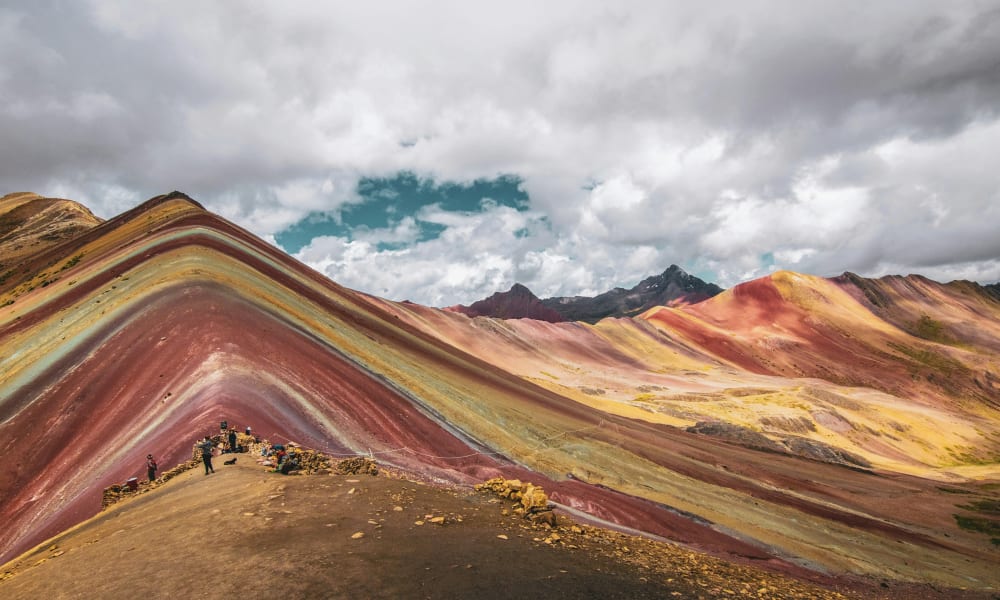
Ten years ago, hardly anyone outside the Quechua villages around Pitumarca knew about this mountain. Vinicunca lay beneath an ice cap, and what today lies in bright red, ochre, turquoise, and violet in the Andean light was for centuries simply invisible. It was not until 2013 that the glacier ice melted back far enough to reveal the mineral layers. Two years later, a Peruvian hiker discovered the colors, and the first photo spread through social networks — and since then, up to 1,500 people pilgrimage daily to a mountain that has only existed in its current form for just over a decade.
This makes Vinicunca a strange symbol: both a natural wonder and a climate witness. The colors that prompt you to hike up are the result of glacial melting that no one with a sense for the ecosystem would celebrate. Those who know this approach the mountain with different eyes — and understand why we still recommend it in good conscience: The exclusively locally organized tourism has created a source of income in the villages of the region that did not exist before. The Rainbow Mountain Peru is today both — a postcard motif and an economic factor for around 500 families.
To the second point: Vinicunca is not a leisurely stroll. The starting point is at 4,600 meters, the viewpoint at officially 5,036 meters — in the overwhelming online literature, it is often stated as 5,200 meters; you will find both numbers in every serious source. The air pressure up there is about 50 percent of sea level. Those who come directly from Cusco without acclimatization regularly underestimate the ascent. With the right preparation, however, the hike becomes a strong day — one of the strongest that a trip to Peru has to offer.
The hike — what to expect
The day starts early. Most tours pick you up between 3 and 4 AM in Cusco because the drive over the Cuyuni pass takes about three hours, and the stable weather windows are in the morning. You have breakfast along the way in a simple village house — coca tea, scrambled eggs, bread, often a piece of cheese — and are at the trailhead by around 7 AM.
Depending on the booked route, the hike starts either in Chillihuani (northern route via Cusipata) or in Chilca Pampa / Pitumarca (southern route). Both bring you to the same viewpoint. The Pitumarca route has established itself over the years as the quieter and — after a community conflict in 2024 — also the more stable option; more about that further down.
The path uphill is just under 6 kilometers long and climbs from 4,600 to around 5,036 meters — so over 400 vertical meters at an average gradient of about 4 percent. This sounds harmless and is at sea level. At this altitude, the same ascent becomes an exercise in patience: ten steps, stop, breathe, continue. Plan for two to three hours up, one to one and a half hours down. Those who lack the stamina or desire can rent a horse in the village — around 80 to 100 soles (about 20 to 25 euros) for the ascent just below the summit. The last 100 vertical meters must be walked by everyone themselves.
Upon arrival at the top, the view opens up to the flank for which you are here: seven recognizable stripes of color that run diagonally across the slope. Red from oxidized iron, ochre and yellow from sulfur, turquoise from copper, violet to mauve from goethite, along with lighter limestone tones and greenish copper chlorides. Opposite rises the Ausangate (6,384 m) into the sky, the sacred mountain of the region — the Quechua call it Apu Ausangate, one of the most important mountain gods of the entire Andes.
Altitude and altitude sickness at 5,036 meters
The Rainbow Mountain is challenging not because of the length but because of the altitude. At 5,036 meters — some signs and maps also mention 5,200 — it is higher than any peak in the Alps. At this altitude, the partial pressure of oxygen is about 50 percent of sea level. Studies on acute mountain sickness (AMS) show that above 4,500 meters, more than half of all unacclimatized visitors develop at least mild symptoms: headaches, shortness of breath, nausea, dizziness.
The most important rule is therefore: not directly from Lima. Those who set off for Rainbow Mountain the morning after arriving in Cusco are grossly negligent with their own circulation. Plan at least two to three nights at 2,800 to 3,400 meters — ideally first in the Sacred Valley (Urubamba, 2,870 m), then in Cusco (3,400 m), before going up to 5,036 meters. This is not a recommendation from caution, but from experience from several hundred trips to Peru.
Two other things have proven effective: Acetazolamide (Diamox) 24 hours before the ascent — in consultation with your family doctor — and Mate de Coca, the coca tea that has been served at altitude in the Andes for centuries. A specific medical effect against AMS is not documented for coca, but the ritual promotes hydration and subjective well-being. In the first 48 hours in Cusco, the rule is: no alcohol, little heavy food, at least three liters of water per day.
Insider tip oxygen on the mountain: The local guides now carry oxygen tanks with them, and the use is included in the prices of most serious tours. Ask specifically before booking — those who do not offer this operate at the lower end of quality. In case of persistent shortness of breath, confusion, or severe headache, the only reliable therapy is: descend, do not discuss.
Vinicunca or Palccoyo — the honest alternative
Those who have only seen Vinicunca photos before the trip do not know about the second Rainbow Mountain of Peru: Palccoyo, about four hours south of Cusco, at 4,900 meters. Palccoyo is geologically the same phenomenon — the same mineral layers, the same oxidation history — just in triplicate. Three adjacent mountain ridges with the same color stripes, along with a quirky Stone Forest (bosque de piedras) of towering rock formations along the path.
The difference is noticeable: Palccoyo is 100 to 300 vertical meters lower than Vinicunca, the hike takes only 45 to 90 minutes instead of three hours, and the viewpoint is nearly accessible by vehicle. The total height remains at 4,900 meters — demanding, but significantly less challenging than Vinicunca. And: there, you stand with just a handful of other travelers instead of in a line of 1,000 people.
The downside: Palccoyo is less spectacular. The colors are there, but the drama of Vinicunca's sharply sloping flank is missing — Palccoyo is flatter, wider, quieter. Those who have the sought-after photo in their mind will only find it at Vinicunca. However, those who weigh geology, tranquility, and physical feasibility against the Instagram icon often make the wiser choice with Palccoyo.
Our honest recommendation: Those who are fit, sufficiently acclimatized, and can sacrifice a free day should go to Vinicunca. Those traveling with family, respecting altitude, or seeking peace should choose Palccoyo. For truly passionate hikers, there is a third option: the Ausangate Trek, a 5- to 6-day circuit around the sacred mountain, which passes Vinicunca on the fourth day as a secondary highlight — without day tourism, with camping at 4,800 meters, and views of glacier lakes that no day visitor gets to see.
Best time of day and best travel time
The best time to visit Rainbow Mountain is the dry season from May to October. During these months, the probability of clear visibility is significantly above 80 percent, the trails are not muddy, and the ascent is reliably feasible. From June to August is peak season — then, on weekdays, 1,000 to 2,000 people crowd the viewpoint; the national park office counted around 365,000 visitors in the year 2023/24.
In the rainy season from November to March the mountain is often shrouded in clouds, fog, or snow — the colors are completely covered by fresh snow. Those traveling in January or February should realistically calculate that they may not see the mountain at all. The shoulder months April and October offer the best compromise: trails largely dry, weather mostly stable, noticeably fewer people.
Within the day, there are two windows with less rush:
- Between 8 and 10 AM — most groups arrive at the top between 10 and 12 o'clock. Those who start very early (departure 3 AM from Cusco) will stand almost alone at the viewpoint for 30 to 45 minutes.
- After 3 PM — the day tours are back, and the mountain is empty. The local providers are increasingly offering afternoon tours with departures at 11 AM and returns around 7 PM. The light atmosphere in the late afternoon is among the strongest of the day.
Getting there, tours, and prices
Cusco is the only sensible starting point. The drive to the trailhead takes about three hours on a well-paved road until just before the pass, then a partly bumpy track. Along the way, you have no mobile phone reception — from the village boundary, it is silent until you return to Cusco in the afternoon.
The price range for 2025/26 is wide, with varying quality:
- Group tours in a shared bus: 35 to 60 USD (about 32 to 55 euros), group size 12 to 20 people, guide often only in Spanish and English. Feasible for cost-sensitive travelers but rarely recommended.
- Premium small groups: 70 to 110 USD, group size 6 to 10, German-speaking or experienced English-speaking guides, oxygen, better vehicles, real breakfast.
- Private tours: 220 to 380 USD for two people, individually planned, free departure time, private guide, flexibility with breaks and photo stops.
In addition, there is the entry fee of S/ 35 to S/ 45 (about 9 to 11 euros), which goes directly to the local communities. There is no permit system like on the Inca Trail — however, the area was placed under regional protection in 2019 to curb erosion and wild camping.
Palccoyo is cheaper to calculate: group tours from 30 USD, private tours from around 160 USD for two people. The day is shorter (departure from Cusco around 5 AM, return around 5 PM), and the physical strain is significantly less.
Insider tip Pitumarca route: At the end of 2024, there was a conflict on the northern access route via Chillihuani between competing communities over tourism revenues, in which one person lost their life (Bloomberg, 2025). Since then, we have continuously recommended the southern route via Pitumarca / Chilca Pampa — more stable, with a clear cooperative structure and the most direct local benefit for the villages we have known for years.
Sustainability and overtourism
Rainbow Mountain is a case study in accelerated tourism history. Between 2015 and 2019, the number of day visitors rose from zero to around 1,500 per day — a development that economically lifted the surrounding villages but severely impacted the mountain ecosystem. Vegetation damage along the main trails, erosion on the steep sections, litter in the first hundred meters after the parking lot: all visible, all known, all actively addressed.
The regional protection regulation of 2019 restricts wild camping, defines the official main trail, and channels tourism through the cooperatives of the villages of Pitumarca, Chilca, and Cusipata. Around 500 families today live directly or indirectly from Rainbow Mountain tourism — guides, horse rental, breakfast stops, ticket sales, maintenance.
As travelers, you can do the right thing relatively easily: choose reputable providers that work directly with the communities (not the cheapest shared bus offers), leave no trash behind, stay on the marked path, and fairly pay for the horse offerings from the villages instead of bargaining. And: seriously consider Palccoyo as an alternative — the mountain welcomes everyone who detours.
Frequently asked questions
How hard is the hike to Rainbow Mountain?
Technically easy, conditionally demanding. The path is wide, well-marked, and has no exposed spots. The difficulty lies solely in the altitude: starting at 4,600 m, viewpoint at 5,036 m, nearly 6 kilometers of easy path, around 400 vertical meters. Those who are well acclimatized and have moderate fitness can complete the stretch in two to three hours up. Those who are not acclimatized should either opt for Palccoyo (4,900 m, 45 to 90 minutes) or at least set aside three nights in Cusco. Horses are available for the ascent — the last 100 vertical meters each person walks themselves.
Can I visit Rainbow Mountain without a guide?
Basically yes, practically not advisable. The trailhead is 3 hours by car from Cusco, there is no public bus to it, and there is no mobile reception. In theory, renting a car is conceivable, but the track in the last kilometers is challenging, and in an emergency, you are without local contacts. All reputable tours go with local guides who know the way, the altitude warning signs, and the cooperative structures — this is not an optional comfort at this altitude.
Palccoyo or Vinicunca — which is the better choice?
It depends on your priorities. Vinicunca is the more dramatic mountain with the famous colorful flank and the view of Ausangate, but also fuller, more exhausting, and with a longer drive. Palccoyo offers the same geological phenomenon in triplicate, a short path, hardly any people, and the bizarre stone forest as a bonus — but is visually flatter. For first-time visitors with photos in mind: Vinicunca. For families, those sensitive to altitude, and travelers focused on peaceful nature experiences: Palccoyo. Those with time should do both.
How do I prepare for the altitude?
Three things have measurable effects: gradual acclimatization (first Sacred Valley at 2,870 m, then Cusco at 3,400 m, and at the earliest on the fourth day to Rainbow Mountain), sufficient hydration (three liters of water per day), and avoidance of alcohol and heavy food in the first 48 hours after arriving in Cusco. Those who are altitude sensitive should speak with their family doctor before the trip about Acetazolamide (Diamox) — Take 24 hours before arrival. Coca Tea is culturally rooted and promotes subjective well-being; a specific effect against acute mountain sickness is not scientifically proven.
When is it least crowded at Rainbow Mountain?
Between 8 and 10 a.m. — those who arrive with the earliest tour (departure Cusco 3 a.m.) have up to 45 minutes of almost clear visibility before the main wave hits. The second quiet time is after 3 p.m.: Day tours are back, some providers now offer afternoon tours (departure Cusco 11 a.m., return around 7 p.m.), the light is soft and warm. In the shoulder months of April and October, the mountain is generally noticeably emptier than in July and August.
Is Rainbow Mountain visible during the rainy season?
Often not. From November to March, the mountain is regularly covered in clouds, fog, or fresh snow — and a snow cover completely obscures the mineral colors. Those traveling during this time must factor in the possibility of seeing a gray rock cone instead of a rainbow. In the shoulder months of April and October, visibility chances are usually good; the core months for reliable visibility are from May to September.
Plan Rainbow Mountain individually
Rainbow Mountain is not its own vacation — it is a strong day within a well-planned trip to Peru. The art lies in incorporating it at the right time: after two to three nights of acclimatization, not directly after arrival. With oxygen, a private guide, and a reputable provider. And with an honest look at whether Palccoyo might be the better choice for you.
We plan your route individually — with the appropriate altitude order, vetted local partners via the Pitumarca route, and decision support between Vinicunca and Palccoyo, born from hundreds of trips to Peru.
Two routes are particularly recommended:
- Peru Highlights: Lima, Cusco & Machu Picchu — the classic 10-day route, expandable to one and a half days Rainbow Mountain or Palccoyo
- Peru Intensive: Inca, Amazon & Rainbow Mountain — 14 days with Sacred Valley, Machu Picchu, Amazon lodge and Rainbow Mountain as a fixed highlight
For a personal conversation and a tailored offer contact our Peru team — we usually respond within 24 hours.
To book a trip or for more information, contact us. We'll help you plan and guide you through your upcoming adventure!