

This image was generated with AI.
Floreana
The most mysterious island of the archipelago
The most mysterious island of the archipelago
Floreana Island Galapagos: Post Barrel, German settler history, flamingos & snorkeling with penguins at the Devil's Crown. Discover the most mysterious Galapagos island.

Best travel time
All year round
Why Floreana is different from all other Galapagos islands
Somewhere in the southern Galapagos archipelago lies an island where pirate history, unsolved criminal cases, and pink flamingos intertwine in a story that no screenwriter could invent better. Floreana — 173 square kilometers in size, 1.5 million years old, and with only about 150 inhabitants, the sparsely populated inhabited island of the Galapagos Islands — is the place where Charles Darwin made his decisive mockingbird observations in 1835, where German emigrants sought paradise in the 1930s, and where a self-proclaimed baroness vanished without a trace.
Floreana Galapagos Island was the first permanently inhabited island of the archipelago. Already in the 16th century, pirates used the only freshwater source as a base. Whalers followed, then settlers — and with them came rats, cats, and goats that nearly destroyed the unique wildlife. Today, after the largest conservation project in the history of the Galapagos Islands, life is returning: In February 2026, giant tortoises were released on Floreana for the first time in over 150 years.
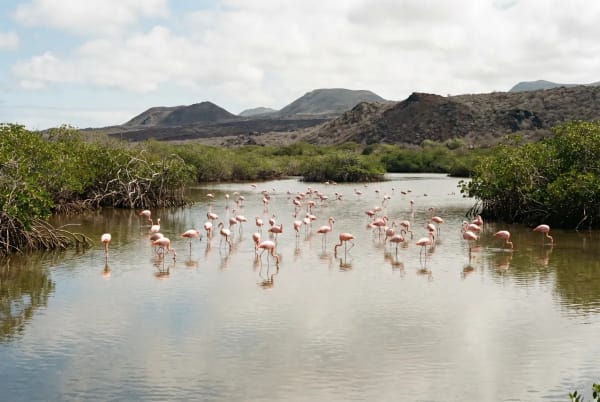
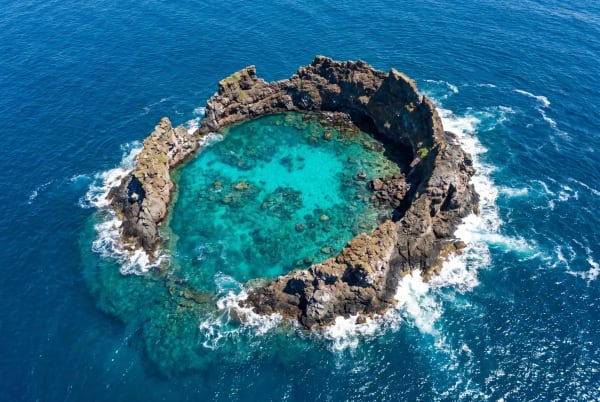
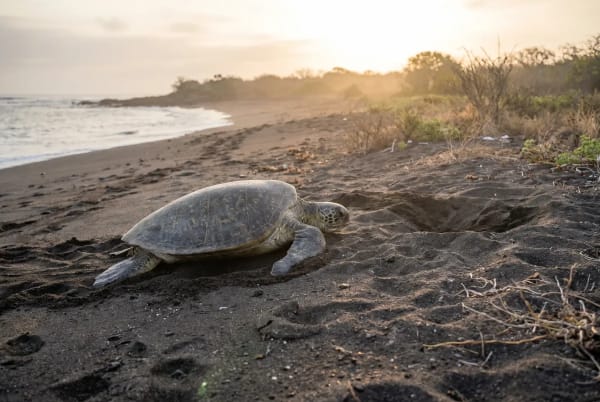
But Floreana is more than history and conservation. Off the coast lies the Devil's Crown — a partially submerged volcanic crater that is considered the best snorkeling spot of all the Galapagos Islands. At Punta Cormorant, flamingos wade through a tranquil lagoon, while at the neighboring Flour Beach, green sea turtles lay their eggs. And at Post Office Bay, there has been a wooden barrel since 1793, which still serves as a post station — without stamps, without postmen, only on honor.
History of Floreana — German settlers, a baroness, and a mystery that remains unsolved to this day
The first settlers: Dr. Ritter and Dore Strauch (1929)
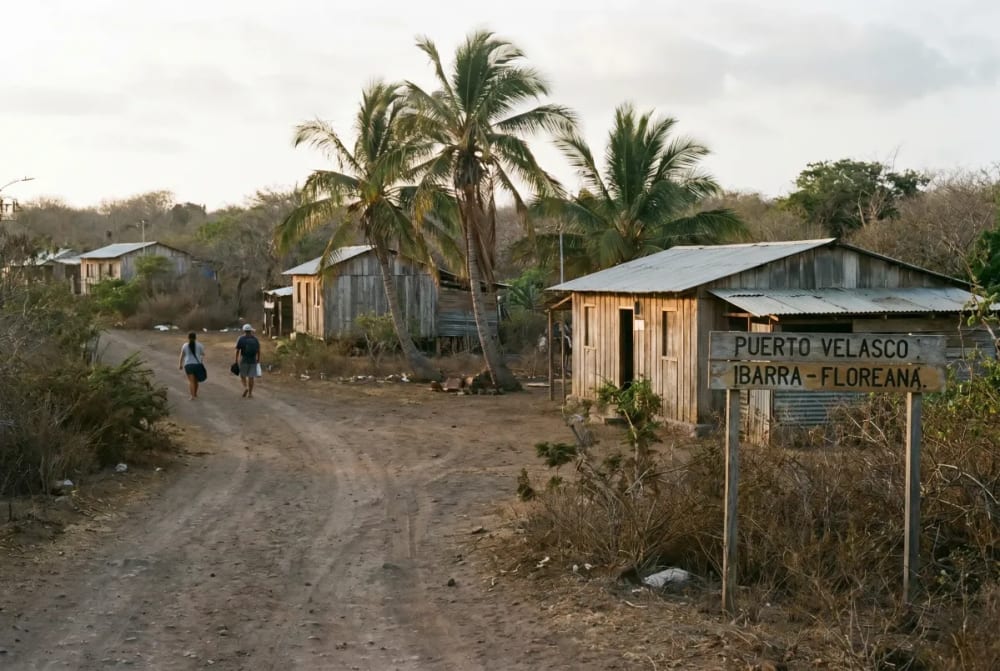
In 1929, the Berlin doctor Dr. Friedrich Ritter and his patient Dore Strauch left Germany — in search of a life away from civilization. Both had all their healthy teeth pulled before departure and shared a single steel denture from then on. On the uninhabited Floreana, they established a primitive settlement at Asilo de la Paz, the only freshwater source on the island. Newspapers in Europe and America enthusiastically reported on the "Paradise Experiment" — inadvertently attracting more settlers.
The Wittmers — and the baroness who vanished without a trace
In 1932, the Cologne family Wittmer arrived: Heinz, his pregnant wife Margret, and their son Harry. They took over the pirate caves at Asilo de la Paz. Margret gave birth to her son Rolf on Floreana — the first child officially born on the Galapagos Islands.
A few months later, the self-proclaimed "Baroness" Eloise Wehrborn de Wagner-Bosquet appeared with two lovers: Rudolf Lorenz and Robert Philippson. She proclaimed herself the "Empress of Floreana" and announced plans to build a luxury hotel for wealthy Americans — the "Hacienda Paradiso." In reality, only a tin hut with two rooms was built.
On March 27, 1934, the baroness and Robert Philippson disappeared without a trace. According to Margret Wittmer, they left on a yacht for Tahiti — but there are no records of this yacht, and they never showed up in Tahiti. Rudolf Lorenz, who had been kept as a slave by the baroness, tried to leave the island. His mummified remains were later discovered on the remote island of Marchena — he presumably died of thirst. Dr. Ritter died in November 1934 from food poisoning caused by chicken — despite being a devoted vegetarian.
The mystery is still considered unsolved.
Book and film about the story
Margret Wittmer, the only survivor of all the protagonists, died in 2000 at the age of 96 on Floreana — as the last person who could have uncovered the secret. Her book Poste Restante Floreana (1959, available as a paperback) tells the story from her perspective. The documentary film The Galapagos Affair: Satan Came to Eden (2013) and the feature film Eden (2025, directed by Ron Howard, starring Jude Law and Ana de Armas) bring the mystery closer to a wide audience. The descendants of the Wittmers still live on Floreana and run the Wittmer Lodge.
Post Office Bay — the oldest post station in the world
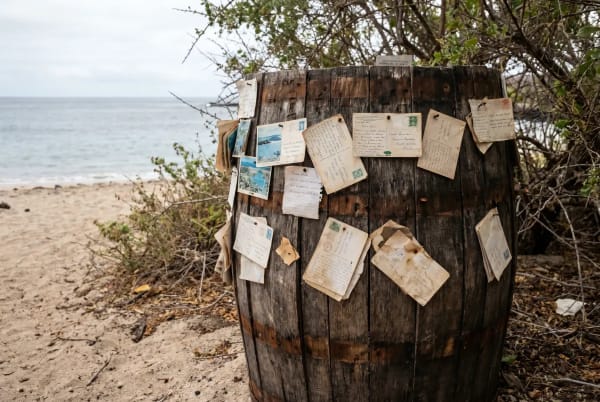
The post barrel on Floreana is one of the most unusual traditions in maritime history. In 1793, British Captain James Colnett placed an empty whisky barrel at Post Office Bay — as a provisional mailbox for whalers who often spent two or more years at sea. The system functioned through reciprocity: sailors left addressed letters in the barrel and hoped that the next sailor heading in the direction of the recipient would take the letter and deliver it personally.
How the tradition works to this day
Over 230 years later, this tradition continues — only today tourists, instead of whalers, exchange letters:
- Write a postcard — with complete address, without stamp
- Place in the barrel — the current barrel is at the same location as the original
- Select cards for your homeland — check addresses near your own place of residence
- Deliver personally — bring the collected cards personally after returning home or drop them in the nearest mailbox
In addition to the post barrel, Post Office Bay offers further attractions: a walkable lava tunnel leading to the sea, as well as snorkeling opportunities with sea turtles and sea lions.
Post Office Bay
- Since — 1793 — over 230 years of uninterrupted tradition
- Landing — Wet Landing (wet landing on the beach)
- Duration — About 1 hour (post barrel + lava tunnel)
- Tip — Write postcards BEFORE the trip — there is no writing material available on the island
Insider tip
Sometimes postcards arrive before the sender gets home — that's part of the charm. If you find a card for your homeland and deliver it personally, you may have a conversation about Galapagos with a complete stranger on the doorstep. That's the real magic of the post barrel.
Wildlife on Floreana — what, where, and when to see
Flamingos in the Punta Cormorant lagoon
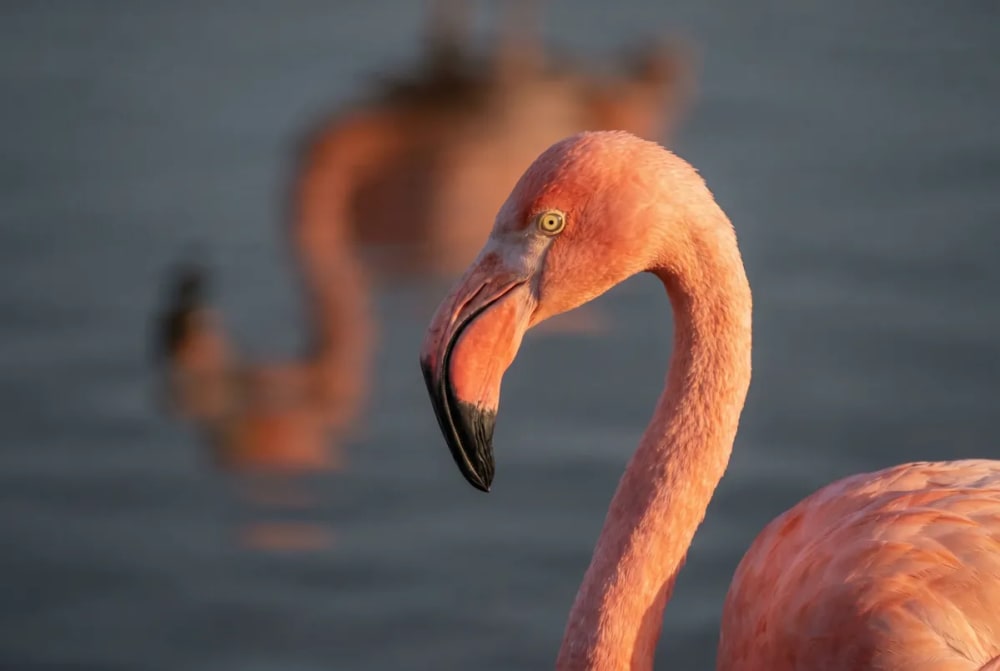
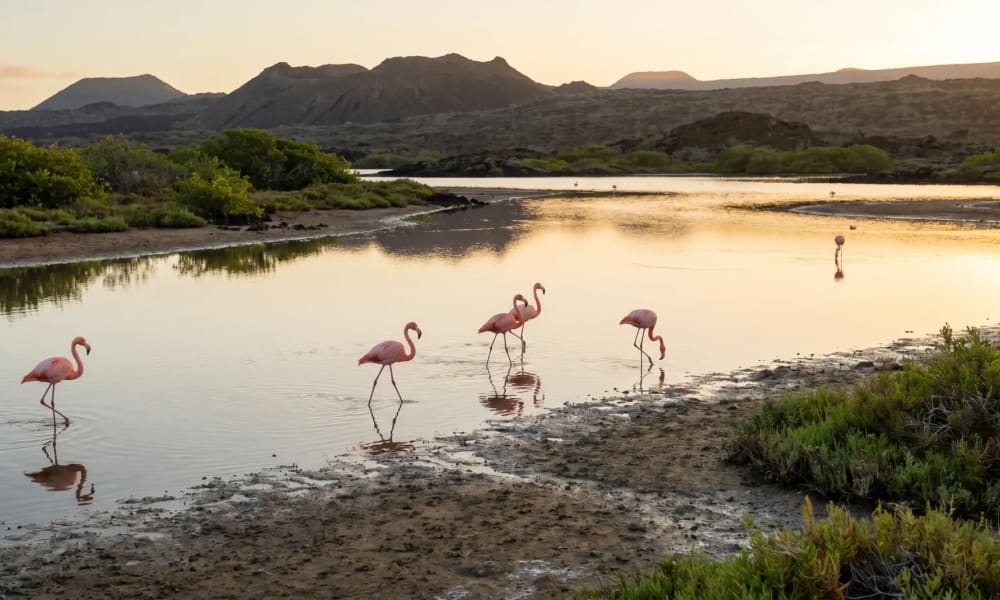
The American flamingo (Phoenicopterus ruber) is represented in the Galapagos Islands by only 300 to 550 individuals — the smallest flamingo subpopulation in the world. The lagoon of Punta Cormorant on Floreana is one of the most reliable observation points in the entire archipelago. The birds wade through the shallow brackish water and filter shrimp from the mud with their curved beaks — the carotenoid pigments in their food give them their characteristic pink coloration.
Flamingos are present on Floreana all year round, but particularly active and visible in larger groups during the breeding season (March to July).
Punta Cormorant
- Landing — Wet Landing at the Olivine Beach (green crystals)
- Trail — 720 meters, moderate difficulty, about 1 hour
- Flamingos — Year-round, breeding season March–July
- Special feature — Two completely different beaches in a small area
Green sea turtles — nesting site at Flour Beach
Between the flamingo lagoon and the sea lies Flour Beach (Flour Beach) — fine coral sand that is so white and fine it feels like flour. This beach is one of the most important nesting sites for Green sea turtles (Chelonia mydas) in the entire Galapagos Islands. From December to May, females dig their nests in the sand at night. Between April and June, the hatchlings emerge and struggle their way to the sea.
Do not enter the water at Flour Beach
At Flour Beach, stingrays lay hidden in the sand — swimming and wading is not allowed here. The high-water line at the nesting area must also not be crossed. Snorkeling is only permitted at Olivine Beach on the other side of Punta Cormorant.
Galapagos penguins, sea lions, and marine iguanas
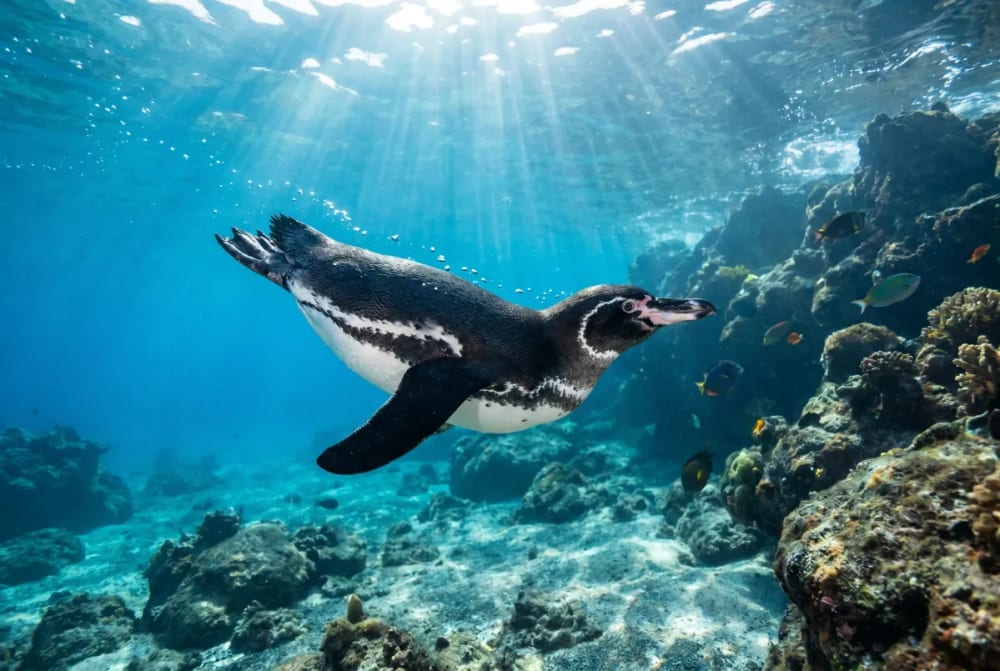
The Galapagos penguin (Spheniscus mendiculus) is the only penguin that lives north of the equator. About 90 percent of the population is concentrated on Fernandina and Isabela — but a small population can be observed while snorkeling at the Devil's Crown in front of Floreana. Galapagos sea lions frequent the beaches and curiously approach during snorkeling up to arm's length. Marine iguanas sunbathe on the lava rocks along the coast.
A special role is played by the Floreana mockingbird (Mimus trifasciatus) — the first mockingbird species described by Charles Darwin in 1835. It has been extinct on the main island since the 1880s and survives only on the tiny satellite islands of Champion and Gardner. The ongoing restoration of the island aims to enable its return.
Devil's Crown — snorkeling inside a submerged volcanic crater
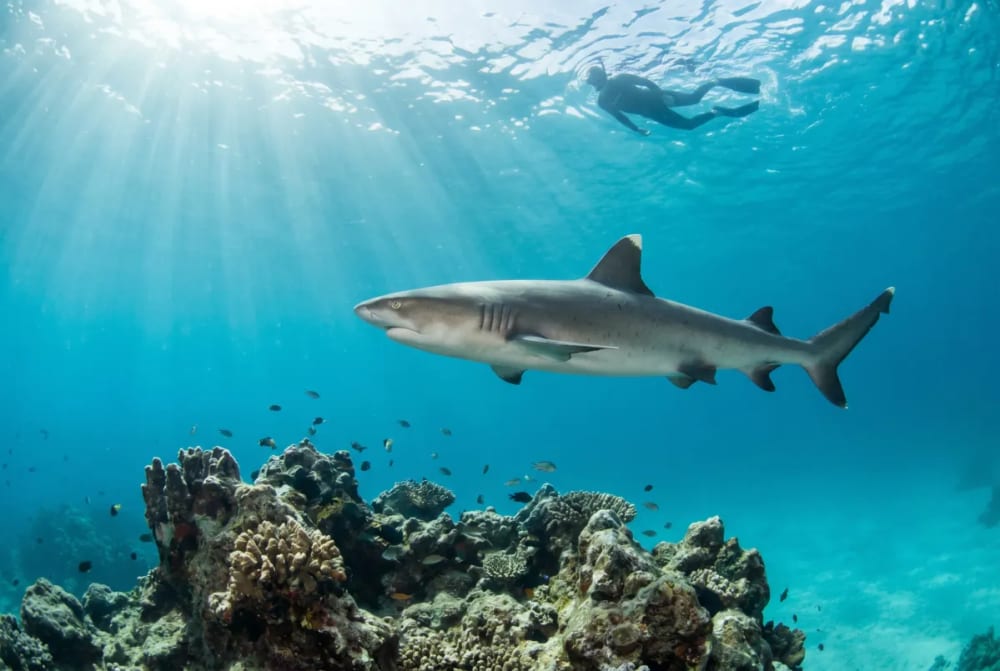
The Devil's Crown (Corona del Diablo, also Devil's Crown) is a partially submerged, eroded volcanic cone located directly off the coast of Floreana. The jagged rocks that protrude above the water form a semicircular formation — resembling a crown. Many experts consider it to be the best snorkeling spot of all the Galapagos Islands.
What animals you can see in the Devil's Crown
Inside the crater: White-tipped reef sharks (Triaenodon obesus), spotted eagle rays, sea turtles, Galapagos penguins, sea lions, king angelfish, parrotfish, and surgeonfish. On the outside (deeper water, stronger current): occasional hammerhead sharks and large rays.
Devil's Crown (Devil's Crown)
- Access — Only by panga (boat) — no direct landing
- Duration — 45–60 minutes of snorkeling
- Difficulty — Advanced — current can be strong
- Best visibility — July–December (dry season, 17–20 C)
Safety note
The current in the Devil's Crown can be unexpectedly strong — this snorkeling experience is NOT suitable for beginners. There is no way to exit the water and take a break. If fatigued, the panga must be called. A wetsuit is recommended, even in the warm season — the Galapagos water is cooler than expected due to the Humboldt Current.
Asilo de la Paz — freshwater source and giant tortoise reserve
Asilo de la Paz (Refuge of Peace) in the highlands of Floreana is the first settlement site of the Galapagos Islands. The same place that pirates used in the 16th century rescued shipwrecked Patrick Watkins in 1807 and housed the Wittmer family in the pirate caves in 1932.
Today, a moderate round trail (about 1 km, 30–60 minutes) leads to three main attractions: the giant tortoises -reserve, the historic freshwater source, and the pirate caves. In February 2026, 158 juvenile giant tortoises of the Floreana lineage were released here — the first reintroduction after over 150 years of absence. Two hundred years ago, approximately 20,000 giant tortoises lived on the island. Whalers and a devastating fire led to the complete eradication until around 1850. Geneticists later discovered that whalers had dropped off Floreana tortoises on Isabela — DNA analyses identified hybrid animals, from which the breeding program produced 600 offspring. A total of 700 tortoises are planned for Floreana.
Largest conservation project in Galapagos history
The Floreana restoration project includes the removal of all invasive species and the reintroduction of 12 locally extinct animal species. By the end of 2023, rats and feral cats were eliminated by helicopter baiting over 17,000 hectares. Initial results: The Galapagos rail was seen on Floreana for the first time since Darwin's time, blue-footed boobies are nesting in larger numbers, and the agricultural yields of the residents increased.
Best travel time for Floreana
The best travel time for the Galapagos Islands varies on Floreana depending on interest. The island is visitable all year round — the average temperature is 25 degrees Celsius, with an annual rainfall of only 299 mm.
| Month | Sea turtles | Flamingos | Snorkeling (Devil's Crown) | Special feature |
|---|---|---|---|---|
| Jan–Mar | Nesting time (at night) | All year round | Good (warm, 22–25 C) | Peak turtle season, warmest water |
| Apr–Jun | Hatchlings emerge | Breeding season, very active | Very good | Hatchlings on the beach, best flamingo observation |
| Jul–Sep | Rarer | All year round | Excellent (cool, 17–20 C) | Best visibility Devil's Crown, Humboldt Current |
| Oct–Dec | Preparing for nesting season | All year round | Good | Transition period, fewer visitors |
Our tip: March to May offers the best combination: warm seawater, active flamingos during the breeding season, and hatching turtle hatchlings. If you want to experience Devil's Crown with maximum underwater visibility, choose July to September — then the water is cooler due to the Humboldt Current (17–20 degrees Celsius), but the biodiversity and visibility are at their highest. More in the Galapagos Wildlife Calendar.
How to reach Floreana — Cruise and island hopping
Unlike Espanola , which can only be reached by cruise, Floreana offers two access routes — an advantage for travelers who do not wish to book a cruise ship.
Floreana by cruise
Floreana is located on the southern route of the Galapagos cruises . Typical cruises combine San Cristobal, Espanola, Floreana, and Santa Cruz in 4–5 days. Extended 8-day routes also include Bartolome, North Seymour, or Santa Fe. The advantage: Cruises typically visit Post Office Bay, Punta Cormorant, and Devil's Crown in one day — a program that is hardly possible in such depth on a day trip.
Floreana by island hopping — Day trip from Santa Cruz
The day trip from Santa Cruz is a popular alternative: Departure around 7:00 a.m. in Puerto Ayora, approximately 2 to 2.5 hours boat ride. The trip includes Post Office Bay, Punta Cormorant, and snorkeling at Devil's Crown. Return around 4:30 p.m.
Those who really want to get to know Floreana need at least one overnight stay. The question Cruise or island hopping? is answered by our detailed comparison.
Arrival in Floreana Galapagos → Floreana
Costs and fees — Galapagos National Park
Status March 2026. NO ATM on Floreana — withdraw cash in USD in Santa Cruz. Credit cards are hardly accepted on the island. National park fees are paid at Baltra or San Cristobal airport.
Detailed budget information in our Galapagos Cost and Budget Guide. General information about Entry requirements for Galapagos .
Floreana in your Galapagos trip
A typical cruise day on Floreana combines history, wildlife, and underwater world in a single day:
Day 1 — Floreana — Post Office Bay, Punta Cormorant & Devil's Crown
Note: Those who stay overnight on Floreana can additionally visit Asilo de la Paz in the highlands — giant tortoise reserve, pirate caves, and the historical freshwater spring.
Let us plan your Galapagos trip — we know Floreana from personal experience and advise you personally on whether a cruise or island hopping is the better choice for your route. Request a non-binding consultation now .
Discover more Galapagos islands
Espanola — The only albatross breeding ground in the world
Santa Cruz — The heart of the Galapagos archipelago
Isabela — Largest island — volcanoes and penguins
Also read: Cruise or island hopping? — our comparison helps with the decision. And in the Galapagos Wildlife Calendar you will learn which animals you can see when on which island. Or compare: Pantanal vs. Galapagos — where is the better wildlife?
To book a trip or for more information, contact us. We'll help you plan and guide you through your upcoming adventure!
Frequently asked questions
The post barrel is a wooden barrel at Post Office Bay that has served as an improvised mailbox since 1793. Visitors leave postcards behind (without a stamp, with a complete address) and take cards addressed to their own country with them to deliver them in person. The tradition was started by British whalers and has worked on an honor system for more than 230 years.
Flamingos (Punta Cormorant lagoon), green sea turtles (nesting sites on Flour Beach, December–May), Galapagos penguins (Devil's Crown), whitetip reef sharks, spotted eagle rays, Galapagos sea lions, marine iguanas, blue-footed boobies, giant tortoises (Asilo de la Paz), Sally Lightfoot crabs and numerous species of Darwin's finches.
Yes. Floreana can be reached on a day trip from Santa Cruz (Puerto Ayora) — around 2 to 2.5 hours by boat each way, costing approximately USD 180–215 per person including guide, lunch and snorkeling equipment. There is also a ferry for around USD 35, but it does not run daily. Floreana has two places to stay: the Wittmer Lodge and the Floreana Lava Lodge.
The day trip takes 7 to 8 hours in total. Departure is around 7:00 AM in Puerto Ayora, arriving on Floreana after about 2 to 2.5 hours. On the island you visit Post Office Bay, Punta Cormorant and Devil's Crown. The return is around 4:30 PM. The boat ride can be rough in heavy swell — seasickness medication is recommended.
Devil's Crown (Corona del Diablo) is a half-submerged volcanic crater just off the coast of Floreana — rated by experts as the best snorkeling spot in the entire Galapagos Islands. Inside the crater you will find whitetip reef sharks, sea turtles, penguins, eagle rays and colorful reef fish. Note: suitable only for confident swimmers, as the current can be strong.
Floreana can be visited year-round. March to May offers the best combination: warm water, flamingo breeding season and hatching turtles. July to September is ideal for snorkeling at Devil's Crown (best visibility thanks to the cool water of the Humboldt Current). Turtles nest from December to May.
From 1929, German emigrants settled on the then uninhabited Floreana: Dr. Friedrich Ritter and Dore Strauch (1929), the Wittmer family from Cologne (1932) and the self-proclaimed 'Baroness' Eloise Wehrborn de Wagner-Bosquet (1932). In March 1934 the Baroness and her lover vanished without a trace — the mystery remains unsolved to this day. The story was told in the documentary 'The Galapagos Affair' (2013) and in the feature film 'Eden' (2025, Ron Howard).
Yes, there are two places to stay: the Wittmer Lodge (run by descendants of the German settlers, from around USD 96 per night) and the Floreana Lava Lodge (10 eco cabins with sea views, from around USD 130 per night). Both need to be booked well in advance. Important: there is no ATM on Floreana — withdraw cash in USD on Santa Cruz.
Many postcards really are delivered — sometimes within a few weeks, sometimes only after months or years. Delivery depends on whether another visitor picks up a card for somewhere near the recipient. There are stories of postcards that arrived home before the sender did. The honor system has worked for more than 230 years — it is part of the magic.
Floreana lies on the southern route of the Galapagos cruises. Typical itineraries combine San Cristobal, Espanola, Floreana and Santa Cruz over 4–5 days. Our 8-day yacht expedition and the individual island-hopping tour both include Floreana. Contact us for personal advice.