

Lencoeis Maranhenses
The white bedsheet on Brazil's northeastern coast — UNESCO World Heritage Site since 2024
The white bedsheet on Brazil's northeastern coast — UNESCO World Heritage Site since 2024
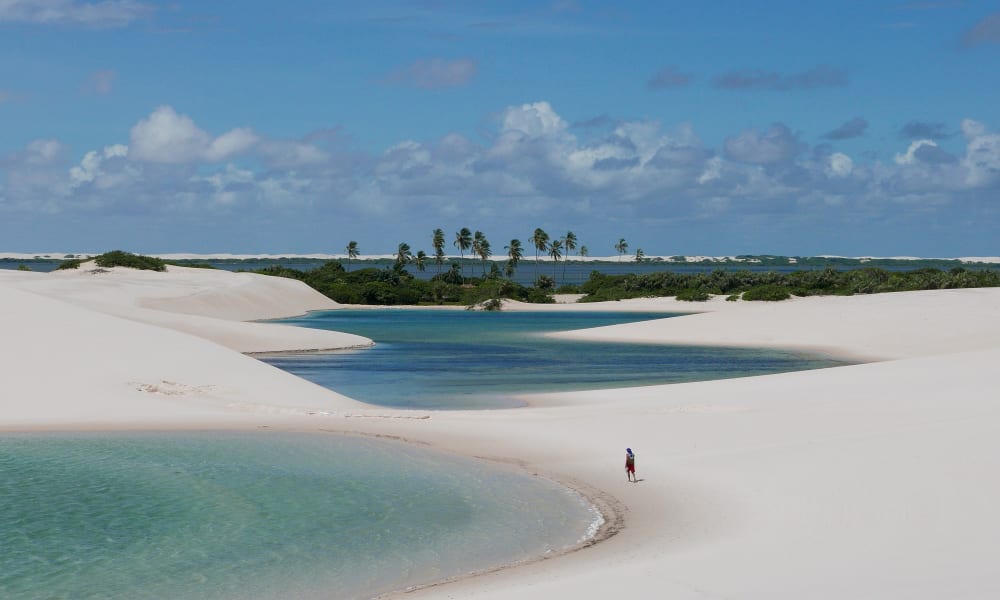
White quartz-sand dunes as far as the eye can see, and between them thousands of turquoise freshwater lagoons that exist for only three months a year: the Lençóis Maranhenses have been a UNESCO World Heritage Site since July 2024 — and the world's only desert-lagoon ecosystem of its kind.

Best Time to Visit
July to September — the narrow three-month window when up to 36,000 turquoise freshwater lagoons appear between the white dunes.
Why Lençóis Maranhenses?
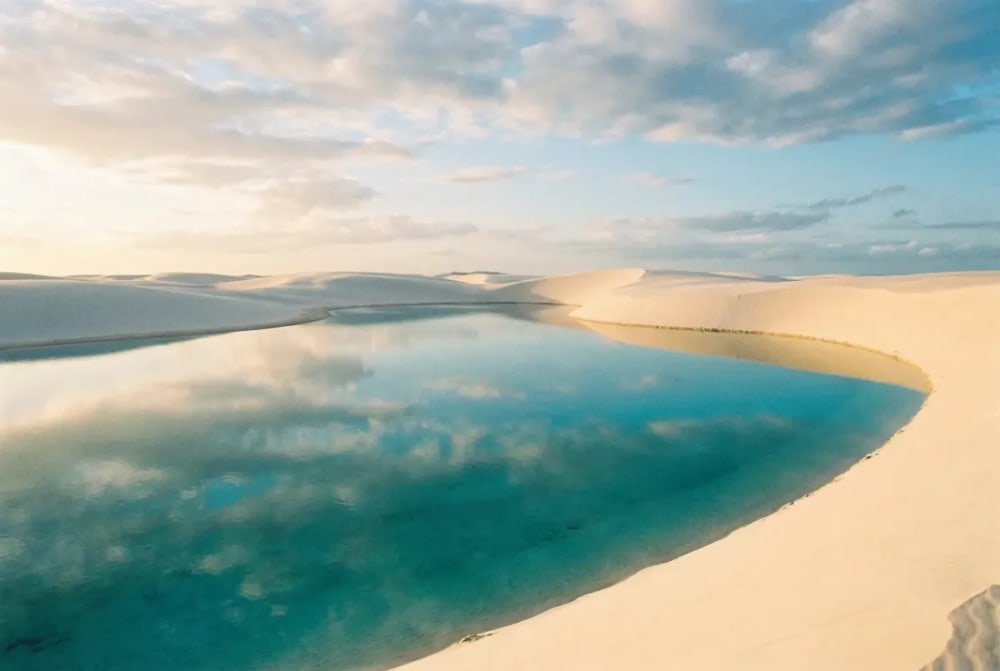
There are landscapes you think you know from guidebooks — and then there are the Lençóis Maranhenses. 155,000 hectares of pure quartz-sand dunes on Brazil's Atlantic coast, where between July and September tens of thousands of freshwater lagoons appear. Turquoise, emerald, deep blue. No kiosk, no power, no cell signal. Only dunes, lagoons, and the wind off the Atlantic.
On July 26, 2024, at its 46th session in New Delhi, UNESCO confirmed what geologists and travelers had long known: this place is unique in the world. It was inscribed under the natural criteria (vii) and (viii) — "exceptional natural beauty" and "significant geological processes." No other desert-lagoon ecosystem on Earth meets both conditions at once.
And that's exactly why the region is at a turning point. In 2019, around 60,000 visitors came. In 2025, more than 650,000 — a tenfold increase in six years. The responsible park authority, ICMBio, has been considering a visitor cap since January 2026. Anyone who wants to experience the Lençóis Maranhenses as a quiet, empty place probably has only a window of a few more years.
The lagoons — how they form
The obvious question on first sight: how does the water get between the dunes if it looks like the Sahara? The answer lies under the sand.
The Lençóis Maranhenses are what's called a wet desert. 1,600 to 2,000 millimeters of rain fall here every year — far more than in London (600 mm) or Berlin (580 mm). Beneath the up to 40-meter quartz-sand layer lies an impermeable clay layer. It works like the floor of a shallow tub: instead of seeping into groundwater, rainwater rises from below to above in the wet season and fills the troughs between the dunes. Thousands of temporary lakes appear — some only a few square meters across, the largest up to 100 meters long and 3 meters deep.
Researchers at the Brazilian science foundation FAPESP have figured out why this spectacle repeats year after year: the oscillation frequency of the groundwater table matches almost exactly the time it takes a dune to advance by its own width — about a year. Dunes in the Lençóis migrate westward at four to twenty-five meters per year. A lagoon that exists in July lies under a dune two years later. And a lagoon that never existed is suddenly born.
A small biological detail underlines the ecosystem's uniqueness: 49 documented freshwater fish species live in the lagoons. The best known is the wolf fish Hoplias malabaricus. When the lagoons dry up in October, it burrows into the wet sand under the dunes, falls into a kind of dormancy, and waits there for eight months for the next rains. When new lagoons appear, it surfaces again. No evolutionary biologist would dream this up.
Best time to visit — the three-month window
The Lençóis Maranhenses are the opposite of a year-round destination. To experience the turquoise lagoons that made the landscape famous, you have a window of about three months: July to September.
Here's how the year goes:
- January to June: rainy season. The lagoons fill slowly. Travel is possible, but the images people come for aren't there yet.
- July: the peak month. Lagoons full, skies mostly clear, Brazilian school holidays. Highest accommodation prices and lots of visitors — early booking is essential.
- August: almost as good as July. Slightly fewer people, lagoons still brimming. For many Brazil specialists, the best month to travel.
- September: shoulder season. Lagoons in the center (Barreirinhas) start drying out at the end of August; in the east (Atins) already by mid-August. Santo Amaro in the west holds out until early September.
- October to December: evaporation phase. Most lagoons are empty. Kitesurf season begins in Atins (winds 15–25 knots through January).
An important detail for planners: the lagoons don't dry out everywhere at the same time. If you can only travel in mid-September, choose Santo Amaro as your base. If you start as early as June, Atins already has full lagoons — Barreirinhas usually needs until early July to deliver the maximum picture.
Temperatures stay between 28 and 33°C during the day year-round; nights cool to 22–26°C. The dry season (July to September) has the most pleasant humidity. Start tours early — between 11 am and 3 pm, the sun is brutal in the shadeless dunes.
Barreirinhas vs. Atins vs. Santo Amaro — which gateway?
The national park has three gateway towns offering three very different travel experiences. The choice shapes the character of the whole trip.
Barreirinhas — the main gateway
Around 68,000 inhabitants, paved streets, the most pousadas, the most tour operators, restaurants on the Avenida Beira Rio waterfront promenade. Barreirinhas is the tourism heart of the Lençóis Maranhenses. The two classic half-day tours to Lagoa Azul and Lagoa Bonita start here, as does the boat tour on the Preguiças. The closest lagoons are 45 to 60 minutes away by 4×4. Recommendation: for a first visit of three to four days, Barreirinhas is the right base.
Atins — the fishing village at the park's eastern edge
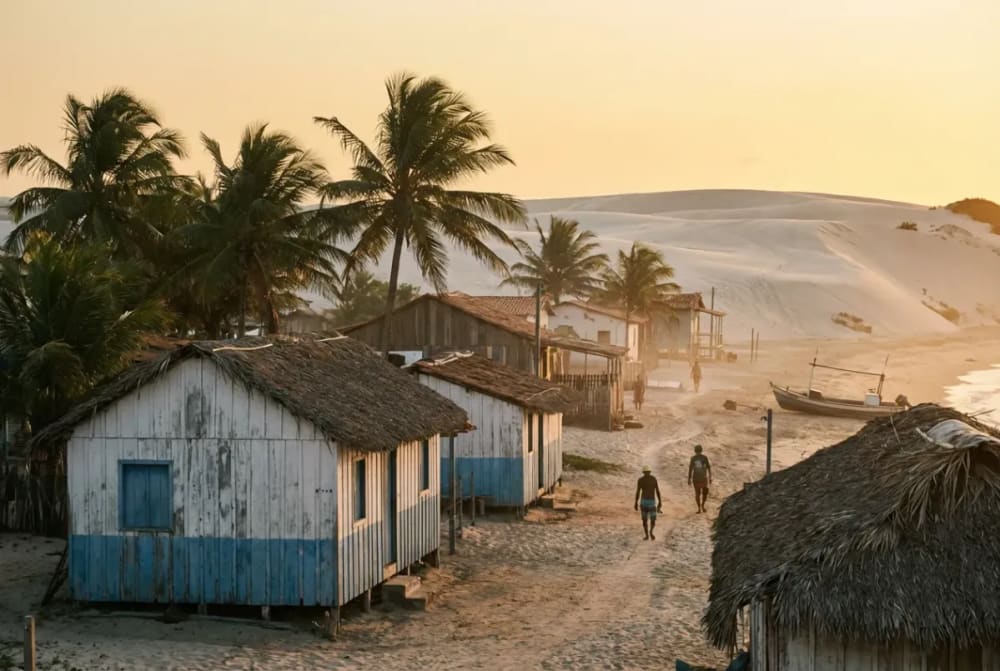
Atins has no paved roads, no regular cell signal, no ATMs. Life happens in the sand. Reachable by boat down the Preguiças River (about an hour and fifteen) or by 4×4 through the dunes. Boutique pousadas, a strong kitesurf scene (best winds July to January), small excellent restaurants. Atins is more expensive than Barreirinhas, but closer to the wild interior of the park. The classic multi-day trek to Santo Amaro starts here.
Santo Amaro do Maranhão — the wild west
Around 14,000 inhabitants, little tourist infrastructure, right at the park's edge. Lagoons reachable on foot in under five minutes. If you've been to the Lençóis before and this time want the wild, empty lagoons — Lagoa da Esperança, Lagoa das Emendadas, Lagoa da Gaivota — you'll find them in Santo Amaro. One specialty: Lagoa da Esperança is fed by an inflow of the Rio Negro and is full year-round, so it's worth seeing even in October. From São Luís it's 237 kilometers and about three and a half hours.
Our recommendations by traveler profile: three to four days and first time here — Barreirinhas. Five to seven days — combine Barreirinhas with Santo Amaro or Atins. Off the tourist track to "really" see the park — head straight to Santo Amaro.
Getting there & logistics — from São Luís
The Lençóis Maranhenses are deliberately not easy to reach. And that's part of the character.
The starting point is always São Luís (airport code: SLZ), the capital of the state of Maranhão. Daily domestic flights from São Paulo, Rio de Janeiro, and Belém with LATAM, GOL, and Azul. Barreirinhas Airport (BRB) ended its scheduled commercial flights in March 2025 — for travelers from abroad, that means: connect in São Luís, then transfer overland.
Real news for European travelers: from October 26, 2026, TAP Air Portugal will fly nonstop from Lisbon to São Luís for the first time. Twice weekly (Mondays and Thursdays), with a stop in Fortaleza, on an Airbus A321LR; departure Lisbon 7:05 pm, arrival São Luís 12:10 am the next day. Until then, getting there has been awkward — via São Paulo or Rio with a domestic flight. From October 2026, Brazil's North will be as accessible as the South.
Travelers flying nonstop from Lisbon to São Luís with TAP from October 2026 onward save roughly a full travel day compared to the previous routing via São Paulo. For our guests from Europe, it's the most comfortable connection the Brazilian Northeast has ever had — change in Lisbon, sleep once, wake up in Maranhão.
The transfer São Luís → Barreirinhas takes four to five hours on a well-maintained but winding road. Three options:
- Bus: Expresso Guanabara or Crisbell, from São Luís Rodoviária, travel time 4.5 to 5 hours, from approx. €15 per person.
- Shared van: several departures daily, around four hours, approx. €25 to 35 per person.
- Private transfer: approx. €180 to 200 per vehicle — significantly more comfortable for couples and small groups, flexible with stops.
To Santo Amaro it's 237 kilometers, about 3.5 hours by van. Three daily departures.
A planning note: the last shared-van departures leave around 3:30 pm. If you land in São Luís in the evening, stay overnight and continue the next morning. São Luís itself has been a UNESCO World Heritage Site since 1997 (colonial center with azulejo facades) and is worth at least a day — many of our travelers deliberately plan one or two days in the city.
UNESCO World Heritage and sustainability
The 2024 UNESCO inscription was a six-year process — Brazil submitted the dossier as early as 2018. "This impressive landscape of dunes and lagoons will benefit from the highest level of international protection," said UNESCO Director-General Audrey Azoulay at the announcement. With the Lençóis Maranhenses, Brazil now has 24 UNESCO World Heritage Sites — more than Germany (currently 16).
The flip side of the recognition is the visitor explosion: from 60,000 guests annually before the UNESCO nomination to over 650,000 in 2025. The International Union for Conservation of Nature (IUCN) rates the park's conservation status in 2025 as "good but with concerns." The main threats listed: motorized vehicles in the park, uncontrolled infrastructure expansion, and real estate speculation in the gateway towns. Since early 2026, ICMBio has been studying what a visitor cap might look like.
What this means for trip planning:
- Book local guides instead of large chain operators — it strengthens the communities in and around the park.
- Use biodegradable sunscreen and apply at least 30 minutes before swimming. The lagoons have slightly acidic freshwater (pH 4.9–6.2) and very low buffering capacity — chemical sunscreens are a real burden.
- No soap, no shampoo in the lagoons.
- Book early — not out of panic, but because good local pousadas in July and August are routinely booked two to three months ahead.
- Respect traditional communities: in the oases of Baixa Grande and Queimada dos Britos, families have lived for generations. If you stay overnight, you're a guest, not a customer.
Experiences & activities
The Lençóis Maranhenses are experienced almost exclusively with local guides — motorized vehicles inside the park are reserved for licensed operators. That isn't a downside, on the contrary: the rides through the dunes are themselves among the highlights of every trip.
Circuito Lagoa Azul
The classic from Barreirinhas. A 4×4 half-day tour to three to five lagoons, including Lagoa Azul (deepest color, intense turquoise) and Lagoa do Peixe. Duration about five hours, around €21 per person. Two departures daily — mornings cooler, afternoons golder light.
Circuito Lagoa Bonita
The afternoon classic. Departure around 2 pm, return around 7:30 pm. Lagoa Bonita sits high up — after a thirty-minute climb over dunes (partly with rope ladders), you stand on a panoramic point overlooking the whole dune field. Sunset from the highest point above the park. About €21 per person.
Boat tour on the Preguiças River
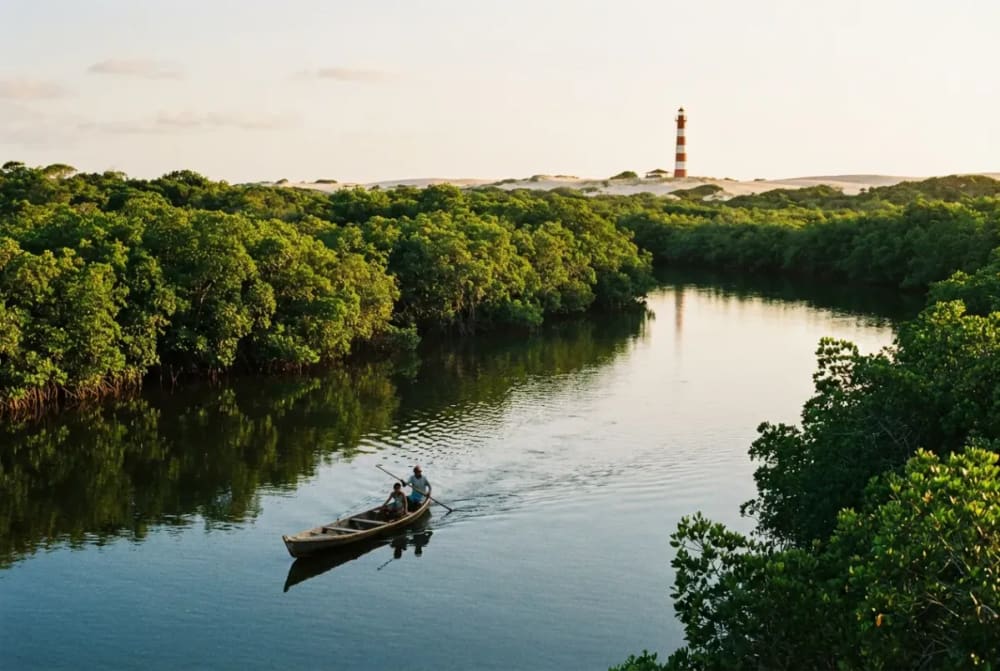
A full-day excursion by speedboat down the river "Preguiças" — the name means "the lazy ones" in Portuguese. Stops at the Pequenos Lençóis at Vassouras (dunes on the river bank), at the 35-meter lighthouse of Mandacaru with panoramic views over the river mouth, and on the Caburé peninsula between river and Atlantic. With some luck, scarlet ibises among the mangroves. Duration about seven hours, approx. €21.
Scenic flight over the dunes
25 to 30 minutes by small plane from Barreirinhas Airport (still in use for scenic flights and charters). The only way to truly grasp the dimensions of the landscape — from the air, you understand why the region is called "bedsheets." About €160 per person.
The 5-day trek: Atins → Santo Amaro
Our premium tip for experienced hikers. Start in Barreirinhas with a boat to Atins, then on foot through the heart of the park: Atins → Baixa Grande → Queimada dos Britos → Vila Betânia → Santo Amaro. About 70 kilometers over soft sand, moderate to challenging. Daily stages between 10 and 28 kilometers, early starts between 1:30 and 5:30 am because of the heat, midday rest in the oases. Mandatory accredited ICMBio guide. Overnights with traditional families in simple lodgings. Only possible between May and September. From approx. €630 per person for the guided complete package.
Atins is the best starting point for the multi-day trek. The opening leg to Baixa Grande is short and allows time to acclimatize, the oases along the way are legendary, and arriving in Santo Amaro means you've seen the park in a way 99 percent of visitors never will. For fit guests over 40 with trekking experience, this is our favorite.
Kitesurfing, horseback riding, raft trip
From Atins: sunset horseback ride through the dunes (3.5 hours), kitesurf lessons at the river mouth, guided kite tours over the lagoons in season (July to January). From Barreirinhas: boia-cross — float down the Rio Formiga in an inner tube, around €19.
Combination route: Rota das Emoções
The iconic Northeast loop links Jericoacoara in Ceará via the Parnaíba Delta in Piauí to the Lençóis Maranhenses. Seven to fourteen days, three states, three completely different landscapes. With more time, you can build the Rota das Emoções in as an extension — we've driven the route in both directions and know where to find the most spectacular dune transitions.
Where to stay
Infrastructure in the Lençóis Maranhenses is charmingly low-key. There are no big hotel chains, but family-run pousadas in every price range.
Barreirinhas offers the widest selection: mid-range pousadas from €50 to €85 per night, upscale houses like the Porto Preguiças Resort from €100. For first-timers, Barreirinhas is the safest choice — broad selection, good availability outside peak weeks.
Atins is the boutique segment. Houses like Convento Arcádia (coconut grove, eco-design) or Vila Aty Lodge run €100 to €155 per night. Many places deliberately skip Wi-Fi — remoteness as a feature. In 2025, the region overtook Fernando de Noronha for the first time in Brazilian luxury rankings, which keeps pushing prices in the top segment.
Santo Amaro is small: a few pousadas like Rancho das Dunas or Villaz Lençóis Maranhenses, prices comparable to budget Barreirinhas, but quick to sell out. In high season, we recommend booking rooms at least two to three months ahead.
The simplest rule for choosing accommodation: the longer you stay and the more quiet you seek, the further west you should move. Three days in Barreirinhas? Perfect for an introduction. A week with trek ambitions? Atins. Two weeks of Brazilian Northeast as a second trip? Santo Amaro at the heart.
We work with hand-picked pousadas in all three towns — get in touch , and we'll recommend the house that matches your travel profile.
Planning the Lençóis Maranhenses individually
To experience the Lençóis Maranhenses properly, combine them with other stops in Brazil. The classic is the Northeast route with Salvador de Bahia and the Chapada Diamantina — two worlds in one trip: Afro-Brazilian coastal culture, table mountains, and then the dunes of the North. With more time, add the Amazon, the Pantanal, or the Rota das Emoções.
Our most-booked routes including a Lençóis leg:
- Brazil Northeast: Lençóis Maranhenses & Salvador — 14 days of Bahia and the Northeast with a full Lençóis leg
- Brazil Highlights: Amazon, Pantanal & Northeast — the great nature triangle with the Lençóis as the finale
For personal advice and a tailor-made offer, contact our Brazil team — we usually reply within 24 hours and know the region firsthand.
To book a trip or for more information, contact us. We'll help you plan and guide you through your upcoming adventure!
Frequently Asked Questions
Between mid-July and mid-August, the lagoons of the Lençóis Maranhenses are at their annual peak. August is our favorite recommendation: lagoons full, temperatures pleasant, visitor numbers slightly lower than in the Brazilian holiday month of July. In September, focus on Santo Amaro in the west of the park — the lagoons last longest there, while in Atins and Barreirinhas the water is already receding.
The starting point is São Luís (airport SLZ). From Europe until October 2026, via São Paulo, Rio de Janeiro, or Belém with a domestic connection. From October 26, 2026, TAP Air Portugal flies nonstop from Lisbon to São Luís for the first time (twice weekly, with a stop in Fortaleza). From São Luís, continue by bus, shared van, or private transfer to Barreirinhas (4–5 hours) or Santo Amaro (3.5 hours). Direct flights to Barreirinhas were discontinued in March 2025 — scenic flights over the dunes are still possible.
For a first trip and three to four days: Barreirinhas. The infrastructure is better, the tour selection wider, and the classic highlights Lagoa Azul and Lagoa Bonita are reachable directly from there. For a longer trip, kitesurf interest, or a quieter stay: Atins. The fishing village in the east has no paved roads, no ATMs, and excellent boutique pousadas — reachable by boat on the Preguiças River or 4×4 through the dunes. Combine the two and you experience both faces of the park.
Three days is the minimum for the Lençóis Maranhenses — one day Lagoa Azul, one day Lagoa Bonita, one day Preguiças River boat tour. Four days is more comfortable and leaves time for Atins or a scenic flight. If you plan the 5-day trek, count on a total of eight to ten days, including arrival, departure, and a recovery day. For most of our guests, the region is one leg of a 10- to 14-day Brazil tour.
Longer than usual, but well planned. From Europe, a long-haul flight to São Paulo (or from October 2026, direct to São Luís with TAP), then a domestic flight to São Luís and four to five hours of overland transfer. The road between São Luís and Barreirinhas is paved and safe, but winding. Our tip: plan at least one night in São Luís — the city is itself a UNESCO World Heritage Site and a worthwhile stop. Inside the park, you move only with licensed 4×4 guides, which makes things significantly more comfortable.
Absolutely. The Lençóis Maranhenses, paired with Salvador de Bahia, the Chapada Diamantina, or the Rota das Emoções (Jericoacoara → Parnaíba Delta → Lençóis), create one of the most landscape-contrasting tours in South America. Two weeks is a good minimum to combine two or three legs without rushing. Our Brazil Northeast: Lençóis Maranhenses & Salvador tour shows how these building blocks fit together.