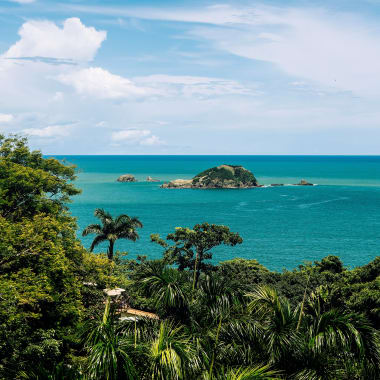


This image was generated with AI.
San Cristobal
Darwin's first island & Kicker Rock
Darwin's first island & Kicker Rock
San Cristobal Galapagos — Darwin's first island, Kicker Rock as the best dive and snorkel spot, sea lions right on the beach, and the second Galapagos airport. Discover the underestimated island.

Best travel time
Year-round, ideal December–May
Why San Cristobal is the most underestimated island in the Galapagos
A sea lion sleeps on the park bench next to the airport exit. Three meters away, a taxi is waiting. Ten minutes later, you are in the center of Puerto Baquerizo Moreno — the provincial capital of Galapagos, which feels like a fishing village where the animals are in charge. This is how San Cristobal Galapagos begins: without bus transfer, without ferry, without the organized chaos that characterizes Baltra airport.
Most Galapagos travelers fly to Baltra, take the ferry to Santa Cruz, and forget that there is a second option — a more stress-free one, if you will. San Cristobal has its own Galapagos airport, located ten minutes from the city center. You get off the plane, and the Galapagos Islands are right there. Instantly. Unbroken.
San Cristobal is the easternmost of the Galapagos Islands and with 558 square kilometers the fifth largest. It is between 2.4 and 4 million years old — one of the geologically oldest islands in the archipelago and also the wettest and most fertile. About 6,000 people live here, most in Puerto Baquerizo Moreno. Yes, the capital of the Galapagos province is located on San Cristobal, not on Santa Cruz — a detail that surprises most travelers.
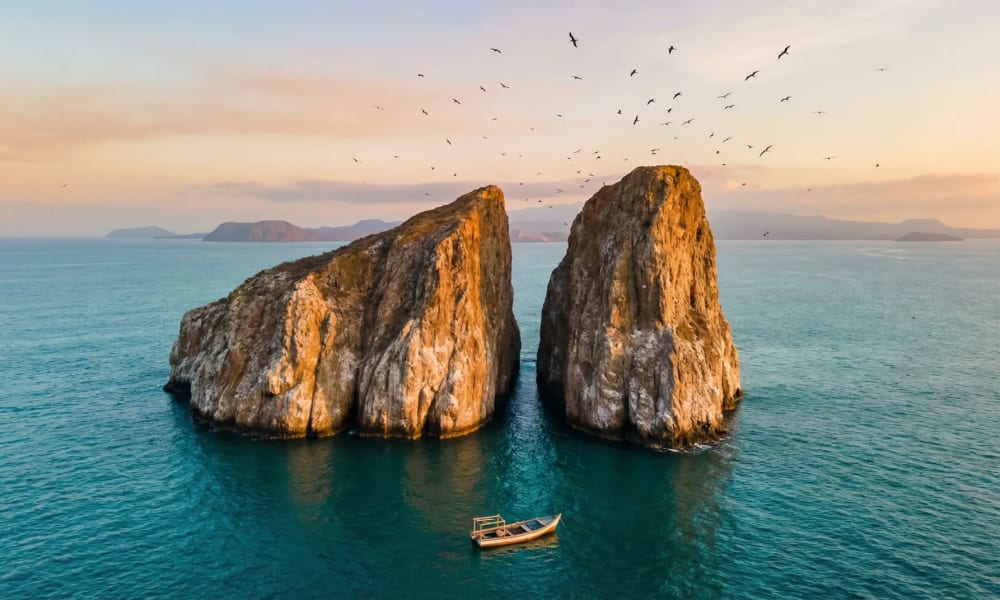
Off the coast, Kicker Rock rises 153 meters out of the ocean: two volcanic rock needles, separated by a narrow channel where hammerhead sharks, Galapagos sharks, and sea turtles swim. It is the most iconic dive and snorkel spot in the entire archipelago — and it belongs to San Cristobal.
And then there is the history. On September 16, 1835, Charles Darwin stepped here for the first time on Galapagos soil. The bay where he landed is now a free snorkel spot. The same cliffs, the same waves — just 190 years later.
San Cristobal is not a hidden gem. It's the island that too few have on their radar — and that's exactly why it's still as pristine as the Galapagos Islands should be.
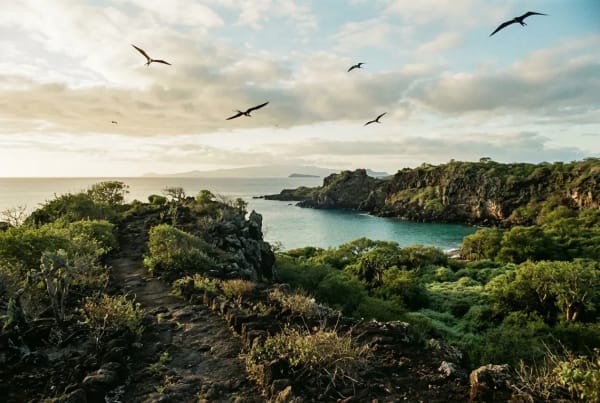
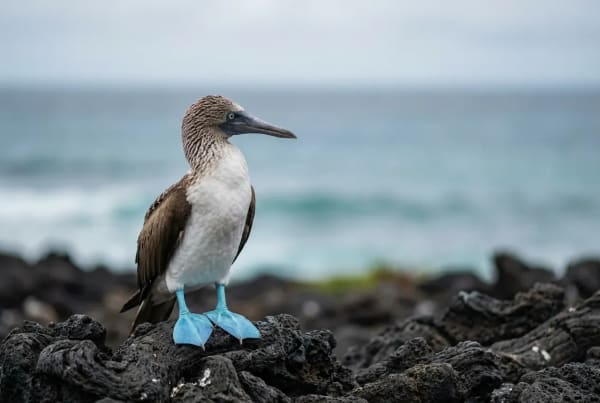
Kicker Rock (Leon Dormido) — the best dive spot of the Galapagos
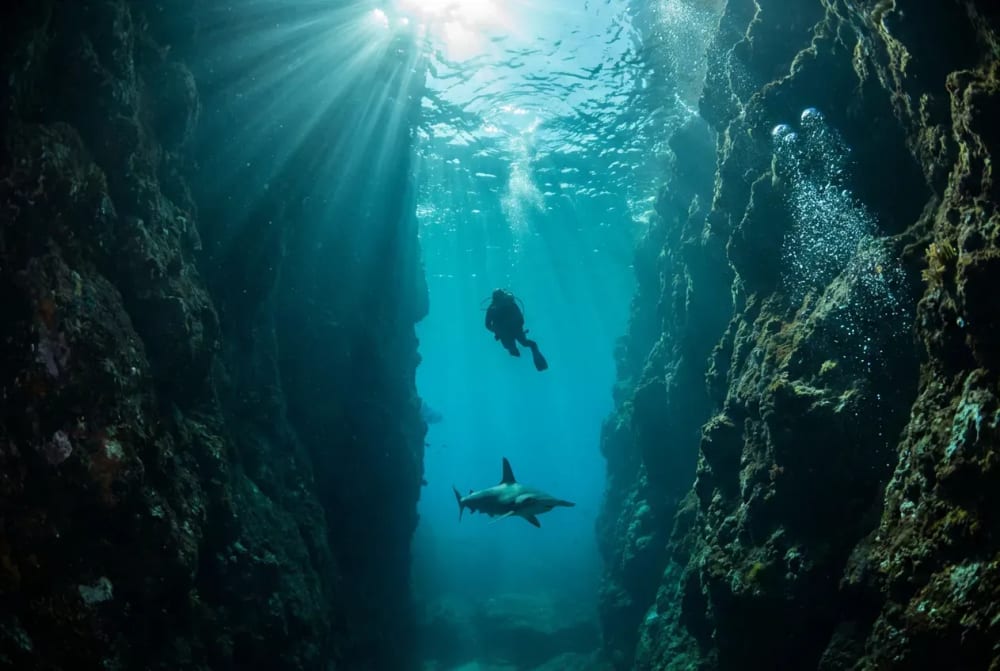
Imagine: 17 kilometers off the coast, two rock needles rise from the Pacific, 153 meters high, separated by a channel that is no wider than a living room. Shadows glide beneath you in the water — hammerhead sharks, slow and unimpressed. This is Kicker Rock, and it is the moment for which divers and snorkelers from all over the world come to San Cristobal.
The Spanish name Leon Dormido — sleeping lion — describes the silhouette from the sea. In English, the formation is called Kicker Rock because it resembles a boot from the other side. What matters: They are two columns of solidified volcanic tuff, and the narrow channel in between — 6 to 8 meters wide, 14 to 18 meters deep — is one of the richest underwater habitats in the entire archipelago.
In and around Kicker Rock, you can regularly encounter: hammerhead sharks (especially December to May), Galapagos sharks, white-tipped reef sharks, green sea turtles, eagle rays, golden rays, sea lions, and marine iguanas. At the cliffs above, Nazca boobies, blue-footed boobies, and frigate birds nest.
Snorkeling or diving at Kicker Rock?
Kicker Rock Galapagos is also impressive without a diving license. Snorkelers see the same channel, the same sharks, the same turtles — only from the surface. The standard tour lasts 6 to 8 hours and includes a 1.5-hour boat ride there and back, as well as three hours in the water. Snorkeling tours cost 135 to 161 USD per person, diving tours with two dives 190 to 210 USD.
For divers: Open Water certification as a minimum, advanced experience recommended. The currents can be strong and cold. The water fluctuates between 22 and 28 degrees Celsius in the warm season (December to May) and 18 to 22 degrees in the cool Garua season (June to November).
Kicker Rock (Leon Dormido)
- Tour duration — 6–8 hours (including 3 hours boat ride)
- Distance — 17 km from Puerto Baquerizo Moreno (1.5 hours by boat)
- Best time — Dec.–May for hammerhead sharks and warm water
- Price — Snorkeling from 135 USD, diving from 190 USD
Experience Kicker Rock without a diving license
Those who do not dive book a snorkeling tour — the experience is hardly less impressive. Many tours combine Kicker Rock with a stop at Isla Lobos (sea lions, blue-footed boobies). Bringing your own snorkel mask is worthwhile: rented masks do not always fit. A wetsuit (min. 3 mm) is also recommended in warm season. Book the tour at least one day in advance — popular early morning departures sell out quickly.
Sea lions in the city — why San Cristobal is unique
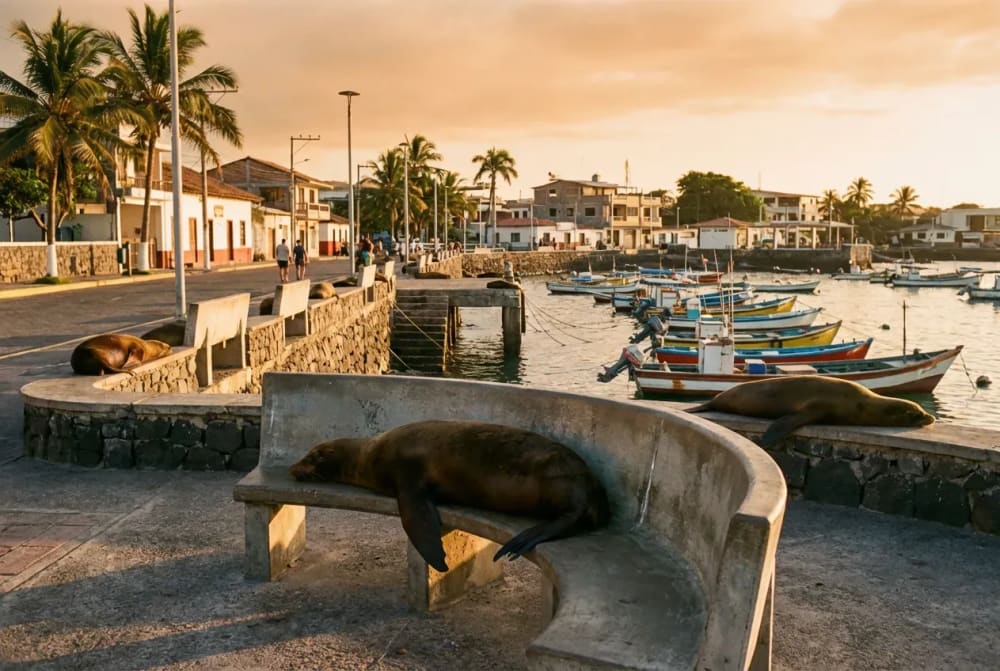
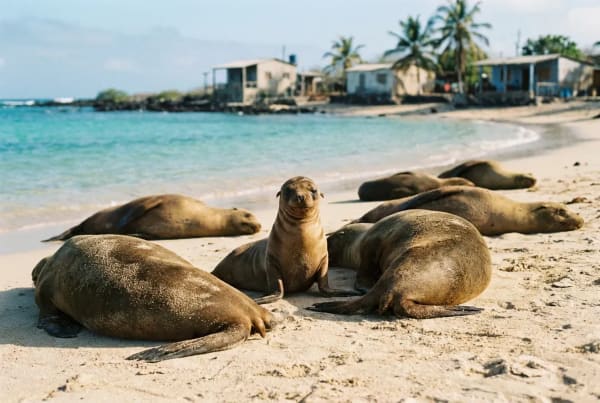
In the Galapagos, you encounter sea lions everywhere. But nowhere as directly as in San Cristobal. Around 500 Galapagos sea lions have settled in the urban area of Puerto Baquerizo Moreno — that's 13 percent of the entire population. They sleep on park benches along the Malecon, occupy fishing boats in the harbor, and lounge on the concrete steps of the promenade. No one is bothered by it. The city has adapted to the animals, not vice versa.
The Galapagos sea lion (Zalophus wollebaeki) is listed as endangered on the IUCN Red List — the total population has dropped by 50 percent in 40 years to about 20,000 animals. Those who experience them here at arm's length intuitively understand why their protection is not an abstract demand.
Playa Mann — the sea lion beach in the city center
Playa Mann is the main beach of Puerto Baquerizo Moreno, just ten minutes from the center. Here, sea lions lie right next to bathers — shallow, calm water, ideal for snorkeling. The beach has showers, toilets, a small restaurant kiosk, and lifeguards. Entrance is free. In the morning before 9 am, the animals are most active, and the photo light is best.
La Loberia — the wilder sea lion beach
Two kilometers south of the city lies La Loberia: less infrastructure, fewer tourists, more wilderness. The name says it all — a large colony of sea lions lives here. While snorkeling, you encounter eagle rays, sea turtles, eels, and schools of colorful fish. Access: 20 to 30 minutes on foot, by bicycle, or by taxi (about 2 USD). Also a surf spot for experienced surfers.
Playa Mann & La Loberia
- Playa Mann — 10 min. walk from the center, free
- La Loberia — 2 km south, taxi 2 USD, wild, less infrastructure
- Sea lion pups — August–November (especially playful and curious)
- Tip — In the morning before 9 am: most active animals, best photo light
Safety distance to sea lions
Never stand between a mother and her pups — this is perceived as a threat. Bulls (significantly larger, recognizable by the neck mane) can become aggressive. Minimum distance according to national park rules: 2 meters. The animals will approach on their own — let them decide.
Darwin's first island — a history you can feel
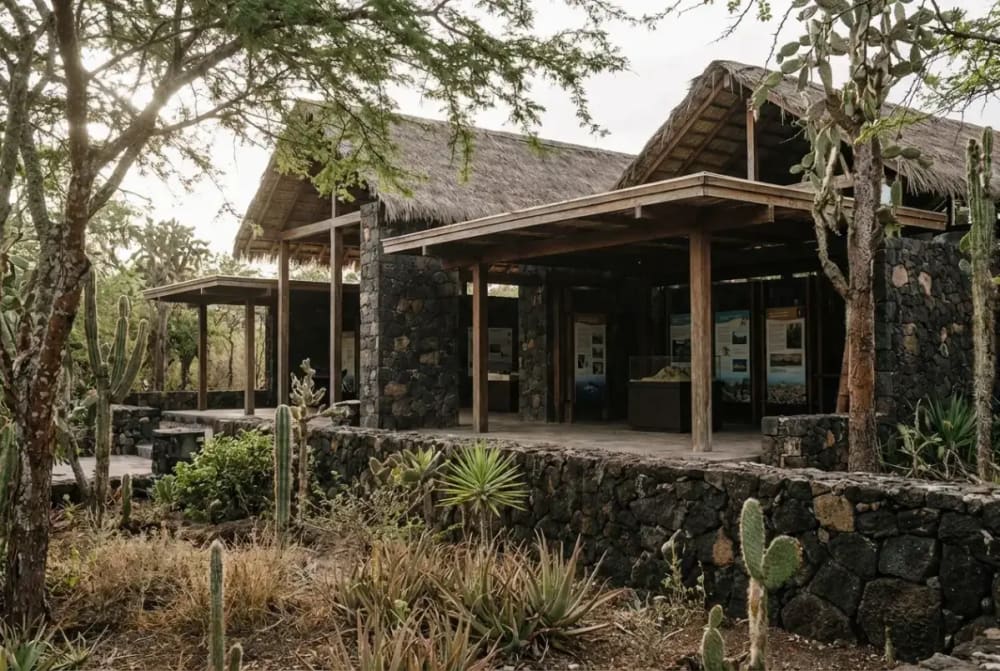
On September 15, 1835, the HMS Beagle sighted Mount Pitt at the eastern tip of San Cristobal. The next day, on September 16, Charles Darwin stepped for the first time on Galapagos soil — at the bay beneath today's Cerro Tijeretas. He spent most of his 19 Galapagos days on this island and dedicated a quarter of his field notes to it: the iguanas, the birds, the vegetation, the volcanic landscape. What he observed here became the foundation of the theory of evolution — an idea that fundamentally changed our understanding of life.
Cerro Tijeretas — Darwin's landing site today
Cerro Tijeretas (Frigatebird Hill) is the hill right next to the Interpretation Center. Here both species of frigatebirds nest together — a rare sight, even in the Galapagos. The hiking trail (about 1 hour, moderate difficulty) leads over lava rock paths to the viewpoint with a Darwin statue and a historic military cannon. At the foot of the hill lies the bay where Darwin landed — now a free snorkeling spot with concrete steps for easy access. Sea turtles, sea lions, eagle rays, and schools of tropical fish are the norm here, not the exception.
Interpretation Center — more than the Darwin Station
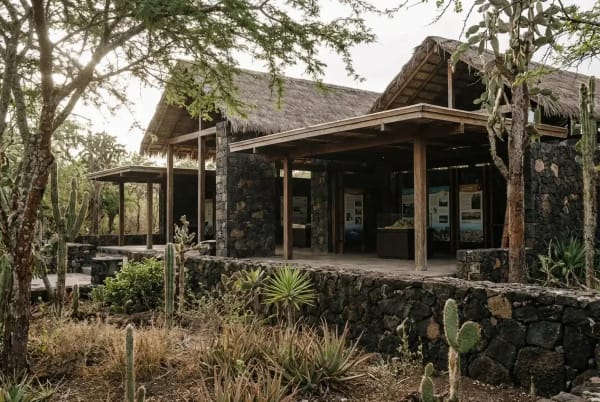
The Centro de Interpretacion is the best museum about the history of the Galapagos Islands. Unlike the Charles Darwin Research Station on Santa Cruz (focus: turtle breeding), this museum addresses the entire natural history of the archipelago: volcanic origin, ocean currents, colonization history and human influences. Entrance is free — and unlike many museums in this world, not a minute is wasted.
Free three-hour combination
Interpretation Center, Cerro Tijeretas hike, and snorkeling in Darwin Bay — this combination is completely free and can be completed in 2 to 3 hours. An ideal morning activity before the day tour boats return. Bring snorkeling gear or rent in town (10–15 USD per day).
More highlights on San Cristobal
Laguna El Junco — the only freshwater lake in the Galapagos
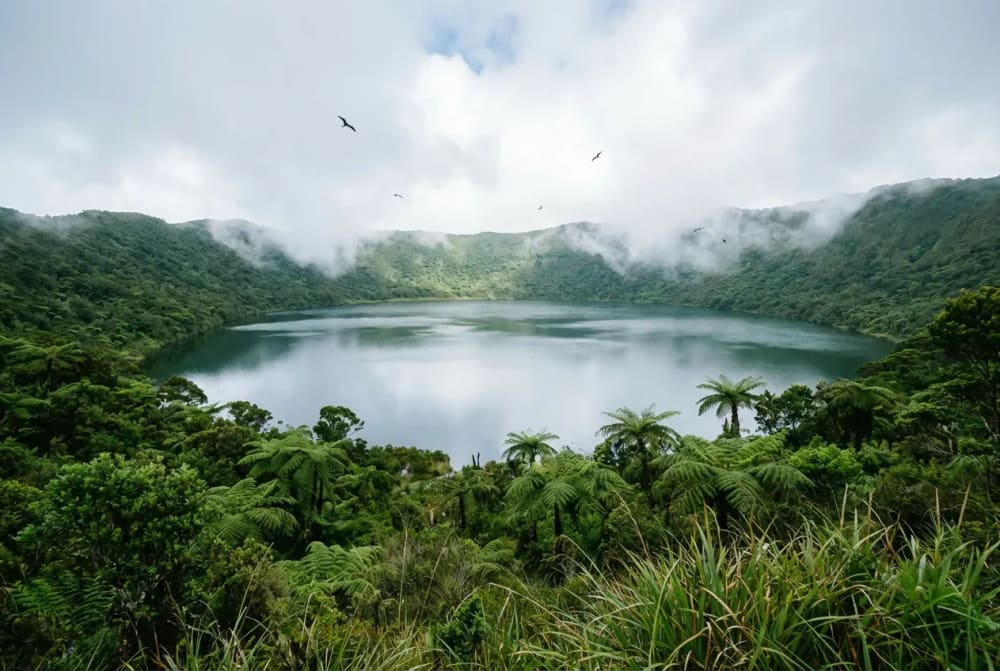
At 700 meters high lies something that shouldn't exist in the Galapagos: freshwater. Laguna El Junco is the only permanent freshwater lake in the entire archipelago — 270 meters in diameter, up to 6 meters deep, filled with 360,000 cubic meters of water in a volcanic crater. During World War II, US forces on Baltra used this lake as the main water source. Today El Junco is a bird paradise — frigatebirds regularly land on the lake to wash salt from their feathers. White-cheeked pintails, moorhens, coots, and Darwin's finches inhabit the shores.
Galapaguera de Cerro Colorado — giant tortoises up close
The breeding and protection station is 30 minutes by car from Puerto Baquerizo Moreno. Around 140 free-roaming giant tortoises in various stages of development — from hatchlings to fully grown giants. Unlike the Charles Darwin Research Station on Santa Cruz, the conditions here are more natural: no laboratory, no incubator, more wilderness. The animals move through their natural habitat, not through enclosures. Entrance is free, daily 6:00 AM to 6:00 PM.
Punta Pitt — all three booby species in one place
Punta Pitt at the eastern tip of San Cristobal is the only place in the Galapagos — and worldwide — where blue-footed boobies, red-footed boobies, and Nazca boobies nest side by side. Along with frigatebirds, Darwin's finches, and sea lions. The tour includes a two-hour hike along olive-colored sandy beaches with volcanic viewpoints. Only accessible by boat tour (about 179 USD, Fridays).
Puerto Chino — the hidden beach
24 kilometers from Puerto Baquerizo Moreno lies a secluded beach: white sand, turquoise water, no infrastructure, no crowds. Snorkeling with sea turtles and stingrays. Taxi about 5 USD, 15 minutes on foot from the parking lot. Bring water and snacks — there is no provision on site.
Combine highland tour optimally
El Junco and Galapaguera de Cerro Colorado can be perfectly combined as a half-day tour (taxi for 4 people: about 60–80 USD). Go in the early morning when the lake is still free of clouds — by noon, the Garua fog cover can obscure the view.
Puerto Baquerizo Moreno — the underestimated Galapagos capital
Puerto Baquerizo Moreno is the opposite of Puerto Ayora on Santa Cruz . About 6,000 residents, a relaxed harbor town atmosphere, fewer souvenir shops and more sea lions per square meter than anywhere else in the archipelago. The Malecon (promenade) is the heart of the city — here are the restaurants, bars, souvenir shops, and boat docks for day trips and ferries to Santa Cruz or Isabela .
Infrastructure is available: several supermarkets, banks with ATMs, pharmacies, a basic care hospital, tour operators, and the Galapagos Academic Institute for the Arts and Sciences (GAIAS). Internet and mobile networks (Claro/Movistar) work, though not always reliably.
A culinary secret: San Cristobal produces the only organic Galapagos coffee in the world. At Hacienda El Cafetal in El Progreso — the oldest farm on the island, founded in 1866 — coffee grows completely pesticide-free, as Ecuadorian law prohibits chemicals in the Galapagos. Visits by reservation are possible, including lunch. Anyone who leaves San Cristobal without trying this coffee has missed something.
Galapagos airport directly in the city
The SCY airport is ten minutes on foot — or two minutes by taxi (2–3 USD) — from the city center. In comparison: travelers arriving via Baltra airport need 45 to 60 minutes (bus, ferry, another bus) and pay about 11 USD to get to Puerto Ayora. For travelers planning San Cristobal as the first stop in Galapagos island hopping, flying to SCY is the less stressful option.
Best travel time for San Cristobal
The best travel time for the Galapagos Islands depends on what you want to experience on San Cristobal. The island is visitable year-round — each season has its own character.
| Month | Kicker Rock | Sea lions | Snorkeling | Special feature |
|---|---|---|---|---|
| Dec.–Mar. | Hammerhead shark season, warm (22–28 °C) | Pup season begins (Aug.) | Excellent (warm, clear visibility) | Warmest time, best Kicker Rock conditions |
| Apr.–June | Good, transition period | Pups growing up | Very good | Calm seas, fewer visitors |
| July–Sept. | Cooler water (18–22 °C) | Puppy peak (playful, curious) | Good (cool, more marine life) | Garua season, frigate birds' mating |
| Oct.–Nov. | Transition to the warm season | Puppies still active | Good | Fewer visitors, transition period |
Our tip: December to May offers the strongest overall combination for San Cristobal — warm water and best visibility at Kicker Rock, hammerhead season, and pleasant temperatures. Those who want to experience the most playful sea lion puppies come from August to November. A detailed overview can be found in the Galapagos Wildlife Calendar.
Travel to San Cristobal — flight and ferry
San Cristobal has a decisive advantage over all other Galapagos islands: a private Galapagos airport directly in the city. Those planning San Cristobal as the first or last stop in the island hopping save the complicated transfer via Baltra — and gain precious hours lost elsewhere in buses and ferries.
Travel to San Cristobal Ecuador mainland / Santa Cruz → San Cristobal
Seasickness and entry formalities
The speedboat crossing from Santa Cruz can be rough, especially in the Garua season (July to November). Take seasickness tablets before departure. Seats in the middle of the boat are more stable. Pack bags in plastic bags — it will be wet inside as well. When entering by flight: National park fee (200 USD since August 2024) and transit control card (20 USD) are due at the airport. Sworn declaration form to be filled out online in advance (mandatory since December 2024 for all travelers over 18 years old). Details can be found in our guide to the Entry rules for Galapagos .
Costs and accommodations on San Cristobal
As of March 2026. ATMs (ATM) available in Puerto Baquerizo Moreno — however, bring enough USD cash as credit cards are not accepted everywhere. The national park fee is paid at the Galapagos airport upon arrival.
You can find detailed budget planning in our Galapagos cost and budget guide. Everything about visa, national park fees, and entry formalities is explained on our page about the Entry rules for Galapagos .
San Cristobal in your Galapagos trip
San Cristobal deserves at least two to three full days — as a starting point for island hopping or as its own station. Here is what your program might look like:
Day 1 — Arrival and exploring the city
Day 2 — Kicker Rock — the highlight
Day 3 — Highlands and onward travel
Note: If you have a fourth day, you should book the Punta Pitt tour (Fridays, 179 USD) — the only place in the world where all three booby species nest together. Or the Espanola day tour (Mon./Thu., 240–274 USD) for albatrosses and the most spectacular cliffs of Galapagos.
Three days are enough to experience the most important places of San Cristobal — as part of a Galapagos island hopping trip or combined with a cruise . Whether as an entrance airport to start or a quiet conclusion to your Galapagos trip — we know San Cristobal from personal experience and advise you personally. Incorporate San Cristobal into your Galapagos trip — inquire now without obligation .
Discover more Galapagos islands
Espanola — Only albatross breeding site in the world
Santa Cruz — The heart of the Galapagos archipelago
Isabela — Largest island — volcanoes and penguins
Read more: Cruise or island hopping? — our detailed comparison will help with your decision. In the Galapagos Wildlife Calendar you will find out which animals you can observe when on which island. Or a completely different comparison: Pantanal vs. Galapagos — where is the better wildlife experience?
To book a trip or for more information, contact us. We'll help you plan and guide you through your upcoming adventure!
Frequently asked questions
Kicker Rock (Leon Dormido) consists of two 153-meter-high rock needles made of volcanic tuff stone off the coast of San Cristobal. The narrow channel between them (14–18 meters deep, 6–8 meters wide) is one of the best diving and snorkeling spots in the Galapagos Islands. Frequently seen: hammerhead sharks, Galapagos sharks, sea turtles, eagle rays, and sea lions. Snorkeling tours start at 135 USD, diving tours at 190 USD.
By speedboat ferry from Puerto Ayora (Santa Cruz) to Puerto Baquerizo Moreno (San Cristobal). Daily two departures at 07:00 and 15:00, travel time 2 to 2.5 hours, price 35 USD per person. Book tickets in advance and be at the dock 30 minutes before departure. The crossing can be rough — seasickness tablets are recommended.
Yes, San Cristobal has the Galapagos airport SCY — the second Galapagos airport besides Baltra. LATAM and Avianca fly daily from Quito and Guayaquil. The big advantage: The airport is only 10 minutes' walk from the city center of Puerto Baquerizo Moreno — no bus transfer or ferry needed like in Baltra.
Absolutely. Kicker Rock is considered one of the best diving spots in the Galapagos Islands and worldwide. Open water certification is the minimum, advanced experience is recommended due to strong currents. Two dives cost from 190 USD. Hammerhead sharks are especially common from December to May. For divers who want more, we offer the Galapagos diving cruise.
Snorkeling tours cost 135 to 161 USD per person (6–8 hours, incl. guide, equipment, wetsuit, lunch). Diving tours with two dives cost 190 to 210 USD. Most tours combine Kicker Rock with a stop at Isla Lobos. Early morning departures are the most popular — book at least one day in advance.
Charles Darwin first set foot on Galapagos soil on San Cristobal on September 16, 1835. He spent most of his 19 Galapagos days on this island and dedicated a quarter of his field notes to it. His landing site at the bay of Cerro Tijeretas is now a free snorkeling spot. The interpretation center in Puerto Baquerizo Moreno tells the complete story — also for free.
San Cristobal is visitable year-round. December to May is ideal for Kicker Rock (hammerhead season, warm water 22–28 degrees Celsius, best visibility). August to November is the sea lion puppy season — the young are especially playful. July to September offers cooler water with more marine life. Detailed overview: Best time to visit Galapagos.
At least 2 to 3 days. Day 1: City, interpretation center, Cerro Tijeretas, Playa Mann. Day 2: Kicker Rock tour (the highlight). Day 3: Highlands (El Junco, Galapaguera) and onward travel. If you have a fourth day, you should book the Punta Pitt tour (Fridays, 179 USD) or the Espanola day tour.