


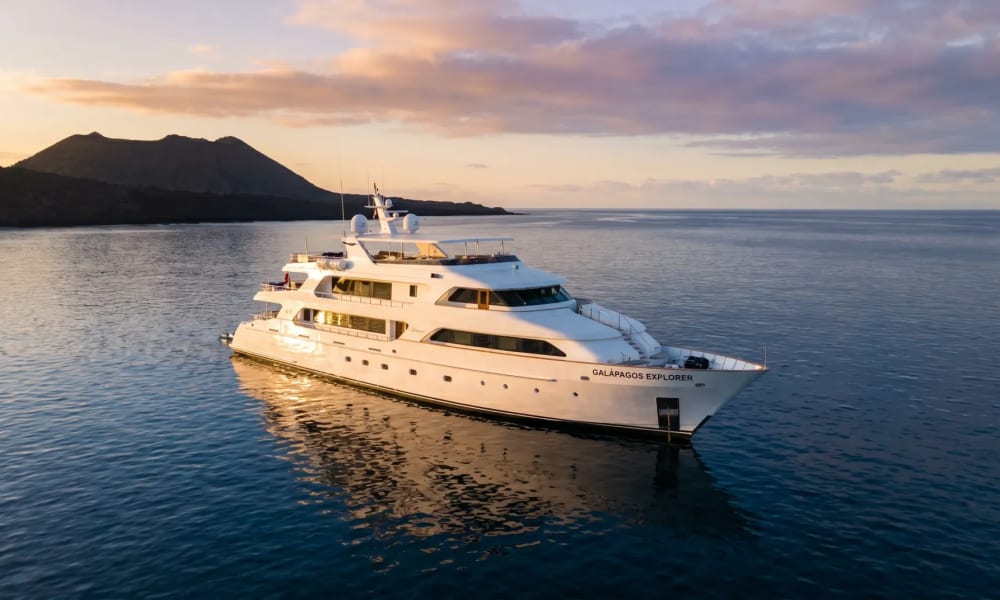
This image was generated with AI.
Galápagos Cruise: The Complete Guide to Your Expedition
Tourist Superior, First Class, or Luxury — every class, yacht size, and route compared
Tourist Superior, First Class, or Luxury — every class, yacht size, and route compared
A Galápagos cruise is unlike any other ship-based trip: Galápagos is a UNESCO World Heritage Site and a strictly protected zone — every island visit happens exclusively in licensed groups with certified naturalist guides, every yacht has a route assigned by the Galápagos National Park, and only a handful of the 13 main islands are reachable on day trips at all. Anyone who wants to see the remote islands of Fernandina, Genovesa, or Española — the most spectacular wildlife hotspots — has no way around a cruise. This guide compares classes, yacht sizes, and routes honestly and offers a clear recommendation for the right traveler. More on the Galápagos trip overall on our overview page.

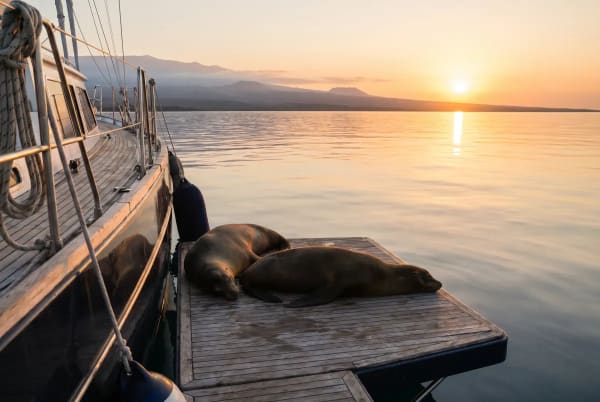
Cruise or island hopping — the honest decision aid
This question shapes the character of your Galápagos trip more than any other detail. Both options are valid — but they speak to different traveler types.
What a Galápagos cruise really means
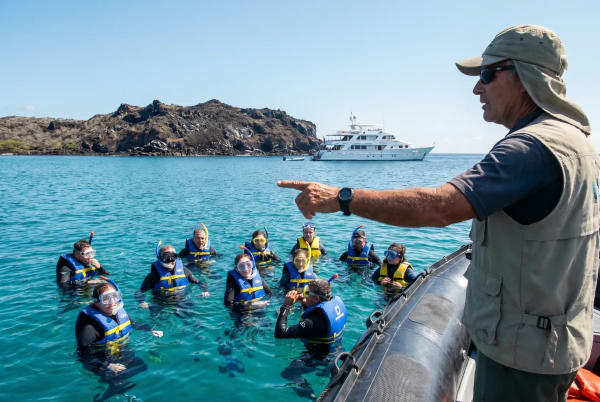
You sleep on board, the ship sails to the next island at night, and every morning you wake up at a new wildlife hotspot. Each day you visit two sites (morning and afternoon), with snorkeling sessions in between. You'll see 8–12 islands in 7–8 days, including the day-trip-inaccessible hotspots Fernandina, Genovesa, and Española. Full board, naturalist guide, and all park entry fees are included. You give up flexibility — the route is fixed and assigned by the Galápagos National Park.
What island hopping really means
You sleep at hotels on Santa Cruz, Isabela, and San Cristóbal, travel between islands by public speedboat (2–2.5 hours on open water), and book day trips as needed. You'll visit 3 inhabited islands intensively, plus a few uninhabited islands on day trips, but none of the remote wildlife hotspots. You get more flexibility, more contact with island life, lower entry-level prices — and to be honest, the speedboat transfers can also cause seasickness.
Comparison table — cruise / island hopping / combination
| Criterion | Cruise | Island hopping | Combination (4 days cruise + 3 days land) |
|---|---|---|---|
| Islands accessible | 8–12 (incl. Fernandina, Genovesa, Española) | 3 (Santa Cruz, Isabela, San Cristóbal) | 5–8 + 3 |
| Wildlife variety | very high | high | very high |
| Price (8 days, from) | USD 2,800 (Tourist Superior) | USD 2,100 | USD 3,500 |
| Flexibility | low (route fixed) | high | medium |
| Seasickness risk | medium (overnight sailing) | low–medium (speedboats) | medium |
| Minimum age, children | usually 6–8 | none | 6–8 |
| Booking lead time | 9–18 months | 4–8 weeks | 9–12 months |
| Best for | maximum wildlife, limited time, premium | active travelers, families with small children, budget, prone to seasickness | best coverage, more travel time |
Who we recommend the cruise for
If you want maximum wildlife variety in limited time, want to see remote islands, value premium comfort, and prefer not to deal with inter-island ferries: cruise. Especially for travelers visiting Galápagos once and wanting the full experience, the cruise is the honest pick — no other option shows so many islands in so little time.
Who island hopping suits better
Families with children under 6 (the minimum age on many yachts), travelers prone to seasickness who already find a speedboat transfer taxing, budget travelers who need to stay below USD 2,500 per person, or experienced Galápagos visitors who want to explore specific islands in depth: island hopping.
The combination as a third path
A 4–5-day cruise through the remote western islands (Isabela, Fernandina, Genovesa) plus 3–4 days land-based on Santa Cruz or San Cristóbal combines the strengths of both worlds. We recommend this option especially for premium travelers with 12–14 days of travel time. More on the best time to visit for combinations like this.
Galápagos cruise classes — what to expect
The Galápagos fleet comprises around 80 licensed yachts in four main classes. Prices are per person on double occupancy — as of May 2026.
Tourist Superior (USD 350–500 per person/day)
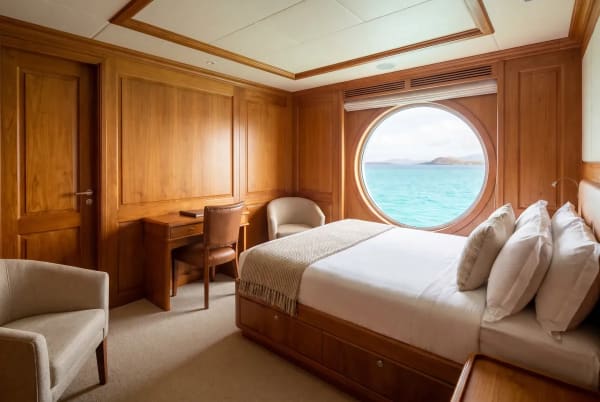
Simple, functional yachts with 16 passengers or small ships with up to 40. Cabins are small (often 8–10 m²), with portholes instead of panoramic windows, and double or bunk beds. Full board with simple, international cuisine; all park fees included. Naturalist guide holds a Galápagos Level II license. Examples: Yolita II, Bonita, Fragata. For budget-conscious travelers who care more about the wildlife experience than cabin amenities.
First Class (USD 600–800 per person/day)
Comfortable yachts, often 16 passengers, higher-end cabins with private bath, air conditioning, and panoramic windows. Better cuisine (often with an Ecuadorian focus), naturalist guide frequently Level III, sometimes diving gear on board. Examples: Beluga, Cachalote Explorer, Coral I/II. The best value for premium travelers who don't need the top tier.
Luxury & expedition yachts (USD 1,500+ per person/day)
Yachts and small expedition ships with extensive suites, private balconies, sommelier, multiple restaurants, spa, and Level III naturalist guides often with academic backgrounds. Operators: Aqua Mare (Aqua Expeditions, from approx. USD 10,000/trip), Silver Origin (Silversea, from USD 14,000), Origin (Ecoventura, from USD 9,450), Lindblad/National Geographic Endeavour II.
Dive cruise (liveaboard Wolf & Darwin)
Specialized dive ships such as Galápagos Sky, Galápagos Master, Humboldt Explorer. 7–8 days exclusively at Wolf and Darwin Island — the most remote and hammerhead-rich dive sites. 4 dives per day, advanced level (currents, cold water, 5 mm wetsuit). Cost USD 5,500–10,000/trip excluding travel to and from. Booking lead time 12–18 months.
Catamaran vs. motor yacht
Catamarans (e.g. Cormorant, Petrel) have less roll motion — more comfortable in lateral swell. They compensate with more pitching (longitudinal motion) when seas come from ahead. Motor yachts roll more but are calmer in head seas. For most routes the difference is marginal — yacht size matters more.
Yacht size — 16, 40, or 100 passengers?
16 pax (the majority of the Galápagos fleet): the classic Galápagos yacht. Group dynamic like a family, fast disembarking and embarking, personal contact with the naturalist guide. No pool, limited lounge areas. Our recommendation for premium travelers 40 and up.
40 pax: more social variety, larger cabins possible, more amenities (lounge, bar, sometimes pool), but longer wait times when boarding and disembarking the dinghies. Naturalist guide ratio 1:10 instead of 1:8.
100 pax (e.g. Silver Origin, Endeavour II): large-ship character, multiple restaurants, spa, lecture hall, often 3–4 naturalist guides. Longest embark/disembark times, less personal character, noticeably more expensive. For travelers who appreciate the comfort of an expedition cruise ship.
Which size for you?
For premium travelers 40 and up, we recommend 16-pax yachts. Personal contact with the naturalist guide, fast island visits, family atmosphere — and most yachts in this size are the most beautiful boats in the fleet. We're happy to figure out which yacht suits you in a personal conversation. Get in touch .
Routes — North, South, West
The Galápagos National Park rotates the fleet across three main routes to spread wildlife pressure.
Classic routes
| Route | Main islands | Wildlife highlights | Available in |
|---|---|---|---|
| Northern | Genovesa, North Seymour, Bartolomé, Santiago | red-footed booby colonies, Pinnacle Rock, Bartolomé viewpoint | all classes |
| Southern | Española, Floreana, San Cristóbal, Santa Fe | waved albatross (Apr–Dec), Galapaguera, Post Office Bay | all classes |
| Western | Isabela, Fernandina, Santiago | penguins, marine iguanas, flightless cormorant, volcanic landscapes | mostly First Class and Luxury |
Islands accessible only by cruise
Española , Genovesa, Fernandina, Marchena, Wolf, Darwin, and Santa Fe — these islands are accessible only on park-assigned routes of licensed yachts. If you want to see these hotspots, you can't avoid a cruise.
5-day vs. 8-day vs. 12-day
5-day cruises show either the northern or the southern route — compact, but incomplete. 8-day cruises combine north and south or run the full western route — the gold standard. 12-day cruises combine all three routes — recommended for first-time visitors with a high budget or wildlife enthusiasts.
Which route fits your travel window?
Wildlife highlights vary strongly by route and season. We analyze your travel window and find the optimal yacht-route combination. Free consultation .
Operators at a glance
Four operators have proven especially well-suited for international premium travelers:
- Ecoventura (First Class & Luxury): family-run cruise line since 1990, ships Origin, Theory, Evolve. Two German-speaking naturalist guides in the pool (Yvonne Mortola, Maria "Gaby" Espinoza). 16-pax yachts, very personal. From approx. USD 9,450/trip.
- Metropolitan Touring (First Class & Expedition): brands Yacht La Pinta, Isabela II, Santa Cruz II. 40–90 pax, Ecuadorian operator with a long tradition. From approx. USD 4,604.
- Aqua Expeditions / Aqua Mare (Luxury): premium megayacht with just 16 pax, the highest comfort level on Galápagos. From approx. USD 10,000.
- Silversea (Luxury Expedition): Silver Origin with 100 pax, all suites with balcony, multiple restaurants. From approx. USD 14,012.
Beyond these, there are dive specialists (Galápagos Sky, Master), Lindblad/National Geographic, Quasar Expeditions, and many more — we advise you individually on the right choice.
What to keep in mind on board
Seasickness
Galápagos waters are mostly calm — most routes run through sheltered island areas. The western route has the roughest passages (Cromwell Undercurrent region north of Isabela). If you're sensitive, choose midship cabins on a low deck, take medication prophylactically (e.g. cinnarizine), and look at the horizon rather than reading. Speedboat transfers on island hopping (2–2.5 hours) can also cause seasickness — island hopping is therefore not automatically the "safe" option for sensitive travelers.
Accessibility
Most 16-pax yachts have narrow stairs and no elevators — travelers with limited mobility should pick larger ships such as Silver Origin or Santa Cruz II. Island visits themselves happen by dinghy with a "wet landing" (through the water onto the beach) or "dry landing" (onto a stone pier) — both require a certain level of mobility.
Dietary requirements
Vegetarian, vegan, gluten-free, and common allergies can be accommodated easily on all First Class and Luxury yachts — for Tourist Superior, communicate flexibly. We pass dietary requirements to the cruise line several weeks before departure.
What a Galápagos cruise costs
Prices by class and duration (as of 2025/2026)
| Class | 5 days | 8 days | 12 days |
|---|---|---|---|
| Tourist Superior | USD 1,800–2,400 | USD 2,800–4,000 | USD 4,500–6,000 |
| First Class | USD 2,800–4,000 | USD 4,500–6,500 | USD 7,000–9,500 |
| Luxury | USD 6,000–9,000 | USD 9,500–15,000 | USD 14,000–24,000 |
| Dive cruise | USD 5,500–8,000 | USD 7,500–10,000 | — |
Included
- Full board (3 meals, snacks, often non-alcoholic drinks)
- Naturalist guide (Galápagos National Park certified)
- All island visits and snorkeling gear (mask, fins, sometimes wetsuit)
- Dinghy transfers, day excursions
- Park entry logistics (but not the USD 200 fee itself)
Excluded (hidden costs)
- Galápagos National Park fee: USD 200 per person (USD cash, on arrival, doubled from USD 100 in August 2024)
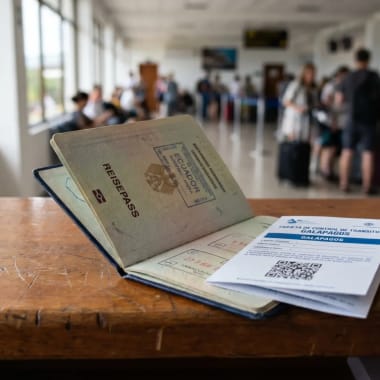
- Transit Control Card: USD 20 per person (online since May 2025) — see entry rules
- International flights to Quito or Guayaquil
- Domestic flights mainland → Galápagos (USD 200–400)
- Tipping (recommended: USD 8–15 per person/day for crew, plus USD 5–8/day for the naturalist guide)
- Alcoholic drinks (Tourist Superior and most First Class)
- Travel and international health insurance
Realistic full cost, 8 days First Class: yacht USD 5,000 + NP+TCC USD 220 + tips USD 100 + domestic flights USD 350 = approx. USD 5,700 per person, excluding international flights.
Last-minute vs. early booking
Last-minute bookings (within 4–6 weeks of departure) can deliver up to 40% off in the shoulder season (May, September, October) — especially in Tourist Superior and First Class. In high season (December to April, July/August), last-minute is practically impossible. Early bookers (12+ months out) often get a 5–10% early-bird discount at luxury operators like Ecoventura or Aqua, plus their pick of cabin.
English-speaking naturalist guides — and why language matters
Galápagos requires certified naturalist guides — all speak English, often Spanish, but only a handful of the roughly 700 licensed guides speak German. At Ecoventura, two German-speaking guides are currently in regular rotation. On request, tours with German-speaking guides can be reserved with select operators — a quality marker that noticeably increases the depth of the experience for German-speaking travelers. Naturalist guides explain every island visit, lead snorkeling sessions, and identify wildlife — if you want to experience complex topics like evolutionary biology or volcanology in your own language, ask early.
Practical planning of your cruise
When to book?
| Class | Recommended lead time | High-season lead time |
|---|---|---|
| Tourist Superior | 3–6 months | 6–9 months |
| First Class | 6–9 months | 9–12 months |
| Luxury | 9–12 months | 12–15 months |
| Liveaboard | 12–18 months | 15–18 months |
Getting to Galápagos
International flight to Quito (UIO) or Guayaquil (GYE), then a domestic flight (LATAM, Avianca, Equair) to Baltra airport (GPS, for Santa Cruz) or San Cristóbal (SCY). Your yacht will tell you in advance which airport to fly to. More on the process in the entry rules .
A typical day on board
A typical day: 6:30 am wake-up, 7:00 breakfast, 8:00 first island visit (hike, 2–3 hours), 11:00 snorkeling session, 12:30 lunch + siesta, 3:00 pm second island visit, 5:30 lecture/briefing, 7:00 dinner, then overnight sailing to the next island. The routine is demanding but rewarding — no day without at least two wildlife highlights.
Frequently asked questions about the Galápagos cruise
Prices per person on double occupancy: Tourist Superior USD 350–500/day, First Class USD 600–800/day, Luxury USD 1,500+/day, dive cruise USD 800–1,250/day. An 8-day First Class cruise comes in at around USD 5,700 per person including tips, the National Park fee (USD 200), and the domestic flight — excluding international flights.
A cruise shows 8–12 islands in 7–8 days, including the remote hotspots Fernandina, Genovesa, and Española — the most spectacular wildlife islands. Island hopping covers only 3 inhabited islands; it's cheaper and more flexible. For premium travelers seeking maximum wildlife variety, we recommend the cruise. For families with small children, travelers prone to seasickness, or budget travelers, island hopping is better. A combination of a 4-day cruise plus 3 days of island hopping unites both worlds.
Four main classes: Tourist Superior (USD 350–500/day), First Class (USD 600–800), Luxury & Expedition (USD 1,500+), and dive cruise (liveaboard Wolf+Darwin, USD 800–1,250). Tourist Superior and First Class run mostly on 16-pax yachts; Luxury runs from 16-pax megayachts (Aqua Mare) up to 100-pax expedition ships (Silver Origin, Santa Cruz II).
Tourist Superior: 3–6 months (high season 6–9). First Class: 6–9 months (9–12). Luxury: 9–12 months (12–15). Liveaboard Wolf+Darwin: 12–18 months. In shoulder season (May, September, October) last-minute bargains with up to 40% off are possible; in high season they're effectively unavailable.
All certified naturalist guides on Galápagos speak English. German speakers are rare — at Ecoventura two German-speaking guides are regularly on rotation. With sufficient lead time, tours with specific language guides can be reserved at select operators — we're happy to check this for your travel window.
Galápagos waters are mostly calm — most routes run through sheltered island areas. Only the western route has rougher passages. Sensitive travelers should choose midship cabins on a low deck and take medication prophylactically. Important: speedboat transfers on island hopping (2–2.5 hours) can also cause seasickness — island hopping is not automatically the safe option.
Española, Genovesa, Fernandina, Marchena, Wolf, and Darwin Island are accessible only on park-assigned routes of licensed yachts. If you want to see waved albatrosses, flightless cormorants, hammerhead schools, or penguin colonies, you need a cruise — these islands have no hotels and no day trips from Santa Cruz.
In theory, yes — Puerto Ayora on Santa Cruz has last-minute agencies that sell open cabins. In shoulder season, discounts of up to 40% are possible. In high season, supply is effectively zero. We still advise against this for premium travelers: yacht quality, naturalist guide language, and cabin choice aren't guaranteed. Booking through us in advance secures quality and your preferred cabin.
Your Galápagos cruise, individually planned
Finding the right yacht is a matter of trust. We know the Galápagos fleet from firsthand experience, work directly with the cruise lines, and book without surcharge. Get a free, no-obligation quote .
More Galápagos guides
- Best time to visit Galápagos — wildlife calendar, climate
- Galápagos entry rules — TCC, park fee, process
- Galápagos giant tortoises — 12 species, viewing spots
- Region: Santa Cruz · Isabela · Española · San Cristóbal · Floreana
Your dream holiday, tailor-made by true connoisseurs.
From the first spark of inspiration to the moment you return home full of stories, we’re by your side – whether by phone, email or WhatsApp, whenever you need us. Every journey we design is as unique as you are: individually crafted with exclusive privileges and exceptional arrangements that make your experience truly unforgettable.
Experts for your trip

You might also like this
This image was generated with AI.
This image was generated with AI.
This image was generated with AI.