

This image was generated with AI.
Isabela
The wildest island in the Galápagos
The wildest island in the Galápagos
Isabela Galápagos — the largest and wildest island of the archipelago: hike Sierra Negra volcano, snorkel with penguins, and watch whitetip reef sharks at Las Tintoreras.

Best Time to Visit
Year-round, ideal July–September
Why Isabela is unlike any other Galápagos island
The ground beneath your feet isn't shaking — but it could be. Five of the six shield volcanoes on Isabela are active; the youngest eruption was just eight years ago. To stand on this island is to stand on geologically young terrain: lava that's less than a hundred years old, craters wider than major cities, and a wilderness that no fence or road has tamed.
Isabela is the largest island in the archipelago — at 4,586 square kilometers, bigger than all other Galápagos Islands combined. Its shape resembles a seahorse; its reality is a place that civilization has barely touched. Around 2,000 people live here, all in a single town: Puerto Villamil. No tourist crowds like Santa Cruz, no overrun trails. Instead: a volcanic crater ten kilometers across, penguins hunting at the equator, and reef sharks resting in knee-deep water.
On the western coast, the Cromwell Undercurrent rises from the deep — cold, nutrient-rich water that feeds one of the richest marine faunas in the entire Pacific. Sixteen whale species have been documented in the Bolívar Channel between Isabela and Fernandina. Five different Giant Tortoise subspecies live on the island — each volcano produced its own population, evolutionarily isolated over hundreds of thousands of years. And on Wolf Volcano in the north lives the Pink Land Iguana: only 300 individuals, only 25 square kilometers of habitat, one of the rarest reptiles on Earth.
Isabela is the most intense nature experience the archipelago has to offer — and, surprisingly, the most overlooked island in island hopping.
Sierra Negra — hike to the world's second-largest volcanic crater
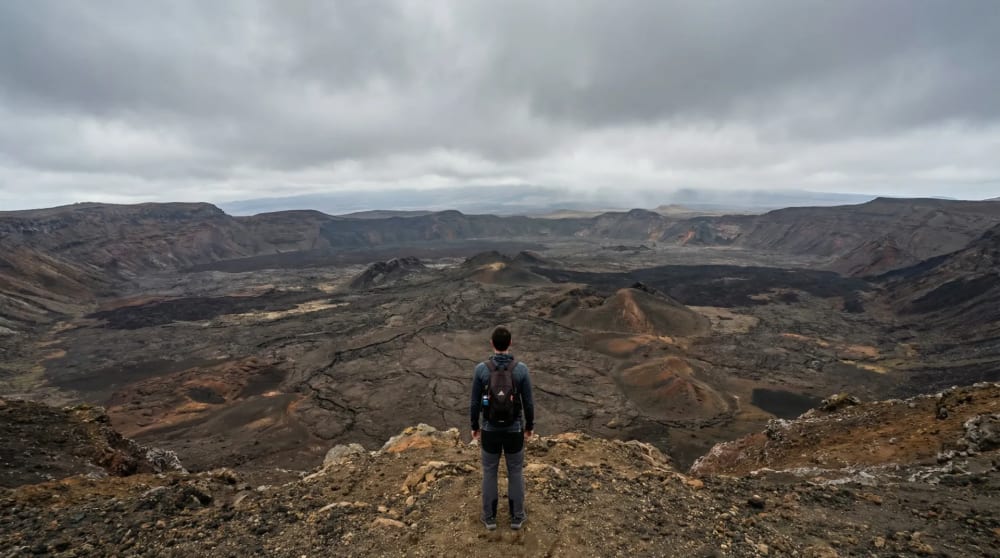
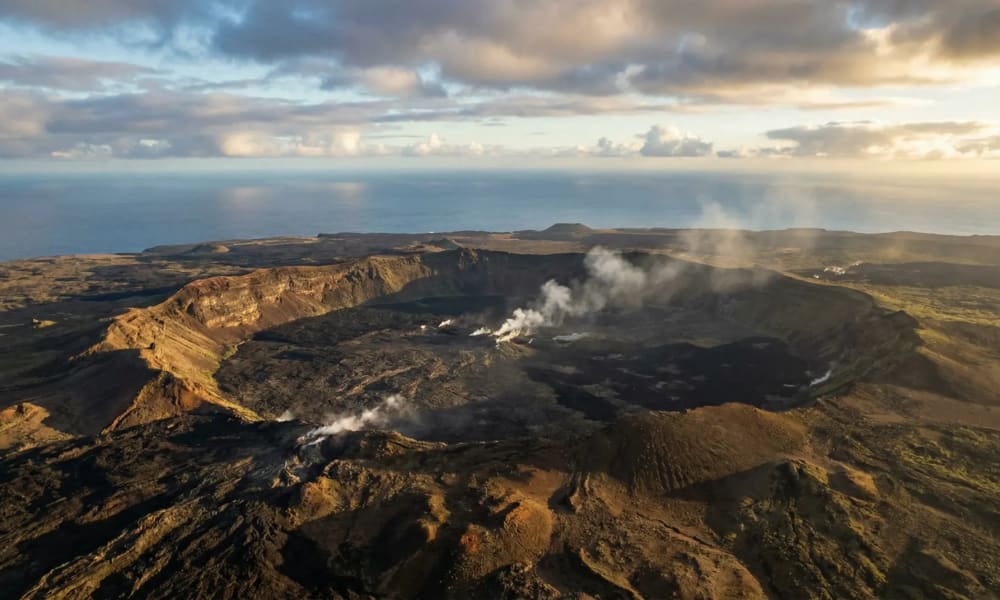
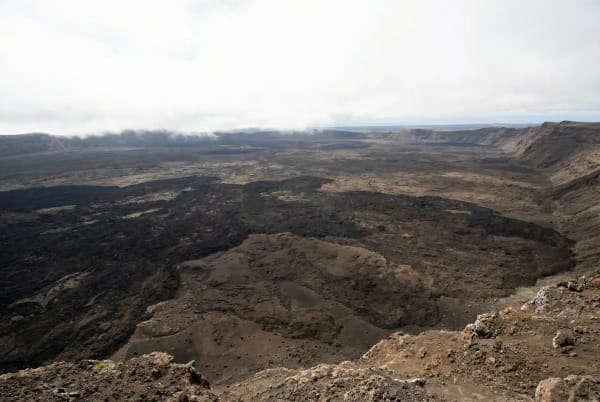
Imagine standing at the rim of a crater that measures ten kilometers north to south and nine kilometers east to west — a perimeter of about 30 kilometers. Sierra Negra has the second-largest active caldera in the world. On June 26, 2018, it last erupted. Lava flowed for 57 days, reached the sea on July 6, and permanently extended the island's coastline. What you see today is a volcano that is far from finished.
What to expect on the Sierra Negra hike
The hike starts at 900 meters and runs 16 to 17 kilometers (round trip) to the crater rim at 1,100 meters. The route is rated moderate — the real challenge isn't the climb but the heat: long stretches cross open lava with no shade. Travelers in the wet season (December to May) instead battle mud and clouds that often shroud the crater.
In between: endemic bird species found nowhere else. Darwin's finches forage among the lava boulders, the brilliant red Vermilion Flycatcher flashes through the brush, and with patience the rare Galápagos Hawk appears overhead.
Volcán Chico — the lunar landscape beyond the rim
The real spectacle starts past the rim. Volcán Chico is a 1.5-kilometer extension of the trail through a landscape that looks lunar: lava ovens (hornitos), sulfur-steaming fumaroles, and young lava fields in every shade from black to rust. On clear days the view stretches to the volcanoes Darwin and Santiago, Fernandina, and Pinzón — a panorama that makes the geological force of this archipelago tangible.
Sierra Negra + Volcán Chico
- Duration — About 5 hours (16–17 km round trip)
- Start — Trailhead at 900 m, 21 km from Puerto Villamil
- Best time — June–November (dry season, better visibility)
- Price — Approx. USD 55 incl. transport, guide, and lunch
Important for the hike
A certified Galápagos National Park guide is mandatory by law — independent hiking is not allowed. Sturdy shoes, at least 2 liters of water, sun protection, and a rain jacket are essential. Less fit travelers can do part of the trail on horseback (about USD 30 extra). Tours start daily at 7:20 am with a return around 1:00–2:00 pm.
Los Túneles — snorkeling through submerged lava worlds
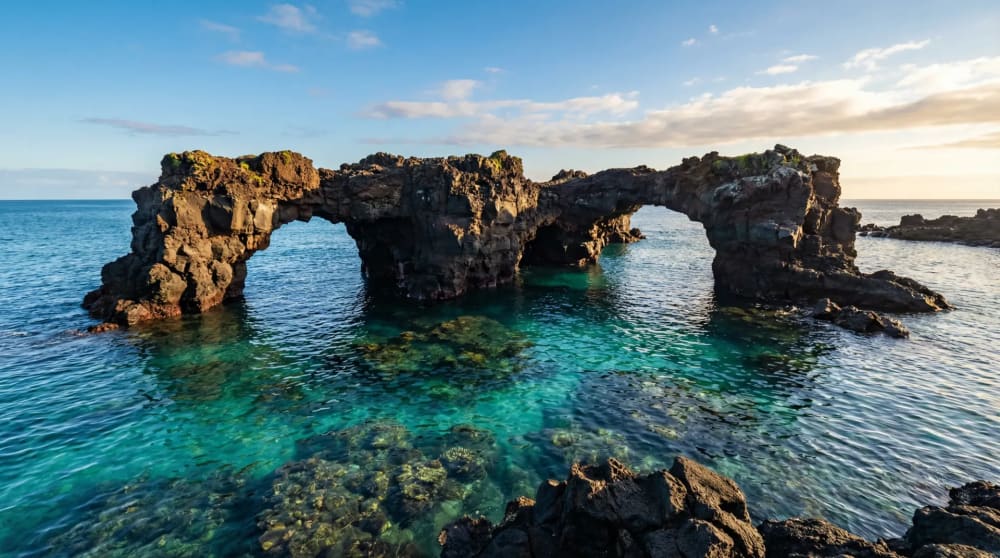
An hour by boat from Puerto Villamil, on Isabela's south coast, geology has done something unusual. Thousands of years ago, lava flowed into the sea, solidified on the surface while the molten flow continued underneath, and left hollows behind. Erosion did the rest: today, bizarre arches and tunnels rise from the turquoise water — an underwater landscape that looks like an architect designed it.
What you'll see at Los Túneles
The calm water, two to ten meters deep, makes Los Túneles one of the best snorkeling spots in Galápagos — suitable for any level, impressive at every level. Whitetip reef sharks glide between the lava arches, sea turtles drift past, golden rays and eagle rays hover above the bottom, and now and then the shadow of a manta ray crosses your view. Galápagos Penguins hunt underwater here — snorkeling with penguins at the equator is one of those experiences only Isabela offers.
What no other guidebook mentions: in the seagrass meadows between the lava formations, pipefish and seahorses hide — perfectly camouflaged and missed by most snorkelers. Ask your guide specifically to look for them.
Los Túneles
- Duration — About 5 hours (1h boat each way, 3h on site)
- Access — Only by organized tour from Puerto Villamil
- Best time — Year-round — June–Nov more marine life, Dec–May warmer water
- Price — Approx. USD 70–100 incl. transport, guide, lunch, and gear
Don't forget seasickness pills
The boat ride across open water can be rough — especially in the dry season with bigger swells. A wetsuit is recommended; the water is noticeably cool from June to October (most operators rent them for a small surcharge).
Las Tintoreras — whitetip reef sharks in shallow water
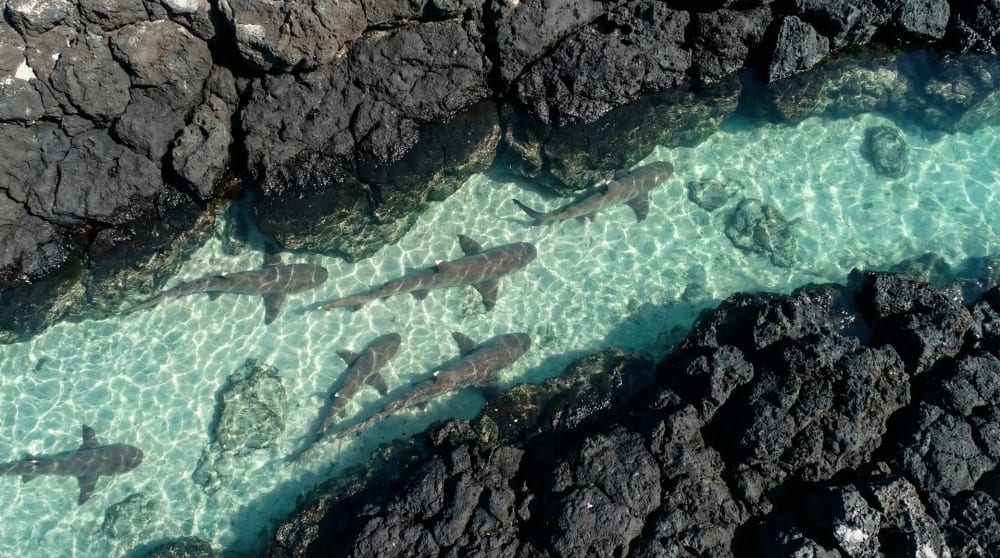
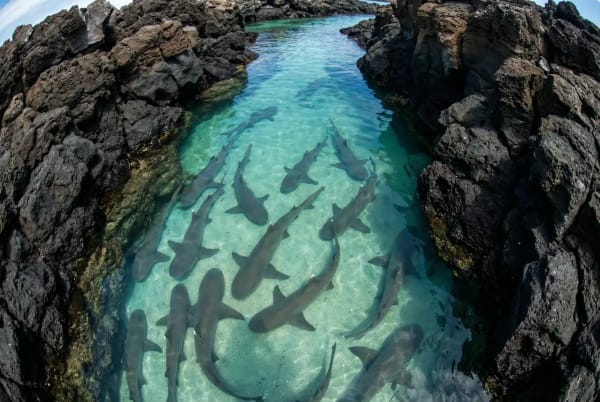
Ten minutes by boat from Puerto Villamil, you peer into a natural lava fissure with turquoise water, where 1.5-meter sharks lie still in the shallows. Las Tintoreras takes its name from these animals — tintoreras is Spanish for whitetip reef sharks. You watch the sharks up close from a rock path: no need to enter the water, no dive gear, no risk.
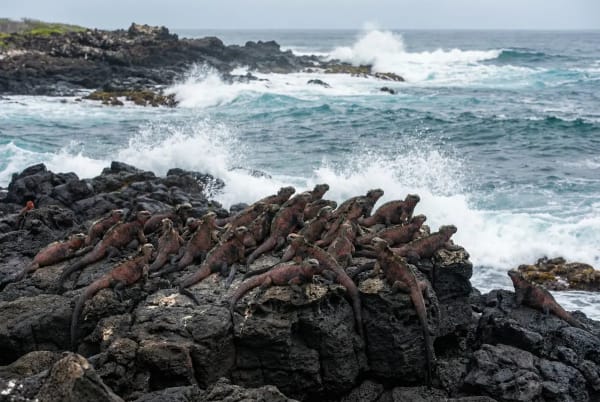
The whitetip reef sharks are peaceful and entirely harmless — they ignore humans with the calm that's typical for Galápagos. Beyond the sharks, Las Tintoreras hosts one of the most important Marine Iguana breeding colonies in the archipelago. A 1.4-kilometer trail crosses sharp-edged a'a lava to Galápagos Penguins, Blue-footed Boobies, frigatebirds, and sea lions warming themselves in the midday sun. The follow-on snorkel around the islets brings encounters with sea turtles and reef sharks underwater — this time at eye level.
Las Tintoreras
- Duration — About 3 hours (walk + snorkel)
- Access — 10 min by boat from Puerto Villamil pier
- Note — Jan–Mar: Marine Iguana breeding season — trail partially restricted
- Price — Approx. USD 25–35 incl. boat ride and guide
Book early morning
Early in the morning the sharks are most active and the light for photos is at its best. Wear sturdy shoes — the black a'a lava is extremely sharp. Sandals or bare feet are off-limits.
Penguins on Isabela — the only penguin north of the equator
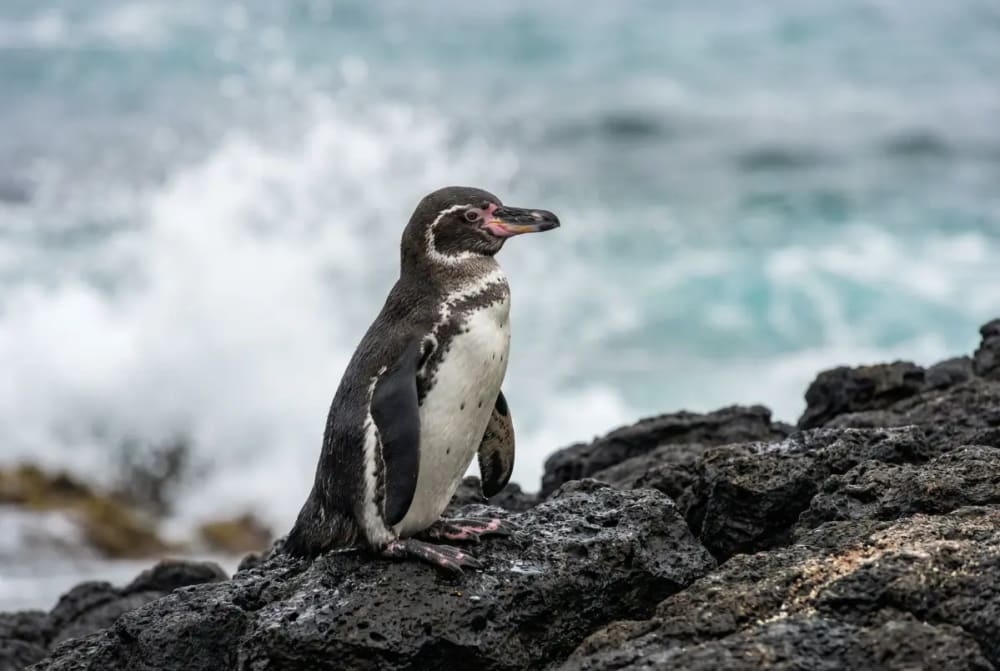
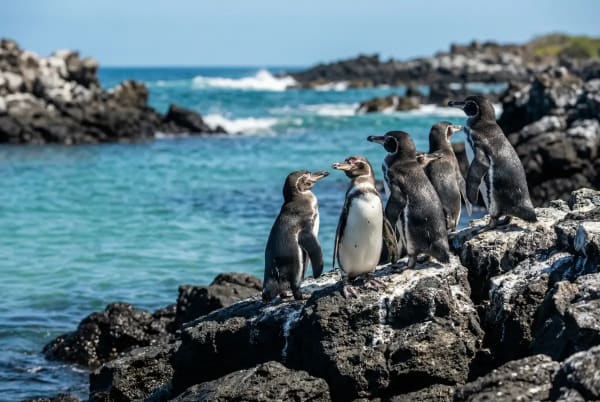
A penguin at the equator — that sounds like a glitch in nature. It isn't. The Galápagos Penguin (Spheniscus mendiculus) is the only penguin species that lives north of the equator. Because Wolf Volcano on Isabela sits exactly on the equator, some colonies are actually in the Northern Hemisphere — the only penguins of the Northern Hemisphere worldwide. What keeps them here is the cold Cromwell Undercurrent, which pushes nutrient-rich deep water onto the coast.
About 90 percent of all Galápagos Penguins are concentrated on Fernandina and the western coast of Isabela. Fernandina is reachable only by cruise — which makes Isabela the only island in island hopping where you can experience penguins in significant numbers. The best places: Las Tintoreras, Los Túneles, Concha de Perla (free, no guide required), and Elizabeth Bay (cruise only). Underwater, the small birds hunt at speeds up to 35 km/h — and breed up to three times a year, a record among penguins. Best viewing: July to September, when the water is cooler and food more plentiful.
Other wildlife on Isabela
Isabela is far more than penguins and sharks. The largest Galápagos island holds a species diversity that is exceptional even for this archipelago — a result of the six volcanoes that work like separate islands within a single one.
Giant Tortoises : Five different subspecies on one island — each volcano has produced its own evolutionarily isolated population. Isabela is home to more wild Giant Tortoises than all other Galápagos islands combined. At the Centro de Crianza Arnaldo Tupiza (1.6 km from Puerto Villamil, USD 10 entry), you can meet all five subspecies in one place.
Flamingos: The Laguna Pozas Salinas right behind Puerto Villamil hosts the largest flamingo concentration on the Galápagos. Access is free via a boardwalk through mangrove forest. If you arrive at sunrise, the lagoon is yours and the flamingos' alone.
Flightless Cormorant: A bird that now spreads its wings only to dry them. The world's largest cormorant lost its ability to fly because it had no natural predators on Isabela and Fernandina — evolution at its most pragmatic. Best viewing sites: Punta Vicente Roca and Elizabeth Bay (cruise only).
Pink Land Iguana: Only 300 individuals, only 25 square kilometers of habitat, only on Wolf Volcano in northern Isabela. One of the rarest reptiles on Earth — not accessible to regular visitors, but a testament to what evolution produces on this island.
Mangrove Finch: The rarest bird of the Galápagos lives exclusively on Isabela. Thanks to an intensive conservation program, the population grew from 60 birds (2014) to about 100 (2024) — a quiet success that gives reason for hope.
Puerto Villamil — the most relaxed village in the Galápagos
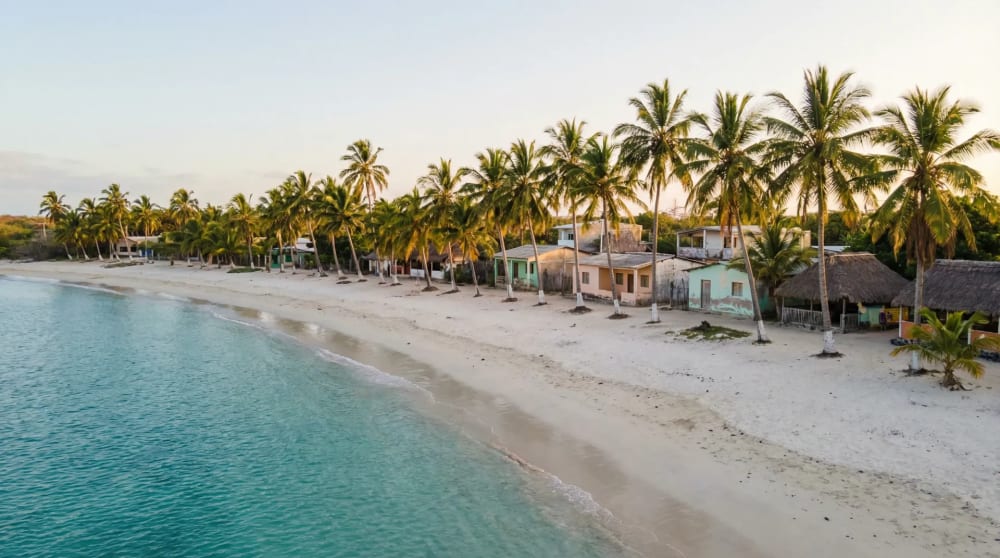
Puerto Villamil is the opposite of Puerto Ayora on Santa Cruz . Unpaved sand streets instead of asphalt, a long white sand beach with palms, around 2,000 inhabitants, and an atmosphere that feels less like organized Galápagos tourism and more like a sleepy fishing village where sea lions have right of way on the pier. The island lends itself wonderfully to cycling (rentals USD 10–15 per day) — the roads are flat, and around every corner you'll meet animals you didn't expect.
Concha de Perla — free snorkeling on Isabela without a guide
Concha de Perla is the only free snorkel site in the entire Galápagos archipelago accessible without a mandatory guide. Fifteen to twenty minutes on foot from town, sheltered by rock formations and mangroves, you'll meet penguins, sea lions, sea turtles, and colorful reef fish. Arrive before 8:00 am and you'll share the lagoon only with the animals.
Centro de Crianza — five tortoise subspecies in one place
The Centro de Crianza Arnaldo Tupiza sits 1.6 kilometers from Puerto Villamil, reachable via a boardwalk through the flamingo lagoon and wetlands. Around 330 Giant Tortoises of all five Isabela subspecies are raised here and prepared for life in the wild. Our tip for an inexpensive half-day: combine the flamingo lagoon, Centro de Crianza, and Concha de Perla as a loop — the boardwalk connects all three.
No ATM on Isabela
Isabela has no reliable ATM — and credit cards aren't accepted in many restaurants and shops. Withdraw enough USD cash in Puerto Ayora on Santa Cruz before you take the ferry. Mobile coverage is patchy at best, WiFi is available only in a few hotels. Isabela is, in the best sense, a place where you can forget your phone.
Muro de las Lágrimas — the Wall of Tears
Five kilometers from Puerto Villamil stands a structure that doesn't belong in this landscape — and precisely for that reason should not be forgotten. The Wall of Tears: 100 meters long, 7 meters high, over 3 meters wide, built from heavy lava blocks that served no purpose other than punishment. Between 1946 and 1959, around 300 inmates of a penal colony hauled the stones under the burning equatorial sun from distant quarries to this site. The colony used US military infrastructure left behind on the island after World War II.
The unfinished wall stands today as a memorial in the middle of a wilderness that has not let human cruelty take anything from it. The way there is bikeable (about 30 minutes) — along the way, La Playita beach invites you to cool off and Mirador Cerro Orchilla offers a panoramic view of the island. Eleven kilometers round trip in total, no guide required.
Best time to visit Isabela
The best time to visit the Galápagos Islands on Isabela depends on what you want to experience. The island is open year-round — each season has its own character.
| Month | Penguins | Sierra Negra | Snorkeling (Los Túneles) | Note |
|---|---|---|---|---|
| Jan–Mar | Year-round | Muddy, often clouded | Good (warm, 25–27 °C) | Marine Iguana breeding (vivid red colors) |
| Apr–Jun | Breeding starts | Transition, still wet | Very good | Flightless Cormorant courtship |
| Jul–Sep | Best viewing | Excellent (dry, clear) | Excellent (cool, 21–23 °C) | Humpback whales in Bolívar Channel, peak penguin time |
| Oct–Dec | Good | Good (transition) | Good | Cormorant breeding season, fewer visitors |
Our take: July to September offers the strongest overall combination for Isabela — dry weather for the Sierra Negra hike, peak penguin viewing, humpback whales in the Bolívar Channel, and excellent conditions for snorkeling on Isabela. For warmer water and easy beach time, choose December to May. A detailed overview is in the Galápagos wildlife calendar.
Getting to Isabela — ferry and flight
Most travelers reach Isabela by speedboat ferry from Santa Cruz (Puerto Ayora) — two hours across the channel, which can be a test of patience in rough weather. There is no direct connection from San Cristóbal ; the route always goes via Santa Cruz. Whether cruise or island hopping is the better fit for your route is settled in our detailed comparison.
Getting to Isabela Santa Cruz → Isabela
Seasickness and pier fee
The channel between Santa Cruz and Isabela can be very rough, especially in the dry season (June to November). Take seasickness medication before departure. On arrival in Puerto Villamil: USD 1 water taxi to the pier plus USD 10 Isabela pier entry fee — Isabela is the only Galápagos island that charges this fee.
Costs and accommodations in Puerto Villamil
As of March 2026. NO ATM on Isabela — withdraw USD cash on Santa Cruz. Credit cards barely accepted. Park fee is paid at Baltra or San Cristóbal airport, not on Isabela.
For detailed budget planning, see our Galápagos costs and budget guide. For everything on visas, park fees, and entry formalities, see our entry rules for Galápagos .
Isabela on your Galápagos trip
Isabela deserves at least two to three full days — anything less wouldn't do justice to the wildest island of the archipelago. Here's how your program might look:
Tag 1 — Arrival and Las Tintoreras
Tag 2 — Sierra Negra volcano hike
Tag 3 — Los Túneles and departure
Hinweis: With a fourth day, you can ride out to Muro de las Lágrimas at a relaxed pace (11 km, with beach stops) and visit Concha de Perla again in the afternoon.
Three days are enough to see Isabela's most important places — as part of a Galápagos island-hopping trip or as an extension of a cruise . We know the island from firsthand experience and can advise you personally on the route that fits your interests. Add Isabela to your Galápagos trip — get a free, no-obligation consultation .
Discover more Galápagos islands
Floreana — Post barrel, mystery & Devil's Crown
Santa Cruz — The heart of the Galápagos archipelago
San Cristóbal — Sea lion island and Darwin's first landing
Read on: Cruise or island hopping? — our detailed comparison helps you decide. The Galápagos wildlife calendar tells you which animals to look for on which island and when. Or a different angle altogether: Pantanal vs. Galápagos — where to watch wildlife?
To book a trip or for more information, contact us. We'll help you plan and guide you through your upcoming adventure!
Frequently Asked Questions
By speedboat ferry from Puerto Ayora (Santa Cruz) to Puerto Villamil (Isabela). Daily departures at 7:00 am and 3:00 pm, about 2 hours, USD 35 per person. There is no direct connection from San Cristóbal — the route always goes via Santa Cruz. Book tickets at least 3 days in advance. The channel can be rough, especially in the dry season — take seasickness medication before departure.
The hike is rated moderate: 16–17 km round trip, climbing from 900 to 1,100 meters. The challenge isn't the climb but the heat — long stretches cross open lava with no shade. In the wet season (Dec–May) the trail turns muddy and the crater is often shrouded in cloud. Sturdy shoes, at least 2 liters of water, and sun protection are essential. A certified National Park guide is mandatory by law. Less fit travelers can do part of the trail on horseback (about USD 30 extra).
Isabela is the best island for penguin encounters in island hopping. The three top spots: Los Túneles (snorkel with penguins underwater), Las Tintoreras (penguins on land and in the water), and Concha de Perla (free, no guide — 15 minutes' walk from Puerto Villamil). 90% of all Galápagos Penguins live on Isabela and neighboring Fernandina. Best viewing time: July to September, when the water is cooler and food more plentiful.
No. Whitetip reef sharks (Triaenodon obesus) are entirely harmless and peaceful. They rest in the shallow water of the lava lagoon and ignore humans. You watch them from a rock path — no need to enter the water. Tintoreras is suitable for all ages.
At least 2 to 3 days. Day 1: Las Tintoreras and the flamingo lagoon. Day 2: Sierra Negra volcano hike and Concha de Perla. Day 3: Los Túneles snorkel tour. With a fourth day, you can explore Muro de las Lágrimas by bike and enjoy Puerto Villamil at a relaxed pace.
Yes, Puerto Villamil offers accommodations across price points: simple hostals from USD 16/night, mid-range hotels from USD 60/night (usually with breakfast), boutique hotels right on the beach like Iguana Crossing or Casa Marita (USD 175–480/night), and Scalesia Lodge in the highlands with 16 luxury tents from USD 400/night. Important: Isabela has no reliable ATM — withdraw enough USD cash on Santa Cruz.
Budget travelers manage on USD 50–80 per day (hostal, menú del día, free activities like Concha de Perla and the flamingo lagoon). Comfort travelers should plan USD 150–300 per day (boutique hotel, restaurant meals, 1–2 guided tours). On top come one-time fees: Galápagos National Park entry (USD 200 since August 2024), Transit Control Card (USD 30), Santa Cruz–Isabela ferry (USD 35), and the Isabela pier fee (USD 10 — the only Galápagos island that charges this).
Isabela is open year-round — each season has its strengths. July to September offers the strongest overall combination: dry weather for the Sierra Negra hike, peak penguin season, humpback whales in the Bolívar Channel, and excellent snorkeling. December to May is ideal for relaxed beach time and warm snorkel water (25–27 °C). Our detailed monthly overview: Best Time to Visit Galápagos.