


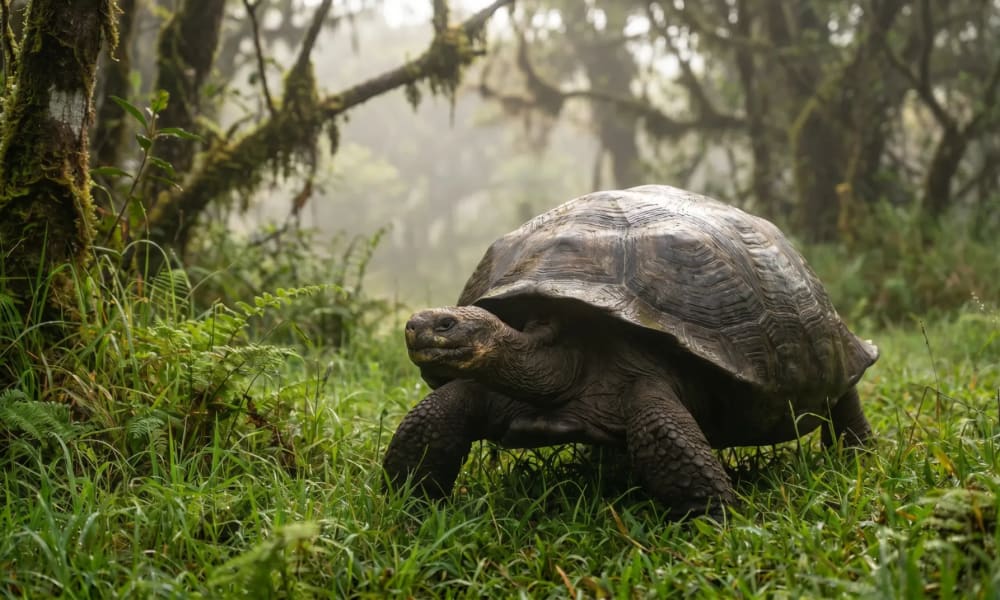
This image was generated with AI.
Giant Tortoises in Galápagos: Species, Locations, and Behavior
12 subspecies, Lonesome George & observation sites per island
12 subspecies, Lonesome George & observation sites per island
Galápagos giant tortoises are the oldest animals you can meet on Earth — some specimens were born when Charles Darwin was still alive. Up to 200 years life expectancy, up to 400 kg weight, 12 subspecies distributed across the islands that the archipelago owes its name to: galápago is old Spanish for saddle, a reference to the shell shape of some species. These tortoises are not just animals — they are witnesses of evolution, ecological keystone species, and the symbol of the world's most successful conservation story. If you plan a Galápagos trip you should schedule at least three of the five most important observation sites.

12 species, 5 islands — the biology of Galápagos giant tortoises
Galápagos originally had 15 giant tortoise subspecies. Three are now extinct — Pinta tortoise (Chelonoidis abingdonii, with Lonesome George 2012), Floreana tortoise (C. niger, in the 19th century) and Santa Fe tortoise. The exact number of living species is taxonomically disputed and is given between 11 and 13 — the scientifically validated number today is 12 subspecies.
Shell shape as proof of evolution — saddle vs. dome
The two main forms of Galápagos tortoises developed independently — a textbook example of convergent evolution (Cayot et al., peer-reviewed 2017):
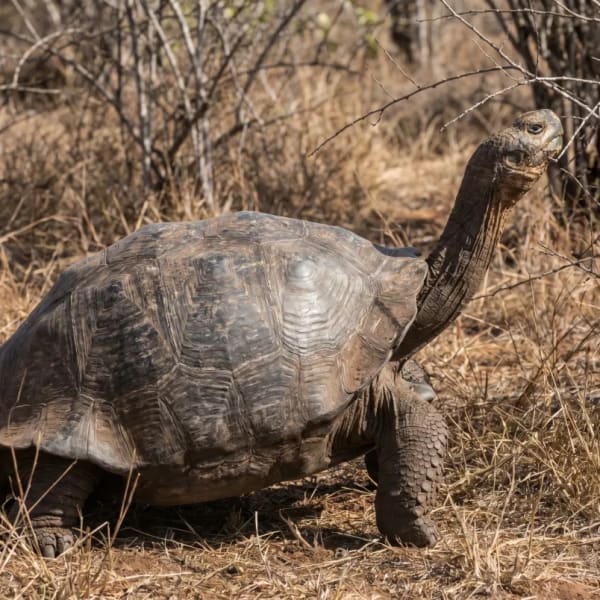
- Saddleback shell (saddleback): Front shell edge highly elevated, long neck, long legs. Adaptation to arid islands with fast-growing vegetation (cacti, shrubs). Examples: Española, Pinzón, Pinta, Hood tortoise.
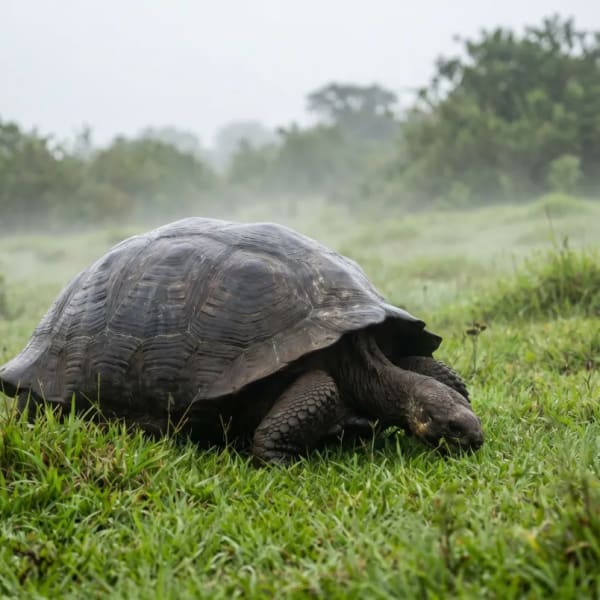
- Dome shell (domed): Classic round shell shape, shorter neck. Adaptation to humid highland islands with low vegetation. Examples: Santa Cruz, Volcán Alcedo Isabela, San Cristóbal.
Darwin himself noted the differences in shell shape between islands in 1835 — observations that later were included in On the Origin of Species.
Facts at a glance
| Characteristic | Value |
|---|---|
| Subspecies living today | 12 (from originally 15) |
| Maximum size | up to 1.5 m shell length |
| Maximum weight | up to 400 kg (males larger than females) |
| Life expectancy | up to 175–200 years (Harriet 176 years, documented) |
| Sexual maturity | approximately 25 years |
| Eggs per clutch | 8–16 |
| Hatching success in nature | under 10 % |
| Hatching success in incubators | over 90 % |
| Current total population | approximately 15,000–25,000 (controversial) |
| Historical population | 200,000–250,000 (before 1800) |
Where to see Galápagos giant tortoises? The 5 best places
Charles Darwin Research Station — Santa Cruz
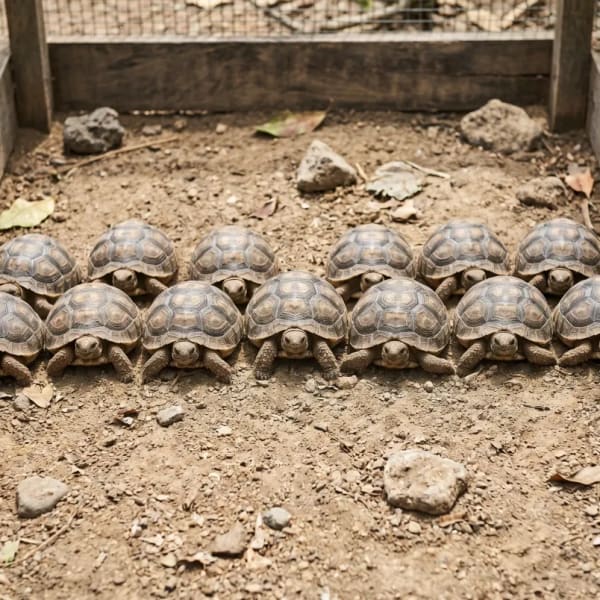
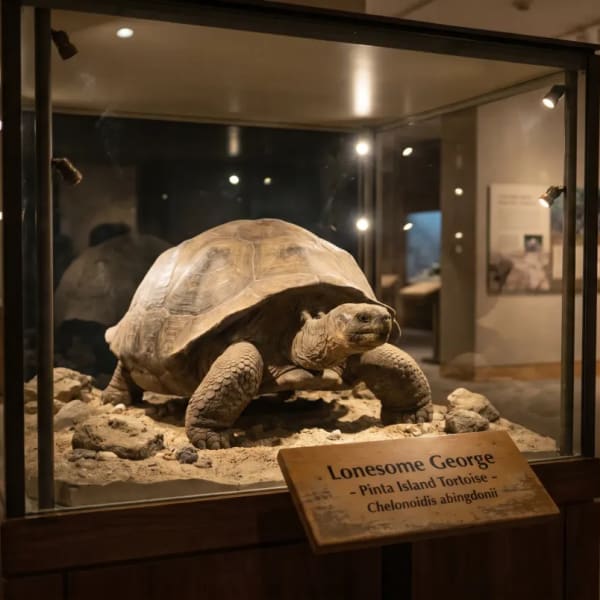
The central research and breeding station of the Galápagos Conservancy in Puerto Ayora is the most accessible observation site. Here, breeding programs for several subspecies run — especially babies at various ages can be seen, along with adult animals as ambassadors. Formerly, Lonesome George also stood here, whose stuffed body is now displayed in a climate-controlled showcase in the "Symbol of Hope" building. Admission: free. Getting there: on foot from Puerto Ayora center, 15 minutes. Best time: mornings before 11 a.m. (cooler, tortoises more active).
El Chato Reserve & Highlands Santa Cruz — wild and free-roaming
40 minutes drive north of Puerto Ayora into the humid highlands. Several private reserves (Rancho Primicias, Rancho El Manzanillo) offer hikes where you can see giant tortoises freely in their natural habitat — usually groups of 5–15 animals in meadows and swampy hollows. The contrast to the breeding station is significant: here you experience the animals as Darwin saw them. Admission: 10–15 USD. Best time: Garua season June to December (tortoises come to lower highlands for vegetation).
Galapaguera de Cerro Colorado — San Cristóbal
Semi-natural reserve in the south of the island. A breeding and protection station for the Chelonoidis chathamensis subspecies, which moves freely in the area. Beautiful hiking trails through dry forest, less visited than the Charles Darwin Station. Admission: free. Getting there: 1-hour taxi/rental car ride from Puerto Baquerizo Moreno. Best time: mornings.
Giant Tortoise Breeding Center "Arnaldo Tupiza" — Isabela
In Puerto Villamil on Isabela. The largest breeding station in Galápagos — here, several Isabela subspecies are bred, which were endangered by invasive goats and rats. Exciting is the look into the egg incubators and the breeding boxes. Afterward, the "Camino de las Tortugas" — a 2 km hiking trail, where wild tortoises sometimes appear, is worth it. Admission: free. Best time: all day, combinable with Sierra Negra tour.
Sierra Negra Highlands — wild tortoises on Isabela
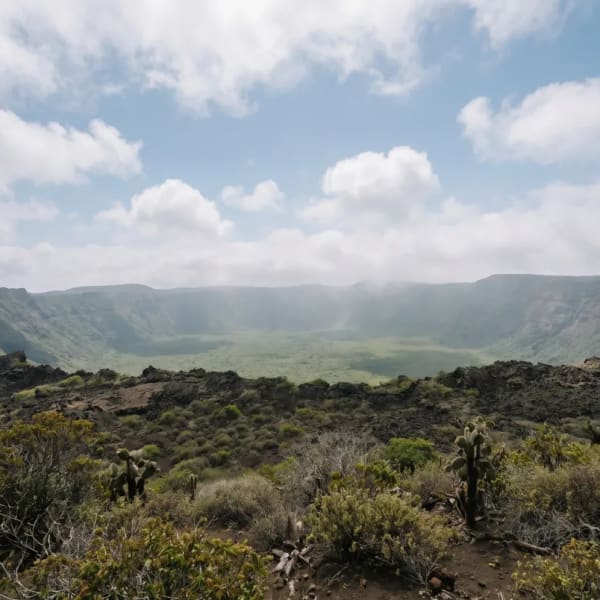
The wildest observation experience. On a day tour to the Sierra Negra volcano (the second largest crater in the world with 9 km in diameter), you traverse the highlands where wild tortoises of the Volcán Alcedo population live. These animals were never bred — they are direct descendants of the original population. A tougher tour, but the experience of "tortoise in the volcanic area" is incomparable. Tour through local providers, approx. 70 USD without meals.
Lonesome George — the end of a species and its legacy
On June 24, 2012, the most famous conservation ambassador of the 20th century passed away. Lonesome George was the last known specimen of the Pinta tortoise (Chelonoidis abingdonii) — and thus the final representative of a whole species. He was discovered in 1971 by Hungarian geologist József Vágvölgyi on the island of Pinta, which had been ecologically devastated by introduced goats. George lived for four decades in the Charles Darwin Station, cared for by Fausto Llerena. Several attempts to mate him with closely related females from Volcán Wolf (Isabela) and Española failed — the eggs were either unfertilized or did not hatch. His stuffed body traveled to New York for taxidermy and returned to Galápagos in 2017. Today, he is in a climate-controlled glass case in the Charles Darwin Station — with the inscription: "Whatever happens to this single animal, let him always remind us that the fate of all living things on Earth is in human hands."
The Española tortoise — one of the greatest success stories in species conservation
While Lonesome George failed, the opposite took place on Española: one of the most spectacular rewilding stories in science. In the 1960s, there were only 14 giant tortoises (Chelonoidis hoodensis) left on the island — 12 females and 2 males. Goats had destroyed the vegetation, and the population was on the brink of extinction. In 1965, the Galápagos National Park and Charles Darwin Foundation started a breeding program. A third male bull, Diego, who had lived in the San Diego Zoo since the 1930s, was returned in 1976 — and became the hero of the story: Diego fathered over 800 offspring, about 40% of today's population. Over 2,000 animals were rewilded by 2020; the population is sustainably recovering to an estimated 2,300–3,000 individuals today. In 2020, Diego was retired at the age of 100 on Española — he lives there today. The story shows: Giant tortoises are so-called ecosystem engineers — without them, Waved Albatrosses cannot land on Española because the vegetation would become too dense.
Experience Galápagos tortoises in the wild
El Chato on Santa Cruz and Sierra Negra on Isabela offer the most authentic encounters. We plan Galápagos trips focusing on tortoises — tailored to Garua season and island combinations. Request non-binding consultation .
Wildlife best practices — how to observe tortoises correctly
Galápagos has strict park rules that regulate every island visit. For giant tortoises, the following apply:
- Minimum distance 2 meters. Even if the animals seem calm — they are sensitive wild animals.
- No touching, no petting, no tapping. The skin barrier is sensitive; human bacteria can cause infections.
- No feeding. Changes behavior and dietary basis permanently.
- No photo flash. Stresses the animals unnecessarily.
- No drones without permission. Drone use was further tightened in 2025 — almost all areas are prohibited.
- Do not leave paths. Ground-nesters and hidden eggs react sensitively to footsteps.
- Follow naturalist guide instructions. Licensed guides are mandatory for all island visits outside the inhabited main islands.
- Zero waste. Anything you bring must come back with you.
Park rule violations
Galápagos park rangers strictly enforce violations — fines up to 500 USD and in the worst case, expulsion from the island. The rules exist because the islands are one of the last wildlife natural paradises in the world. Please take them seriously.
When is the best time to see giant tortoises?
Highlands Santa Cruz and Isabela: Garua season June to December brings the most tortoises into the accessible highlands — they migrate for the vegetation. Dry season January to May: migration towards lowland for laying eggs; hatching time for babies December to March.
Time of day: Morning before 11 a.m. is ideal. Mornings are cooler, tortoises are more active. At noon, they often retreat to shade or mud.
Breeding stations: accessible year-round, best visibility in the morning.
More on seasonality in the Best travel time overview.
Giant tortoises and Darwin's theory of evolution
Charles Darwin spent five weeks on Galápagos from September 15 to October 20, 1835. His observation diary repeatedly mentions the different tortoise shell shapes per island — a detail that Vice Governor Nicolás Lawson explicitly pointed out to Darwin ("I can tell by the shell which island it comes from"). This observation later flowed into On the Origin of Species (1859) as one of several examples of adaptive radiation: a stem species differentiates into several subspecies on isolated islands, depending on the local ecology. That saddle and dome shells arose independently multiple times was only fully proven through genetic analyses in 2017 — a late, but elegant confirmation of the theory of evolution.
Your Galápagos trip focusing on tortoises
For a focused tortoise trip, we recommend 5–7 days in the following distribution:
- Day 1–3 Santa Cruz: Charles Darwin Station + 2 days El Chato highlands
- Day 4–5 Isabela: Giant Tortoise Breeding Center + Sierra Negra tour
- Day 6–7 San Cristóbal: Galapaguera Cerro Colorado + island tour
The combination shows three islands, three different breeding stations, and two wild observation sites. We are happy to complement this with a yacht component if you want to see Española (saddle tortoises in the wild) — more in the cruise guide .
More Galápagos guides
- Best travel time Galápagos — wildlife calendar
- Galápagos cruise guide — routes and yachts
- Galápagos entry rules — TCT, park fee
- Region: Santa Cruz (Charles Darwin Station, El Chato) · Isabela (Sierra Negra, breeding center) · San Cristóbal (Galapaguera) · Española (rewilding success)
Your dream holiday, tailor-made by true connoisseurs.
From the first spark of inspiration to the moment you return home full of stories, we’re by your side – whether by phone, email or WhatsApp, whenever you need us. Every journey we design is as unique as you are: individually crafted with exclusive privileges and exceptional arrangements that make your experience truly unforgettable.
Experts for your trip

You might also like this
This image was generated with AI.
This image was generated with AI.

This image was generated with AI.