


This image was generated with AI.
Espanola
The only Albatross breeding ground in the world
The only Albatross breeding ground in the world
Española Galápagos: the only Albatross breeding colony worldwide, thousands of Blue-footed Boobies, cliffs with spray fountains. Only by cruise — plan now.

Best travel time
April to December
Why Española is different from all other Galápagos islands
The Zodiac glides towards the rocky coast. Even before the engine quiets, you hear it — a deep, nasal call that echoes over the cliffs. On the landing dock, sea lions bask in the morning sun, next to them a Blue-footed Booby spreads its bright blue feet for the dance. And a few meters away, right on the hiking path, sits a Waved Albatross on its nest — a bird with a wingspan of 2.5 meters that only breeds in this one place on Earth.
Española Galápagos is the oldest and southernmost island of the Galápagos Archipelago — about 4 million years old, 60 square kilometers in size, uninhabited, and without freshwater sources. What makes the island uninhabitable for humans makes it a refuge for a unique wildlife: No predators on land, nutrient-rich waters all around, and cliffs that provide the perfect take-off and landing area for the largest seabird of the Galápagos islands.
Since 1978, Española has been part of the UNESCO World Natural Heritage. The English name "Hood Island" pays homage to the British naval officer Viscount Samuel Hood — but for nature travelers, the island has long had a different reputation: it is the place where the greatest diversity of endemic seabirds can be observed in the smallest space. Those who are planning a Galápagos cruise and want to explore the southern part of the archipelago cannot miss Española.
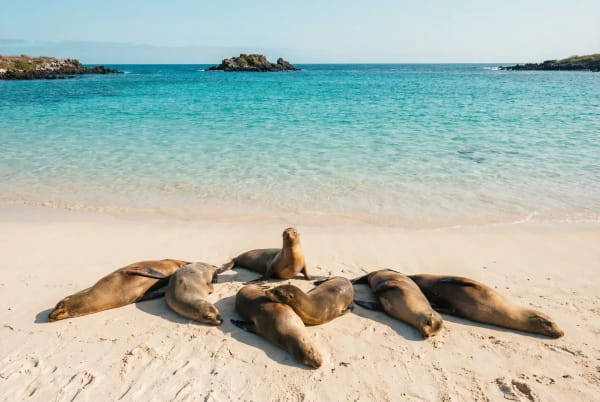
Wildlife on Española — who lives here and when to see them
Waved Albatross — the only breeding colony in the world
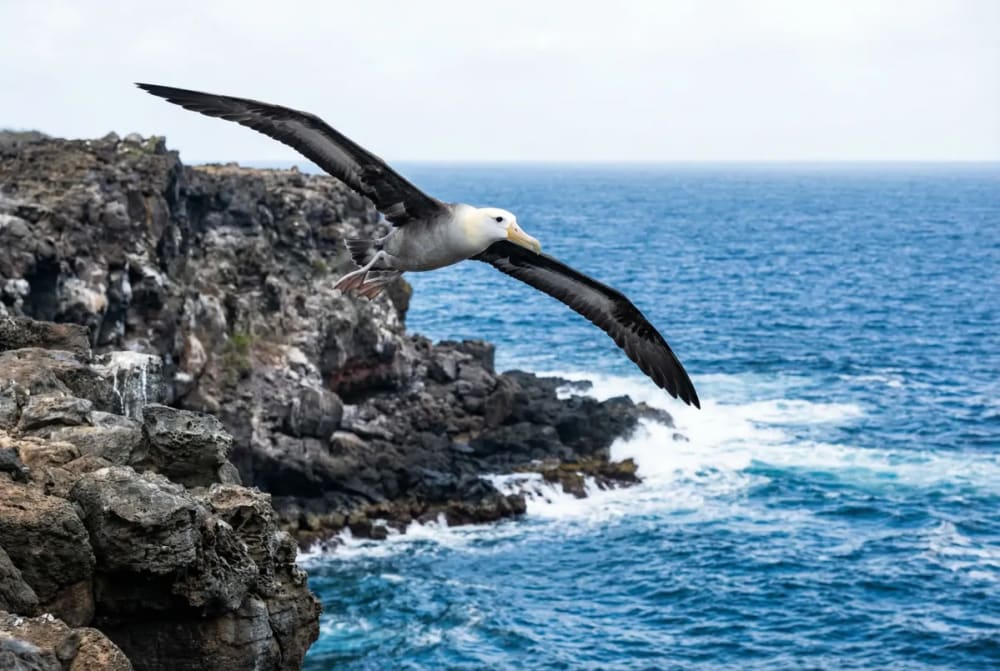
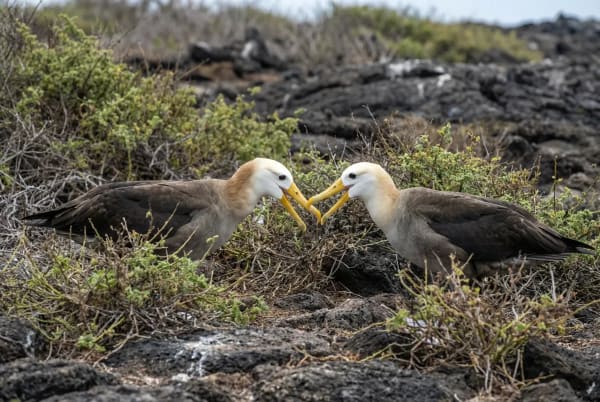
The Waved Albatross (Phoebastria irrorata), also known as the Galápagos Albatross, is the only tropical albatross in the world — and it breeds almost exclusively on Española Galápagos. About 12,000 breeding pairs return here every year between March and April from their wintering grounds off the coast of Peru. A vanishingly small colony of fewer than 20 pairs exists on Isla de la Plata off the coast of Ecuador — but the true home of the Española Waved Albatross is and remains this island.
What makes this bird so special is shown in its courtship dance — one of the most elaborate rituals in the entire animal kingdom. Bill-Circling (synchronous bill circling), Bill-Clacking (loud bill clacking), exaggerated nodding, and a waddling parade walk follow in succession, accompanied by a characteristic nasal call. Each pair develops its own unique dance over the years — a kind of "language" that exists only between these two birds. Waved Albatrosses are monogamous and mate for life. Young birds spend five to six years at sea after their first flight before returning to the breeding colony on Española to find a partner. The average lifespan is about 30 years.
Each pair lays only a single egg per season. Both parents take turns incubating for about two months. Chicks hatch between June and August and fledge by the end of December.
Waved Albatross on Española
- Season — April to January (March–Feb: absent)
- Observation spot — Punta Suarez — nests directly along the hiking path
- Best month for courtship dance — April to June
- IUCN status — Critically Endangered
Critically Endangered
Since 2018, the IUCN has classified the Waved Albatross as "Critically Endangered" — the highest threat category before extinction. Major threats include longline fishing (birds get caught on hooks), marine plastics, and the effects of climate change on food availability. A visit to Española is therefore more than a natural experience — it supports the protection of a unique habitat.
Blue-footed Booby — courtship dance in the thousands
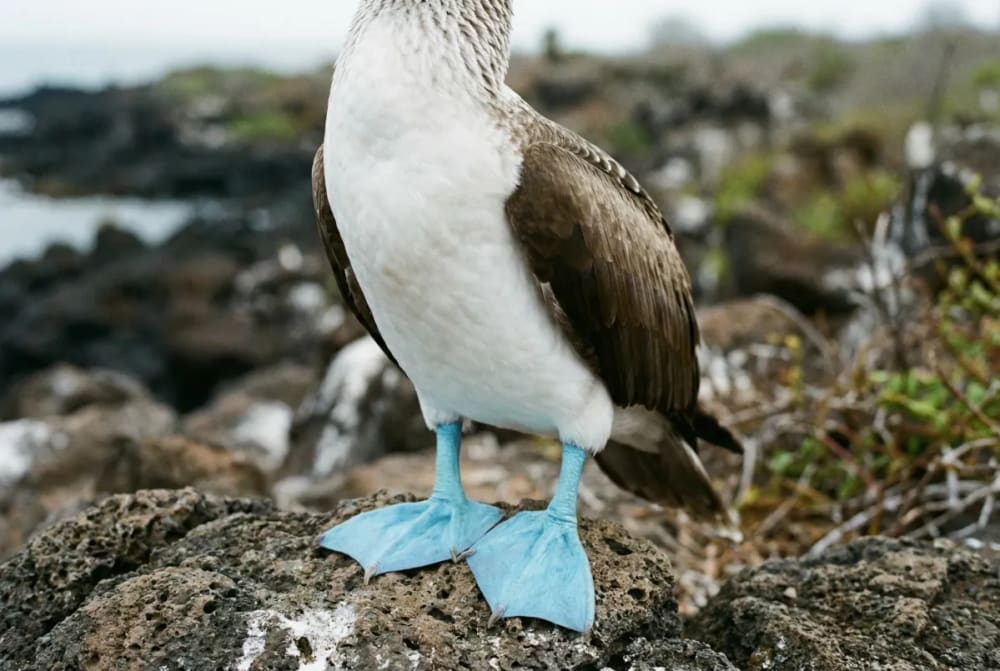
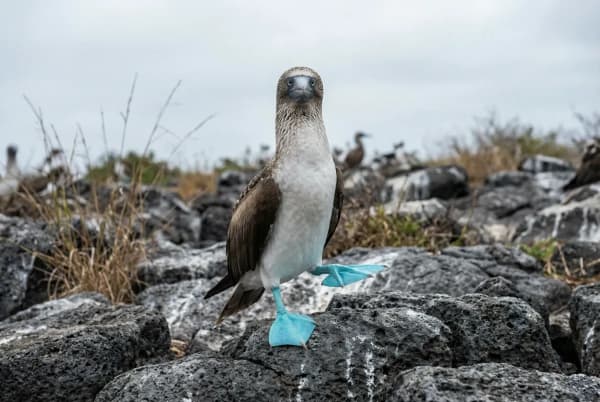
The Blue-footed Booby Galápagos (Sula nebouxii) is present year-round on Española — and its courtship dance is one of those moments that engrave themselves in memory. The male presents the female with a twig or stone as a gift, stretches its wings, tail, and beak skyward (Sky-Pointing), and then begins a high-stepping dance where the brightly colored blue feet are theatrically displayed.
The blue coloring is no coincidence — it comes from carotenoid pigments in fish and signals to the female: This male finds enough food. More intense blue means a fitter partner. While hunting, Blue-footed Boobies dive headfirst into the water from heights of up to 24 meters — often in synchronized groups. The nests are directly on the ground, marked by a circular ring of white guano — the territory marker of the pair.
On the hiking path from Punta Suarez, the trail goes directly through active breeding colonies. Booby nests are often only an arm's length away from the path — the animals show no shyness. Sometimes you have to literally sidestep a brooding bird.
Insider tip
The blue feet shine most brightly in the cool season (June–August), when the sardine high season ensures optimal nourishment. Best photos in morning light — and a telephoto lens (200–400 mm) is worth it, even if the animals are often just an arm's length away.
Nazca Booby and other seabirds
The Nazca Booby (Sula granti) was only recognized as a separate species in 2002 — previously it was considered a subspecies of the Masked Booby. With white plumage, black wing tips, and an orange beak, it is distinctly different from the Blue-footed Booby. A fascinating detail: Nazca Boobies always lay two eggs but never raise two chicks — the first chick to hatch pushes its sibling out of the nest, a fixed behavior pattern known as siblicide. On Española, the breeding time is between November and February.
Other seabirds on Española Galápagos: the elegant Swallow-tailed Gull — the only nocturnal gull in the world — the rare Red-footed Booby, the endemic Galápagos Dove, and the Galápagos Hawk, whose representatives on Española have the largest wingspan of all Galápagos Hawk populations (up to 140 cm).
Marine iguanas, sea lions, and giant tortoises
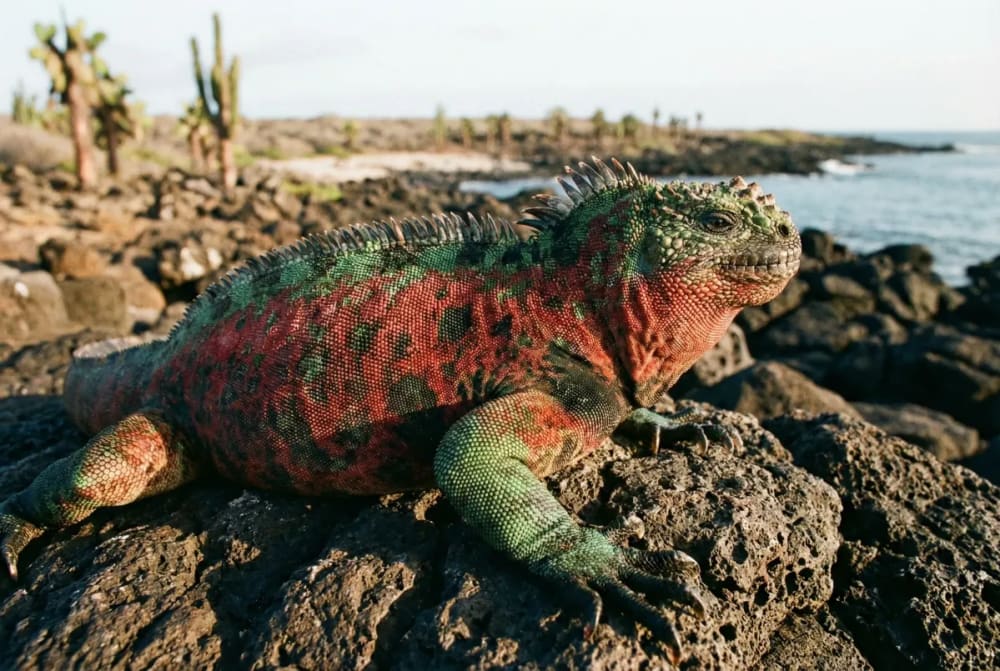
The marine iguanas on Española are a chapter of their own: Their conspicuous red and green coloration has earned them the nickname "Christmas iguanas" (Christmas Iguanas). On all other Galápagos islands, marine iguanas are dark gray to black — only here do they shine in these bright colors throughout the year. Early in the morning, shortly after landing, they lie lazily on the warmed lava rocks — the perfect moment for photos.
The Galápagos sea lions have three breeding colonies on Española, including one at Gardner Bay beach. They lie on the beach, play in the surf, and show no shyness towards visitors — when snorkeling, they often approach curiously up to arm's length.
The Española Giant Tortoise (Chelonoidis hoodensis) has one of the most remarkable conservation stories in the world: In the 1960s, only 15 individuals remained. Through a more than 40-year breeding program — with the legendary breeding male "Diego," which lived to be around 100 years old and sired hundreds of offspring in captivity — over 3,000 tortoises now live on the island again. Diego was released on Española in 2020 after 87 years in human care — a message that captured worldwide attention. The tortoises play an unexpected role for the albatrosses: as so-called Ecosystem Engineers, they keep the vegetation low and thus create the open "runways" that the large birds need for their take-off from the cliffs.
Diego — the savior of a species
The 100-year-old breeding male Diego sired hundreds of offspring in captivity and almost single-handedly saved his species from extinction. After 87 years in human care, he returned to his home island Española in 2020 — a global news story and a symbol of successful conservation on the Galápagos islands.
Punta Suarez — the legendary hiking trail with spray fountain
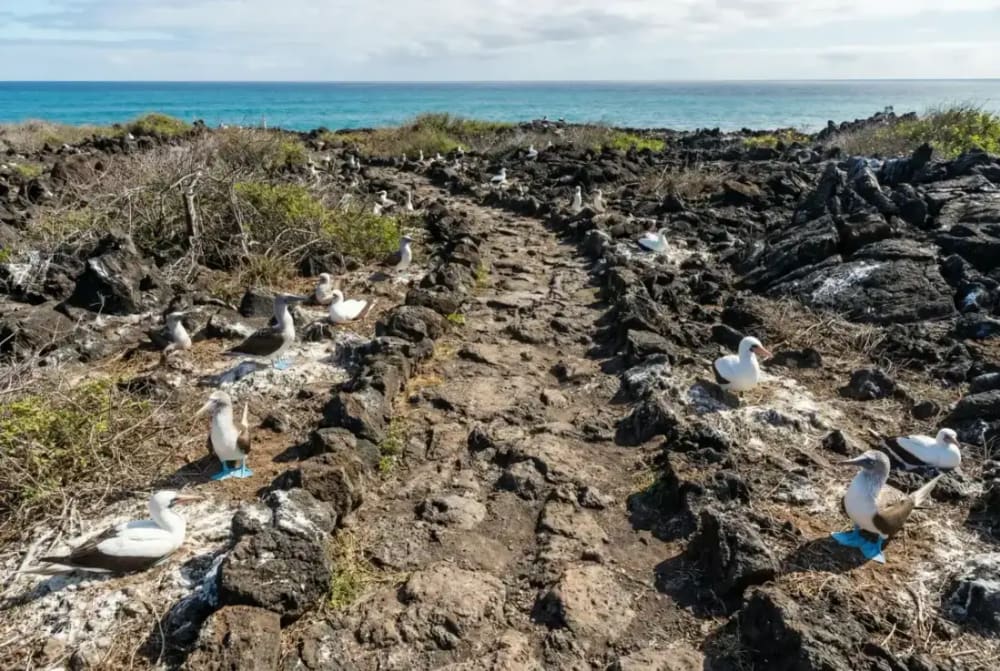
Punta Suarez at the western tip of Española is considered one of the best birdwatching sites of the entire Galápagos islands. Nowhere else can such a high number of endemic seabird species be observed in a single half-day visit — a reason why experienced nature travelers often refer to Española as the highlight of their Galápagos cruise.
What to expect on the circular path
The circular trail is about 3–4 kilometers long and takes about 2 to 2.5 hours. The landing is a Dry Landing — directly on rocks, without wet feet. The terrain is rocky and uneven (raw lava rock), sturdy closed footwear is required.
Right after landing, sea lions often stand on the rock pier — unimpressed by the visitors. The route then leads closely past marine iguanas (the red-green Española variant), lava lizards, Blue-footed Booby nests directly along the path, Nazca Boobies on cliffs, and — from April — the breeding colony of the Waved Albatross. In between, you may be lucky enough to encounter the Española Mockingbird, the only carnivorous mockingbird of the Galápagos — it is known for its curiosity towards visitors. At the end of the path, you will find the Blowhole.
Punta Suarez
- Duration — 2–2.5 hours (approx. 3–4 km circular path)
- Landing — Dry Landing (landing on rocks without getting wet)
- Difficulty — Medium to Hard — raw lava rock, uneven
- Highlights — Albatrosses (Apr–Jan), Blowhole, Booby colonies
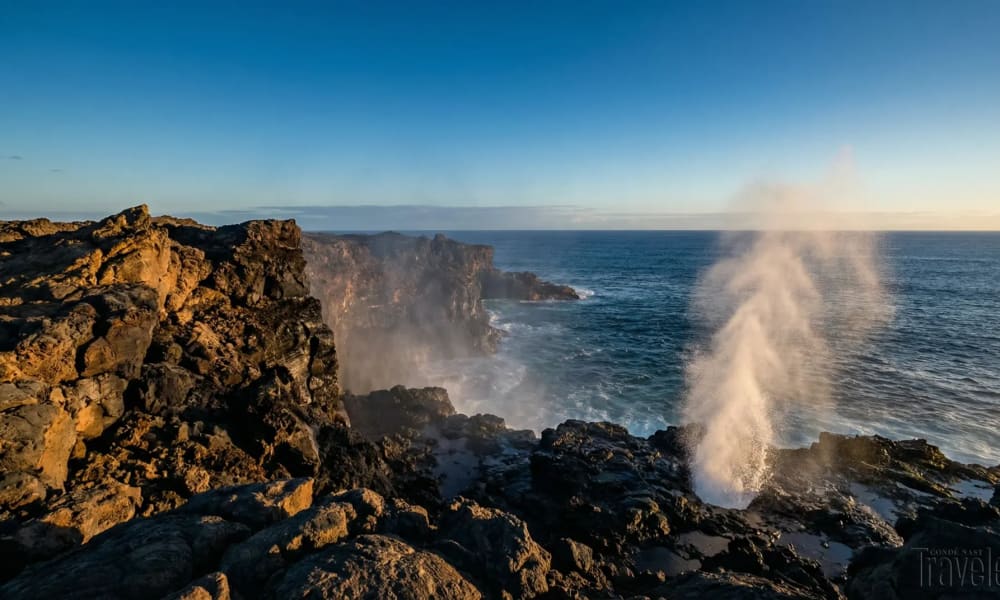
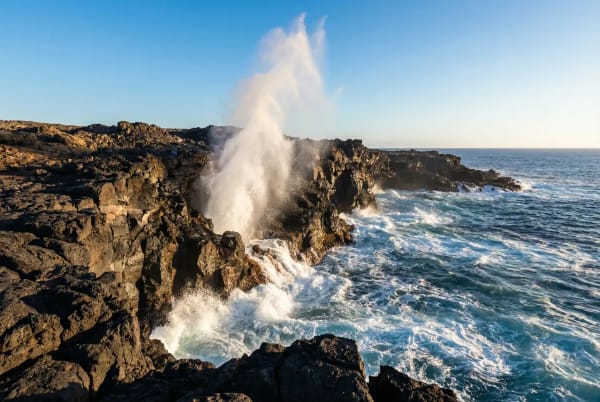
El Soplador — the blowhole of Española
At the end of the hiking path, you will find a natural spectacle that can only be experienced on Española Galápagos: El Soplador, a natural rock fissure in the cliffs through which the sea water is shot up to 23 meters high into the air at high tide. The spray rises like a fountain against the blue sky — most impressive at high tide and rough seas in the morning hours.
From the cliffs, you can also observe the take-off and landing of the Waved Albatrosses. The large birds cannot lift off from a standstill — they need the cliffs as a launch ramp, spread their wingspan of 2.5 meters, and glide away over the open sea. A sight that takes your breath away.
Insider tip
Ask your guide if the visit at Punta Suarez can be coordinated with the tide — the blowhole at high tide and surf is a completely different experience than at low tide.
Gardner Bay — one of the most beautiful beaches of the Galápagos islands
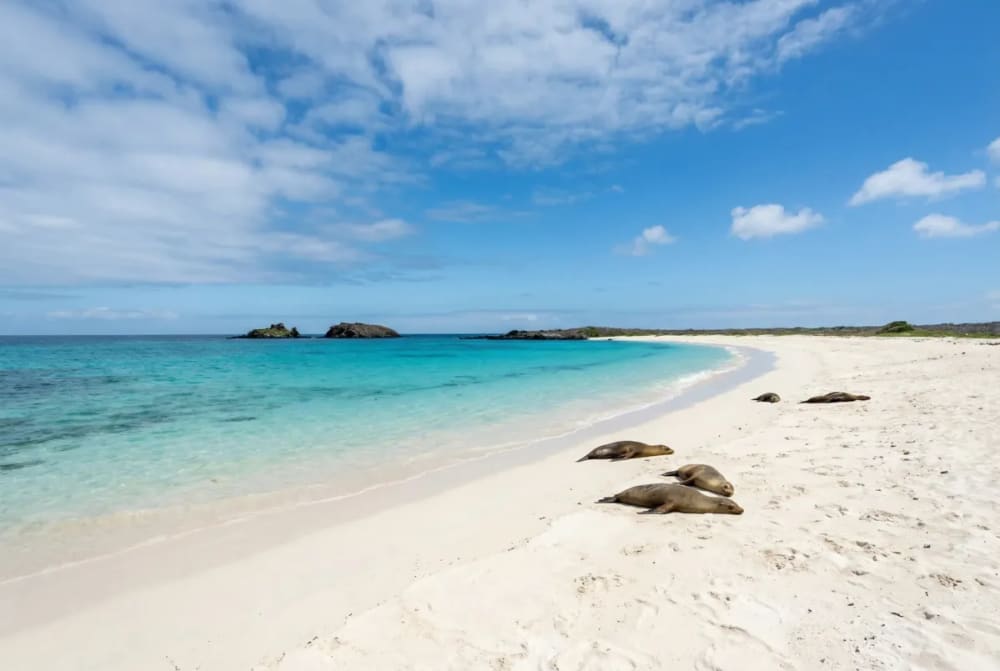
Gardner Bay (Bahía Gardner) is located on the northeast coast of Española and offers about a 2-kilometer-long white coral sand beach — one of the most beautiful and longest beaches of the Galápagos islands. The landing is a Wet Landing: You wade through shallow, crystal clear water to the shore. The contrast to the rugged lava cliffs of Punta Suarez could hardly be greater.
What distinguishes Gardner Bay from Punta Suarez: Here it is less about hiking and birdwatching and more about beach, snorkeling, and the proximity to Galápagos sea lions. The animals lie on the beach, play in the surf, and often come curiously up to arm's length while snorkeling — an experience that you can't have at any other beach in the world.
Snorkeling at Gardner Bay
The main snorkeling site is around Gardner Rock (also called Turtle Rock) — a partially submerged tuff cone about 50 meters off the beach. Here, White-tipped Reef Sharks, rays, sea turtles, and colorful reef fish swim around. Behind the rock, on the side away from the beach, the current and fish abundance are at their peak — eagle rays pass by, and occasionally a Manta Ray glides through the deeper water.
The expanded snorkeling area at Gardner Islet and Osborn Islet offers coral reefs, underwater tunnels, and — with a bit of luck — encounters with hammerhead sharks. The snorkeling gear is usually provided by the cruise.
Gardner Bay
- Duration — 2–3 hours (beach + snorkeling)
- Landing — Wet Landing (wet landing, water shoes recommended)
- Difficulty — Easy — flat sandy beach
- Snorkeling — Year-round, best visibility June–November
Insider tip
Some cruises either visit Punta Suarez or Gardner Bay — not both. The best tours allow for both landings in one day: morning at Punta Suarez (birdwatching), afternoon at Gardner Bay (beach and snorkeling). Be sure to ask specifically when booking.
Best travel time for Española
The best travel time for the Galápagos islands depends largely on the Waved Albatross Galápagos: The birds are on the island from April to January — from February to March, they are absent and winter in the open ocean off Peru.
| Month | Waved Albatross | Blue-footed Booby | Special feature |
|---|---|---|---|
| Jan–Feb | Absent (off Peru) | Year-round | Quieter season, Nazca Boobies breeding |
| March–April | Return, courtship dances | Active | Highest courtship dance activity |
| May–June | Egg laying | Beginning of breeding | Nests active, 24–28°C water |
| July–Aug | Chicks hatch | Main courtship dance | Ideal double observation |
| Sept–Oct | Chicks almost fledging | Feeding | Last chance to see chicks |
| Nov–Dec | Chicks fledge | Active | End of Albatross Breeding Season |
Our Tip: April is the best month for the Albatross courtship dance — the males have just returned and the dance activity is at its most intense. July and August offer the advantage of experiencing Albatross chicks and the intense breeding season of the Blue-footed Boobies at the same time. Those who come in January or February will miss the Albatrosses but will see all the other animals and will have significantly fewer fellow travelers.
Two main seasons determine the climate on Española: The warm, humid season (December–May) brings air temperatures of 25–31 °C and water temperatures of 24–28 °C. The cool, dry season (June–November) is cooler at 21–25 °C, and the water drops to 18–23 °C — a wetsuit for snorkeling is recommended. More about the Galápagos Wildlife Calendar in our blog.
This is how to reach Española — only accessible by cruise
No independent access
Española can only be visited with a licensed Galápagos cruise or through a day trip from San Cristóbal. The island is too far south for day trips from the most populated island, Santa Cruz (10–12 hours of boat ride). An independent visit without an authorized national park guide is not allowed.
Española is on the ‘south route' of Galápagos cruises. The most common route combines San Cristóbal, Española, Floreana, and Santa Cruz in 4–5 days. Extended 8-day routes additionally include Bartolomé, North Seymour, or Santa Fe.
Important to know: Not all cruises stop at Española. Those specifically wanting to see the Waved Albatross Galápagos (April–December) must choose a cruise that includes Española on the south route. When booking, always explicitly ask for “Punta Suarez" and “Gardner Bay" — we are happy to advise you on which routes include Española.
Day trips from San Cristóbal (about 2 hours boat ride each way) are possible but offer significantly less time on the island — cruises typically visit both sites in one day, while day tours often visit only one. More on the topic in our comparison Cruise or Island Hopping?
Travel to Española Galápagos → Española
Costs and Fees — Galápagos National Park
As of March 2026. Park entrance and TCT are not covered by the cruise operator — always carry cash (USD). Many older travel guides still mention the old park fee of USD 100.
Detailed budget information in our Galápagos Cost and Budget Guide.
Rules on Española — National Park Regulations
The Galápagos Islands are under strict nature protection. The following rules apply on Española — as on all islands of the national park:
- Minimum distance of 2 meters from all wildlife (even if they approach you)
- Stay on marked paths — leaving them is strictly prohibited
- Flash photography is prohibited — the animals react sensitively
- No feeding of wildlife — not even the tame Española Mockingbird
- No food to be brought to the island
- Nothing to take away — no lava, no shells, no corals
- Maximum 16 people per guide group
Española on a Galápagos cruise
A typical cruise day on Española starts early — and ends for most travelers as one of the most impressive days of their entire Galápagos cruise:
Day 1 — Española — Punta Suarez & Gardner Bay
Note: For birdwatchers and nature photographers, the ideal cruise is one that combines Española (south) with Genovesa/Tower Island (north) — the two most important seabird islands of the archipelago.
Let us plan your Galápagos cruise — we know the routes from personal experience and will personally advise you on which ships visit Española. Request a non-binding consultation now .
Discover more Galápagos Islands
Floreana — Pirate history and flamingo lagoon
Santa Cruz — The heart of the Galápagos archipelago
Isabela — Largest island — volcanoes and penguins
Also read: Cruise or Island Hopping? — our comparison helps with the decision. And in our Galápagos Wildlife Calendar you will learn which animals you can see when on which island.
To book a trip or for more information, contact us. We'll help you plan and guide you through your upcoming adventure!
Frequently Asked Questions
Yes, practically. About 12,000 breeding pairs nest exclusively on Española. A vanishingly small colony of fewer than 20 pairs exists on Isla de la Plata off Ecuador's coast — but over 99% of the total population breeds on Española. It is the only significant breeding colony of the Waved Albatross worldwide.
April to December. The Albatrosses return in March/April and leave the island in January. The most intense courtship dance occurs from April to June. July to October offer guaranteed chick sightings. In January to March, the birds are absent — they overwinter on the open ocean off Peru.
Only to a limited extent. Española is an uninhabited national park island accessible only with a licensed guide. The most common option is a Galápagos cruise with the south route. Alternatively, day trips from San Cristóbal are offered (about 2 hours of boat ride), which typically only visit one of the two sites (Punta Suarez or Gardner Bay). From Santa Cruz, Española is too far for day trips, with a 10–12 hour journey.
Punta Suarez (west point) is the place for birdwatching: Albatrosses, Boobies, Marine Iguanas, the spectacular blowhole. The loop trail is 3–4 km long and rocky (Dry Landing). Gardner Bay (northeast coast) features a 2 km long white sand beach with sea lions, ideal snorkeling conditions, and a relaxed atmosphere (Wet Landing). The best cruises visit both in one day.
A typical cruise day on Española includes a half-day visit at Punta Suarez (about 2–3 hours of hiking) and a half-day visit at Gardner Bay (about 2–3 hours of beach and snorkeling). Overall, cruise guests spend about 5–6 hours on the island. Day trips from San Cristóbal offer less time on site.
Besides Waved Albatross and Blue-footed Boobies: Nazca Boobies, red-green Marine Iguanas (the 'Christmas Iguanas', only on Española), Galápagos Sea Lions, Española Giant Tortoises (recovered from 15 to over 3,000 animals), Galápagos Hawks, Española Mockingbirds (the only carnivorous mockingbird), Swallow-tailed Gulls, Red-footed Tropicbirds, and while snorkeling: sea turtles, white-tipped reef sharks, rays, and colorful reef fish.
Española is on the 'south route' of Galápagos cruises. Not all cruises visit the island — they must specifically choose a route that includes Española. Typical combinations: San Cristóbal → Española → Floreana → Santa Cruz (4–5 days). Our 8-day yacht expedition and the Peru & Galápagos Grand Tour include Española. Contact us for personal advice.
As of August 2024, the entrance fee is USD 200 per adult (previously USD 100) — a doubling that many older travel guides have not yet reflected. Children under 12 pay USD 100. Additionally, the INGALA Transit Control Card (USD 20 per person) applies. A total of USD 220 per person in mandatory fees is required — in addition to the cruise price and to be paid in cash (USD).
You might also like this
This image was generated with AI.
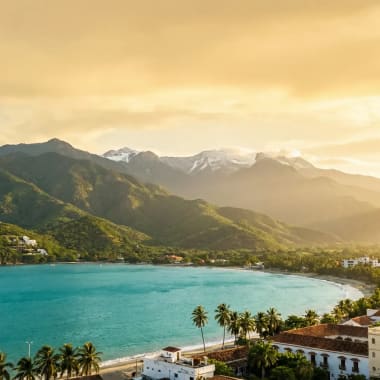
This image was generated with AI.