

This image was generated with AI.
Pantanal
Jaguar safari in the largest wetland in the world
Jaguar safari in the largest wetland in the world
4,000 to 7,000 jaguars, over 650 bird species, and the only wilderness in Latin America where a big cat sighting is almost guaranteed: The Pantanal is Brazil's wildest chapter — open, vast, and surprisingly accessible during the dry season.

Best travel time
July to October — dry season in the Pantanal with the highest jaguar sighting rates worldwide (90 to 99 percent).
Why Pantanal?
The Pantanal is the largest wetland on Earth — around 150,000 to 200,000 square kilometers of flooded plain, three times the size of Switzerland, spread across Brazil, Bolivia, and Paraguay. Those searching for wildlife in Latin America often only know the Amazon. However, the rainforest is dense, dark, and keeps its inhabitants hidden. The Pantanal is the opposite: open, vast, flat. Here you see what remains hidden in the Amazon.
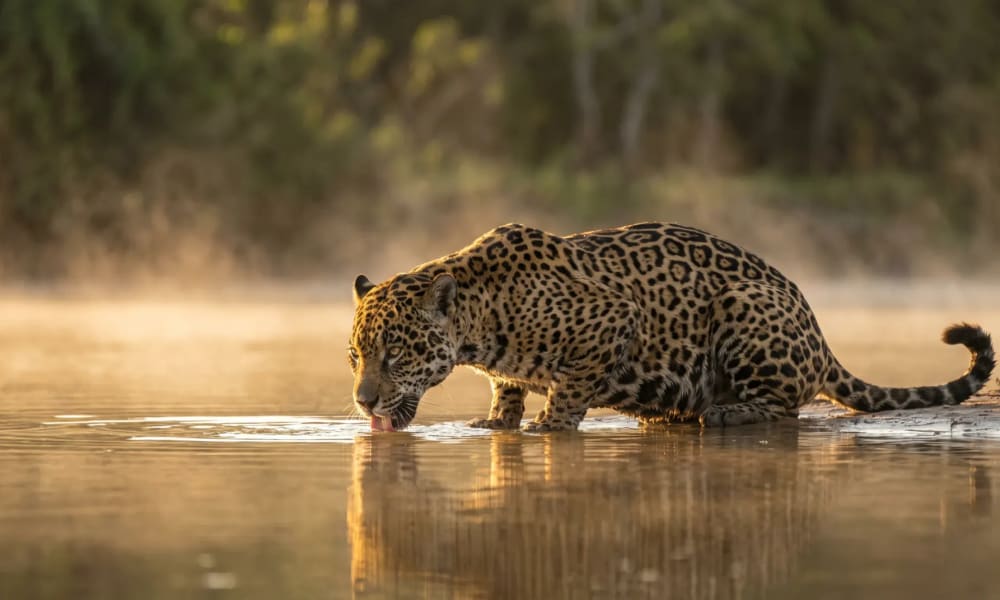
This is especially true for the jaguar. Between 4,000 and 7,000 animals live in the wetland, and in the northern Pantanal around Porto Jofre, the likelihood of spotting them during the dry season is 90 to 99 percent — values that no other place in the world reaches. The big cats come to the banks of the Rio Cuiabá and its tributaries to hunt caimans and capybaras. From a speedboat, you observe them from just a few meters away, without disturbing the animals.
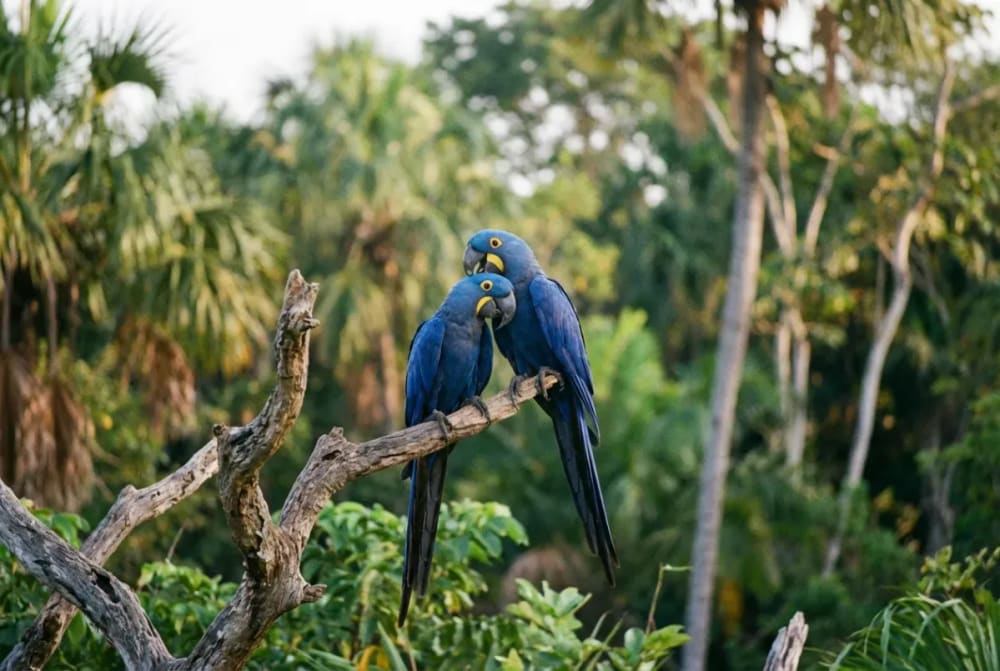
In addition, there are over 650 bird species, including the hyacinth macaw — with a wingspan of one meter, the largest parrot in the world — as well as giant otters, giant anteaters, tapirs, and around ten million yacaré caimans, making it the densest crocodile population on Earth. The Pantanal is Brazil's major wildlife destination. Not a substitute for the Amazon, but its logical complement.
North Pantanal vs. South Pantanal
The Pantanal is not a uniform place. It divides into two very different regions — and choosing between north and south is the most important decision in your travel planning.
North Pantanal (Mato Grosso, access via Cuiabá) is the classic jaguar region. The center is called Porto Jofre, at the end of the Transpantaneira, where the Rio Cuiabá fans out into a maze of river arms. Jaguar safaris take place here almost exclusively by speedboat. The Jaguar ID Project documented 1,488 sightings in the 2025 season alone. If you have the classic image of the Pantanal in mind — big cat on the riverbank, golden light, caimans on sandbanks — look for the north.
South Pantanal (Mato Grosso do Sul, access via Campo Grande) is quieter, broader, more diverse. Instead of boat safaris, open 4x4 vehicles traverse the fazenda land — large cattle ranches that have often dedicated part of their land to ecotourism for generations. The biodiversity is noticeably higher: giant anteaters, marsh deer, maned wolves, and significantly more bird species along the trails. Jaguars are also present here but harder to see — with one exception.
The Caiman Lodge in the south has operated the Onçafari program for habituating jaguars since 2011. Animals are accustomed to safari vehicles over the years without being fed until they perceive the cars as neutral. Result: The sighting rate rose from 16 percent (2013) to 100 percent (2023) — year-round, not just during the dry season. This is unique worldwide and makes Caiman a premium alternative in the south.
Our recommendation: If you are traveling to the Pantanal for the first time and prioritize jaguar photography, head north. If you have more time, appreciate biodiversity, and prefer a quieter, more luxurious experience, choose the south — and for both, a combination of two stays is advisable.
Jaguar safari — what to expect
A typical safari day in the North Pantanal starts before sunrise. At half past five, you are sitting in the open speedboat, coffee in hand, still in a jacket. The guide slowly steers through the arms of the Rio Cuiabá, scanning the banks. Radio hints come from other boats. Suddenly, the call: "Onça." Ten minutes later, you stand 20 meters away from a female jaguar lying in the shade of a fig tree.
The boat safaris typically last three to four hours in the morning and again in the afternoon. Between nine and half-past three, there is a break — lunch, hammock, siesta. In the heat of the day, the animals are hardly active. In the evening, you go out again, often until sunset. If you are lucky, you might witness a hunt: in 2025, the Jaguar ID Project documented five anaconda kills by jaguars.
The Jaguar ID Project itself is a piece of research that travelers can experience directly. Since 2013, the initiative has identified over 450 individual jaguars based on their unique coat patterns. In the 2025 season, 120 animals were registered, 32 new individuals discovered, and 23 cubs documented. The most sighted animal of the season was a female named Patricia — 74 individual sightings. Guides know the animals by name, and what initially sounds like a marketing story becomes reality within a few days: You recognize Patricia on the second day yourself.
The effect of jaguar tourism is measurable. The number of habituated jaguars in the northern basin increased from 29 animals in 2013 to 130 in 2023 — an increase of over 400 percent in ten years. Habituated means: the cats perceive boats as a neutral part of their environment, neither a threat nor prey. This is the reason why sighting rates are so extraordinarily high — and why the economy of the region today relies on living jaguars instead of livestock, which previously shot jaguars as pests.
Insider Tip: Guides call jaguars by name — "Patricia," "Marcela," "Medrosa." Those who study the photos of the current season on the Jaguar ID Project's website beforehand recognize the animals themselves on the first boat outing. This elevates every safari to a new level.
Best travel time
The Pantanal dry season from July to October is the most reliable travel time for wildlife sightings. The annual cycle explains this well: During the rainy season from November to March, large parts of the wetland are up to three meters underwater, dispersing animals across the entire area. By April, water levels drop, and by July, animals concentrate in the remaining waterways — making them much easier to see.
In detail, the jaguar calendar in the North Pantanal looks like this: May to June, the sighting rate is 60 to 75 percent; in July and August, it rises to 85 to 95 percent; September and October peaks at 90 to 99 percent. From November, the values drop again as the first rains disperse the jaguars.
The downside of the peak months: more boats, higher prices, early booking requirement. Lodges in Porto Jofre and at Caiman are often booked out for September and October six months in advance. Those who appreciate peace of mind and can live with a 75 percent sighting probability find June to be the better compromise: empty boats, full day tours, moderate prices.
The rainy season, on the other hand, is not a deal-breaker — it is a different journey. From November to March, the Pantanal transforms into a vast inland sea; jaguars are harder to see, but migratory birds from North America arrive, anacondas are easier to observe (best time December to May), and the landscape is lush green. Photographers and birders appreciate these months; for the classic first safari, we still recommend the dry season.
Arrival & logistics
North Pantanal: International flights end in São Paulo (GRU), then continue to Cuiabá (CGB) — about two hours. From Cuiabá, the actual journey begins: about 100 kilometers to Poconé, where the Transpantaneira starts, then 147 kilometers of gravel road to Porto Jofre. The pure travel time is four to five hours, with wildlife stops realistically six to seven. Total transfer from Cuiabá: four to six hours. Those who want to save time can take a charter flight Cuiabá → Porto Jofre — more expensive, but one full safari day more on the boat.
South Pantanal: Flight to Campo Grande (CGR), then transfer to Miranda, Aquidauana or the Corumbá region. Depending on the lodge, two to four hours on good roads. Caiman Lodge has its own landing strip — a charter flight from Campo Grande costs $300 to $600 per person but saves the four-hour transfer.
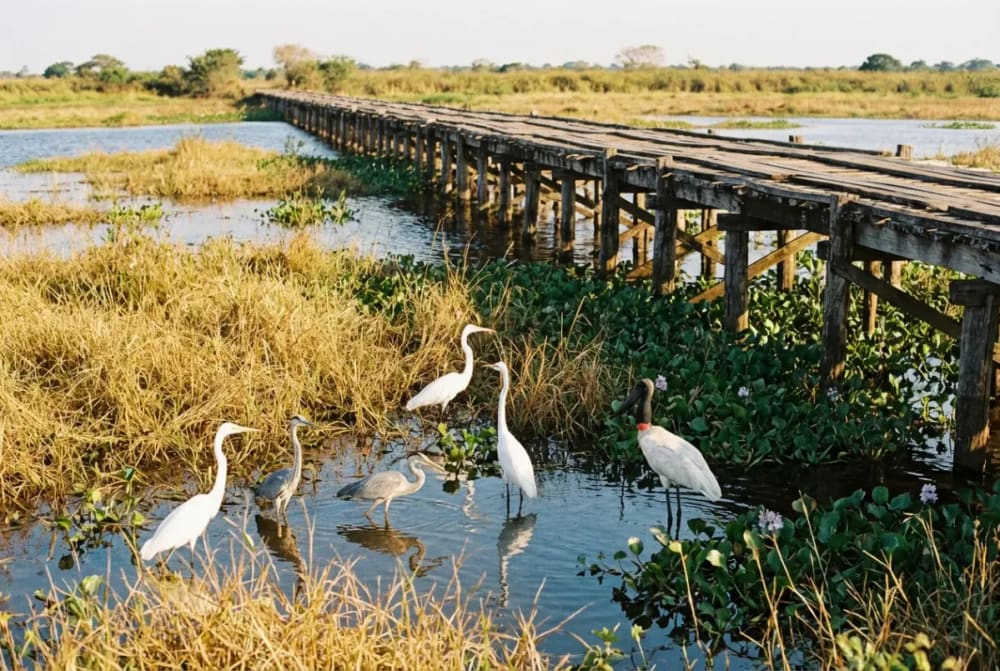
The Transpantaneira itself deserves a special mention. The 147-kilometer-long Rodovia MT-060 crosses 122 to 125 wooden bridges and is the only land connection deep into the North Pantanal. It is both access and safari: yacaré caimans at the roadside, capybaras in family groups, hyacinth macaws on buriti palms, and often tapirs in the morning hours coming to the road to take minerals. Don’t plan the drive solely as transportation, but as the first safari — keep your camera ready in your lap.
Insider Tip: The last gas station before Porto Jofre is in Poconé. Those driving a rental car should fill up there. And: Many lodges and guides along the Transpantaneira only accept cash in reais. Withdraw cash in Cuiabá before you set off.
Wildlife beyond jaguars
The unofficial Pantanal Big Five are jaguar, giant anteater, giant otter, jabiru stork, and tapir. Four of these can typically be seen in a well-planned week with high probability — the giant anteater remains the greatest challenge and is easier to spot in the south than in the north.
Giant otter (Pteronura brasiliensis): These river bandits can grow up to two meters long and live in family groups of five to ten individuals at established riverbanks. It is estimated that 2,000 to 5,000 of them live in the Pantanal, which sounds like a lot but represents a 50 percent decline over 25 years. In March 2026, giant otters were listed under Appendix I and II of the UN Convention on Migratory Species (CMS) — an official conservation status as a threatened migratory species. The animals can be seen almost daily on boats between June and December; guides know the family locations well.
Hyacinth macaw (Anodorhynchus hyacinthinus): The largest parrot in the world, electric blue plumage, one meter long, prefers buriti and acuri palms. About 5,000 individuals live in the Pantanal — around 70 percent of the world population. The species has recovered from a low of 2,500 individuals in 1987 to over 6,500 in 2008 but is under pressure again according to IUCN due to fires and habitat loss. Sightings occur year-round and without major effort.
Yacaré caiman (Caiman yacare): Around ten million animals — the densest crocodile population on Earth. During the dry season, they gather in masses on sandbanks and in the remaining puddles; one quickly gets used to the sight of hundreds of pairs of eyes under the light of the boat lamp.
Tapir, capybara, jabiru stork, giant anteater, yellow anaconda, marsh deer, coati, water pig, hoco chicken, tuiuiú — the list goes on. The Pantanal is regarded as the most biodiverse ecosystem on the continent, with 656 bird species, 159 mammal species, 325 fish species, and 98 reptile species according to the latest counts. Those arriving with binoculars and a bird book are likely to leave the Pantanal with a life list that runs long.
Accommodations in the Pantanal
The Pantanal is not cheap. Everything — electricity, food, personnel — has to be delivered over the Transpantaneira or poor gravel roads. For this reason, the best lodges are far more than hotels: They are conservation projects, research stations, often with their own guides who have worked in the area for decades.
Araras Eco Lodge (North Pantanal, directly on the Transpantaneira, about 135 km from Cuiabá). Pioneer of sustainable tourism in the Pantanal since 1976. 22 air-conditioned suites, two observation towers (12 and 25 meters), included hiking, riding, canoeing, and photo safari tours. TripAdvisor lists Araras as the number one specialty lodge in Brazil (4.5/5). Prices for 2026 per person: 3 nights/2 days from $833 (low season) to $1,189 (high season July–October), 5 nights/4 days from $1,491 to $2,184. Wildlife Preservation Fee $75 additional. Ideal as an introductory stop before Porto Jofre.
SouthWild Pantanal Lodge (North Pantanal, on the Pixaim River, 2.5 km off the Transpantaneira). 15 air-conditioned rooms, jaguars are seen on average every six days within ten minutes of the lodge by boat. The new Naturezas facility (since March 2025) offers the only open rooftop terrace with a sky bar for sunsets with wildlife views. Our premium recommendation in the north when photography quality and a quiet atmosphere are priorities.
Pousada Piuval (North Pantanal, 10 km from Poconé, first lodge on the Transpantaneira). 20 rooms on a 7,000-hectare ranch. Wide range of activities from photo safari to canoeing and horseback riding to piranha fishing. Hyacinth macaws nest regularly in close proximity. The most affordable of the houses mentioned here, ideal for one night as a starting point before Porto Jofre.
Refúgio Ecológico Caiman (South Pantanal, Miranda region, Mato Grosso do Sul). Luxury eco-resort on 53,000 hectares of private land with its own 5,600-hectare conservation reserve. Home to the Onçafari jaguar project. Three accommodations to choose from: Casa Caiman (18 suites), Villa Baiazinha (6 rooms), Pousada Cordilheira (5 rooms). Prices for 2026 per person: 4 nights/3 days from $2,757 (low season) to $3,508 (July/August/holidays), 5 nights/4 days up to $4,465. Wildlife Preservation Fee $200. The premium option in the south — and due to the year-round jaguar habituation, a unique offering.
A classic seven-night package in the north (two nights at Araras for acclimatization plus three nights at Hotel Pantanal Norte in Porto Jofre for the jaguar safaris plus two nights in Cuiabá/transfers) starts in high season at around $3,990 per person — all meals, guides, and safaris included. A premium trip in the south at Caiman starts at $3,500 for five nights.
Insider tip: Book high season stays at least six months in advance. River view rooms in SouthWild and the Villa Baiazinha at Caiman are often booked out twelve months ahead. Those planning spontaneously are recommended to choose the shoulder weeks of June and early November.
Sustainability — the Pantanal at a tipping point
The Pantanal is under pressure. The fires of 2020 were the worst in the history of the wetland: around 43 percent of the total area burned, an estimated 17 million vertebrates died directly, and 45 percent of the jaguar population were affected. Active fires were 123 percent above the average of the years 2002 to 2020.
In 2024, the next disaster struck. 1.3 million hectares burned just in the first half of the year — eight times the area of London. The number of fires increased by 1,500 percent compared to the first half of 2023. Studies show that climate change makes such fire conditions 40 percent more intense and four to five times more likely. In September 2025, Mongabay raised the question of whether the Pantanal was at a tipping point — not just climatically, but also touristically, as the boat density for jaguar sightings in the peak weeks is becoming a problem.
This sounds bleak, and it is serious. But there is also another story: jaguar tourism has quintupled the number of habituated animals in the northern basin. Caiman's Onçafari project proves that habituation works without feeding. Hyacinth macaw populations recovered due to dedicated conservation programs before the fires pushed the trend line down again. Giant otters received new protection status under the UN Convention on Migratory Species in March 2026.
What does this mean for your trip? Those traveling to the Pantanal finance the economy that protects the jaguar. But the choice of lodge makes a difference. Places like Araras, SouthWild, and Caiman are measurable reinvesting in conservation, collaborating with research projects, and imposing limits on boat numbers. Cheap alternatives on the edge of the Transpantaneira often do not do this. We recommend exclusively partners whose conservation work we can track — this is a compelling consideration given the prices here.
Planning your Pantanal individually
A Pantanal trip lives from the details: which lodge on which river, which guide, which seasonal week, which charter flight, which combination with other regions. We plan your route personally — with handpicked partners in the north and south, English and partially German-speaking guides, and logically connected with additional components such as Chapada Diamantina , the Amazon or northeastern Brazil.
These routes are particularly popular:
- Brazil Nature: Pantanal & Fernando de Noronha — premium combination of jaguar safari and island paradise
- Brazil Highlights: Amazon, Pantanal, Northeastern Brazil — the great nature triangle in 18 to 21 days
For personal advice and a tailor-made offer contact our Brazil team — we usually respond within 24 hours.
To book a trip or for more information, contact us. We'll help you plan and guide you through your upcoming adventure!
Frequently Asked Questions
In the North Pantanal around Porto Jofre, the rates range between 90 and 99 percent during the peak dry season from July to October. May and June are at 60 to 75 percent, November at 50 to 60 percent. In the south, the values outside the Caiman Lodge are significantly lower (around 40 to 60 percent), but within Caiman, due to the Onçafari program, they are year-round at 98 to 100 percent. The highest rates in the world — no other place comes close.
The two regions are complementary, not competitive. The Amazon is a denser rainforest: You hear more animals than you see. The Pantanal is open wetland: wildlife is visible, especially large mammals. Those who want to see biodiversity in the foreground should plan both — classically three to four nights in the Amazon plus four to six nights in the Pantanal. If only choosing one: Pantanal for jaguars and open landscapes, Amazon for rainforest atmosphere and indigenous culture. Our Amazon region around Manaus describes the counterpart in detail.
Yes, but as a different experience. From November to March, the wetland can be partially three meters underwater; jaguars are harder to see, but migratory birds arrive, anacondas are more active, and the landscape is lush green. Some roads are impassable, and parts of the Transpantaneira are temporarily closed. For first safaris, we recommend the dry season; for photographers and birdwatchers, the green season can be rewarding.
A complete North Pantanal trip with four to six nights in premium lodges, transfers from Cuiabá, all meals, guides, and safaris starts at around €1,800 per person in the low season and reaches €4,000 to €5,000 in the peak high season. South Pantanal at Caiman starts at around $2,700 per person for four nights. International flights (Frankfurt–São Paulo–Cuiabá from €900 Economy) and Wildlife Preservation Fees of $60 to $200 are additional.
Yellow fever vaccination is recommended for the Pantanal and is sometimes required. Hepatitis A, typhoid, and tetanus should be current. Malaria prophylaxis is not normally necessary for the Pantanal, but mosquito protection with DEET-containing products (50 percent) is indispensable — especially during twilight hours. Details and current recommendations can be found in the vaccination and health guide.
Muted colors in beige, olive, gray — no white shirts (they reflect and scare animals), no camouflage patterns (militarily connoted in Brazil). Long-sleeve shirts and long pants against mosquitoes, a thin sweater for the cool morning hours on the boat (which can fall to 12 degrees in July), a wide-brimmed hat, sunscreen SPF 50, binoculars (8x42 is the best choice), a camera with tele-zoom starting from 300 mm, sufficient memory cards, and batteries. Cash in reais for tips and guides along the Transpantaneira.