

Amazon Manaus
The gateway to the largest rainforest on Earth
The gateway to the largest rainforest on Earth
Manaus and the Brazilian Amazon — jungle tours, lodges, and the best time to visit. The meeting of the waters, pink river dolphins, and a side-by-side lodge comparison.

Best Time to Visit
July to November
Why Manaus is the key to an unforgettable Amazon stay
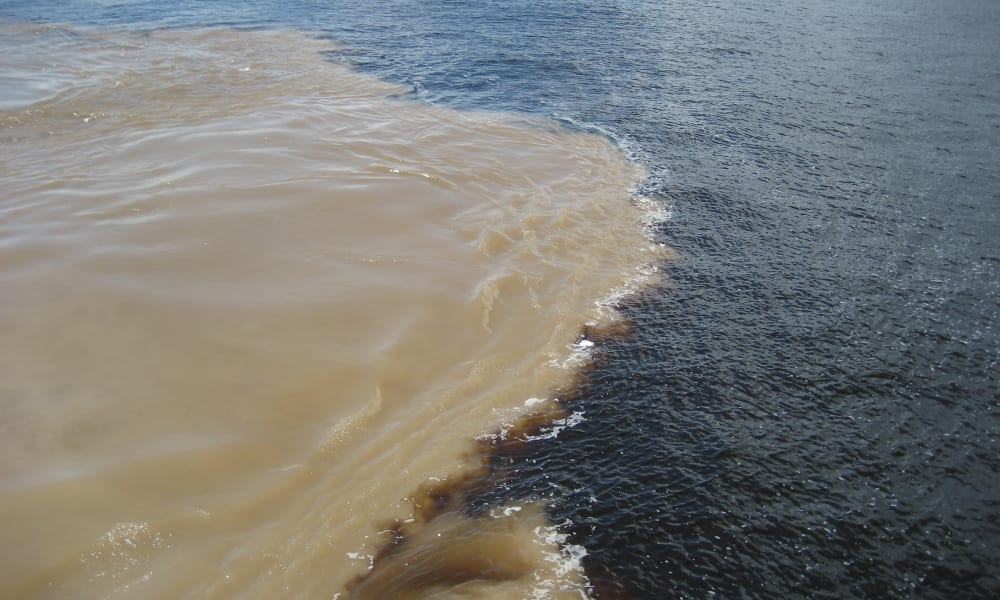
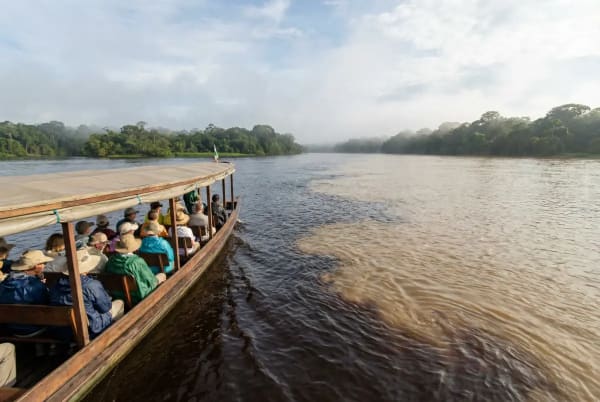
The boat glides silently toward the confluence. Then it lies before you: on the left, the inky black of the Rio Negro; on the right, the milky sandy-brown of the Solimões — two rivers that refuse to merge for more than six kilometers. Geologist Robert Meade called it "the planet's largest hydrological spectacle." What surpasses the phenomenon itself? The fact that it's only the beginning of what awaits you in the Amazon rainforest around Manaus.
Manaus, a city of two million in the middle of the jungle and reachable only by air or boat, is the gateway to a region the size of Western Europe. During the rubber boom around 1900, it was one of the wealthiest cities in the world — the so-called "Paris of the Tropics" had electric light and sewers when most European cities were still planning theirs. The grand Teatro Amazonas and the Mercado Municipal designed in part by Gustave Eiffel still bear witness to that era. Since 1957, Manaus has been a free trade zone and is Brazil's fourth-richest city.
But most travelers don't come for the urban history. They come because Manaus is the starting point for Amazon tours into one of the most species-rich ecosystems on Earth. We recommend at least three to four nights in a lodge outside the city. In that time, you'll witness the meeting of the waters up close, encounter pink river dolphins, fish for piranha with bamboo rods, and glide through the absolute stillness of the rainforest on a night safari — while caiman eyes light up red in the beam of your flashlight. From our experience, Manaus combines well as a stop on a Brazil tour with the Pantanal or Rio de Janeiro .
Encontro das Águas — where two worlds collide
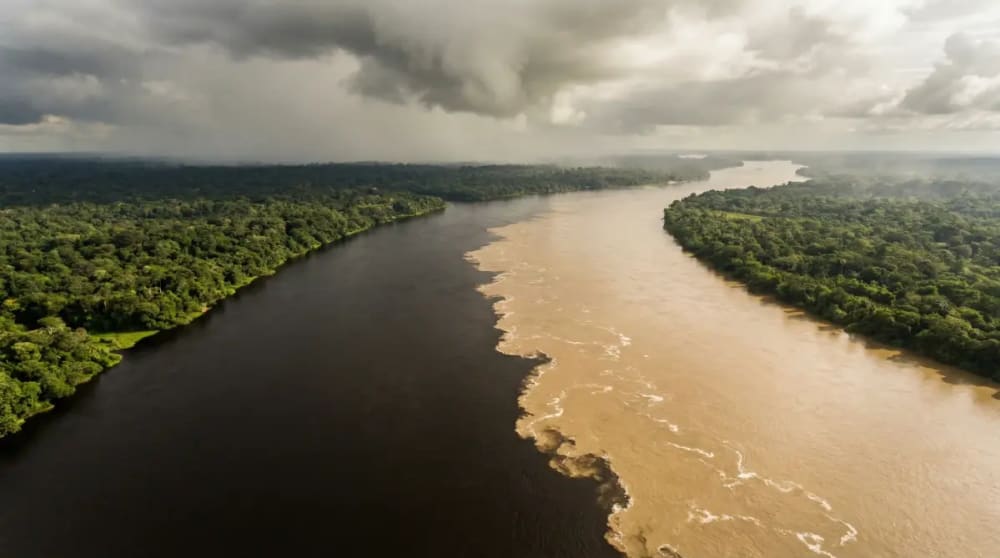
About 15 kilometers east of Manaus, the Rio Negro meets the Rio Solimões — and they flow side by side for six kilometers without merging. The line between them is so sharp it looks ruler-drawn. Only after that does the Amazon proper begin, the mightiest river on Earth.
What lies behind this phenomenon? The answer is physical. The Rio Negro flows at about two kilometers per hour with a water temperature of 28°C. The Solimões is twice as fast at four to six kilometers per hour and noticeably cooler at 22°C. Add differences in density, sediment, and pH — the Rio Negro is strongly acidic at pH 3.5, the Solimões mildly alkaline at 7.5. The combination of speed, temperature, and chemistry keeps the two waters from blending quickly.
We know few natural spectacles you can experience this directly. From the boat, you can hold one hand in each river at the same time and feel the temperature difference. The encounter is most striking before 10 am — softer light, sharper colors, and far fewer boats around.
Encontro das Águas (Meeting of the Waters)
- Boat tour — from €50/person (half-day)
- Duration — 3-4 hours (half-day)
- Distance — approx. 15-20 km east of Manaus
- Tip — Go before 10 am — better light, fewer boats
Insider Tip
Lodges on the Rio Negro have a little-known advantage: the acidic blackwater (pH 3.5) prevents mosquito larvae from developing. If you're sensitive to mosquitoes, deliberately choose a lodge on the Rio Negro rather than the Solimões — it's a difference you'll feel.
Jungle tours from Manaus — what to expect
Day trips vs. multi-night lodge stays
Day trips from Manaus offer a compact overview: meeting of the waters, piranha fishing, and with some luck a boto sighting — all in one day. But that isn't enough for a real Amazon experience. Anyone who wants to feel the rainforest — the soundscape at sunrise, the humid stillness of the afternoon, the nocturnal concert of thousands of voices — needs at least three nights in a jungle lodge.
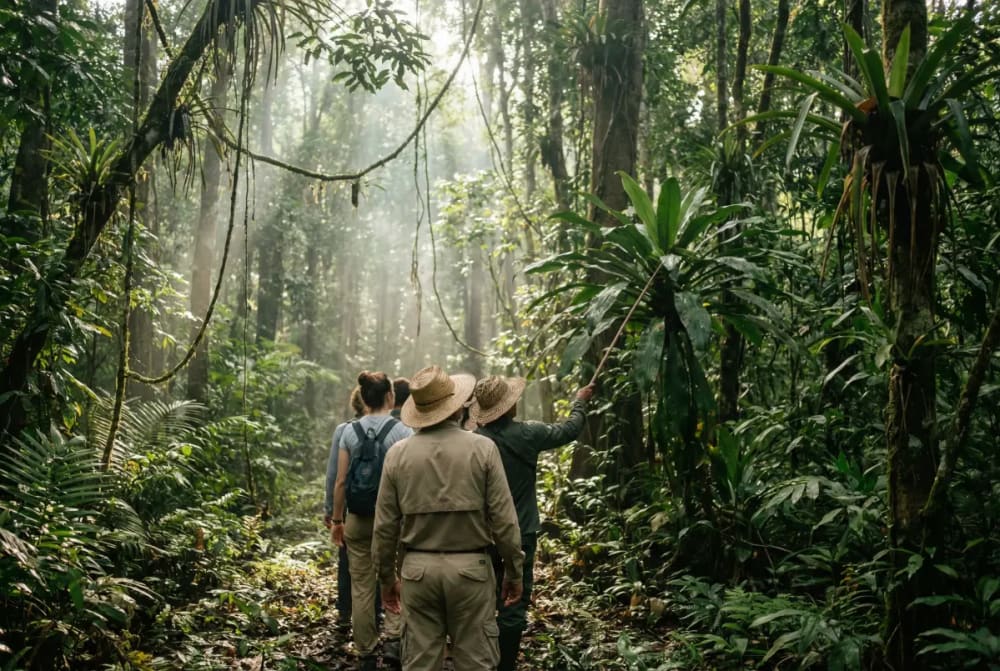
A typical lodge day begins at six in the morning with a forest walk, when the rainforest is at its most alive. Howler monkeys call through the canopy while your guide points out medicinal plants and the tracks of nocturnal visitors. After breakfast comes a boat tour through the river's branching side channels. Afternoons feature piranha fishing or a canoe trip through blackwater lagoons. And after dinner, you glide into the darkness on a night safari. This rhythm — this full immersion — only works if you stay overnight.
In our experience: lodges two to three hours from Manaus deliver a noticeably more authentic experience than the cheaper 30-minute options on the city's edge. The extra hour is worth it.
Piranha fishing — myth vs. reality
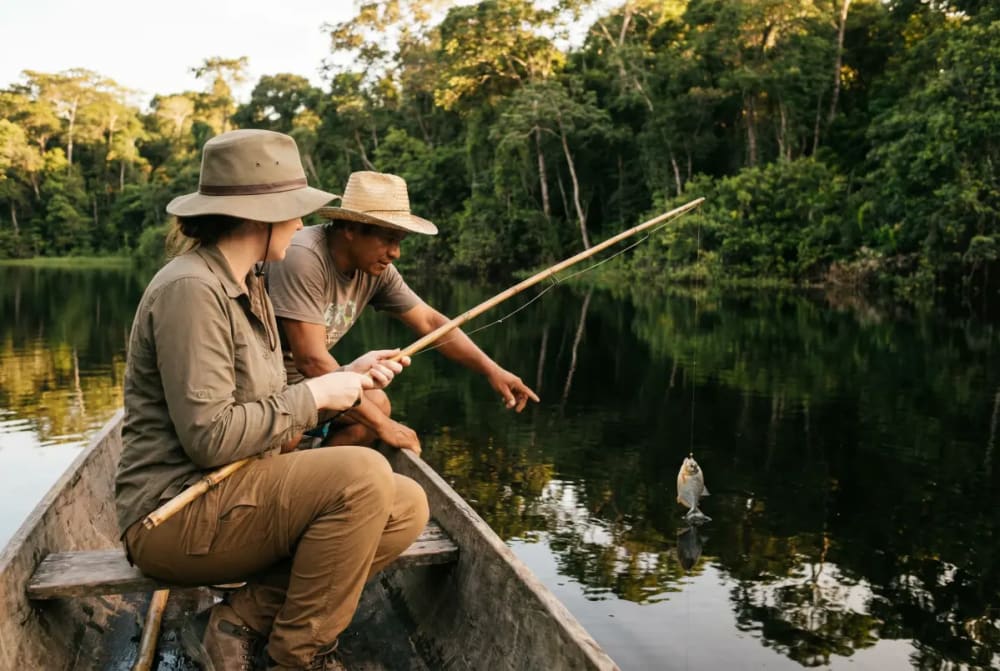
Forget the Hollywood clichés: piranhas aren't monster fish. Fishing with a simple bamboo rod and a piece of meat as bait works for absolute beginners. The technique is simple — cast, wait, set the hook. Only when removing the hook should you use pliers, not your fingers. Your guide will show you every step.
The most productive time is in the afternoon between 2 and 5 pm, when the fish are more active. In the dry season (June to November), piranhas concentrate in deeper waters and bite more reliably. They're more numerous in the Solimões than in the Rio Negro. As part of a multi-night lodge package, piranha fishing is included — no surcharge.
Piranha fishing
- As a day tour — from $80/person (combined with caiman watching)
- Duration — 2-3 hours
- Best time — Afternoons 2-5 pm, dry season (Jun-Nov)
- In lodge package — Included
Night safari in the rainforest
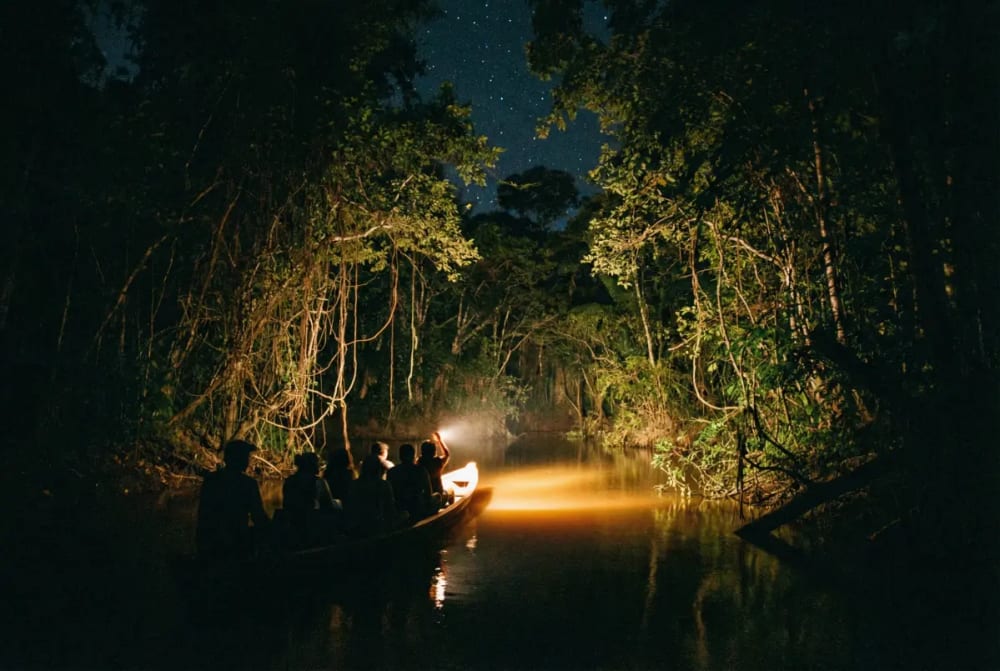
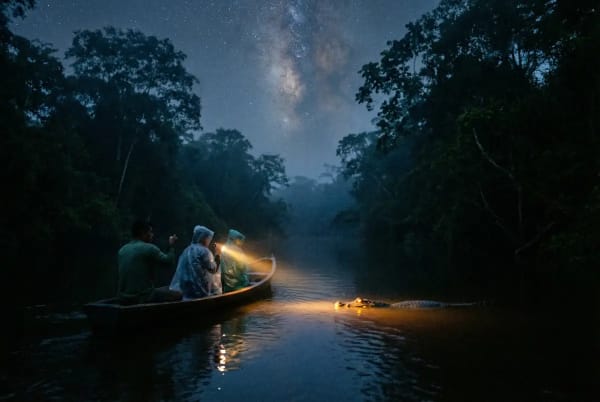
After dinner, around 9 pm, you board the boat. The motor cuts, and the silence of the rainforest settles in — a silence that isn't silent, but cut by the chirping of cicadas, the occasional call of a night monkey, the distant splash of a caiman. Equipped with flashlights, you glide through blackwater channels searching for the reflective eyes of caimans, glowing red in the beam.
Guides occasionally catch young spectacled caimans for a brief explanation of the animals' biology — then return them gently to the water. Beyond caimans, you encounter bats, nocturnal birds, frogs, and with some luck tarantulas at the trail's edge. The silent gliding through the darkness under a clear starry sky — especially striking on moonless nights around the new moon — counts for most travelers as the absolute highlight of their Amazon stay. It's one of those experiences you'll still talk about years later.
Insider Tip
Want a night walk without committing to a lodge stay? MUSA (Museu da Amazônia) offers a separate night trail through the rainforest for R$120 (approx. €20) — an in-city alternative right in Manaus, complete with a 42-meter observation tower.
Boto — meeting the pink river dolphin
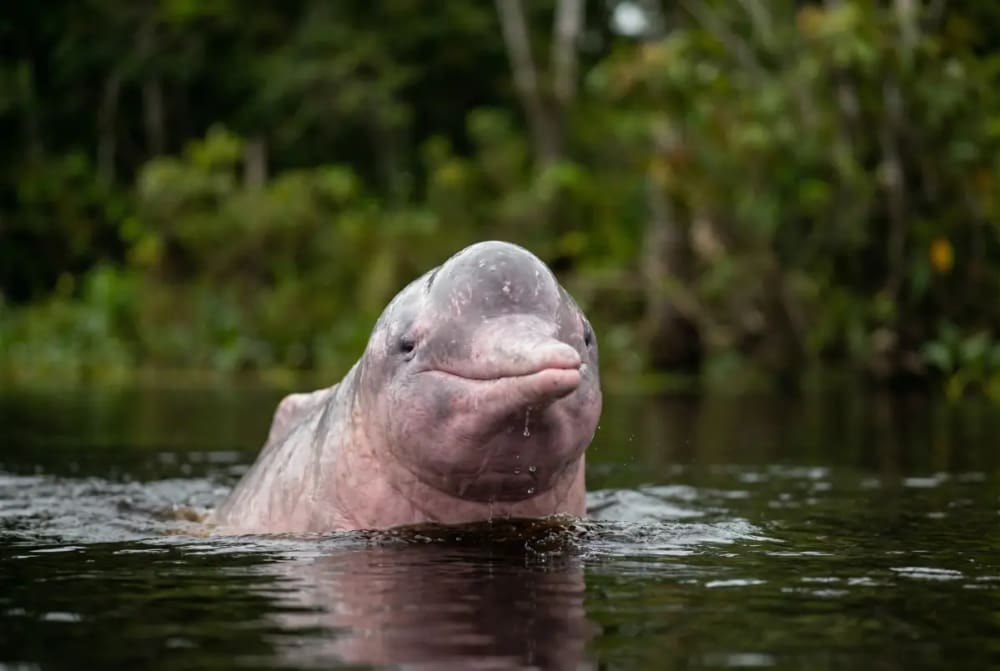
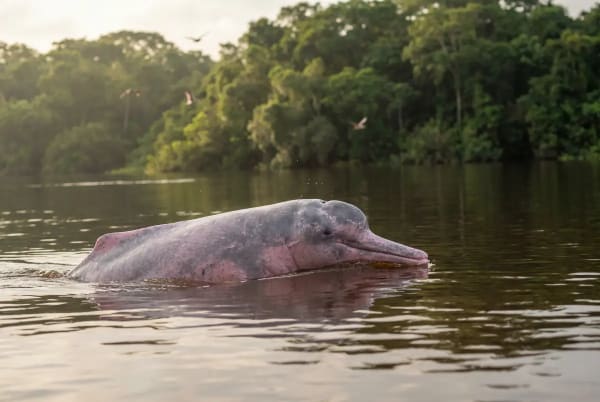
The Amazon river dolphin, called boto in Brazil, is the largest river dolphin in the world. Males reach up to 2.5 meters and 185 kilograms. Their distinctive feature: pink skin, which intensifies with excitement and physical activity — a sight that gives even seasoned travelers pause. Unlike marine dolphins, botos can rotate their heads 90 degrees — an adaptation for hunting between the roots and branches of flooded trees.
In local mythology, the boto is a magical being said to transform into a handsome young man at night and seduce humans. The reality is less romantic: since 2018, the IUCN has classified the boto as endangered. Up to 1,500 animals are killed annually in Brazil, their flesh used as bait for catfish. That makes every encounter with these animals in their natural habitat all the more valuable — and all the more important to experience respectfully.
The most reliable sightings are in the Anavilhanas Archipelago, a national park with over 400 islands about three hours by road from Manaus. In the dry season (July to November), botos concentrate in the main river channels and are easier to observe. At the Boto Flutuante, a floating platform in the Anavilhanas Archipelago, encounters are nearly guaranteed. Small wooden boats work better than large tourist vessels — the dolphins approach them more curiously.
Boto watching
- As a day tour — from $80/person (Anavilhanas)
- Best time — July to November (dry season)
- Best location — Anavilhanas Archipelago (3h from Manaus)
- In lodge package — Included (on multi-night stays)
Let us plan your Amazon stay — we know the lodges, the guides, and the best routes from our own experience. Inquire now .
Amazon lodge or river cruise — what suits you?
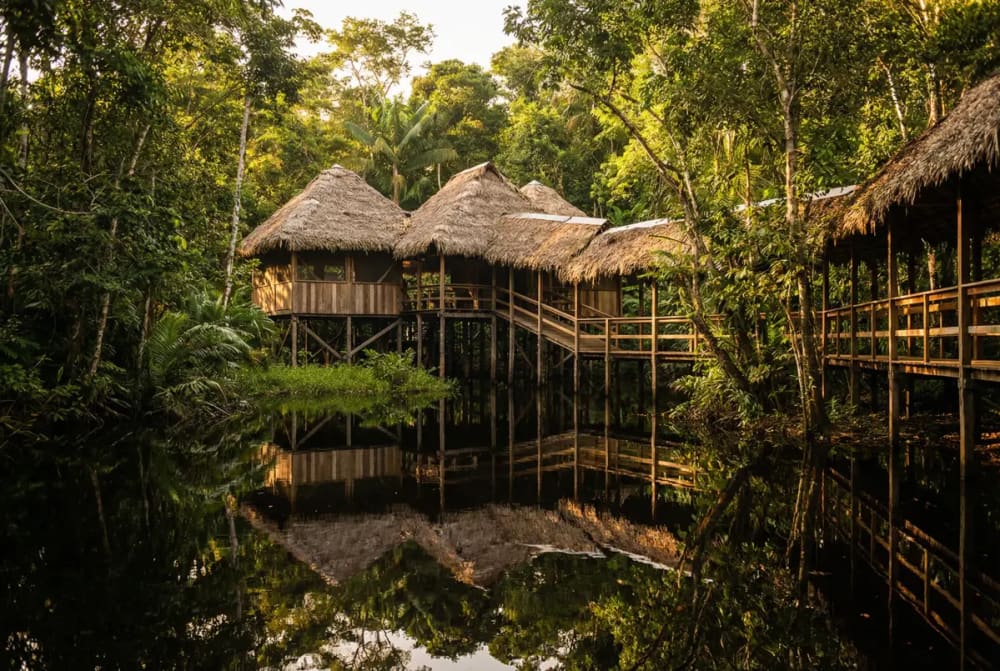
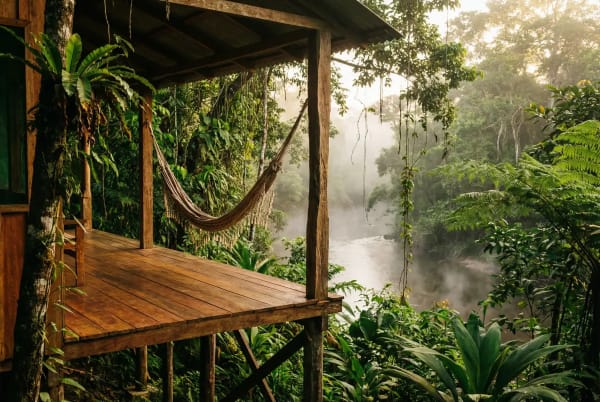
Choosing the right accommodation defines your Amazon experience. You have three main options: eco-lodges for nature-close immersion with the rainforest at your doorstep, upscale boutique lodges for the highest comfort in remote locations, and river cruises for travelers who prefer new anchorages every day without dragging luggage. All include full board and guided tours — you don't have to organize anything.
We've personally visited every lodge we recommend and know the differences in detail. An eco-lodge like Amazon Ecopark is just 50 minutes from Manaus and offers a solid entry point. Travelers willing to take a three-hour transfer are rewarded with much more pristine nature in the Anavilhanas National Park. And the Mirante do Gavião, with only 13 suites, is among the most exclusive addresses in the entire Amazon basin.
Prices as of March 2026. All figures per person, double occupancy, including transfer, full board, and guided tours.
Anavilhanas Jungle Lodge
In the heart of the national park
Ab from $810 / 3 nights
- Rio Negro location
- Few mosquitoes
- Anavilhanas NP
- À la carte cuisine
Mirante do Gavião
Luxury with only 13 suites
Ab from $1,317 / 3 nights
- Treehouse suites
- Design hotel
- Panoramic view
- Exclusive
Insider Tip
All the lodges mentioned here sit on the Rio Negro — which means noticeably fewer mosquitoes than on the Solimões, thanks to the acidic blackwater (pH 3.5) that suppresses larval development. You feel the difference particularly in the evening on the veranda.
We know these lodges personally and are glad to help you choose — because the right accommodation makes the difference between a good and a special trip. Send an inquiry .
How many days for the Amazon? Our recommendation
The most common question we get: how long should a Manaus Amazon trip last? Our clear recommendation: at least three nights at the lodge, plus half a day for the city of Manaus. A 4-day/3-night package gives you two full days of activities — enough for all the core experiences. If you'd rather take it slower, or want to add a canoe trip through flooded rainforest (igapó), choose four nights.
Tag 1 — Arrival and first impressions
Tag 2 — Rainforest, deeply
Tag 3 — Water experiences
Tag 4 — Final morning and the city of Manaus
Hinweis: For a more relaxed program, we recommend four nights — that leaves an extra day for canoe trips through flooded rainforest (igapó) or a visit to the Anavilhanas Archipelago with its 400-plus islands. If you'd like to combine the Amazon with a tour through Brazil, our Brazil Highlights itinerary is the ideal route.
Best time to visit the Amazon around Manaus
Temperatures in Manaus are constant year-round at 26 to 32°C — there's no classic summer or winter. The decisive variable is the water level, and with it the kind of experiences that are possible. Both seasons have their own character, and we deliberately advise against ruling out the rainy season categorically.
Dry season (July to November): less rainfall (58 to 183 mm per month), up to seven hours of sunshine a day. The best time for rainforest hikes since the trails are passable. Sandbanks appear along the riverbanks. Boto sightings are more reliable as the dolphins concentrate in the main channels. August and September especially combine low water and low rainfall.
Rainy season (December to May): 220 to 320 mm of rain per month, high water from February. In return, canoe trips through flooded rainforest (igapó) are only possible in these months — a unique experience where you paddle between the canopies of trees that normally tower meters above the water. The forest is lusher and greener, lodge prices are lower, and visitor numbers smaller. Many animals come closer to the water because their usual paths are submerged.
Note
Rainy season doesn't mean constant rain. Showers usually come as intense, short bursts in the afternoon — mornings and evenings are often dry, with particularly clear air. We've had some of our most striking Amazon moments during the rainy season.
A particular highlight for culture fans: the Festival de Parintins (Boi-Bumbá), Brazil's second-largest festival after Rio's carnival, takes place on the last weekend of June each year (2026: June 26–28). It's reachable by boat from Manaus — book early, at least three months ahead.
For more, see our guide to the best time to visit Brazil .
Manaus — more than just a starting point
Plan at least half a day for the city itself. Manaus surprises — and in a good way.
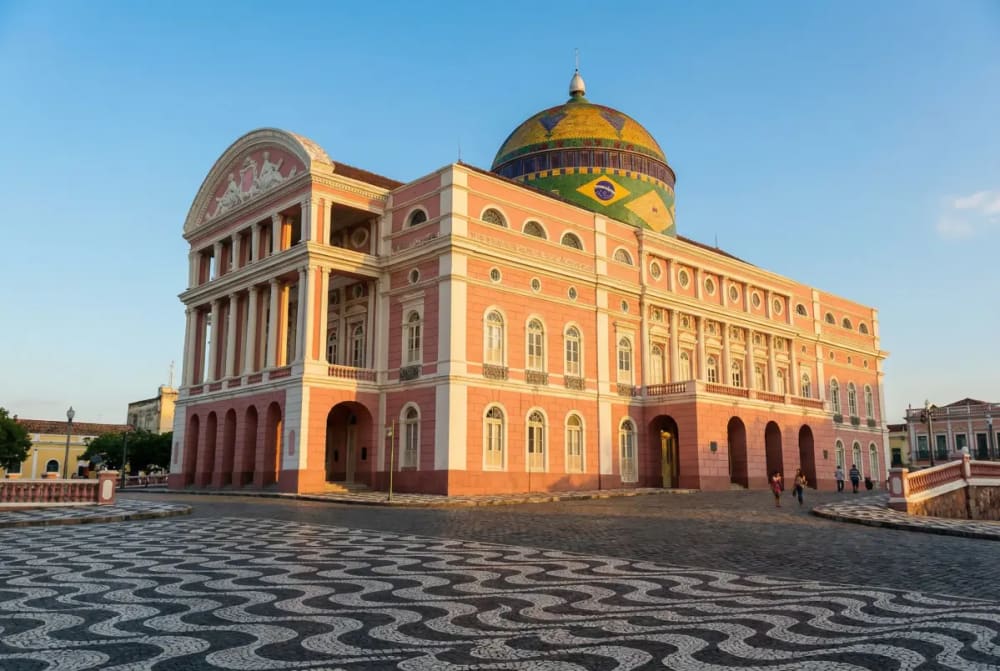
The Teatro Amazonas, opened on December 31, 1896 at the height of the rubber boom, is one of the most beautiful opera houses in South America. Rubber barons who wanted a slice of Parisian elegance in the middle of the rainforest had it fitted with imported Carrara marble, Bohemian chandeliers, and Parisian wall paintings. After the rubber price collapse in 1907, the last performance was given — then decades of silence, until Plácido Domingo reopened it with a concert in 1990. Today, performances are once again regular, including the annual Festival Amazonas de Ópera (April/May).
The Mercado Municipal Adolpho Lisboa, inaugurated in 1883 and co-designed by Gustave Eiffel, is an Art Nouveau jewel on the bank of the Rio Negro. You'll find fruits you've never seen, fresh river fish, aromatic tucupi sauces, and wood carvings by local artists. Don't miss tacacá — a hot soup made from fermented manioc juice with dried shrimp and jambu leaves, which produce a surprising tingle on the tongue. Most authentic straight from the tacacazeiras at the market, not at a tourist restaurant.
For an upscale culinary experience, we recommend Restaurant Banzeiro by chef Felipe Schaedler — a pioneer of modern Amazonian cuisine and on the World's 50 Best Discovery list. His tambaqui (freshwater fish ribs, similar to BBQ ribs) and pirarucu in tucupi sauce rank among the best Brazilian cuisine has to offer. Reservations recommended.
Less famous but worthwhile: the Praça do Paço da Liberdade with the Palácio Rio Branco and the newly installed city museum offers restored historic buildings and a quiet contrast to the bustling market. And Bosque da Ciência (INPA) is a short forest walk with rescued manatees, monkeys, and giant otters — for just R$5 admission, ideal for travelers with limited time.
Teatro Amazonas & Mercado Municipal
- Teatro Amazonas — R$20 (approx. €4) admission
- Hours — Tue-Sun (Teatro), Mon-Sat 6 am-5 pm (Mercado)
- Restaurant tip — Banzeiro — modern Amazonian cuisine, reservations recommended
- Banzeiro dinner — approx. €40-70/person
Good to know before you go
Getting to Manaus
There are no direct flights from Europe to Manaus. The most common route for international travelers runs via São Paulo (direct from Frankfurt, approx. 12 hours), then onward to Manaus (approx. 4 hours). LATAM and Gol offer multiple daily connections. The domestic flight from São Paulo starts around $94 (one-way).
Transfer Manaus Airport (MAO) → City / Lodge Eduardo Gomes Airport → City center / Lodge
More on flights and getting to Brazil .
Health and vaccinations
For the Amazon, a yellow fever vaccination is strongly recommended and required for some entries. Discuss malaria prophylaxis with a tropical medicine specialist — the risk is lower in lodge areas on the Rio Negro than on the Solimões, thanks to the acidic blackwater that suppresses mosquito development. Insect repellent with DEET (at least 30%) is non-negotiable in any case.
More on vaccinations and health in Brazil.
Safety
Jungle lodges are safe, guided environments with no crime risk — you're in better hands here than in any major city. In the city of Manaus, the usual big-city rules apply: leave valuables in the hotel safe, use Uber or the local app 99 instead of street taxis, and don't walk alone in unlit neighborhoods at night.
Basic precautions in the city of Manaus
Pickpocket hotspots: Mercado Adolpho Lisboa, the Ponta Negra waterfront, around Teatro Amazonas. Avoid public transit — use Uber or 99 (the local Brazilian Uber equivalent) instead. Both apps are reliable in Manaus.
More on safety in Brazil. Information on entry and visa and our packing list for Brazil.
Costs at a glance
What does an Amazon trip from Manaus cost? The overview below gives you a realistic estimate — from a half-day boat tour to a multi-night lodge with a full program.
Prices as of March 2026. Lodge prices per person, double occupancy. Exchange rate: 1 EUR ≈ 5.80 BRL.
More on costs and budget in Brazil.
Discover more of Brazil
The Amazon combines beautifully with other stops on a Brazil tour . The classic combination pairs the Amazon with the Pantanal — two completely different ecosystems that complement each other perfectly: dense, humid rainforest with hidden wildlife on one side, open savanna with the best wildlife viewing in South America on the other. Domestic flights from Manaus reach every region of Brazil within a few hours.
Pantanal — Brazil's wildlife paradise
Fernando de Noronha — Brazil's hidden island archipelago
Rio de Janeiro — Between mountains and sea
Our Brazil Highlights: Amazon, Pantanal & Northeast tour links the Amazon with the country's most striking regions. For nature lovers, we recommend Brazil Nature: Pantanal & Fernando de Noronha. If you have more time, our Brazil Intensive: 3 Weeks offers the most comprehensive route.
Reading tip: our blog post Pantanal vs. Galápagos — where do you see better wildlife? compares two of South America's best wildlife destinations.
To book a trip or for more information, contact us. We'll help you plan and guide you through your upcoming adventure!
Frequently Asked Questions
The dry season from July to November offers the best conditions for hikes and wildlife sightings — less rain, up to seven hours of sunshine a day, and boto dolphins concentrating in the main river channels. The rainy season (December to May) has its own appeal: canoe trips through flooded rainforest (igapó) are only possible then, lodge prices are lower, and there are far fewer tourists. For more, see our guide to the best time to visit Brazil.
We recommend at least three nights at a jungle lodge. A typical 4-day/3-night package offers two full activity days plus a half-day arrival and half-day departure — enough for the meeting of the waters, piranha fishing, a night safari, and boto watching. For a more relaxed program with extra canoe trips, four nights is ideal. Add half a day for the city of Manaus (Teatro Amazonas, Mercado Municipal).
A mid-range eco-lodge starts at $300 per person for three nights (all-inclusive with transfer, full board, and guided tours). Upscale lodges like Anavilhanas Jungle Lodge start at around $810; luxury boutique lodges like Mirante do Gavião from $1,317. Amazon river cruises start at $1,049 for four days. All prices per person, double occupancy (as of March 2026).
We strongly advise against it. The rainforest can't be navigated safely without local guides, and the best experiences — night safari, boto watching, piranha fishing — require experienced guides with local knowledge. Lodges offer well-organized programs with trained nature guides who know the forest and its inhabitants. That's the safest and most rewarding way to experience the Amazon.
A yellow fever vaccination is strongly recommended and required for some entries. Discuss possible malaria prophylaxis with a tropical medicine specialist — the risk varies by lodge location. Lodges on the Rio Negro have far fewer mosquitoes than on the Solimões, since the acidic blackwater suppresses larval development. DEET-based insect repellent (at least 30%) is essential. More in our guide to vaccinations and health in Brazil.
Most lodges organize the transfer from the city of Manaus or directly from the airport — the price is included in the package. Depending on the lodge, the boat ride takes between one and three hours. Amazon Ecopark is reachable in 50 minutes; Anavilhanas Lodge takes about three hours by van and boat. We recommend taking the longer transfer: more remote lodges offer a noticeably more intense nature experience.
In the dry season (July to November), the chances are highest — botos concentrate in the main river channels. At Boto Flutuante in the Anavilhanas Archipelago, encounters are nearly guaranteed. In the rainy season, the dolphins move into flooded forests and are harder to find. Your guide knows where the best chances are — we only work with guides who have known these waters for years.
Absolutely — and we recommend it. The classic combination is the Amazon and the Pantanal: two completely different ecosystems, just a few hours apart by domestic flight. Rio de Janeiro and Brazil's Northeast also fit naturally on the same trip. Our Brazil Highlights tour links the most striking regions in a thoughtful route.