

Manuel Antonio
Where jungle, sloths, and three dream beaches meet on 19.83 square kilometers
Where jungle, sloths, and three dream beaches meet on 19.83 square kilometers
Costa Rica's smallest national park is also the most visited — and not by chance: Nowhere else in the country does the path between rainforest and dream beach shrink to just a few hundred meters. Sloths above the path, capuchin monkeys at the roadside, endemic titi monkeys in the treetops. Manuel Antonio is the place where first-time visitors understand what 'Costa Rica' actually means.

Best travel time
December to April — dry season on the central Pacific coast with the most sunshine hours. August to October combines green season with humpback whale high season.
Why Manuel Antonio?
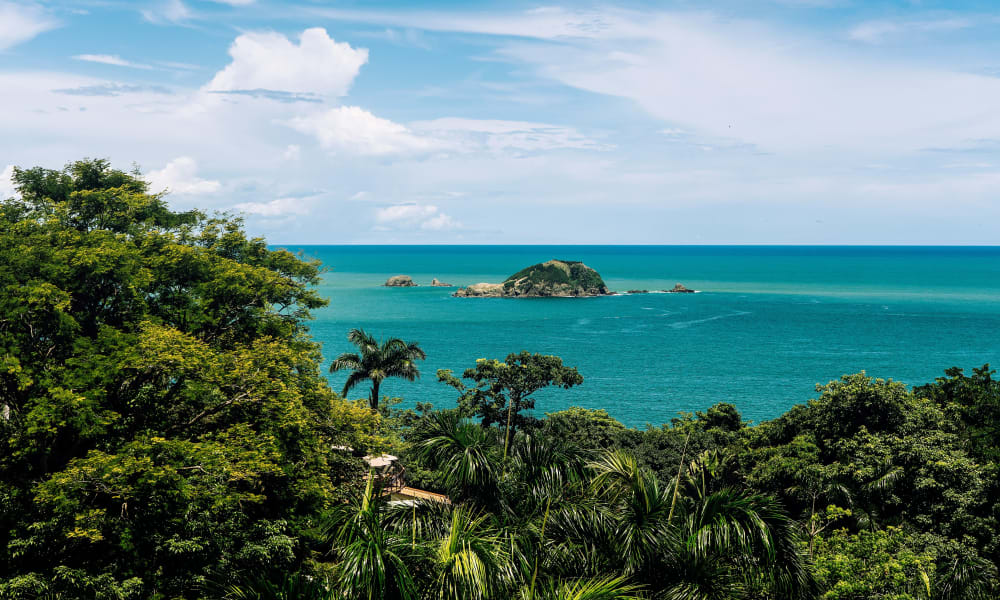
There are larger parks, wilder parks, and parks that are harder to reach in Costa Rica. Manuel Antonio is none of those. The smallest national park in the country measures 19.83 square kilometers of land area — and that is its promise: jungle, sloth, capuchin monkey, and dream beach are not a day's journey apart, but side by side. Those who step off the main path stand ten steps later in the golden sand of Playa Manuel Antonio; the turquoise Pacific swells onto a beach framed by rocks into a perfect horseshoe bay.
Forbes counted Manuel Antonio among the twelve most beautiful national parks in the world in 2011 — in the same breath as the Serengeti and Fuji-Hakone-Izu. The author's justification, Jane Levere: 'a dizzying variety of tropical rainforest, beaches, and rocky peninsulas.' For the fraction of a Serengeti area, one can document 109 species of mammals and 184 species of birds — a density of biodiversity that is extraordinary even in Costa Rica.
The history of the park is rarely told and explains a lot: In the early 1970s, the then-owner Arthur Aime Bergeron fenced off the beaches and hired armed guards. The youth of Quepos tore down the fences time and again. After years of protest, the government intervened; on November 15, 1972, parliament passed law No. 5100 and declared the area a national park. Manuel Antonio is in this sense not a gift of nature to tourism — it is the result of a community that did not want to give up its coast.
For travelers today, this means: well-developed paths, a strict nature conservation framework, and a park that retains its character despite its popularity. Since 2023, a daily visitor limit of 1,120 people applies — a third of the former upper limit. Those who visit Manuel Antonio as part of a Costa Rica round trip will find here the probably most entry-friendly wildlife spot in the country. And at the same time, the place where every Costa Rica trip ending on the Pacific coast has its emotional high point.
The national park — Trails through the rainforest
The park is small, but well developed. Seven to eleven trails with a total of around seven kilometers of paths can be easily combined in one day. Most are flat, paved or gravelled — hiking shoes are not necessary; sturdy footwear is sufficient.
The Sendero Principal is the main artery: a one to two kilometer long, wide path from the entrance to Playa Manuel Antonio. Every park visit begins here, and most animal sightings are also here — sloths in the tree branches, capuchins at the edge, occasionally a toucan. The parallel trail Sendero Perezoso is the secret discovery: an approximately 570 meter long, barrier-free boardwalk with Braille signage and wheelchair accessible. It leads through a mangrove area to Playa Espadilla Sur and is one of the most inclusive nature trails in all of Central America.
Those seeking a view should choose the Sendero Punta Catedral — a 1.2 kilometer long circular path over the namesake rock peninsula. The highlight at 100 meters offers a 360-degree panorama of the coast and offshore islands. Punta Catedral itself is geologically remarkable: a tombolo, that is, a former island that connected to the mainland through sand accumulation over about 100,000 years. Two beaches, separated but also connected by 100 thousand years of earth history.
The Sendero Mirador is the most challenging path with stairs, but leads to a quiet viewpoint of the jagged coastal formation Punta Serrucho and is, because it is less frequented, one of the best trails for wildlife sightings away from the crowds. Similarly quiet: the Sendero Puerto Escondido (about 1.6 kilometers), which leads through dense tropical forest to the eponymous secret beach. Those who walk here should check the tides — at high tide, the beach may become inaccessible or cut off visitors.
Insider tip: The park closes the beaches at 3:00 PM, and the exit at 4:00 PM. Those who book the last entry at 2:00 PM realistically have just under an hour at the water. To ensure a full park visit, definitely choose a time slot between 7:00 and 9:00 AM.
A warning that is rarely mentioned in catalog texts but belongs to the honest picture: The park is home to the Manzanillo tree (also known as Manchineel), one of the most poisonous trees in the world. Its milky sap causes severe skin irritation, and its apple-like fruits are highly toxic. The specimens in the park are marked — do not touch, do not stand under when it rains, and definitely do not try the fruits. Guides routinely point out the trees.
Wildlife — what you are guaranteed to see with patience
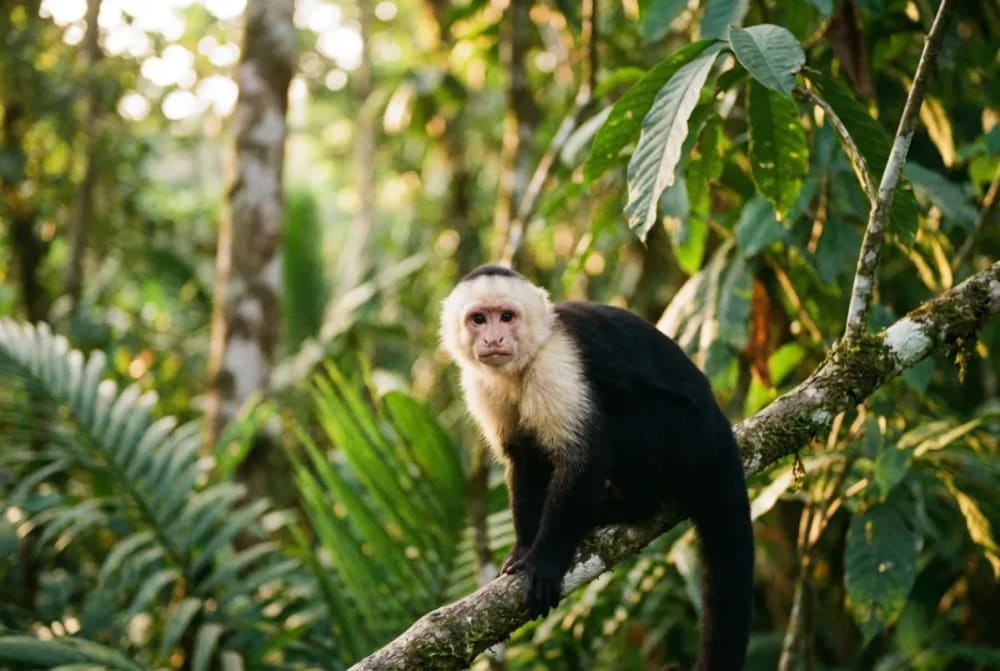
Manuel Antonio is the park where first-time visitors learn to read Costa Rica. Three of the four Costa Rican monkey species live here: the white-headed capuchin (Cebus capucinus), the howler monkey (Alouatta palliata) and the Central American squirrel monkey, locally called titi (Saimiri oerstedii citrinellus).
The titi is the park's flagship species — and a silent drama. The subspecies lives exclusively on the central Pacific coast around Quepos and Manuel Antonio. In the early 1980s, the population was estimated at around 200,000 animals; today, Costa Rican primatologists estimate about 2,000 individuals. A decline of 99 percent, caused by habitat loss and fragmented forests. Those who stand on the Sendero Principal in the first entry hours and are lucky may see a group of 20 to 75 animals moving through the branches — golden fur, bright skull caps, remarkably fast movements. It is one of the few places in the world where the species can still be observed in the wild.
The capuchins are the most common monkeys and the most taming — almost too taming. They have learned to open zippers and rummage through bags. Never leave backpacks unattended, do not carry visible snacks, and do not interpret eye contact as an invitation. You can hear the howler monkeys before you see them: their deep, raspy calls carry for kilometers and are among the loudest sounds in the animal kingdom.
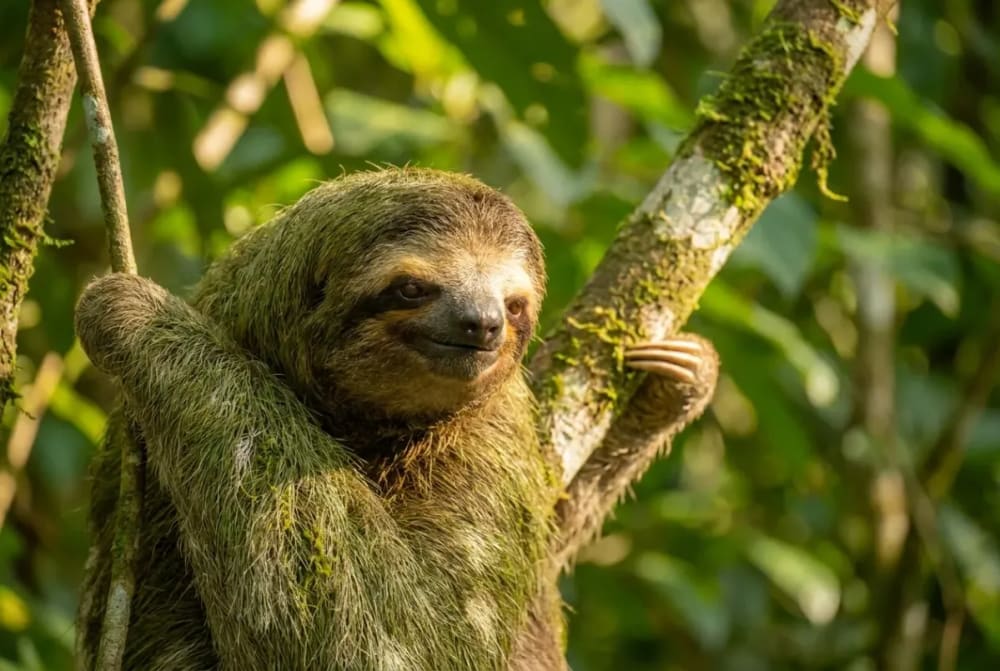
The two sloth species of the country are both represented: the three-toed sloth (Bradypus variegatus), diurnal, often in mid-tree forks between five and fifteen meters high, and the two-toed sloth (Choloepus hoffmanni), nocturnal and considerably harder to spot. Both sleep 15 to 20 hours a day and are masterfully camouflaged. Here, the value of a guide becomes most apparent: Those who are out alone miss about 70 percent of the wildlife, according to experienced guides. With a guide and spotting scope, what remains hidden to the naked eye becomes visible — an immobile sloth in the foliage, a camouflaged basilisk on a roots, a dendrobat in the fern.
Added to that are coatis, green iguanas, the 'Jesus lizards' that can walk on water, colorful poison dart frogs, toucans, and motmots. Occasionally, ocelots, white-tailed deer, or even tapirs appear. Pelicans and frigatebirds can be seen along the coast year-round.
The beaches — Manuel Antonio, Espadilla Sur, and hidden bays
Playa Manuel Antonio, sometimes called Playa Tres, is the postcard bay: a horseshoe-shaped bend of golden sand, framed by rocks that noticeably slow down waves and currents. The water is calm, clear, suitable for swimming and snorkeling. Blue Flag certified in the Costa Rican Bandera Azul Ecológica program, with a three-star rating — a sign of real water quality, not marketing gloss. The rainforest grows right up to the sand's edge. Those who come early have this beach almost to themselves; it fills up around ten in the morning.
Playa Espadilla Sur is right next door, separated by Punta Catedral. Crescent-shaped, more spacious, with more space to lie down — but also with noticeably stronger currents. Swimming here is only possible with caution; families with younger children are better off on the Manuel Antonio side. Two more bathing bays can be reached via short paths: Playa Gemelas, two small twin bays about 20 minutes from the main beach, rarely overcrowded; and the more remote Playa Puerto Escondido, which should only be reached with a tide calendar in hand.
Those wanting to go to the water after 3:00 PM — when the park is closed — divert to the public Playa Espadilla. It is located outside the park, directly north of the entrance, is free to access, and is ideal for the evening after a park visit, with sunsets that are notorious in the region.
Insider tip: Reef-safe sunscreen is mandatory in the park — regular sunscreens harm the offshore coral structures. And: Do not bring food. Bag checks at the entrance have been strict since 2025; allowed are water and fruit juices in glass or reusable containers. The cafeteria in the park has reopened since 2024.
Activities outside the park
Two to three nights in Manuel Antonio leave room for more than just the park itself. Especially Tuesday — when the national park is closed all day — becomes a natural day for the surroundings.
One of the most rewarding day trips leads to the Nauyaca waterfalls, about an hour south in Dominical. Two cascades plunge one over the other — the upper one 45 meters, the lower one 20 meters over rocky steps — into a natural swimming pool. Three access options are available: a six-kilometer hike (entrance 10 USD), a horseback riding tour with Don Lulo from 8:00 AM to 1:30 PM including lunch (around 80 USD), or a jeep tour for about 32 USD. The horseback riding tour has a weight limit of around 100 kilograms and must be booked in advance.
For a quiet, very Costa Rican morning, the mangrove kayak tour on Isla Damas ten kilometers north is recommended. Two hours of guided paddling through a maze of mangrove channels, where capuchins, sloths, kingfishers, caimans, and ibises come into view. From around 45 USD per person; the exact times depend on the tide level and are often only confirmed 48 hours before the tour begins. Morning tours are clearly preferable to afternoon tours.
From July to October — peaking in August and September — humpback whales cross in front of the coast of Manuel Antonio. A second, weaker window opens from December to April. Catamaran tours from Quepos combine whale watching with snorkeling and lunch and cost 65 to 80 USD per person. Dolphins — spinner and spotted dolphins — are on the move year-round. Those wanting to dive deeper can travel to Isla del Caño, an hour further south: over 25 meters of visibility, manta ray chances, day trips from about 130 USD.
Best travel time and the park's visitor limit
The central Pacific coast is wetter than the northern Pacific, and even in the dry season, it occasionally rains here. The classic high season runs from December to April: the most sunshine hours, lowest probability of rain, but also the highest prices and the quickest sold-out park tickets. January to March are considered the most reliable months.
The green season from May to November is underrated. Rain usually falls in the afternoon, often for one to three hours, while the mornings often have clear skies. The vegetation is lush green, the wildlife is active, accommodations cost about 20 percent less, and park tickets are much easier to obtain. Particularly rewarding: August to October, when the green season overlaps with humpback whale high season. For travelers with flexible schedules, one of the best windows overall — fewer people, lower prices, whales offshore.
Average temperatures remain between 27 and 32 degrees Celsius throughout the year, feeling temperatures can reach up to 38 degrees on hot afternoons. Nights stay warm.
The crucial planning tip concerns the visitor limit: Since a ruling by the Costa Rican Constitutional Court in 2023, a maximum of 1,120 people per day are allowed in the park — a third of the previous upper limit. Admission occurs in 40-minute windows starting at 7:00 AM; the last window opens around 2:00 PM. Tickets are available exclusively online through the official SINAC portal (serviciosenlinea.sinac.go.cr), no on-site sales. In high season, tickets are often sold out days in advance; we recommend booking two to three weeks in advance, earlier during peak weeks. And: The park is closed all day on Tuesdays — a rule introduced in 2019 that many German-speaking travel guides are still unaware of.
Entrance 2026: 16 USD for foreign adults plus 13 percent tax (around 18.08 USD), 5 USD plus tax for children aged two to twelve years, free for those under two years old.
Arrival and logistics
Manuel Antonio is 157 road kilometers from Juan Santamaría International Airport (SJO) in San José. Four options:
- Rental car: 3.5 to 4 hours without traffic, via Route 3 through Atenas or more scenically via Costanera Sur (Route 34). The route is completely paved; a regular car is sufficient for Manuel Antonio itself; a 4x4 is not required.
- Shared shuttle: about 3.5 to 4 hours, from about 65 USD per person, hotel-to-hotel transfer. Comfortable, several departures daily.
- Private transfer: similar travel time, around 210 USD for one to six people. Flexible with stops, ideal for families or small groups.
- Domestic flight with SANSA or Skyway: only 25 minutes from SJO to Quepos, from 125 USD one way. For travelers who want to save time or are traveling with small children, the best option.
The public Tracopa bus from San José takes four to five hours and costs about 11 USD — rarely the best choice for individual travelers when the day is limited.
On-site, the question is: Quepos or Manuel Antonio? Quepos is the authentic port town, seven kilometers north of the park. Cheaper accommodations, local sodas, marina, lively nightlife — but no bathing beach right in town. The town Manuel Antonio is located directly at the park entrance, is more touristy, more expensive, but has Playa Espadilla at its doorstep and a concentration of boutique hotels and restaurants with sea views. The hill road between both locations is the actual hotel zone in the region, with the most well-known resort addresses and viewpoint restaurants.
Our rule of thumb: Families and first-time visitors are best accommodated directly in the town of Manuel Antonio. Couples who value peace and views will find their balance on the hill road. Quepos is worthwhile for travelers who prioritize authentic local flair and lower prices. The bus between both places runs every 20 to 30 minutes for less than a dollar, taxi around eight dollars.
For a selection of accommodations based on travel style — from the small eco-lodge to the Relais & Châteaux resort — please contact us directly . We know the properties personally and know which one fits which journey.
To book a trip or for more information, contact us. We'll help you plan and guide you through your upcoming adventure!
Frequently Asked Questions
Not mandatory, but highly recommended. Experienced rangers estimate that solo visitors miss about 70 percent of the wildlife — especially sloths, camouflaged dendrobats, resting snakes. A guide with a spotting scope reveals details that the naked eye does not perceive. At the park entrance, guides can be booked for around 20 to 30 USD per person for two hours; full packages with transfer from the hotel cost 50 to 85 USD. For first-time visitors to Costa Rica, the extra cost is almost always worth it.
Two to three nights is the right size. With two nights, you spend a full day in the park (six to eight hours including beach time) and one day for Nauyaca, mangroves, or catamaran. Three nights leave room for a relaxed rest day at the beach or an additional wildlife tour. If you have a Tuesday in your time, you’ll automatically plan the park around this closure day.
Families and first-time visitors are best accommodated directly in the town of Manuel Antonio: short distance to the park, Playa Espadilla at their doorstep, nice boutique hotels. Couples and connoisseurs will find resorts with sea views and infinity pools on the hill road between the two locations. Quepos is the choice for travelers who prioritize local flair and cheaper prices, but are willing to take a taxi or the bus to the beach.
No, the park is open on holidays. The only regular closing day is Tuesday — a rest rule introduced in 2019, during which wildlife and trails find rest from visitor traffic. The park is open Wednesday to Monday from 7:00 AM to 4:00 PM, with the last entry around 2:00 PM. The beaches close at 3:00 PM.
No. Since 2025, food is generally not allowed, and bags are checked at the entrance. Allowed are water and natural fruit juices in glass or reusable containers. The park cafeteria has been back in operation since 2024 and offers drinks and small meals. Additionally prohibited: drones, pets, alcohol, single-use plastics, umbrellas, lounge chairs, and hammocks. These rules are part of the conservation concept — capuchins should not be conditioned to human food.
Yes, it is one of the most family-friendly national parks in Costa Rica. The paths are flat and paved, the Sendero Perezoso is barrier-free and also suitable for baby strollers, Playa Manuel Antonio has shallow, calm waters and Blue Flag status. Wildlife sightings are almost guaranteed with a guide — and hardly any experience excites children as reliably as a sloth above their heads. Children up to two years have free entry, up to twelve years the reduced rate applies. A Costa Rica family trip usually combines Manuel Antonio with Arenal or Monteverde into a round route.