


Fernando De Noronha
UNESCO World Natural Heritage in the South Atlantic — 354 km off the coast of Brazil
UNESCO World Natural Heritage in the South Atlantic — 354 km off the coast of Brazil
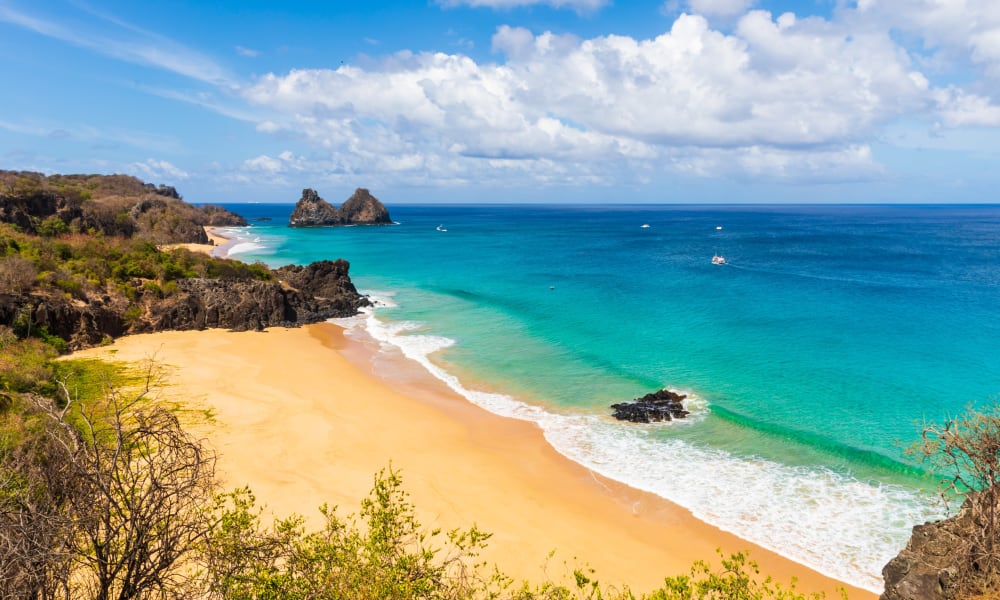
21 volcanic islands in the South Atlantic, a strictly limited visitor quota, and the beach Baía do Sancho, repeatedly voted the most beautiful in the world: Fernando de Noronha is Brazil's most exclusive nature destination — UNESCO World Heritage since 2001, Mission Blue Hope Spot since October 2025, and an archipelago that protects its own reputation with visitor limits, environmental fees, and a plastic ban.

Best Travel Time
August to January — Dry season with calm seas on the inside and diving visibility from 30 to 50 meters.
Why Fernando de Noronha?
354 kilometers off the northeastern coast of Brazil, in the middle of the South Atlantic, a volcanic cone rises from the sea — rooted 4,300 meters deep on the ocean floor, visible 320 meters above water. What can be seen above the surface are 21 islands and rocks, of which only one is inhabited: Fernando de Noronha. About 3,000 people live on 26 square kilometers. There are no traffic lights, no hotel chains, no single-use plastic bottles — and only one single entry point, the airport.
UNESCO declared the archipelago a World Natural Heritage site in 2001, alongside the neighboring Rocas Atoll. The reasoning reads like an invitation: exceptional natural beauty, the largest concentration of tropical seabirds in the western Atlantic, the only oceanic mangrove forest in the South Atlantic. In October 2025, a second seal of quality was added — the Mission Blue initiative of marine biologist Sylvia Earle included Fernando de Noronha as a “Hope Spot" in its global network of critical marine protection areas. An archipelago home to 1,500 documented species, including 250 reef fish and two bird endemics found nowhere else in the world.
That one is even allowed to fly there is not a matter of course. Since May 2023, a formal visitor limit of 11,000 people per month has been in place — 132,000 per year. In 2025, this limit was exceeded for the first time according to the responsible management committee, with about 140,000 guests. Anyone wanting to experience Fernando de Noronha in the coming years is traveling to a natural laboratory that is currently grappling with its own future. And the most important component is: early planning.
The Most Beautiful Beaches
Fernando de Noronha is often described as the “Brazilian Galápagos," but the beaches are a chapter of their own. 17 beaches on the main island, each with its own character, its own access regulations, and its own time window. The island is naturally divided into two halves: the calm Mar de Dentro in the northwest (towards the mainland) and the rough Mar de Fora in the southeast (open Atlantic).
Baía do Sancho — the World Beach
Baía do Sancho has been voted the most beautiful beach in the world six times overall at the Travellers' Choice Awards by TripAdvisor — in 2014, 2015, 2017, 2019, 2020, and 2023. A crescent-shaped bay, framed by 70-meter-high, densely vegetated cliffs, with turquoise water and a single, remarkable access route: two vertical iron ladders through a narrow rock crevice. Those who descend pay with about 70 meters of vertical descent — not suitable for those with a fear of heights, but part of the ritual, without which the bay would not be the same. Alternatively, it can be reached by boat, with only four boats allowed to anchor in the bay at the same time.
Access is through the control point PIC Golfinho-Sancho (open 8 am to 6 pm) and requires the ICMBio park ticket. In the mornings, visitors queue up at the ladders; those who plan wisely come in the afternoon from 2 pm — then the bay is noticeably emptier and the light is more spectacular.
Baía dos Porcos and Praia do Leão
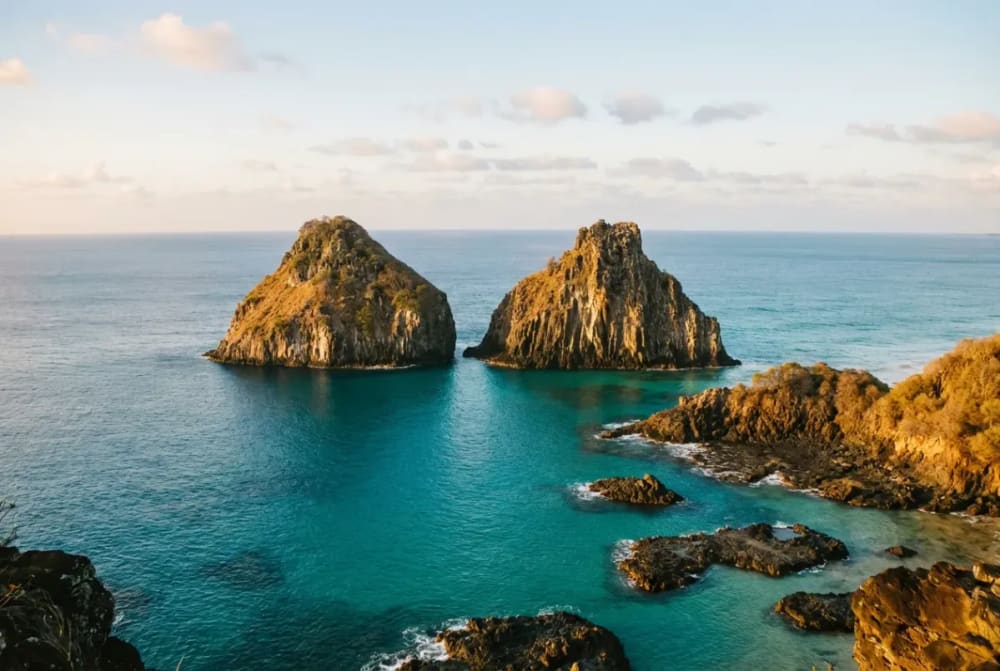
Baía dos Porcos is the little sister bay of Sancho: only about 100 meters wide, with rock needles in the turquoise water and a view of the namesake Morros Dois Irmãos, the two brothers' rocks. Accessible at low tide via the beach path, at high tide only by swimming from the Sancho side. Together, the two bays belong to the best snorkeling spots on the island.
Praia do Leão on the southern side is different — wild, wide, with strong surf. Named after a lion-shaped rock formation, it is considered the most important turtle nesting beach on the island. Between November and March, green sea turtles lay their eggs here at night; swimming is usually prohibited throughout the year due to currents. Those who come do so for the view and the tranquility.
Praia da Conceição, Praia do Porto and the small secrets
Praia da Conceição is the longest central beach on the island — over one kilometer of sand with the 320-meter-high Morro do Pico in the background, one of Brazil's most photogenic scenes. No park ticket is needed because the beach is in the APA zone. Praia do Porto right at the harbor is perhaps the most underrated tip: one of the easiest places in the world to snorkel with sea turtles spontaneously, without a tour, without reservation, and without entrance fee.
Then there are the quieter beaches — Praia do Bode with golden sand and few visitors, Praia do Sueste with a mangrove forest more than 2,000 years old (the only one of its kind in the South Atlantic), and Cacimba do Padre, the world-class surfing beach when the Atlantic waves roll in from the northwest between December and March.
Five hiking trails on the island — Capim Açu, Abreu, Atalaia, Pontinha Caieira, and Morro São José — can only be hiked with an accredited ICMBio guide and within daily tidal windows. The Atalaia, with its natural tidal pools home to turtles and small sharks, is the most booked destination — early reservation is recommended.
Diving and Snorkeling
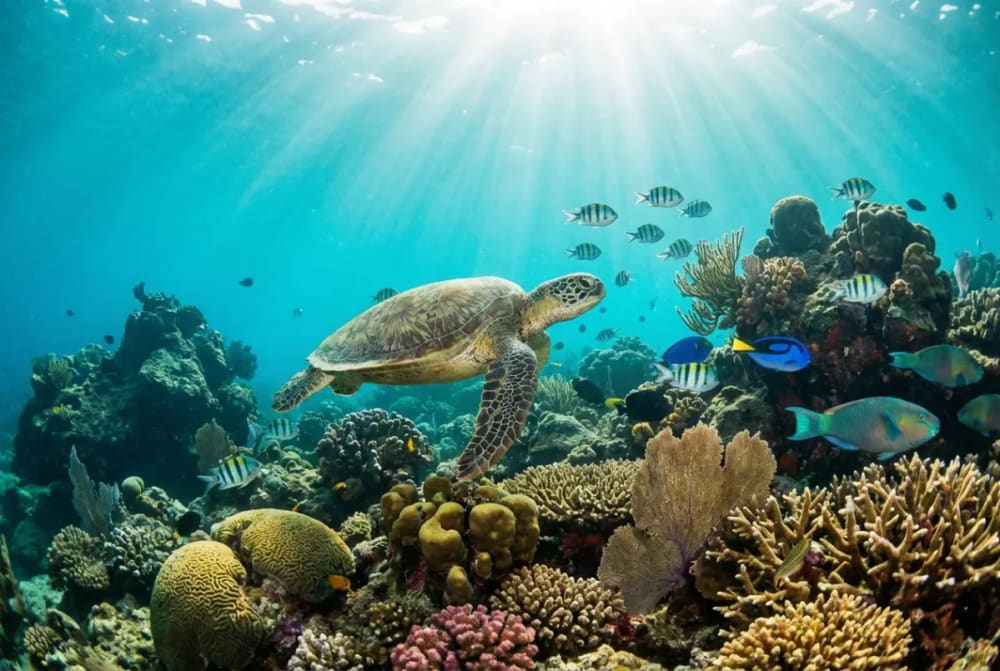
There are diving spots in the world where one can see ten meters away. Fernando de Noronha starts at 30. In the best weeks of the year, underwater visibility in the coral reefs on the island's inside can reach 50 meters — values that are usually only reached in the open ocean or in a few freshwater sources. The water temperature remains consistently between 25 and 27 °C year-round, neoprene is not necessary at typical depths.
The reason for this visibility lies in the geology. Because Fernando de Noronha, as a pure volcanic island, has no continental shelf, the walls rise directly from the deep water. Sediments are carried away by currents instead of settling in shallow water. In addition, there is strict regulation: The responsible conservation association ICMBio limits the daily number of boat departures per licensed operator, each diver can only complete a maximum of two dives per day, and free diving outside approved routes is prohibited.
An Overview of the Dive Sites
Of the 22 active dive sites, three sites stand out even in international comparison. The Corveta Ipiranga (V-17) is a Brazilian warship wreck that was deliberately sunk in the 1980s and now lies at depths of 20 to 62 meters. The bow section is shallow enough for advanced divers, the stern is tech diving territory. Schools of barracudas, morays, rays, and schools of triggerfish have claimed the wreck.
The Caverna da Sapata at the western tip of the island is an underwater cave, entrance at 24 meters, bottom depth 35 meters. Orange corals cover the walls; black grouper weighing up to 400 kilograms (“Meros”) patrol the entrance, manta rays glide by in the current. Here, advanced certification is also recommended.
Pedras Secas is the photographer's spot: a network of tunnels, rock crevices, and natural arches at depths of 8 to 25 meters, covered with colorful corals and easily accessible for solid open water certified divers.
Fernando de Noronha is also officially classified as an Important Shark Ray Area (ISRA) — one of the few zones worldwide where Caribbean reef sharks can be regularly and predictably observed resting in caves. None of the sharks that regularly occur here are considered aggressive towards divers.
Operators and Prices
Four providers have long-standing licenses: Atlantis Divers (since 1994, Brazil's largest operator), Águas Claras (since 1998, only provider with its own 3-meter training pool), Noronha Divers (over 30 years of experience), and Sea Paradise Noronha. A guided double dive with boat transfer and guide costs around R$ 1,200 to 1,400 (around 195 to 230 euros) in 2026, an introductory dive (“Discover Scuba Diving”) costs R$ 950 to 1,200. The PADI, SSI, and NAUI certificates are recognized.
Insider Tip: The Mar de Dentro on the island's inside is calmest and clearest from August to February — ideal for snorkeling, beginner dives, and maximum visibility. The outside (Mar de Fora) offers more exciting encounters with pelagic species from March to July. Those diving extensively should plan at least six full days on the island — with two dives per day, too many highlights will otherwise go unseen.
In high season (December to February, July to August), dive slots with Atlantis Divers and Águas Claras are often booked weeks in advance — direct booking from Germany is mandatory.
Wildlife — Dolphins, Turtles, Sharks
Fernando de Noronha is Brazil’s most concentrated wildlife stage in the sea. And each flagship animal has its own place, its own time, and its own rule.
The Spinner Dolphins of Baía dos Golfinhos
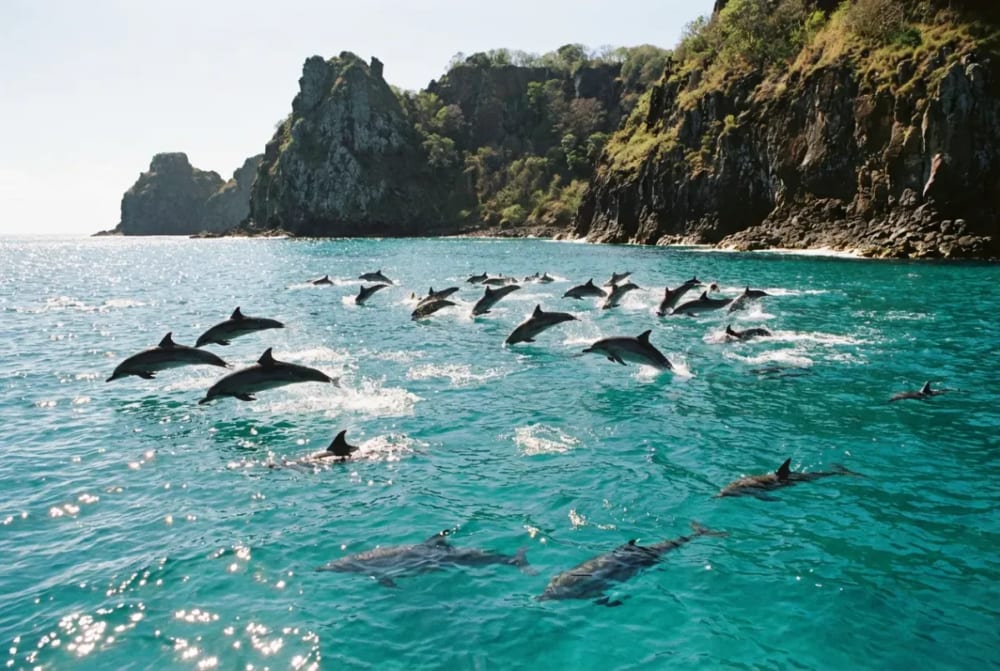
The bay at the northwestern end of the island has its name for good reason: Spinner dolphins (Stenella longirostris longirostris) retire here after their nightly hunt in the open Atlantic, for breeding and socializing. The official Projeto Golfinho Rotador, founded in 1990 and supported by Petrobras for decades, has documented dolphin sightings on 93 percent of all days of the year — between 1991 and 2015, an average of 284 animals entered the bay daily, with peak values of up to 2,000 individuals.
The dolphins arrive between 5:30 and 9:00 am. Between 9 and 11 am, they leave the bay again heading toward the open sea. This means: Those who want to see them should be at the viewpoint Mirante dos Golfinhos by 6 am at the latest. Researchers from the project are often on-site and provide binoculars. Watching is free and does not require a national park ticket. Swimming with dolphins, however, is strictly prohibited.
The scientific justification for this ban is uncomfortable but important. Between 1998 and 2015, the average length of stay of dolphins in the bay dropped from 8.5 to 2.6 hours per day — a decrease of almost 70 percent, triggered by nautical mass tourism. Any disturbance shortens the resting time, and any shortened resting time affects the population. Today's rules are the answer to this finding.
Projeto TAMAR and the Turtles
The Projeto TAMAR has been working on Fernando de Noronha since 1984. An average of 100 nests are cared for each year, from which around 8,900 green sea turtles (Chelonia mydas) hatch. The endangered hawksbill turtles (Eretmochelys imbricata) also nest here. The main nesting time is between November and March, peaking from December to February — during these months, night observations of nests are possible at Praia do Leão under professional supervision.
The TAMAR visitor center in the village of Vila dos Remédios is free and worth a morning visit — open breeding tanks, documentaries, evening lectures (mostly in Portuguese, often translated).
Sharks, Rays, the Quiet Reef
Caribbean reef sharks, nurse sharks, and lemon sharks are part of the normal inventory of every dive safari. Tiger and hammerhead sharks are documented but rare. Shark incidents with divers or snorkelers are statistically not recorded in Fernando de Noronha. Those without diving experience who want to see sharks can snorkel at Praia do Sueste — a marine protected area with reliable reef fish and turtle populations.
Best Travel Time — Dry vs. Rainy Season
Fernando de Noronha has two sharply separated seasons. The dry season from August to January is considered a classic: 0 to 60 millimeters of rain per month, seven to nine hours of sunshine daily, calm sea on the inside, and the best diving visibility. September to November is the absolute peak for divers.
The rainy season from February to July has an undeserved bad reputation. 100 to 300 millimeters of rain per month usually falls as short intense showers, not as days of continuous rain — six to eight hours of sunshine remain. The island becomes greener, prices drop, and the pousadas are easier to book. Divers continue to benefit from good visibility, and the outside is even best for pelagic encounters from March to July.
Two special phenomena alter the map: Between December and March, Atlantic swell waves of 1.2 to 2.5 meters hit the northern side — dream time for surfers at Cacimba do Padre, but unpleasant for snorkelers on the northern beaches. Between November and March is turtle nesting season, making November a particularly rewarding month: diving still in top condition, turtles at Praia do Leão, prices before the Christmas peak.
Temperatures hardly vary — stable 29 to 31 °C during the day, 22 to 24 °C at night. The water remains year-round at 25 to 27 °C.
Our Recommendation by Travel Profile:
- First Visit with Diving Focus: September to October
- Families Interested in Turtles: November
- Budget and Low Crowd: April to June
- Surfers: December to March
Travel, Entry, and Environmental Fee
Fernando de Noronha is deliberately difficult to reach, and that is part of the conservation concept. There is no international direct flight, no ferry, no entry by boat. Two domestic flight options are:
- Azul Airlines from Recife (REC): about 1 hour 15 minutes flight time. Several daily connections.
- GOL Airlines from Natal (NAT) or Recife: from Natal about 1 hour, often cheaper and shorter than from Recife.
The typical journey from Germany leads via São Paulo (GRU), Lisbon (TAP), or Frankfurt (seasonally directly to Recife with Condor) to the mainland, then onward with Azul or GOL to the island. Domestic flight prices REC–FEN start at around R$ 379 (about 60 euros) as a bargain, the average is R$ 793 one way. In high season, book two to four months in advance.
For EU citizens (Germany, Austria, Switzerland), visa-free travel for tourist stays of up to 90 days has been in effect since 2023. Valid passport and return ticket are checked upon arrival.
The two fees affecting every trip
Many travelers confuse the two charges imposed on Fernando de Noronha. They are two separate payments.
The Taxa de Preservação Ambiental (TPA) is the environmental fee of the state of Pernambuco. In 2026, it was increased by 4.4 percent (inflation index IPCA) to now R$ 105.79 per person per day. The scale is progressive — the longer the stay, the higher the accumulated daily rate to dampen long-term visits. Specifically for 2026:
- 1 Day: R$ 105.79 (about 17 euros)
- 5 Days: R$ 520.50 (about 84 euros)
- 7 Days: R$ 672.85 (about 109 euros)
- 10 Days: R$ 901.36 (about 145 euros)
- 15 Days: R$ 1,747.71 (about 282 euros)
Children under 5 years are exempt. Payment online at tpa.noronha.pe.gov.br, digital voucher will be sent via email and presented upon entry.
The ICMBio park ticket for the Parque Nacional Marinho Fernando de Noronha is the second fee independent of the TPA: R$ 384 for foreigners, R$ 192 for Brazilians, valid for ten consecutive days. Without this ticket, there is no access to Baía do Sancho, to Praia do Leão, to Atalaia, or to Sueste. Purchase online at tickets.parnanoronha.com.br — there are long queues at the airport during high season.
For a classic five-day stay, around 146 euros mandatory fees will arise in addition to flights and accommodation. For seven days, it is about 171 euros. Not to be forgotten in budget planning.
On the Island
The main traffic artery is the BR-363 — with only 7 kilometers, Brazil's shortest federal highway, and the only one not connecting to any other road network in the country. Transport on the island:
- Buggy Rental: R$ 300–450 per day, minimum three days. Reserve early from Germany. European driving license Class B is accepted.
- Island Bus: R$ 5 per ride, frequency 30–40 minutes, operates from 7 am to 11 pm.
- Taxi: Fixed prices R$ 20–45 per ride.
There is an ATM on the island, but not near the buggy rental — better to withdraw cash on the mainland before departure.
Sustainability and Visitor Limit
Fernando de Noronha is not a classic travel destination. It is an ecosystem with guest management. The essential protection levels interact:
Two overlapping protection zones. About 70 percent of the archipelago forms the Marine National Park (PARNAMAR) with a full extraction ban. The remaining 30 percent are designated as an environmental protection area (APA) — Islanders may engage in subsistence fishing within limited parameters, tourism occurs under regulations.
Plastic-free since 2018. By decree, the entry, sale, and use of single-use plastic — bottles, cups, straws, bags, Styrofoam — are prohibited on the archipelago. Violations can lead to temporary business closures. It is the most consistent plastic regulation in Brazil and was a pioneer in South America.
Sunscreen regulation. In parts of the national park, non-reef-safe sunscreen is prohibited. Reef-safe products (free of oxybenzone and octinoxate) are strongly recommended. Available on the island, but expensive — better to bring from Germany.
Visitor limit. Since May 2023, a maximum of 11,000 people per month, that is, 132,000 per year, may visit the archipelago. In 2025, this limit was exceeded for the first time according to the management committee — with around 140,000 guests. The discussion about stricter quotas or time windows is ongoing. For travelers, this means concretely: pousadas in high season are booked three to six months in advance, flights two to four months. The recommendation to “book early" is not a sales tactic, it is ecologically justified.
And finally, the Mission Blue Hope Spot recognition from October 2025. Sylvia Earle's initiative has included Fernando de Noronha in its network of critical marine protection areas — accompanied by a clear naming of the threats: uncontrolled tourism at the top, invasive species, insufficient monitoring of commercial pelagic fishing, and potential oil exploration in the region. The award is a warning signal, not a trophy.
What this means for travel planning, we summarize in a simple checklist:
- Book local operators and licensed guides instead of anonymous package deals
- Bring reef-safe sunscreen, apply at least 30 minutes before swimming
- No single-use plastic bottles, instead a reusable bottle with a filter
- No wildlife touching, no swimming with dolphins
- Respect beaches after 6 pm — between October and March, some sections close for turtle protection
Those who experience Fernando de Noronha responsibly will become part of its future. The equation only works this way.
Accommodations
There are no hotel chains in Fernando de Noronha. The accommodation landscape consists of pousadas — family-run establishments ranging from simple guest rooms to luxury suites. The range is remarkable:
- Budget (Hostel/Pousada-Dorm): R$ 130–150 per night (about 21–24 euros)
- Mid-range (Pousada with breakfast, air-conditioned, central location): R$ 300–600 per night (about 48–97 euros)
- Luxury (Pousada Maravilha, NANNAI Fernando de Noronha, Teju-Açu): from R$ 2,400 per night (about 390 euros and up)
Our recommendation for premium travelers usually targets the upper mid-range to luxury — the top pousadas are often the only ones with sea views, private pool access, and the service standard our guests expect. For high-season travel (December to February, July/August): Book at least three to six months in advance. The best suites with Morro do Pico view are often booked six months in advance.
We work with hand-picked partner pousadas on the island — contact us , we recommend the house that fits your travel profile.
plan Fernando de Noronha individually
Fernando de Noronha is almost always a component, not a sole destination. The travel logistics are only worth it from four to five island days, and those who have traveled the long way from Europe once ideally combine the archipelago with a second Brazilian stage.
Classic routes include the connection with the Pantanal (Jaguar safari plus island exclusivity), with Salvador de Bahia (Afro-Brazilian coastal culture plus Atlantic isolation) or with the Lençóis Maranhenses in the northeast (dunes and lagoons plus coral reefs). Those who have three weeks can combine all three landscapes into a grand northeast round trip.
Our most booked round trips with Noronha stage:
- Brazil Nature: Pantanal and Fernando de Noronha — premium combination of jaguar safari and island
- Brazil Highlights: Amazon, Pantanal, Northeast — the great nature triangle in 18 to 21 days
For personal advice and a tailor-made offer contact our Brazil team — we usually respond within 24 hours and know Fernando de Noronha from personal experience.
To book a trip or for more information, contact us. We'll help you plan and guide you through your upcoming adventure!
Frequently Asked Questions
In addition to airfare and accommodation, there are two mandatory fees: the environmental fee TPA (2026: R$ 105.79 per person per day, progressively increasing) and the ICMBio park ticket (R$ 384 for foreigners, valid for ten days). For a five-day stay, this amounts to around 146 euros per person. On-site costs in the mid-range are around R$ 610 per day (about 98 euros), including lodging, meals, and minor activities; in the luxury segment about R$ 1,825 per day (about 295 euros). Additionally, domestic flights Recife–Fernando de Noronha start from R$ 379, averaging R$ 793. A realistic total calculation for a premium week is between 2,400 and 4,500 euros per person plus international flight.
Four days is the absolute minimum, five to seven days are sensible. Under four days, the logistical and financial effort of getting there is hardly worth it. In five days, you can see the most important beaches (Sancho, Porcos, Leão, Conceição), do two to three dives, observe dolphins at Mirante, and take a trip to the TAMAR project. Dive-intensive trips are calculated for six to seven full island days, plus travel days.
Yes — with limitations. The rainy season from February to July has an undeserved bad reputation. Rain falls in short, intense showers, six to eight hours of sunshine remain, the island appears greener, Pousada prices drop noticeably, and the sea on the inside is often calmer than in the dry season. For divers on the *Mar de Fora*, the season from March to July is even particularly rewarding, as pelagic species come closer to the island. However, if you value maximum dive visibility at the coral reefs on the inside, it's better to travel between August and January.
Absolutely. The visitor limit of 11,000 people per month was first exceeded in 2025 — Pousadas in high season (December to February, July/August) are regularly fully booked three to six months in advance, flights two to four months. Dive slots with established operators (Atlantis, Águas Claras) fill up weeks in advance during peak weeks. It's best to buy the TPA and ICMBio ticket online before departure to avoid long lines at the airport.
For free diving, PADI, SSI, or NAUI certificates are accepted. For the wreck side of the Corveta Ipiranga (V-17) starting from the stern area and the Caverna da Sapata, advanced certification is recommended. Those without certification can complete a *Discover Scuba Diving* dive locally (a guided entry dive at shallow depth, without their own certification). Open-water and advanced courses are offered by Atlantis Divers and Águas Claras as five-day complete packages.
The *Taxa de Preservação Ambiental* (TPA) is 2026 R$ 105.79 per person per day — progressively tiered: 1 day R$ 105.79, 5 days R$ 520.50, 7 days R$ 672.85, 10 days R$ 901.36, 15 days R$ 1,747.71. Children under 5 are exempt. The TPA is **not** identical to the ICMBio park ticket, which costs an additional 384 Reais for foreigners (valid for ten days, mandatory for access to Baía do Sancho, Praia do Leão, and other national park beaches). Both fees are charged separately and can be paid online in advance.
You might also like this
This image was generated with AI.
This image was generated with AI.