


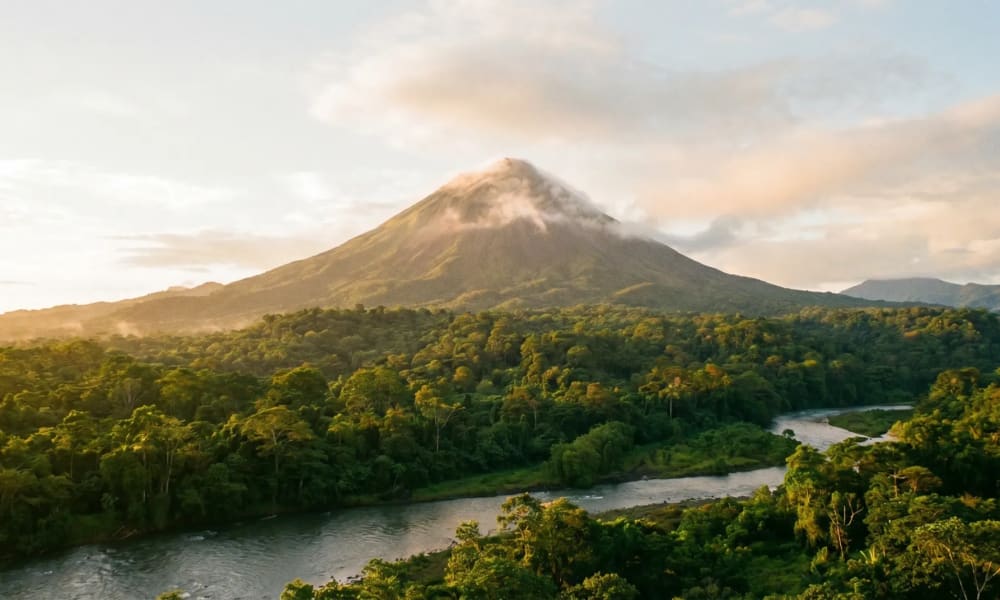
This image was generated with AI.
Arenal La Fortuna
Costa Rica's most iconic volcano between rainforest and thermal rivers
Costa Rica's most iconic volcano between rainforest and thermal rivers
1,670 meters of perfect volcanic cone, naturally heated rivers, and rainforest canopy bridges: Arenal is the nature-loving start of any Costa Rica trip — and the place where wellness and wildlife meet within just a few kilometers of each other.

Best Time to Visit
February to April
Why Arenal?
There are taller volcanoes in Costa Rica. There are rainforests that feel more remote, and hot springs with glossier brochures. But there's only one place where all of this comes together inside a single day's radius — and that place is Arenal. The volcano rises in such a perfectly symmetrical cone above the plains of La Fortuna that it looks as if drawn by a children's-book illustrator: 1,670 meters, green-forested on its flanks, with a gray rocky summit that disappears into clouds or sunlight depending on the hour.
That silhouette is the region's calling card — but it's only the gateway. Around the volcano lies a nature hub of a density you won't find anywhere else in Costa Rica: naturally heated rivers running straight off the mountain, hanging bridges through untouched primary forest, a 70-meter waterfall plunging into a turquoise pool, 500 bird species, two species of sloth, and a man-made lake big enough to windsurf on. From San José's international airport, it's 2.5 hours by road. For many travelers, Arenal is the first leg of a Costa Rica route — and often the one they remember most clearly.
The volcano itself adds another layer. From 1968 to 2010, it was continuously active for 42 years — according to a peer-reviewed study in the Bulletin of Volcanology (Springer, 2022), the tenth-longest volcanic eruption on Earth since 1750. Today it's resting, not extinct. To visit Arenal is to see a mountain that's writing history.
The volcano and its national park
History in three chapters
Until the morning of July 29, 1968, locals considered Arenal an extinct mountain. It had been silent for over 400 years. At 7:30 that Monday morning, it erupted catastrophically. 87 people died, three villages — Tabacón, Pueblo Nuevo, and San Luís — were buried under lava and ash, and more than 232 square kilometers were affected. There followed 42 years of continuous activity with regular lava flows, ash clouds, and nighttime crater glow. In October 2010, the activity stopped. Since then, Arenal has been resting.
"Resting, not extinct" is the phrase volcanologists repeat here. According to the 2022 Springer study, the magma chamber is still being supplied — another eruption is likely at some point, but the timing isn't predictable. OVSICORI, Costa Rica's volcanological observatory, monitors the mountain around the clock. For travelers, that means: zero current risk — and at the same time, a living, observed volcano, not a museum piece.
The national park
Parque Nacional Volcán Arenal covers 12,124 hectares (the official figure from Costa Rica's tourism authority, ICT) and lies 15 kilometers, or 30 driving minutes, from downtown La Fortuna. It's divided into two sectors: the Volcano Sector with the main entrance and the lava fields from 1968, and the Peninsula Sector right on Lake Arenal.
Admission costs $15 for adults and $5 for children (plus tax). The Volcano Sector is open daily from 8:00 am to 4:00 pm (last entry 2:30 pm); the Peninsula Sector stays open until 5:00 pm. One important practical note: there is no online pre-sale, and at the entrance only credit card payment is accepted — cash won't work. If you want a guide, you have to book in advance in La Fortuna; the ranger station doesn't arrange them.
The central trail is Las Coladas (Trail 4), a well-built path across the hardened lava fields of the 1968 eruption. About 2.2 kilometers, easy, with a clearing and a viewpoint toward Lake Arenal. The El Ceibo Trail (3-kilometer loop) leads through secondary forest that has been regenerating since 1968 — the highlight is a ceibo tree more than 400 years old. The Heliconias Trail (600 meters, flat) is the best trail for hummingbirds and butterflies. In the Peninsula Sector, the Los Miradores Trail is fully paved and flat — ideal for guests with limited mobility or families with small children.
Insider tip: if you want to see both park sectors, combine them in a single day — one entry ticket covers both. Volcano Sector in the morning, Peninsula Sector in the afternoon. Splitting them across days means paying admission twice.
Another tip for ambitious photographers: the private Arenal 1968 reserve, just west of the national park, often offers the better volcano views. From the summit viewpoint of its lava-flow trail, you can see the volcano and Lake Arenal in a single frame — a double panorama you can't get inside the park. Admission: $26 for adults, open 7:30 am to 5:00 pm.
And no: you cannot climb Arenal. Even the secondary cone, Cerro Chato, with its green crater lake, has been officially closed since 2017. Any tour that promises otherwise is either outdated or unreliable.
Hot springs — Tabacón, Baldi, Ecotermales, The Springs & free spots
The Arenal region has 14 different thermal-spring facilities — from completely free to luxury spas with volcano views. For first-time visitors, comparing them pays off, because each spring has its own character.
Tabacón Thermal Resort — the only natural thermal river
Tabacón has a genuine unique selling point in the region: it is the only facility with a naturally flowing, non-pumped thermal river. The water comes straight off the volcano, runs 150 meters of riverbed, crosses nine footbridges, and pools in five spring areas with temperatures between 22 and 50°C (72–122°F). All other operators in the region pump thermal water from underground sources into their pools.
The resort has only 42 rooms across 364 hectares of tropical garden — a deliberately low occupancy density. In 2024, Travel + Leisure named Tabacón one of the world's top 3 destination spas. Day pass 2026: $89 for adults, $47 for children ages 6 to 11. In high season (December to April, June to August), advance booking is mandatory — walk-ins meet locked doors.
Baldi Hot Springs — 25 pools for families and groups
Baldi is the lively counterpoint: 25 thermal pools at varying temperatures (34 to 67°C / 93–153°F), water slides, kids' zone, bars with music. If you're traveling with family or planning a casual group day, you're better off here than in Tabacón's quiet. Open daily 10:00 am to 10:00 pm, day pass from around $40.
Ecotermales Fortuna — the limited-access tip
Ecotermales is a family-run counterpoint to the mass market. Only about 100 day visitors are admitted — never overcrowded, even at Christmas or Easter. Eight pools between 32 and 41°C (90–106°F), plus two cold plunges, surrounded by dense forest. Admission 2026: $49 for entry only, $78 including lunch or dinner; children 5 to 11 are $39 with a meal, under 4 free.
Our pick for couples — especially the evening slot from 5:00 pm, with tables right by the pool, is one of the most romantic settings in Costa Rica.
The Springs Resort & Spa — luxury with volcano infinity pools
The Springs is the larger, more family-friendly luxury counterpart to Tabacón. 25 to 28 thermal pools across three themed areas ("Los Perdidos," "Las Lagunas," and the Adventure Center), five restaurants, several infinity pools with direct volcano views. Hotel rooms from $200+ per night; day passes for non-guests are available only on request.
Rio Chollin / Choyin — free and responsible
Right next to Tabacón flows the public stretch of the thermal river — accessible at no charge. Left side hot (volcanic water), right side cooler (mixed). To get there, take Route 142 toward Lake Arenal; just past the Tabacón entrance, a small gate sits on the right side of the road, and a one-minute path leads to the river.
Important for safety: there is no supervision, no restrooms, no lockers. The stones in the riverbed are extremely slippery — water shoes aren't a luxury, they're essential. After dark, the spot becomes dangerous; leave valuables in the hotel safe. Since 2025, the paid Choyin Rio Termal has set up directly on the bank — a new offering with changing rooms and lockers, but it hasn't replaced the original free access.
Insider tip: for the free Rio Chollin, put your swimsuit on at the hotel — there's no changing area on site. Mornings before 9:00 am or late afternoon are when the river is quietest.
Hanging bridges & rainforest
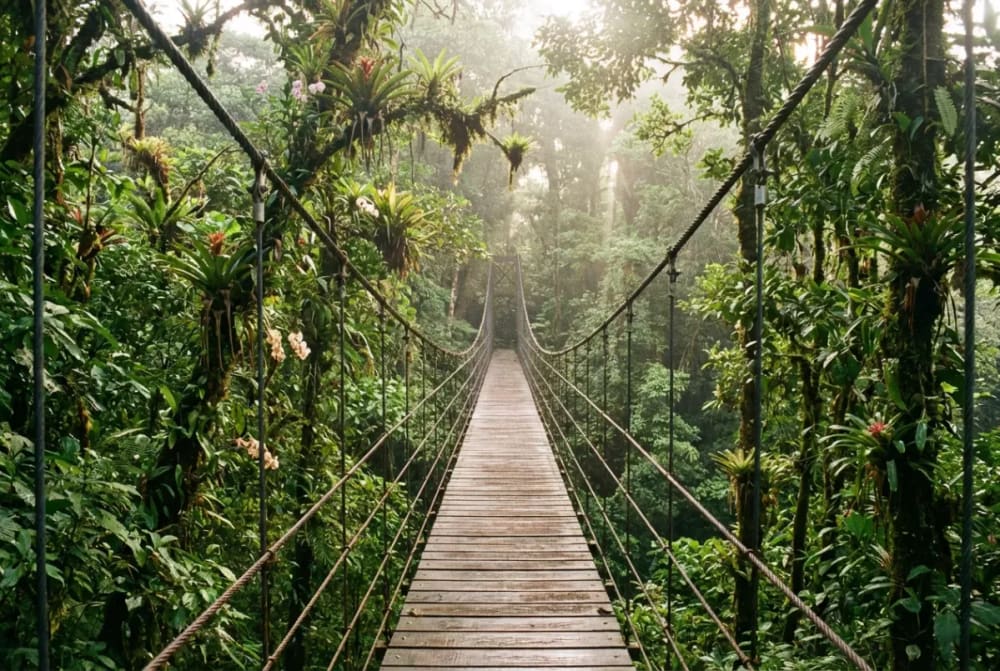
The Mistico Arenal Hanging Bridges Park is the most-visited canopy experience in the region — and one of the few places where you can move through the treetops without climbing a single step. The main path is 3.2 kilometers long, completely flat, with no stairs, designed for 1.5 to 2 hours. Along the loop are 16 bridges — six of them true hanging bridges up to 48 meters high, ten fixed steel bridges.
What makes Mistico special isn't the architecture so much as the wildlife density. Howler monkeys (Alouatta palliata), one of the loudest land animals on Earth, are often audible from the very first hanging bridge. Both of Costa Rica's sloth species live here, along with toucans, hummingbirds, and kingfishers. Arrive at the 6:00 am opening and you'll have the best sighting chances.
Prices 2025/2026: self-guided AM tour from $32 plus tax, PM tour from $28, guided natural-history tour from $44. With hotel transfer from La Fortuna, around $60. Children 6 to 12 about $16, under 6 free. Location: 25 to 30 minutes west of La Fortuna on Route 142.
The fact that the path requires no stairs isn't a cosmetic detail — it makes Mistico the ideal program point for older travelers, families with small children, and anyone who wants to skip the waterfall climb without giving up the rainforest.
La Fortuna Waterfall
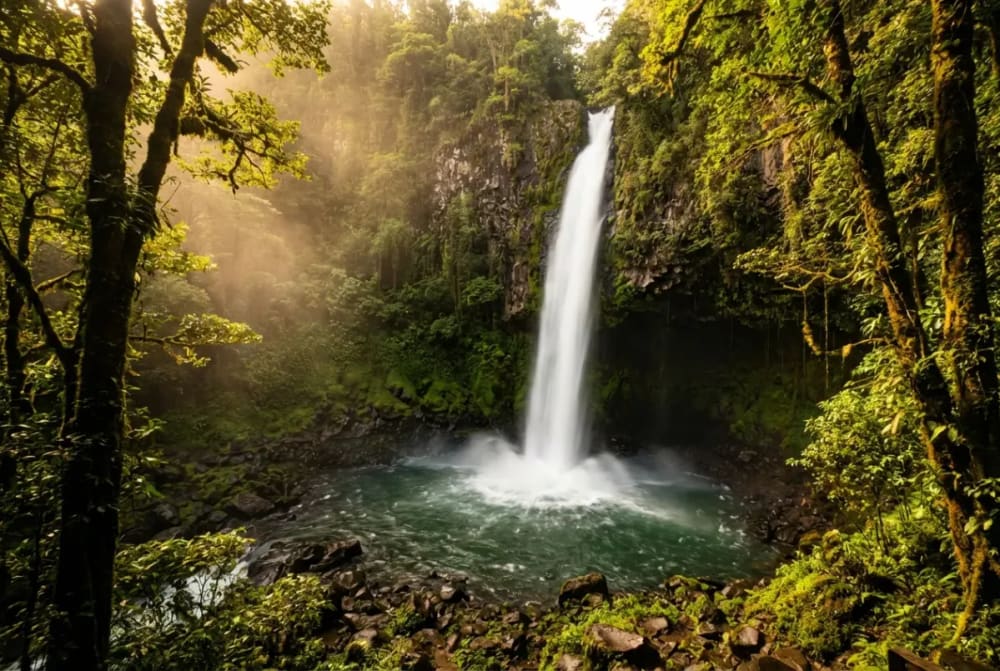
The Catarata La Fortuna drops 70 to 75 meters in a free fall into a turquoise pool, framed by vertical basalt walls and dense tropical green. It's the most photographed waterfall in Costa Rica — and one of the few that holds its power even when you reach it three hours ahead of a tour bus.
The path down is roughly 530 well-built concrete steps with handrails and rest benches. The descent takes about 10 minutes; the climb back up, 20 to 30 minutes — and that climb is the real challenge. Good footwear, plenty of water, and an honest read on your fitness all matter.
Swimming in the pool below the waterfall is allowed as long as conditions are safe. In the rainy season, the pool can be closed. Even in the dry season, the water is bracing at around 18°C (64°F) — a refreshing reward after the climb. Since 2025, a small orchid garden above the waterfall is also included with admission.
Practical (2026): $18 admission for adult international visitors, $5 for children 5–11, under 5 free. Open daily 7:00 am to 5:00 pm, last entry 4:00 pm. Getting there: 5.5 kilometers from downtown La Fortuna on paved road, no 4WD required. Uber $4 to $6, taxi $10 to $15.
Insider tip: arrive right at the 7:00 am opening. Until 9:00 am, you'll often have the pool to yourself, the light is ideal, the climb is noticeably cooler — and the tour buses, which start arriving around 9:30 am, will be long gone by the time they reach the bottom.
Wildlife in Arenal
The area around the volcano is one of the most biodiverse in Costa Rica. On the grounds of the Arenal Observatory Lodge alone, around 500 bird species have been documented. Two sloth species — Hoffmann's two-toed sloth (Choloepus hoffmanni) and the brown-throated three-toed sloth (Bradypus variegatus) — move through the trees, best seen early morning and late afternoon.
Howler monkeys you'll hear before you see them. Their deep, almost raspy calls carry for kilometers through the forest. At Mistico Park, a morning sighting is nearly guaranteed. Toucans — above all the keel-billed toucan with its rainbow-colored beak — are best watched along the waterfall trail and on the hanging bridges. Once you've seen that silhouette, you don't forget it.
Two activities are worth singling out:
- Peñas Blancas Safari Float is a quiet raft trip on a Class 1 river: 4.5 to 5.5 hours including transport, departures at 7:30 am and 1:00 pm. Ideal for wildlife without adrenaline — caimans, iguanas, basilisks, toucans, herons, kingfishers. Most tours include a short cultural stop with homemade tortillas and coffee.
- Night walks open up a completely different fauna: 28+ frog species, kinkajous, armadillos, nocturnal sloths. About 2 hours, around $40 per person, groups of 8 maximum. Operators like Danaus Ecocenter or Arenal Oasis specialize in them.
Insider tip: the hummingbird garden at the Arenal Observatory Lodge is open to day visitors — you don't need to stay there. It's one of the best hummingbird spots in Costa Rica, with up to ten species at once, including the rare black-crested coquette.
Best time to visit
The dry season from December to April is the classic high season — sunny days, little rain, temperatures between 21 and 32°C (70–90°F). Within that window, February and March are the most reliable months for clear volcano views. The trade-off: hotel rates 20 to 30 percent above the annual average and top hotels regularly fully booked.
An honest warning: even in the dry season, the Arenal summit is often wrapped in clouds in the afternoon. The most reliable clear views are between 6:00 and 10:00 am. If you book a breakfast spot with a volcano view, you'll often see more of the mountain than the afternoon visitor at the sunset lounge.
The green season from May to November is widely underrated. The landscape stands in deep green, the waterfalls run at full force, accommodations cost 20 to 30 percent less, and frogs and amphibians are noticeably more active. Afternoons regularly bring rain showers (usually 1 to 2 hours); mornings are often clear. Especially interesting: September and October bring the so-called veranillo — a mini dry spell within the rainy season, with surprisingly many clear days. For travelers with flexible calendars, one of the smartest choices: good visibility, half the prices, empty trails.
Windsurfing and kitesurfing on Lake Arenal follow their own rhythm: peak from December to March with winds of 20 to 30 knots, good conditions from November to April. The center of the watersports scene is the small town of Tilarán on the western shore — about an hour's drive from La Fortuna around the lake.
Getting there & around
From San José to La Fortuna
La Fortuna is about 165 to 170 road kilometers from Juan Santamaría Airport (SJO). Three options:
- Rental car: 2 to 2.5 hours without traffic (early morning), up to 3.5 hours late afternoon. The route follows the Pan-American Highway and is paved throughout. For the entire Arenal region, no 4WD is needed — a regular car handles every main attraction.
- Shared shuttle: 3.5 to 4 hours, around $55 per person. Multiple daily departures, hotel-to-hotel transfer.
- Private transfer: about 3 hours, $150 to $200 for up to four people. Comfortable for two or three travelers and flexible with stops along the way.
Public buses are technically possible but time-consuming, and rarely the best choice for travelers with limited time.
Jeep–Boat–Jeep to Monteverde
The most classic onward route from Arenal leads to the Monteverde cloud forest — and the most beautiful way to do it is the Jeep–Boat–Jeep transfer. Instead of three to four hours of dirt road around the lake, you board a jeep (20 to 25 minutes to the dam), cross Lake Arenal by boat (30 to 40 minutes, with the volcano behind you), and ride a second jeep up to Monteverde in 90 minutes. Total time: 3.5 to 4 hours, but with a spectacular lake crossing instead of a dusty back road.
Prices: shared $33 on the 8:00 am departure, $40 at 2:00 pm. Private transfer $245 for up to five people. The morning crossing is not only cheaper but also offers the better volcano views.
Around the region
Within the Arenal region, distances are short: it's 5.5 kilometers from downtown La Fortuna to the waterfall, 15 kilometers to the national park's main entrance, and about 15 to 20 minutes to all the major hot springs along Route 142 to the west. Uber works reliably in La Fortuna. For guests who want to combine multiple activities a day, a rental car is still the most flexible choice.
Where to stay
The region has an unusually clear range — from authentic nature lodges to Relais & Châteaux villas. Our favorites by profile:
Arenal Observatory Lodge — closest to the volcano
The Observatory Lodge sits 1.5 kilometers as the crow flies from the crater — closer than any other accommodation. 48 rooms on 350 hectares of private land, including 270 hectares of primary forest. Eleven kilometers of private trails, the famous hummingbird garden with up to ten species at once, and around 500 documented bird species in the area. Not luxury in the classic sense, but an authentic nature lodge for birders and nature lovers. Prices from about $100 per night. Remote location — 30+ minutes from downtown.
Tabacón Thermal Resort & Spa — thermal river at the doorstep
42 rooms on 364 hectares, with direct and exclusive access to the region's only natural thermal river. In 2024, Travel + Leisure named Tabacón one of the world's top 3 destination spas. The combination of tropical garden, private river access even after sunset, and real volcano proximity makes Tabacón the first address for wellness-focused travelers. Luxury segment; long waiting lists in high season — book early.
Nayara Gardens & Nayara Springs — family and honeymoon under one roof
Nayara Gardens is the family-friendly sister hotel with freestanding bungalows, private plunge pools, six communal pools, and Leading Hotels of the World membership. Nayara Springs next door is adults-only, Relais & Châteaux, 35 villas of 139 square meters each, with private thermal pools — fed by natural springs straight from the volcano. Ultra-luxury segment, prices on request. Nayara Gardens has been recognized as the #1 resort in Central America.
Amor Arenal — boutique tip for couples
Amor Arenal is the least-known of our recommendations — and our pick for honeymoon couples for whom Nayara Springs is too large or too expensive. Adults-only (13+), 14 casitas with private whirlpool, volcano view, small spa, yoga studio, breakfast included. Prices from about $475 per night for the Luxury Villa — a clear price advantage over Nayara Springs at comparable intimacy and quality.
For a tailor-made accommodation choice — including lesser-known boutique houses we know personally — talk to us directly .
To book a trip or for more information, contact us. We'll help you plan and guide you through your upcoming adventure!
Frequently Asked Questions
Arenal has been in a **resting phase** since October 2010, not extinct. From 1968 to 2010, it was continuously active for 42 years — according to a peer-reviewed study in the *Bulletin of Volcanology* (Springer, 2022), the tenth-longest volcanic eruption on Earth since 1750. The same study concludes: the magma chamber is still being supplied, another eruption is likely at some point, but the timing isn't predictable. Current risk to travelers is zero — OVSICORI monitors the mountain around the clock. Occasional water-vapor and gas emissions from the summit are normal and entirely harmless.
**Two to three nights** is the right size for most travelers. With two nights, you fit in the national park or hanging bridges on day one and the waterfall plus hot springs on day two. With three nights, you have room for a safari float tour, a night walk, or a rest day at the thermal spa. If you want to windsurf or compare several hot springs, plan four nights.
That depends on your travel style. **Tabacón** for luxury and the unique experience of a natural thermal river ($89). **Ecotermales** for couples and quiet-seekers, with strictly limited day visitors ($49 to $78). **Baldi** for families and groups with kids — livelier, with water slides and more action (from $40). **The Springs** for family-luxury with volcano infinity pools. For a free first impression, the public stretch of Rio Chollin right next to Tabacón is the answer — bring water shoes and leave valuables behind.
No. The volcano itself can't be climbed and couldn't even during its active phase. The secondary cone **Cerro Chato** with its green crater lake has been officially closed since 2017. The best volcano views come from the lava-field trails in the national park, the private Arenal 1968 reserve, and the terraces of the Arenal Observatory Lodge.
The classic onward route is to **Monteverde** (cloud forest) via Jeep–Boat–Jeep — 3.5 to 4 hours, with a spectacular lake crossing. To continue to the coast afterward, head down to the Pacific to **Manuel Antonio** (rainforest meets beach) or onward to the **Osa Peninsula** for wilder nature. For wildlife focus, the combination with **Tortuguero** on the Caribbean coast (sea turtles, canal trips) is strong. On a three-week trip, Arenal works as your first stop after arrival, paired with three or four further regions — we'll plan the right route together with you.
The major 2026 cost blocks at a glance: national park admission $15, La Fortuna Waterfall $18, Mistico Hanging Bridges $32 to $44, Arenal 1968 $26, hot springs $40 to $89 (or free at Rio Chollin). Guides for half-day tours in the national park $70 to $90. Premium accommodations like Amor Arenal from about $475 per night, the ultra-luxury villas at Nayara Springs on request. A realistic daily budget for premium travelers — including accommodation, activities, meals, and transport — runs €300 to €500 per person. For an exact calculation tailored to your trip, contact our Costa Rica team — we usually respond within 24 hours.


